CryptoCurrency Review
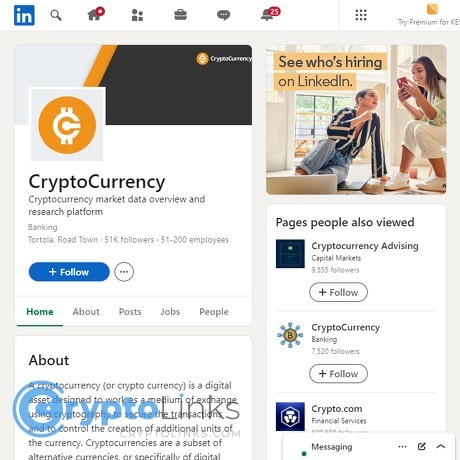
CryptoCurrency
www.linkedin.com
Cryptocurrency LinkedIn Page Review Guide: What It Really Is, How It Helps You, And What To Watch Out For
When you see a big, official-looking LinkedIn page called “Cryptocurrency”, what’s your first instinct?
“Wow, this must be the official crypto headquarters”… or “hmm, this looks a bit too polished to be real”?
If you feel that tug of curiosity mixed with suspicion, you’re in the right place.
Most people type “cryptocurrency” into LinkedIn, click the biggest result, and assume they’ve just discovered some kind of central authority for the entire crypto space. That tiny mistake is where a lot of bad decisions, scam inbox messages, and lost money begin.
Let’s be honest: LinkedIn has become a huge hangout spot for crypto people — builders, marketers, influencers, traders, and, unfortunately, a fair number of scammers. A generic, serious-sounding page like “Cryptocurrency” looks safe by default, which is exactly why it can be so dangerous if you don’t know how to read it.
Why that “Cryptocurrency” LinkedIn page can be a problem
Here’s what tends to happen:
- Someone new to crypto searches “cryptocurrency” on LinkedIn.
- They see a big company page with a nice logo, thousands of followers, and slick posts.
- They assume, without thinking, “Ok, this must be the crypto page. If it’s here, it’s legit.”
That small assumption opens the door to three big problems.
Too much hype, not enough context
Crypto content on LinkedIn often looks like this:
- Screenshots of massive profits.
- Stories about early adopters turning a few hundred dollars into life-changing money.
- Bold, emotional claims: “This altcoin is the next Bitcoin,” or “I made $1,000 a day, you can too.”
What’s usually missing?
- The times those same people lost money for weeks.
- Any mention of risk management, taxes, or security.
- Clear warnings like “don’t try this with your rent money.”
There’s actually data backing this pattern. A 2022 study on financial influencers found that a huge portion of social posts about trading and investing understate risk or skip it completely, especially when there’s a referral link or product being promoted. The crypto niche is even worse, because the profits can be bigger — and so can the hype.
So when a post says, “You can make $1,000 a day with crypto!” it might be mathematically possible under certain conditions… but that’s not the full picture. I’ll talk about the real math and reality of that claim later — it’s not as magical as those screenshots make it look.
Fake authority from generic names
Another issue is what I’d call “borrowed credibility.”
A LinkedIn page with a generic, category-level name like “Cryptocurrency” feels official just because of the name. It taps into the same instinct that makes people trust an email from “Support” or a Twitter handle like “@BitcoinNews” more than they should.
In reality, a name on LinkedIn is just… a name.
- “Cryptocurrency” isn’t a regulator.
- It’s not the official page for Bitcoin, Ethereum, or any other coin.
- It’s not a government body, global exchange, or world council.
It’s simply a company page created by whoever got to that name first. It could be a serious media team. It could be a solo marketer. It could even change hands later if it’s sold.
There’s a psychological trick at work here: we associate generic, broad terms with authority. When you see a page called “Cryptocurrency,” your brain connects it with the whole industry, and that can make you overlook basic checks like:
- Who runs this?
- What’s their track record?
- How do they make money?
If you skip those questions, you’re more likely to trust links, “opportunities,” and advice that shouldn’t be trusted at all.
No clear roadmap for beginners
Now put yourself in the shoes of someone who’s just starting out.
They hear about crypto on TikTok or from a friend at work. They want to “get in early” but have no idea where to start, so they head to a professional network they already trust — LinkedIn. They find that big “Cryptocurrency” page and expect:
- A clear explanation of how crypto works.
- Basic steps: how to learn safely, where to open an account, what tools to use.
- A structured path from beginner to intermediate.
What they usually get instead is a stream of mixed content:
- Some educational posts.
- Some news about regulations or partnerships.
- Some borderline ads disguised as insights.
- Occasional outright scams in the comments or DMs.
There’s no built-in roadmap, no “start here” section, no filter that says “this is safe and this is not.” So they end up bouncing between posts, profiles, and external links — getting more confused, more hyped, and more likely to make a rushed decision.
That’s how you go from “I just want to learn about crypto” to “Why did I just send $300 in USDT to some stranger who promised to trade for me?”
What I’m actually going to help you with
Let’s set expectations clearly.
This isn’t another “crypto is amazing, sign up here” or “crypto is evil, stay away” rant. I want to do something much more useful: show you how to treat the “Cryptocurrency” LinkedIn page as one tool in your learning and networking toolbox — nothing more, nothing less.
Here’s what I’ll walk you through:
- What that “Cryptocurrency” LinkedIn company page actually is (and what it definitely isn’t).
- How to use it smartly for news, networking, and trend spotting, without turning every post into a trade signal.
- Honest answers to money questions you see thrown around LinkedIn:
- Can you really make $1,000 a day with crypto?
- Is $100 enough to start?
- What’s this so-called 30‑day (wash sale) rule about?
- What’s the actual golden rule of crypto so you don’t blow up your account?
- Simple safety rules for not getting tricked by fake “account managers,” high-pressure sales pitches, or polished scam platforms.
- How I personally cross-check LinkedIn content before I treat anything as real — so you can copy the same habits.
The goal is not to turn you into a day trader or a blockchain developer. It’s to help you stop treating a big LinkedIn page as some kind of magic money button. Instead, you’ll learn to use it like a smart researcher:
- See what’s trending.
- Spot who’s building interesting stuff.
- Collect topics you should research further — on neutral, trustworthy resources.
Instead of “I saw it on LinkedIn, so it must be fine,” I want you to get to a place where your default reaction is:
“Interesting. Now let me check who’s behind this, what others are saying, and what the risks are before I even think about sending money.”
Why LinkedIn + crypto is both powerful and risky
There’s a reason people flock to LinkedIn when they get serious about crypto: it really has become a kind of global lobby for the industry.
On any given day you’ll see:
- Founders talking about their new DeFi or Web3 project.
- Engineers breaking down technical upgrades like Bitcoin’s Lightning Network or Ethereum scaling solutions.
- Lawyers explaining new regulations in the EU, US, or Asia.
- Recruiters posting remote jobs for blockchain developers, analysts, and marketers.
- Researchers sharing deep threads on on-chain data, tokenomics, or security.
Used right, this is a goldmine. You get:
- Direct access to people who actually build things, not just talk about prices.
- Early hints about trends — for example, when NFTs were taking off, LinkedIn job posts and project announcements exploded months before some mainstream outlets caught up.
- Real conversations in the comments, where developers and analysts push back on nonsense and ask hard questions.
But the same features that make LinkedIn powerful also make it risky.
- Anyone can dress up a profile and call themselves a “crypto expert.”
- Generic pages like “Cryptocurrency” become easy badges of fake credibility: if they share or like something, newcomers assume it must be trustworthy.
- Shillers and promoters use professional language and stock photos to blend in with real professionals.
In 2023, multiple reports from cybersecurity firms showed a rise in social engineering scams on platforms like LinkedIn. Attackers use polished profiles and professional-looking pages to gain trust, then gradually push targets toward fake investment platforms or wallet-draining schemes. It’s not just an Instagram or Telegram problem anymore — the “serious” networks are in the game too.
So the real challenge isn’t “Is LinkedIn good or bad for crypto?” It’s:
How do you filter signal from noise so LinkedIn becomes a tool, not a trap?
That’s exactly what the rest of this guide is about. You’re going to see how to:
- Look at that “Cryptocurrency” LinkedIn page and immediately understand what it actually represents.
- Spot the subtle warning signs that a page, post, or person is more about hype than truth.
- Use what you see there as a starting point for research — not a final answer on where your money should go.
So here’s the next big question you’ll want answered:
Who actually controls a LinkedIn page called “Cryptocurrency,” and how can you tell if it’s worth trusting at all?
Let’s take a closer look at that next…
What is the “Cryptocurrency” LinkedIn company page, really?
When you search “cryptocurrency” on LinkedIn and see a clean logo, thousands of followers, and a big bold title that simply says “Cryptocurrency”, your brain does something sneaky.
It whispers: “Ah, this must be the official place… the main hub… the serious one.”
That’s exactly the trap you need to avoid.
Let’s strip the mystery away and talk about what that page most likely is in practical, boring, real-life terms – because once you see it clearly, you’re much harder to fool.
What a LinkedIn “company page” actually is
On LinkedIn, a company page is just a branded profile. It can be created by:
- a one-person marketer trying to build a following,
- a media brand posting crypto content,
- a startup hoping to look bigger than it is,
- or a real, established company with a full-time team.
Functionally, that page is just a place to:
- publish posts and articles,
- run ads and collect followers,
- list job openings,
- and link to an external website or product.
That’s it. There is no secret LinkedIn “verification” that turns a generic keyword like “Cryptocurrency” into some kind of global authority. It’s not a regulator, not an exchange, and not “the voice of the industry.”
It’s simply the official page of whoever registered that name first on LinkedIn.
“On the internet, authority is often just a username, a logo, and enough people who didn’t bother to check.”
That sounds harsh, but it’s true. A lot of people confuse polish with power. A generic name like “Cryptocurrency” feels big and neutral, almost like “The Official Crypto Department of the World.” It isn’t.
Owning that page name gives the admin some reach and credibility, but it does not give them the right to speak for the whole crypto space, or for your money.
Why a page called “Cryptocurrency” feels more official than it is
There’s a simple psychological effect at work here: we trust generic labels. “News,” “Finance,” “Cryptocurrency” – they sound like categories, not opinions. That makes us drop our guard.
LinkedIn quietly amplifies this. When you see:
- tens of thousands of followers,
- slick banners with charts or futuristic graphics,
- headlines like “Top 5 Crypto Trends You Can’t Ignore”,
your brain quickly tags it as “official enough.” You might not even realize you did it.
There’s research that backs this up too. A 2021 study on social media trust showed that users are far more likely to believe content when:
- it comes from a profile that looks “corporate” rather than individual, and
- the name sounds generic and broad, not niche or personal.
That’s exactly the combination you’re looking at with a page called “Cryptocurrency”. It’s generic, corporate-looking, and talking about a topic people feel they “should” get into.
This doesn’t mean the page is bad. It might share great educational posts. It might even be run by smart, honest people.
But it does mean you can’t let the name hypnotize you into thinking it’s some kind of official headquarters for the whole crypto industry. It’s just one more brand in the crowd.
How to check if the page is legit or just hype
If you want to use that page without getting pulled into nonsense, you need a quick way to separate “serious content brand” from “hype megaphone.” Here’s the process I use whenever I bump into a new crypto presence on LinkedIn.
1. Read the “About” section like a detective
Click on the page, scroll to the About section, and actually read it line by line. Ask yourself:
- Do they clearly say who runs this?
If it’s all buzzwords like “major global leader in cutting-edge blockchain financial solutions,” but no actual company name, founders, or location, that’s a warning sign.
- Is there a real-world presence?
Look for a city, a country, an incorporation detail, or at least something more grounded than “Decentralized Worldwide.”
- Do they explain what they do?
“We help you earn passive income” is not a business model. “We publish crypto news and educational content” is. So is “We provide analytics tools for traders” or “We build DeFi lending protocols.”
Vague about pages are designed to impress, not inform.
2. Check the website link and domain
Next step: click the website listed on the page – if there is one.
- Is the domain name consistent?
If the LinkedIn page is “Cryptocurrency” but the website is some random string of letters and numbers, that’s weird. I want to see a clean, matching brand.
- Is there a clear “About” or “Team” page on the site?
Look for real names, photos, LinkedIn profiles, and ideally, links to other platforms where they have a history. No team info at all is a big yellow flag.
- Is there proper contact information?
A contact form plus a disposable Gmail address isn’t great. A professional email, social media links, and maybe even a physical address usually mean more accountability.
- Does the site actually work?
Broken links, stock photos, and generic blog posts that read like AI spam are signs you should step back.
At this point, I’ll usually open a new tab and search for “[brand name] + scam” and “[brand name] + reviews”. You’d be surprised how often that instantly saves you from a bad decision.
If the brand has a product (exchange, wallet, analytics tool, etc.), I want to see it mentioned or reviewed on independent sites. I always look for it in curated hubs and review lists, not just in its own ads and self-written Medium posts.
3. Study their posting history, not just the last viral post
Scroll through at least a month of posts. You’re looking for patterns, not one-off pieces.
- Is the content balanced?
Good pages talk about risks, regulations, security, market cycles, not only “Top 10 Coins to Get Rich With.” If every other post is “this altcoin will 100x,” you know the priority.
- Do they post educational material?
Guides on wallets, security, tax hints, on-chain basics – these are signs someone is trying to build informed followers, not just funnel clicks to affiliates.
- How often do they push you off LinkedIn?
If 90% of posts are basically “click this link, sign up here, limited offer,” that’s more marketing machine than community resource.
- Are the claims concrete or fluffy?
“Ethereum upgrade may impact gas fees, here’s why” is concrete.
“This one simple trick will change your crypto life forever” is empty bait.
Consistency matters. A serious educational or news brand doesn’t suddenly switch into “guaranteed returns” mode every few weeks.
4. Look at engagement quality, not just numbers
Follower counts and like totals are easy to fake or inflate. Comments are harder.
- Are there thoughtful comments from real-looking profiles?
Check a few names. Do they have profile photos, work histories, and normal-looking timelines? Do they sometimes disagree or ask critical questions?
- Is every comment just “Great project!” “Next moon!” “Incredible opportunity!”?
That kind of repetitive cheerleading is classic engagement farming and bot behavior.
- Do admins ever respond?
When the team replies to questions, clarifies things, or accepts criticism, it’s a good sign. Silence under hard questions is not.
One trick I like: sort comments on a big, hyped post by “Most recent” and quickly scroll. If it’s just a wall of emoji, repeated phrases, and sketchy profiles, I treat everything on that page with suspicion.
5. Cross-check the brand outside LinkedIn
Never rely on just one platform’s image of a project. Take one or two minutes to look it up elsewhere:
- Search for the brand on Google News to see if any reputable outlets mention it.
- Check if it’s listed on neutral comparison sites or review hubs, not just affiliate blogs.
- See if industry people you already trust follow or interact with it on other platforms.
The more you treat this like you’d treat a potential employer or business partner (basic research, cross-checks, asking “who are these people really?”), the safer you are.
Signals that should make you back off fast
Now let’s get blunt. There are some patterns that, in my experience, almost always lead to trouble. If you see these on a page like “Cryptocurrency,” it’s time to hit the brakes.
- Guaranteed returns or fixed daily profits
Phrases like:
- “Guaranteed 10% per day”
- “Risk-free $1,000 a day strategy”
- “Our AI bot never loses”
Those do not exist in real markets. Not in stocks, not in forex, and definitely not in crypto.
- DMs from “account managers” or “brokers”
If someone reaches out saying:
- “We manage funds for our LinkedIn followers, just send BTC/USDT and we’ll trade for you,”
- or “We’re the official support of [big exchange], send your funds to verify your account,”
that’s a hard no. Real exchanges will never ask you to send funds to a stranger’s personal wallet.
- Links to unknown wallets, brokers, or copy-trading platforms
If the page keeps promoting platforms you’ve never heard of, with no regulation, no track record, and no external coverage, treat it as experimental at best and toxic at worst.
- High-pressure tactics and FOMO
“Only 24 hours left,” “you’ll regret missing this,” “spots are almost full” – that’s sales psychology, not education. Markets don’t disappear overnight; real opportunities will still be worth a look tomorrow.
A simple rule that will save you money: if a page or its admins try to make you move money fast, leave.
Good information makes you think. Scams make you hurry.
How I personally treat pages like “Cryptocurrency”
When I land on a big, generic crypto page on LinkedIn, I don’t think, “Ah, the official word from above.” I frame it in my mind as:
- a sentiment gauge – What are people excited or worried about right now?
- a discovery tool – Which projects, narratives, or tools are getting surface-level attention?
- a question generator – What are beginners confused about, based on the posts and comments?
That’s it. I don’t use it as a buy/sell signal. I don’t assume any link it shares is safe by default. I treat every recommendation as the start of research, not the end.
So when I see a new project mentioned there, I might:
- note the name,
- search for independent coverage, audits, and documentation,
- check if real builders or analysts ever talk about it, not just promoters,
- and only then decide if it’s worth more of my time.
The same goes for educational posts, hype pieces, or “hot trend” threads. I’m always asking:
- Who wrote this and what do they gain if I believe it?
- Is risk mentioned anywhere, or just upside?
- Is this backed by data, or just screenshots and feelings?
That mindset turns LinkedIn from a potential trap into a useful high-level feed. It also keeps your emotions out of the hands of whoever writes the loudest headline that day.
And that brings us to the crucial next step: once you understand what this page really is, how do you actually use it to your advantage – to learn, to connect, and to grow in crypto without getting pulled into the usual drama and scams?
Because a page like “Cryptocurrency” can either be noise in your ear… or a handy tool in your kit.
The difference comes down to how you treat its posts, its comments, and the people who contact you after you follow it. Want to see a practical way to turn that page into a smart news feed and networking map instead of a hype factory?
Let’s look at that next.
How to use the Cryptocurrency LinkedIn page without getting burned
When most people follow a page called “Cryptocurrency” on LinkedIn, they secretly hope it will tell them what to buy next.
That’s the fastest way to get burned.
The way I use that kind of page is completely different: I treat it as a mix of news feed, sentiment gauge, and networking hub — never as a green light to throw money at a coin.
Think of it like standing in a busy conference hallway: you’re there to listen, spot patterns, and meet people… not to hand over your wallet to the loudest voice.
Treat it as a news and trend feed
Used right, the “Cryptocurrency” LinkedIn page can be a solid way to keep your finger on the pulse of what’s going on in crypto without checking 20 websites a day.
I use pages like that to watch for:
- Regulation headlines – things like “EU passes new MiCA rules” or “SEC targets another exchange.” Those don’t tell me what to trade, but they tell me what to research.
- Big partnerships – for example, when a major brand announces an NFT collaboration or a Layer 2 integration with a known exchange.
- Funding rounds – posts like “X protocol raises $50M from Y and Z VC funds.” That tells me where “smart money” might be looking, but not whether I should follow them.
- Macro market sentiment – are posts talking about “crypto winter” and layoffs, or “we’re back” and “institutional floodgates?” That emotional tone matters.
- Educational breakdowns – overviews of Web3, DeFi, NFTs, Layer 2s, rollups, account abstraction, and so on. These are great starting points.
Notice what’s missing: I’m not hunting for “top 5 coins to buy this month” or “hidden gems 100x soon.”
There’s a simple rule I live by here:
News is a research signal, not a trading signal.
When I see a post like “Major bank pilots tokenized assets on blockchain X,” I don’t rush to market buy that token.
Instead, I ask:
- Is this actually live or still just a pilot / press release?
- What does the bank really use? The public chain, a private fork, or just the buzzword?
- What’s the downside or missing detail they didn’t mention?
Then I go off LinkedIn:
- Read the official blog or documentation.
- Check external analytics (TVL, volume, active addresses).
- Look up independent reviews and long-term commentary, not just a one-day hype blast.
That’s how you turn a page like “Cryptocurrency” into a compass for your next research task, not a button that says “buy now.”
Use LinkedIn comments as a “reality check”
One of the most underused tools on LinkedIn is the comment section under crypto posts. It’s where a lot of the truth leaks out — if you know how to read it.
Here’s how I use comments as a quick BS filter:
- Look for builders and devs, not just cheerleaders.
When a project announcement goes live, I scan for comments from people who list roles like developer, auditor, security engineer, protocol researcher, product manager.
If they’re skeptical about a claim (“this scaling number is unrealistic” or “the contract is still unaudited”), I pay attention.
- Watch for knowledgeable disagreement.
A good sign is when smart people respectfully challenge a claim:
- “The APY they quote assumes token emissions that are unsustainable.”
- “Regulators in X country already warned about this model.”
- “Their ‘partnership’ is just a logo swap, not a real integration.”
When a post is all hype and the most experienced voices are pushing back, that’s a massive yellow flag.
- Check profiles, not just opinions.
Before I trust a comment, I click the person’s profile:
- Do they have a work history that makes sense?
- Have they been on LinkedIn for years, with multiple roles and connections?
- Or is it a fresh profile with only a crypto logo, a Telegram handle, and 10 identical posts shilling the same token?
A wall of “Great project! To the moon!” from empty profiles is about as useful as a YouTube spam bot. Real criticism from real people is gold.
- Notice repeated complaints.
When you see multiple different accounts say things like:
- “I can’t withdraw,”
- “Support ignores tickets,”
- “They changed the terms after we deposited,”
…that’s not “FUD.” That’s early warning data.
In 2022, after several high-yield “earn” platforms blew up, there was a clear pattern: weeks or months beforehand, the LinkedIn comment sections already had users complaining they couldn’t withdraw or that terms suddenly changed. The main posts still looked glossy and safe — the cracks showed up first below the fold.
So when you’re scrolling the “Cryptocurrency” page, don’t just skim the headline. Scroll further and ask: What are the people who actually use this thing saying?
Networking without falling for recruiters and “mentors”
LinkedIn’s superpower in crypto is not the posts — it’s the people behind them. But that’s also where a lot of scams start.
You’ve probably seen messages like:
- “I can help you earn 5% daily with my trading bot.”
- “Pay a small mentorship fee and I’ll show you my secret strategy.”
- “Send me USDT and I’ll manage your account for you.”
This isn’t mentorship. That’s a wallet drain with extra steps.
Here’s how I use LinkedIn to connect in a way that builds my network, not someone else’s scam funnel:
- Connect with people who teach, not just tease.
I love accounts that post:
- Clear explainers of how a protocol actually works.
- Breakdowns of real past mistakes they made (bad trades, hacks, failed startups).
- Honest risk talk, not just wins.
When someone shares their process and thinking openly, that’s a good sign. When they only share profit screenshots and “DM me for signals,” I move on.
- Be allergic to instant pitches.
If the first or second message from a new connection is:
- “Send me funds and I’ll trade for you,” or
- “Pay to join my VIP group,” or
- “Give me access to your wallet so I can help,”
I treat that as a non-negotiable red flag and either ignore or block. Good coaches and serious pros rarely need to cold-DM strangers to ask for their capital.
- Join events and groups, but keep your keys sacred.
LinkedIn has plenty of crypto meetups, webinars, and AMAs. These can be useful:
- To hear founders explain their projects live.
- To ask questions about roadmaps, security, and audits.
- To see how transparent a team is when pressed.
But there’s a simple boundary I never cross:
no one ever gets my seed phrase, private key, or full access to my wallet — not a recruiter, not a mentor, not a “tech support” person.
- Use LinkedIn to discover real companies, not unverified heroes.
When I see a new exchange, wallet, or analytics platform shared on the “Cryptocurrency” page, I:
- Check if they have a proper company page with employees, not just one anonymous founder.
- Look for legal info, physical jurisdiction, and compliance statements.
- Then leave LinkedIn and check independent reviews, historical uptime, and security incidents.
The point is: use LinkedIn to find things, but never let it be the only layer of trust.
One more emotional note here: if a stranger on the internet makes you feel “chosen,” like they picked you out of everyone for a secret money-making opportunity… that’s not a compliment. That’s a script.
Building your own “crypto feed” beyond one page
Relying on a single big LinkedIn page called “Cryptocurrency” is like getting all your food from one fast-food place and then wondering why your diet feels off.
You want variety — not for entertainment, but for balance.
Here’s how I build a healthier crypto feed inside LinkedIn:
- Follow researchers and auditors.
People who work in:
- Smart contract auditing,
- Security research,
- On-chain analytics,
- Regulation and policy,
tend to post things like attack breakdowns, bug reports, vulnerability warnings, and risk analyses. They might not be flashy, but they’ll save you from a lot of pain.
- Follow lawyers and compliance folks.
They’re usually the first to explain:
- What a new law or regulation actually means for users.
- When a project structure is legally shaky.
- What kind of yields or promotions are likely to attract regulators.
Their posts add a side of “wait, is this even allowed?” to your feed, which is healthy.
- Follow builders, not just marketers.
Protocol engineers, product managers, and founders often share:
- Dev updates and roadmap changes,
- Post-mortems when things break,
- Rough edges and trade-offs they’re still working on.
That level of honesty gives you a more realistic picture than any glossy brand campaign.
- Follow official pages you already trust.
If you use a particular:
- Exchange,
- Wallet,
- Analytics platform,
- Tax tool,
follow their LinkedIn pages for updates. But again, treat their posts as signals to investigate, not automatic reason to act.
- Add independent publications and reviewers.
Include:
- Crypto news outlets that have been around through multiple cycles.
- Analysts who share data and methodology, not just predictions.
- Review hubs and comparison sites that don’t push a single exchange or wallet.
This mix reduces the chance that one loud narrative will swing your entire view of the market.
There’s actually a kind of “information diversification” at work here. Just like spreading money across assets can reduce financial risk, spreading your attention across different types of experts reduces informational risk.
One page shouting “bull market is here, 100x soon” feels very different when, in the same feed, you see:
- A security engineer breaking down a fresh exploit.
- A regulator hinting at new enforcement actions.
- A macro analyst talking about interest rates and liquidity drying up.
That contrast is what keeps your feet on the ground when everyone else is losing theirs.
“In crypto, you’re not just managing money. You’re managing your attention.”
So, use the “Cryptocurrency” LinkedIn page — absolutely. But make it one voice in a small, carefully picked choir, not the only song you listen to.
Now, if using LinkedIn smartly is one part of staying safe, the next question usually hits much closer to the heart: what about the money itself?
Can those posts about “$1,000 a day from crypto” ever be real — or are they just bait with extra zeros? Let’s take a very honest look at that next…
Can you really make $1,000 a day with crypto? Let’s be honest
Let’s tackle the question everyone secretly types into Google when nobody’s watching:
“Can I really make $1,000 a day with crypto?”
You’ll see slick screenshots all over LinkedIn, especially around anything branded “Cryptocurrency”: green PnL columns, perfect entries, $1,000+ days like it’s just another Tuesday. It looks clean, simple, and weirdly inevitable.
Here’s the uncomfortable truth: the math can make it look possible. Real trading life usually makes it painful.
“The market is a device for transferring money from the impatient to the patient.” – often attributed to Warren Buffett
The $1,000-a-day dream is basically a marketing tool. Let’s unpack the numbers, then compare them to how this actually plays out in real accounts, with real emotions and real losses.
The math vs. the reality
On paper, the logic behind “$1,000 a day” isn’t crazy at all. In fact, it’s seductively reasonable.
Take Bitcoin as an example:
- On many days, BTC has a range of $1,500–$3,000+ between low and high.
- If you hold 1 BTC, then catching a $1,000 chunk of that move sounds doable:
- Buy somewhere near the low
- Sell somewhere near the high
- Pocket ~$1,000 (minus fees)
Or you see leverage examples:
- Account size: $5,000
- Use 10x leverage → trading “$50,000” notional
- Catch a 2% move your way → $1,000 profit
Math says “yes.” LinkedIn posts say “look, I did it.” Your brain says “why not me?”
Here’s where the math turns into a trap:
- You won’t catch the whole move. You’ll enter late, exit early, second-guess yourself. Even pros rarely nail tops and bottoms.
- Fees and slippage bite you. Every trade leaks a bit of money in spreads and commissions. High-frequency gambling on small accounts is like paying a tax on every impulse.
- Your emotions don’t follow the calculator. After two losses in a row, you’ll hesitate on the next setup. After two wins, you’ll feel invincible and oversize the third. That’s where many accounts die.
There’s also one more thing the $1,000-a-day fantasy usually “forgets” to mention: down days.
When you push hard for a fixed dollar target, you tend to:
- Force trades when the market is dead
- Revenge trade after a loss (“I just need to get back to $1,000”)
- Turn a small red day into a huge one trying to “fix it”
One study that tends to echo across trading circles is from FX and CFD regulators. For example, the European Securities and Markets Authority reported that around 74–89% of retail accounts lose money when trading leveraged products. Crypto derivatives behave very similarly. The dream is common. The outcome isn’t.
Leverage just makes everything louder:
- Use 10x leverage and a 1% move against you becomes a 10% loss on your account.
- Use 20x and a tiny 0.5% wiggle can liquidate you.
It’s not that $1,000 is “impossible.” It’s that almost no one chasing that number daily keeps it for long.
What professionals do differently
If you look closely at people who actually survive in this game for years, their approach looks almost boring compared to the “$1,000 every day” crowd.
They tend to do three things very differently.
1. They trade a plan, not a dream.
- They have a written strategy: when to enter, where to exit, how to manage the trade.
- They don’t improvise because of a random LinkedIn post or a flashy PnL screenshot.
A very common rule among serious traders is:
- Risk 1–2% of account equity per trade, max.
If their account is $20,000, that’s $200–$400 risk per trade. If they’re good and the strategy has an edge, the reward on a winning trade might be $400–$800 or more. Some days that might sum up to $1,000. Many days, it doesn’t.
2. They measure performance in percentages, not fixed dollar goals.
Most professionals aren’t waking up thinking, “I have to make $1,000 today.” Instead, they think more like:
- “Can I follow my system flawlessly today?”
- “Can I protect my capital during choppy conditions?”
- “Over months, can I achieve a realistic percentage return with controlled risk?”
That sounds dull compared to “$1,000 a day,” but that’s how you end up still trading five years later instead of rage‑quitting after a brutal liquidation.
3. They treat capital as a tool, not a lifeline.
- They use money they can afford to lose without their life collapsing.
- They don’t borrow from friends or put rent money into a 50x leveraged long because some “pro” flaunted a big win on LinkedIn.
There’s another twist most people don’t think about: many “full‑time traders” actually have other income streams—consulting, education, businesses. That relieves the pressure so trading doesn’t have to pay for every bill, every day. They’re not trading to survive, which makes rational decisions easier.
A healthier way to think about “earnings” in crypto
If the $1,000-a-day dream has been living rent‑free in your head, you’re not alone. But there’s a much healthier way to frame all of this.
1. Treat the first phase as tuition, not income.
Your first months (sometimes years) in crypto are like paying for university, except the “fees” are usually:
- Small losses on bad entries
- Fees you didn’t notice at first
- Missed moves because you panicked out early
That sucks emotionally, but if you keep size small, it’s survivable — and incredibly educational.
2. Focus on process over profit targets.
Instead of asking, “How do I make $1,000 tomorrow?” try asking:
- “How do I avoid blowing up my account this month?”
- “What single mistake cost me the most last week, and how do I stop repeating it?”
- “Am I tracking my trades so I actually know what works for me?”
Many serious traders keep a simple journal or spreadsheet. They log:
- Why they entered
- Where they exited
- How they felt during the trade
- What they’d do differently next time
That doesn’t look flashy in a LinkedIn screenshot, but it’s how you build consistency.
3. Think in terms of long‑term positioning + careful sizing.
Not everyone should trade actively. In fact, a lot of people would be far better off just doing something like:
- Building a small, simple position in major assets (like BTC or ETH)
- Adding slowly over time from money they truly don’t need for essentials
- Accepting that volatility is normal and focusing on the big picture
Then, if you do want to experiment with more active trading, you carve out a tiny percent of your capital for that. The rest stays parked in safer structures or outside the market completely.
One rule I always come back to whenever money and emotions start mixing:
If you need it for rent, food, or emergencies, it should not be in crypto.
Call it harsh. Call it boring. But it’s the line that keeps a lot of people from turning a rough market cycle into a personal disaster.
How this ties back to LinkedIn hype
Now, connect all of this back to what you see in your feed.
Pages with big names and generic branding, including anything labeled “Cryptocurrency,” love to share posts like:
- “This trader makes $1,000 per day with this one simple BTC setup.”
- “How I quit my job and now earn $30,000 per month trading crypto.”
Then you get the link to:
- A course
- A paid signal group
- A copy-trading “opportunity”
- Or some hybrid funnel that eventually asks for your money
When you see any performance claim like “$1,000 per day,” pause and ask:
- Where is the track record? Is there audited proof? Or just cherry‑picked screenshots?
- Do they show losses too? A real trader has red days, red weeks, sometimes red months.
- Can you see risk, drawdowns, and how they handle volatility? Or is it just “look how much I made” with no context?
There’s a brutal but useful mental rule I suggest using:
If someone constantly flaunts “$1,000 a day” and their main product is a paid course, signals, or mentoring, assume the real business is the product, not the trading.
This doesn’t mean everyone selling education is a scammer. It means their incentive is to sell you the dream. The dream sells better when it looks easy, fast, and guaranteed.
Good educators and honest traders usually talk about:
- Risk management
- Psychology
- Capital preservation
- Years of practice, not overnight success
They’ll admit to bad trades, painful drawdowns, and mistakes. They’ll often repeat the same warning: this is not for everyone.
The next time a LinkedIn post makes you feel FOMO or shame because you’re not making “$1,000 every day,” remember: feeds are designed to show you highlights, not reality.
Now, here’s the twist most people miss: what if instead of chasing $1,000 a day right now, you started with something that sounds almost laughably small… like $100 total?
How far can $100 actually take you in crypto if you use it the smart way—without falling into the same traps that wipe people out at $10,000 or $100,000?
That’s where things get interesting, and it’s exactly what we’re going to look at next.
Is $100 Enough To Start With Crypto—And How Should You Actually Use It?
Let’s be honest: when you see someone on LinkedIn or X saying “you can start with just $100 and change your life,” it hits an emotional nerve.
$100 is small enough that you might be willing to risk it… but big enough that you secretly hope it’s a shortcut out of money stress.
“The biggest financial mistakes don’t usually start with greed. They start with hope… and no plan.”
So let’s talk about what $100 in crypto can really do for you, how to use it smartly, and the traps I see people fall into all the time.
What You Can And Can’t Expect From $100
First, the good news: yes, $100 is absolutely enough to start.
It’s enough to click real buttons, feel real emotions, and learn how this whole thing works without risking rent money. That’s powerful.
But it’s not magic. And anyone who pretends otherwise is trying to sell you something.
Here’s the realistic picture:
- $100 is enough to:
- Open an account on a reputable exchange and complete KYC.
- Buy a small amount of Bitcoin, Ethereum, or another large-cap coin.
- Test how limit orders and market orders actually execute.
- Practice sending funds from an exchange to a personal wallet.
- Experience what it feels like to be up 10%… and down 30%.
That emotional side matters. Studies in behavioral finance (like those summarized by Daniel Kahneman and Richard Thaler) show that people feel losses about twice as strongly as gains of the same size. You won’t really understand that until you see “-$23.40” in red on your own screen and feel your stomach tighten.
- $100 is not enough to:
- Realistically turn into $1,000 in a week without extreme risk.
- Generate “passive income” that changes your monthly budget.
- Protect you from volatility if you go all-in on one tiny coin.
- Make you a professional trader just because the numbers are real.
Could $100 become $1,000? Yes, it has happened in bull markets when people bought early into strong coins or got lucky on high-risk bets.
But here’s the part that hype posts skip: for every story like that, there are thousands of quiet losses that never make it to LinkedIn screenshots. Most small accounts that go 10x did it by taking risks that were closer to gambling than a plan.
So if you’re starting with $100, think of it this way:
- $100 is your training ground, not your ticket out.
Smart Ways To Use A Small Starting Amount
Let’s turn that $100 into something more valuable than a quick flip: real experience.
Here’s a simple approach that I’ve seen work well for beginners who want to learn without blowing themselves up.
- 1. Pick one or two reputable exchanges
Don’t scatter your money across five platforms because some influencer said they’re “hidden gems.” Start with a well-known, regulated exchange in your country.
Look for basics like:
- Clear company information and licenses.
- Strong security history (no major hacks or “lost funds” drama).
- Transparent fee structure.
Before you even deposit, check reviews on neutral sites, search “[exchange name] + fees + reviews + security”, and see if the complaints are about small UX issues or serious problems like frozen withdrawals.
- 2. Keep it simple: a small BTC or ETH position
With $100, you don’t need 12 coins. You don’t need a “perfect portfolio.” You need something clear and easy to track.
A very basic starting point could be:
- Buy $50 worth of Bitcoin.
- Buy $50 worth of Ethereum.
Why this kind of mix?
- They’re the most established and liquid assets in crypto.
- They’re supported almost everywhere (exchanges, wallets, tax tools).
- You avoid the trap of chasing obscure tokens just because they’re “cheap.”
Remember, you can buy fractions. You don’t need a whole BTC or ETH to start learning.
- 3. Practice actual orders, not just buying once and forgetting
This is where the $100 becomes “tuition.” Use small slices of it to test features you’ll actually need later.
Examples:
- Place a market order and see how fast it fills and what price you actually get.
- Place a limit order slightly below the current price and watch how long it takes to execute.
- Set a stop-loss on a tiny portion and see how it behaves when the price moves.
When you do this with $5 or $10 at a time, the “cost of mistakes” is tiny. But the learning is real. Professional traders pay for education with years of small experiments like this, not just reading theory.
- 4. Move a small amount to a personal wallet
Custody is a huge part of crypto that LinkedIn posts rarely explain properly. If all your experience is on centralized exchanges, you’re missing half the story.
Take a small part of your $100 (say $10–$20) and:
- Install a reputable software wallet (for example, a well-known browser extension or mobile wallet with lots of real reviews).
- Carefully back up your seed phrase on paper (never digital notes, never screenshots).
- Send that small amount from your exchange to your wallet.
Now you’ve learned:
- How blockchain confirmations feel in practice (they’re not instant like bank transfers).
- How network fees work.
- How terrifying it is the first time you hit “Send.”
This is priceless experience. Better to be nervous with $15 on the line than later with $15,000.
- 5. Track everything in a simple spreadsheet
No fancy tools needed. Open a basic sheet and log:
- Date and time of each trade.
- Asset bought or sold.
- Amount and price.
- Fees paid.
- Why you did it (one sentence is enough).
After a month, read your own notes. You’ll see patterns:
- Do you tend to buy after prices jump because of FOMO?
- Do you sell right after a small dip because you panic?
- Are fees quietly eating 5–10% of your $100 because of too many tiny trades?
This kind of self-review is exactly what serious traders and investors do. The stakes are lower with $100, but the habit is the same.
Treat every mistake as a “paid lesson.” If you lose $12 to bad timing or fees but learn to avoid that behavior later with larger amounts, that’s cheap tuition.
Avoiding The Small-Account Traps
If starting with $100 is smart, losing it in a week to obvious traps isn’t. Let’s talk about the biggest ones I see.
- 1. High-fee platforms that eat your entire balance
Some apps make money on people with small balances because they know you won’t notice individual fees.
Watch out for:
- Flat withdrawal fees that are huge relative to $100.
- 5–10% spreads between buy and sell prices on “easy” one-tap apps.
- Deposit or conversion fees buried in the fine print.
If you’re paying $4–$8 in fees on a $100 account every time you move, you’re handing away your chance to learn. Compare platforms before committing. If a single withdrawal costs you 5–10% of your total, look for another option.
- 2. Overtrading to “grow small money fast”
This is a classic psychological trap.
You start with $100 and think, “I need to be aggressive or it’ll never grow.” So you start trading daily, maybe even using leverage, trying to catch every move.
The problem: research in trading behavior shows that high-frequency retail traders tend to underperform exactly because of this. More trades often means:
- More fees.
- More emotional decisions.
- More chances to be wrong.
With a tiny account, you don’t need fast gains—you need slow, calm experience. Try this challenge instead:
- Limit yourself to a small, fixed number of trades per week.
- Write down the reason before you enter.
- Review each trade on the weekend, not five minutes after it closes.
You’ll learn far more from 5 thoughtful trades than from 50 random ones.
- 3. Chasing microcaps just because they’re “cheap”
This one is everywhere on social media:
“Why buy Bitcoin at $60,000 when you can buy this coin at $0.0003 and get 100,000 tokens!”
The human brain loves big token counts. It feels like owning “a lot” of something. But price per token is meaningless without context like market cap, liquidity, and real usage.
With $100, going all-in on an illiquid microcap usually means:
- Huge slippage when buying or selling.
- Massive risk of rugs, abandoned projects, or sudden 90% crashes.
- No real way to exit if you ever want your money back.
If you really want to “experiment” with microcaps, make a rule for yourself: maybe 80–90% of your $100 stays in major assets, and at most 10–20% goes into speculative stuff. Treat that speculative slice as already spent.
- 4. Trusting random names from social or LinkedIn posts
One pattern I see all the time: a beginner starts with $100, sees a LinkedIn post praising some obscure exchange or wallet, and moves everything there without checking anything else.
That’s how people end up on platforms that:
- Freeze withdrawals without warning.
- Suddenly shut down and vanish.
- Have no real support or security practices.
At minimum, before you trust a new platform with your $100, do this:
- Search “[platform name] + reviews + scam + security”.
- Check independent collections and rankings that don’t earn affiliate fees from every listing.
- Look for long-term user feedback, not just one or two glowing posts.
The same way you wouldn’t pick a bank just because one person on social media posted a pretty card design, don’t pick a crypto platform that way either.
What Happens When You See “You Can Start With Just $100” On LinkedIn?
You’ll notice a lot of content on professional platforms saying exactly that: “You can start with just $100.” Technically, they’re right—but the context is everything.
When you see that kind of message attached to a link, ask yourself:
- What are they really saying?
Are they encouraging you to learn slowly, or are they hinting that $100 could become life-changing money if you “just follow their system”?
- Who benefits if you click?
Are they pushing an exchange that pays them per signup? A course? A signal group?
- Do they talk about risk and fees?
Or is it all upside and screenshots?
There’s nothing wrong with someone saying, “Start small, even with $100.” That’s actually responsible advice when done right. The problem is when that phrase becomes bait for:
- High-fee platforms that quietly eat your balance.
- Copy-trading schemes where you don’t understand what’s happening to your money.
- “Mentors” who promise to coach you to riches for a fee.
Before you follow any recommended platform from a post:
- Search “[platform name] + fees” and read the official page.
- Search “[platform name] + hacked” or “[platform name] + withdrawal problem” and see if anything worrying shows up.
- Look for independent reviews and longer-term user comments, not just launch-day hype.
If, after all that, you still feel comfortable putting your $100 there—great. At least it’s an informed decision, not just emotional FOMO from a polished graphic.
So yes, you really can start with $100. Used well, that money can buy you something far more important than a quick 2x: it can buy you experience, confidence, and scars that don’t ruin your life.
But there’s one more piece you need before you move real money around, even if it’s “only” $100: understanding the basic rules that protect you from yourself and from the tax man.
Have you ever wondered how those 30‑day rules you hear about—and the “never invest more than you can afford to lose” mantra—actually fit into this picture of starting small?
That’s exactly what comes next.
The 30‑Day Rule, Tax Basics, And The Real “Golden Rule” Of Crypto
If there’s one thing that turns excited crypto beginners into stressed‑out crypto survivors, it’s taxes and risk.
You see a flashy LinkedIn post saying “harvest tax losses in crypto” or “just buy back in tomorrow, wash sale rules don’t apply!” and suddenly you’re playing accountant, lawyer, and trader at the same time.
Let’s slow that down.
In this part, I want to clear up two things that keep coming up around pages like the big “Cryptocurrency” LinkedIn company page:
- The so‑called 30‑day (wash sale) rule and how it might affect your crypto taxes
- The actual golden rule of crypto investing that matters much more than any clever tax trick
I’ll keep it practical, not legal‑text boring. Treat this as a map so you can ask better questions and avoid costly assumptions.
What Is The 30‑Day (Wash Sale) Rule And How Does It Touch Crypto?
Let’s start with the basic idea, using stocks first.
In many countries (for example, the U.S.), there’s a concept usually called the wash sale rule. In simple terms, it says:
If you sell an asset at a loss and then buy back the same or a substantially identical asset within about 30 days, you usually can’t claim that loss for tax purposes.
Tax offices brought this in to stop people from playing games like:
- Selling a stock on December 30th “just to lock in a loss” for the year
- Buying it back on January 2nd, keeping the same position
- And still claiming the loss as if they really exited
Now here’s where it gets messy with crypto.
For a long time, in some jurisdictions, crypto wasn’t clearly covered by these rules. It was treated differently from stocks, which led to a popular strategy:
- Sell a coin at a loss
- Buy it back almost immediately
- Still count the loss for tax purposes (because wash sale didn’t technically apply)
On paper, that sounds like free alpha: keep your position, book the loss, reduce your tax bill.
But laws and regulators don’t like loopholes staying open forever.
In the last couple of years, more countries have started to tighten their tax treatment of crypto. Some are explicitly moving to apply wash‑sale‑style rules to digital assets. Others are reclassifying crypto in a way that makes those rules bite indirectly.
And this is where you need to be careful.
Let me show you how this might look in real life so it’s not just theory.
Example: The “Sell Today, Buy Tomorrow” Trap
Imagine this:
- You bought 0.5 BTC at $60,000/BTC ($30,000 total)
- Now it’s trading at $40,000/BTC (your 0.5 BTC is worth $20,000)
- You are sitting on a $10,000 unrealized loss
It’s late in the tax year and you think, “I’ll sell my 0.5 BTC today, book the $10k loss, then buy back 0.5 BTC tomorrow at about the same price.”
So you:
- Sell 0.5 BTC at $40,000/BTC → Realized loss: $10,000
- Buy back 0.5 BTC the next day at $41,000/BTC
You now still hold 0.5 BTC, almost exactly where you started in terms of exposure.
But from a tax perspective, that $10,000 loss might:
- Be disallowed in full (classic wash sale treatment), or
- Be partially rolled into the new cost basis, or
- Be completely allowed, depending on your country’s current rules
And here’s the catch: those rules change, and they’re not the same everywhere.
LinkedIn posts or crypto influencers love to talk like it’s universal—“Just tax loss harvest, it’s easy, wash sale doesn’t apply bro”—but they usually aren’t the ones dealing with the tax audit later.
Why You Can’t Rely On Generic Advice Here
There was an interesting trend in the U.S. markets a couple of years back where analytics firms noticed heavy “tax loss selling” in crypto near year‑end. Some traders were clearly assuming wash sale rules didn’t touch them. Then legislators started openly discussing closing that gap for digital assets.
The lesson: regulators watch behavior, then change the rules.
So if you’re using a trick that “everyone on Twitter/LinkedIn is using,” assume it’s on the radar.
My personal rule of thumb:
- I never assume I can just “sell and rebuy within 30 days and still fully claim the loss” without checking current, local guidance.
- For anything more than pocket change, I either:
- Use a proper crypto tax tool that supports my jurisdiction, and/or
- Talk to a local tax professional who understands digital assets
Think of taxes like smart contract security: if you don’t fully understand the rules, don’t get fancy. Simple beats clever when the downside is a letter from the tax office.
Now, the 30‑day rule is important, but let’s be real—there’s a different rule that saves far more people than any tax hack ever will.
The Real “Golden Rule” Of Crypto Investing
If I had to tattoo one line on every newcomer’s screen before they’re allowed to click “Buy,” it would be this:
Never invest more than you can afford to lose.
You’ve heard it before. But the problem isn’t that people don’t know it—the problem is that most people don’t live it.
“Can afford to lose” doesn’t mean “it would be annoying if I lost it.” It means:
- You could lose 100% of that money
- And your rent is still paid
- Your food budget is safe
- Your emergency fund is untouched
- You’re not underwater on a loan
In crypto, risk doesn’t just come from price swings. It comes from:
- Platform failure – Exchanges can blow up (FTX is the obvious example).
- Smart contract bugs – DeFi protocols can get exploited overnight.
- Regulation – New rules can freeze withdrawals or cut off services in your country.
- Your own mistakes – Lost seed phrase, wrong address, mis‑clicked network.
When you honestly accept that any of these can happen, the golden rule stops being a slogan and turns into a practical filter for every decision.
What The Golden Rule Looks Like In Real Life
Here are a few examples of how I apply it mentally when I review platforms and projects:
- Spot coin choice: If someone needs the same money for a bill next month, that money has no business being in an altcoin that can drop 40% in a day.
- Yield products: If a lending platform offers 20% APY on a stablecoin, I assume there’s a real chance it can blow up. That doesn’t mean it will, but I size it like a lottery ticket, not a savings account.
- Leverage: If your whole account would be wrecked by one or two bad trades, you’re already over the line of what you can afford to lose, no matter what your LinkedIn feed says about “risk management.”
Back in 2021–2022, multiple studies and exchange data showed a familiar pattern: retail traders piled heavily into highly volatile coins near the top, often with leverage. When the market turned, most of them didn’t just lose their gains—they lost their principal, because their position size was way beyond what they could calmly watch drop 70% without panic‑selling.
The golden rule is boring by design. It exists to stop you from putting yourself in positions where one mistake or one bad month ruins your year—or your life.
Two Practical Extensions Of The Golden Rule
- Don’t borrow to invest in crypto.
No loans, no credit card debt, no “my friend is lending me money to try this strategy.” If the investment needs borrowed money to “work,” it’s already too risky for most people.
- Separate your “life money” and “risk money.”
Have clear mental (or actual bank/wallet) walls:
- Life money: rent, bills, food, emergency fund
- Risk money: speculative investments, including crypto
Once that line is clear, a lot of insane LinkedIn hype suddenly looks less tempting.
Other Simple Rules That Will Save You A Lot Of Pain
Over the years of reviewing crypto sites, tools, and platforms, I’ve ended up with a set of “friend rules”—the things I’d tell a friend over coffee before they go anywhere near their first coin.
1. If It Sounds Too Good To Be True, It Is
Yes, you’ve heard this one since childhood. But in crypto it needs an upgrade:
If the returns are unbelievable, then the risk is either hidden, misunderstood, or outright fake.
The patterns repeat:
- “Guaranteed 5% per week” → turns into a Ponzi collapse
- “Risk‑free arbitrage bot” → turns into a rug pull
- “Insider signals” → turns into you exit liquidity for someone else
Study after study on retail trading shows the same thing: people are drawn to big promised returns, underestimate risk, and overtrade. Most of them end up underperforming even simple index strategies, and in crypto that underperformance can mean a 95% loss in a single token.
2. If Someone Needs Your Seed Phrase, It’s A Scam
This one is non‑negotiable:
- No support agent needs it
- No “mentor” needs it
- No airdrop, no recovery, no upgrade, no KYC process needs it
Your seed phrase (or private key) is your vault key. Anyone with it has your coins. There’s no undo, no chargeback, no friendly “oops” button.
On LinkedIn, I’ve seen fake “official” accounts for major wallets and exchanges slide into DMs saying things like:
- “We noticed a security issue on your wallet. Please confirm your seed phrase so we can help you secure it.”
- “To complete verification, enter your 12‑word phrase here.”
Real support teams do not ask for that. If a page you discovered through a generic LinkedIn “Cryptocurrency” feed is doing this, you’re looking at a scam farm.
3. If A Page Or Person Avoids Talking About Risk, Walk Away
Genuine builders, serious investors, and real educators always mention risk. It’s not just ethics; it’s survival.
When someone:
- Only posts screenshots of wins
- Never shows losing days, drawdowns, or bad calls
- Calls everything “easy,” “guaranteed,” “low risk,” “set and forget”
They’re either:
- Hiding the downside, or
- Too inexperienced to know it yet
In both cases, they shouldn’t be influencing what you do with your money.
4. Build A Simple Checklist Before You Touch A New Project
Whenever I see a project mentioned on LinkedIn—especially on a broad, generic page—I run a quick mental checklist before I even consider it review‑worthy:
- Who is behind it?
Real names? Real LinkedIn profiles with history? Any known backers? Or just cartoons and first names?
- Is there an actual product or code?
Live app? GitHub? Working testnet? Or only promises, roadmaps, and “coming soon” slides?
- Any security audits or third‑party reviews?
Has any reputable firm looked at their contracts? Are there independent write‑ups?
- What’s the track record?
How long has the project been around? How did it handle previous market drops? Does the team communicate clearly when things go wrong?
I apply the same thinking when I organize and publish resources across exchanges, wallets, news sites, tax tools, and more. The goal is to filter out the endless noise and leave you with things that at least clear basic sanity checks before you risk capital.
Where To Learn More Without Getting Lost
Once you start caring about things like wash sale rules and risk management, you’re already ahead of the “just ape in” crowd. The trick is staying ahead without drowning in conflicting information.
Here’s how I usually structure my own research path when something pops up in a LinkedIn feed:
- Project documentation & whitepapers
Not to worship them, but to see what the team claims they’re building. Good docs explain:
- What the project actually solves
- How the token fits in (or if it even needs one)
- What the main risks and limitations are
- Official blog posts from reputable exchanges and wallets
I like these for:
- Clear policy updates (like tax reporting or regulatory changes)
- Security best practices and incident reports
- Step‑by‑step guides to using features safely
- Independent rankings and reviews
Instead of trusting any single LinkedIn post, I prefer looking at curated collections of tools and platforms:
- Wallets compared by security and usability
- Exchanges compared by fees, reliability, and history
- News and education sites checked for bias and quality
- Tax tools that actually support the jurisdictions they claim
The point is simple: let neutral structure help you see where a new platform fits in the bigger picture, instead of treating it as “the next big thing” just because it went viral.
Whenever I see something on LinkedIn that looks exciting—a new DeFi protocol, a tax trick, a wallet upgrade—I run it past these kinds of resources before I’d ever connect it to my own money or reputation. That extra step has saved me from more nonsense than I can count.
Now, you might be wondering…
“Okay, I’ve got the rules, I get the 30‑day warning, I respect the golden rule—but how does this all fit together in real, everyday decisions? And what about those ‘can I make $1,000 a day’ and ‘is $100 enough’ questions everyone keeps asking?”
That’s exactly what I’m about to tackle next—straight, no‑hype answers to the questions the “Cryptocurrency” LinkedIn crowd can’t seem to stop asking. Ready to see how your expectations stack up against reality?
FAQ: Fast answers to the questions everyone keeps asking
Quick FAQ
Let’s wrap things up by clearing the most common questions I see people ask under big “Cryptocurrency” style pages on LinkedIn, in DMs, and in comments all over the place.
I’ll keep these short, direct, and reality-based.
Can you make $1,000 a day with crypto?
Technically yes. Some people do. But that sentence alone is like saying, “Can you score three goals in a football match?” Sure. Are you playing in the Premier League… or Sunday with your friends?
To have any realistic shot at making $1,000 a day from trading, you usually need:
- Serious capital (think tens of thousands of dollars or more)
- A tested trading system and strict risk rules
- Years of experience and emotional control
- The ability to handle losing days without blowing up
When you see posts saying things like “I made $1,000 today trading crypto, follow my method,” remember:
- They’re showing you a good day, not the losing streak
- You don’t see their account size, risk, or how long they’ve been doing this
- In many cases, the real money is from selling courses, signals, or paid groups, not trading itself
There’s a study on retail FX and CFD traders from ESMA (European Securities and Markets Authority) showing that 70–80% of retail accounts lose money. Crypto isn’t special – it’s just as brutal, sometimes worse, because it trades 24/7 and moves faster.
So here’s how I treat the “$1,000 a day” line:
- As a warning sign, not a goal
- If a LinkedIn post pushes that number hard, I assume they’re selling me something
- If someone is actually profitable, they don’t need to spam strangers about it
If you ever do reach the point where $1,000 days are realistic for you, you won’t get there by chasing it. You get there by focusing on skill, risk management, and staying in the game long enough to learn.
Is $100 enough to start?
Yes, $100 is enough to start learning. No, it’s not enough to “change your life” quickly unless you plan on gambling, which usually ends the same way.
Here’s what $100 is good for:
- Testing how an exchange works
- Trying basic buys and sells (spot trading, not leverage)
- Practicing moving coins to a wallet you control
- Feeling real emotions when your balance goes up or down
And here’s what $100 is NOT realistically good for:
- Turning into $10,000 any time soon
- Recovering years of bad financial decisions in one bull run
- Letting you “retire next year”
Behavioral finance research shows that when people have small accounts, they often take huge risks because “it’s only $100.” Ironically, this teaches all the wrong habits – revenge trading, over-leveraging, chasing random coins because they’re cheap.
A smarter way to use $100:
- Treat it as tuition money, not an investment
- Focus on learning basics: orders, fees, security, withdrawals
- Keep fees low – high-fee apps can eat 10–20% of a small account very quickly
If the “Cryptocurrency” page (or any LinkedIn page) says “you can start with as little as $100,” that part is true – but the story they attach to it might not be. That $100 is for learning, not for chasing life-changing profits in a month.
What is the 30‑day rule in crypto?
People usually mean a “wash sale” style rule when they talk about 30 days.
In classic stock markets, the wash sale rule basically says:
If you sell an asset at a loss and buy it back within about 30 days, you can’t just claim that loss for tax purposes as if you’re out of the position.
With crypto, it gets messy because tax laws change from country to country, and even over time inside the same country.
A few key points:
- In some places, crypto wasn’t covered by wash sale rules at first, but laws are catching up
- Some tax authorities already treat frequent loss selling and rebuying as a red flag
- What you read on Reddit or LinkedIn is not tax advice, it’s usually guesswork
Example:
- You buy BTC at $40,000
- It drops to $30,000 and you sell – that’s a $10,000 loss
- Next day, you buy it back around $30,000
Depending on where you live, that $10,000 loss might:
- Be fully claimable on taxes, OR
- Be disallowed (or partly disallowed) if your country treats it like a wash sale
What I personally do:
- Assume tax authorities are getting stricter, not looser
- Use a crypto tax tool and export proper records
- Check my local tax office guidance or talk to someone who does this for a living
If a LinkedIn post gives you a clever “tax hack” and no disclaimer, I treat it as entertainment, not a strategy. With taxes, you want boring, correct answers – not viral tricks.
What’s the golden rule of crypto?
For me, it’s very simple:
Never invest more than you can afford to lose.
I know you’ve heard that sentence before. The problem is, people hear it and still don’t actually apply it.
“Afford to lose” doesn’t mean “it would sting a bit.” It means:
- You won’t miss rent, food, insurance, or medicine if it goes to zero
- You won’t need to swipe credit cards or loans to fix the hole
- Your mental health won’t collapse if the market nukes overnight
On top of that golden rule, I stack a few others:
- If someone needs your seed phrase, it’s a scam – no exceptions
- If it sounds too good to be true, it is – especially in your DMs
- If a person or page never talks about risk, walk away
There’s a reason regulators worldwide keep publishing warnings about “high-risk crypto investments” and “get rich quick” schemes. They see the complaints and losses on their side. You don’t.
When I look at any project, platform, or offer, I ask:
- What happens if this goes to zero?
- What’s the actual worst-case scenario here?
- Am I OK with that?
If the honest answer is “nope,” I scale down or walk away. That’s the real spirit of the golden rule.
Is the Cryptocurrency LinkedIn page official?
It’s official for whoever created and manages it. It’s not official for the entire crypto industry. There is no global “crypto headquarters” on LinkedIn.
A LinkedIn company page is basically a branded profile. Someone chose the name “Cryptocurrency” (or something close), filled out a description, posted content, maybe built a following. That can be:
- A media brand
- A content team
- An individual or small company
That’s fine – as long as you treat it for what it is:
- A news and trends feed, not a regulator
- A way to see what people in the space are talking about
- A place to discover projects you then research on your own
Before I take any LinkedIn page seriously, I check:
- The “About” section – who’s behind it?
- The website – is it a real site with contact info, not just a single landing page shouting “invest now”?
- The content – do they ever mention risk, or only wins and promises?
Then I cross-check the linked projects and platforms using independent review hubs, security audits, and user feedback outside LinkedIn. No single page gets to decide what’s “real” in crypto for me – and it shouldn’t for you either.
How to keep using the Cryptocurrency LinkedIn page the smart way
Used right, that big “Cryptocurrency” page on LinkedIn can be useful. Used wrong, it can be a fast track to FOMO and bad decisions.
Here’s how I treat it – and how you can too.
- Use it as a starting point, not final truth.
See it as a headline stream: regulations, partnerships, new projects, hiring waves. When something catches your eye, put it on your “research later” list instead of smashing the buy button.
- Always cross-check anything money-related.
If you see a post promoting a platform, token, or “income method,” check it against:
- Independent reviews and rankings on neutral sites
- Official documentation and the project’s own site
- Security info: audits, terms, who actually runs it
- Listen to your body when FOMO hits.
If a post makes your heart rate jump or you feel “I have to do this now or I’ll miss everything,” step away. That’s not how solid investing decisions feel – that’s how marketing feels.
- Pay attention to the comments – and who’s commenting.
Sometimes industry people will call out nonsense right under the post. Check their profiles:
- Do they have a history in the field, or were they created last week?
- Do they share balanced thoughts, or only referral links?
- Use it to network, not to outsource thinking.
Connect with devs, analysts, founders, and educators who explain things clearly and openly discuss risk. Avoid people who DM you with “I can manage your account” or “Send me crypto and I’ll trade for you.”
Every time I see a hyped post, I ask two quick questions:
- Who benefits if I believe this?
- What’s the downside they’re not talking about?
Those two alone filter out a huge amount of noise.
Final thoughts: build your own filter, not blind trust
Crypto is exciting. That’s why it attracts both builders and scammers, serious projects and ridiculous promises. LinkedIn is just a reflection of that mix.
No single page, influencer, or platform has all the answers. Not the “Cryptocurrency” page, not a viral thread, not a loud expert with 200k followers.
The people who survive and actually benefit from this space usually do a few simple things consistently:
- They use social platforms for learning and connecting, not for instant signals
- They question big promises and check who’s getting paid if they believe them
- They build a small, trusted set of resources they keep going back to:
- Quality news sites
- Security-focused tools
- Review and comparison hubs that don’t shill every new token
- They respect the golden rule: only risk what you can truly afford to lose
If you keep those habits, you can scroll that “Cryptocurrency” LinkedIn page without getting dragged into every pump, promise, or magic system.
Stay curious, question loudly, protect your capital, and use LinkedIn – and every other platform – as a tool you control, not a voice you obey.
CryptoLinks.com does not endorse, promote, or associate with LinkedIn groups that offer or imply unrealistic returns through potentially unethical practices. Our mission remains to guide the community toward safe, informed, and ethical participation in the cryptocurrency space. We urge our readers and the wider crypto community to remain vigilant, to conduct thorough research, and to always consider the broader implications of their investment choices.