Cryptocurrency Investing Network Review
Cryptocurrency Investing Network
www.linkedin.com
Cryptocurrency Investing Network Review Guide: Is This LinkedIn Community Worth Your Time and Money?
Have you ever opened LinkedIn, seen yet another “crypto investing” page, and thought…
“Is this actually useful, or am I just getting lined up to be sold something?”
If that sounds familiar, you’re exactly who I’m writing this for.
In this guide, I’m looking specifically at the Cryptocurrency Investing Network on LinkedIn and the bigger question behind it:
Can a LinkedIn “crypto investing” community actually help you go from “I’ve got $100, what now?” to being a more confident investor?
I spend a lot of time checking crypto platforms, groups, and communities. I see the same problems over and over again — not just technical stuff, but real human frustrations:
- Feeling late to the party
- Being scared of scams and fake experts
- Not knowing who to trust
- Constantly asking, “Is now a terrible time to start?”
So instead of hyping anything, I want to walk you through what’s actually going on in your head as a new or growing crypto investor — and why that makes pages like Cryptocurrency Investing Network so tempting.
The real problems new and growing crypto investors face
Let’s be honest: crypto is less about technology at first and more about psychology.
Most people don’t start with “What is a consensus algorithm?” They start with:
- “Is $100 even worth putting into this?”
- “What coin should I buy first?”
- “Am I already too late? Did I miss the Bitcoin and Ethereum wave?”
Under those questions, there are a few big pain points that push people to search for things like “Cryptocurrency Investing Network” on LinkedIn.
Confusion: “Where do I even start?”
Open YouTube, TikTok, Reddit, or X for 10 minutes and it feels like everyone has a different “secret strategy.”
- One person tells you to buy Bitcoin and hold for 10 years.
- Another is trading obscure altcoins with 50x leverage.
- A third is shilling the “next Solana” that you’ve never heard of.
When everything looks urgent and important, it becomes almost impossible to know what’s actually useful. Researchers at Stanford and the University of British Columbia have shown that too many options can lead to decision paralysis — you end up doing nothing because you’re overwhelmed.
That’s exactly how crypto feels for most beginners: so much information that you shut down.
So when you see a LinkedIn page called “Cryptocurrency Investing Network,” promising education and a community, it feels like a shortcut out of the mess.
Fear of scams and being tricked
Crypto has a reputation problem — and it’s not just headlines.
From 2021–2023, different blockchain analytics firms reported billions lost to rug pulls, phishing, and fake “investment groups.” Even if you don’t know the exact numbers, you feel it in your gut: “If I mess this up, I could lose everything I put in.”
You see:
- Fake influencers pushing copy-trading platforms that quietly drain accounts
- Telegram “VIP signal” groups that vanish overnight
- Projects that promise “guaranteed returns” and disappear a few months later
So you start thinking:
“At least on LinkedIn people use their real names, right? It has to be safer than some anonymous Discord channel…”
That’s one of the reasons pages like Cryptocurrency Investing Network feel comforting — they wear the LinkedIn “professional” badge, which makes them look more legit, even if they’re still just pushing content.
Information overload, zero clarity
Crypto content falls into two extremes:
- Too basic: “Buy low, sell high” level advice that doesn’t actually help you act
- Too advanced: on-chain metrics, DeFi liquidity pools, MEV, options strategies… when you’re just trying to understand how to buy your first $100 of Bitcoin
What most people really need early on is very simple, practical guidance like:
- How to move money from your bank to a reputable exchange
- What the difference is between a wallet and an exchange
- How to avoid obvious red flags and social engineering scams
- Why you shouldn’t put your rent money into some meme coin
Instead, they get flooded with:
- Endless coin lists: “Top 10 altcoins for 2025”
- Hype posts: “This project is about to explode!”
- Charts with no explanation: arrows and lines everywhere
So the appetite for something that sounds stable and structured — a “network” or “community” — is huge. That’s the gap that a LinkedIn page like Cryptocurrency Investing Network tries to fill in your mind: a place that filters the chaos for you.
Not knowing who to trust
Crypto has one of the worst “signal vs noise” ratios of any industry online.
You’ll see:
- People with large followings who are secretly paid to promote coins
- Accounts that look smart because they post charts, but never show a real track record
- New “experts” who appeared last month and already promise to mentor you
At the same time, the people who actually know what they’re talking about often speak in technical language that feels intimidating.
So you start looking for a middle ground:
- Somewhere that feels a bit professional (like LinkedIn)
- Where at least profiles look “real”
- Where the tone isn’t full chaos like many public Discords and Telegram groups
That’s exactly why a name like “Cryptocurrency Investing Network” stands out in your feed. The word “network” makes it sound more structured and trustworthy than “crypto signals” or “moonshot traders,” even though it could still be run by the same type of marketers.
The pressure of “getting in at the right time”
Nothing messes with people’s minds like crypto charts.
You see a Bitcoin chart from 2013 to now and think:
“If I had just put $100 in back then, I’d have X today. I can’t miss that again.”
Then you see a chart from some altcoin that went 100x last cycle and think:
“If only I’d known earlier.”
Psychologists call this regret aversion and FOMO (fear of missing out). It’s what pushes people to:
- Buy at the top because “this is the last chance”
- Sell at the bottom because “it’s all going to zero”
- Jump from coin to coin based on whatever is trending that week
Now add LinkedIn into the mix. You scroll and see:
- Professionals posting about “building generational wealth through crypto”
- Polished graphics about “the future of finance”
- Thought-leader style posts about “the opportunity of this cycle”
Suddenly, it’s not just anonymous usernames hyping things — it’s people with job titles, photos in suits, and clean resumes. The pressure to “not miss out again” gets even stronger.
That’s where something like the Cryptocurrency Investing Network feels like a magnet: maybe this is where you finally find the “right timing” answers in a calm, professional setting.
Promise: This review will give you clarity, not hype
If you’ve felt any of this — confusion, fear of scams, overload, FOMO — you don’t need another motivational “you can do it” talk. You need clarity.
So here’s what I’m going to do in this guide as we look at the Cryptocurrency Investing Network:
- Explain what it actually is on LinkedIn — not what the name suggests, but what you really get when you follow it
- Look at how it works in practice: what kind of content shows up, how “educational” it feels, and how it treats beginners
- Discuss what questions it can realistically help you with, like:
- “Is $100 enough to start?”
- “What coins should I even pay attention to?”
- “Is now a totally stupid time to buy?”
- Show you the limits: what a LinkedIn page like this can’t and shouldn’t do for you
- Place it inside a simple, beginner-friendly approach to learning and investing, so it becomes one tool in your kit, not your only lifeline
I’m not going to tell you that following any page will make you rich. That’s not how this works.
Instead, I want you to walk away thinking:
- “I know exactly what this LinkedIn network is good for.”
- “I know what it can’t do for me.”
- “I know how to plug it into my own learning plan without getting sucked into hype.”
If you’re starting with $100, or even $1,000, that mindset is way more valuable than any “hot tip.”
Why LinkedIn crypto communities are different from Reddit and Discord
Before we zoom in on the Cryptocurrency Investing Network itself, it helps to understand the environment it lives in: LinkedIn.
Crypto conversations look very different depending on where they happen.
LinkedIn: the “professional” crypto playground
On LinkedIn, people generally appear with:
- Their real names
- Job titles and company names
- Work history and education
That creates a certain vibe:
- More polished: posts are structured, branded, and often look like mini-articles
- More reputation-aware: people know their boss, colleagues, or clients might see what they post
- More “thought leadership” tone: you’ll see a lot of “Here are 5 lessons I learned…” and “Why crypto will reshape X industry…”
This can be good. It often means:
- Less outright trolling and spam than typical comment sections elsewhere
- More focus on narratives like regulation, institutional adoption, and business use cases
- Content that feels safer and more mature than TikTok “crypto bros” screaming into their phones
But it can also be misleading.
Reddit and Discord: the raw, messy, anonymous side
Reddit and Discord are completely different beasts.
- Users are mostly anonymous or semi-anonymous
- Language can be blunt, chaotic, and emotional
- Communities range from deep, technical experts… to pure meme casinos
The upside is:
- You sometimes get brutally honest discussions and criticism
- Developers, builders, and early adopters often hang out here more than LinkedIn
- You see the unfiltered sentiment around coins and projects
The downside:
- It’s easy to get lost in noise and low-effort speculation
- Scams, shilling, and “pump groups” are everywhere
- Newcomers can feel intimidated or stupid for asking basic questions
So many people think, “Forget this chaos, I’ll go somewhere more serious,” and they drift toward LinkedIn instead.
Why LinkedIn can still be dangerous for crypto newbies
Just because someone posts under their real name doesn’t mean they’re right, honest, or even experienced.
On LinkedIn, you’ll often see:
- Marketers presenting themselves as “crypto educators” while selling webinars or courses
- Self-branded experts who appeared in crypto last year but now talk like veterans
- Echo chambers where everyone agrees with each other because disagreement looks “unprofessional”
Wearing a suit in your profile photo doesn’t protect anyone from making bad calls, being biased, or pushing things they’re financially tied to.
So when you look at a page like Cryptocurrency Investing Network, the key is not “Are they on LinkedIn?” but:
- What exactly are they posting?
- How transparent are they about their agenda?
- Do they respect beginners or just talk at them?
We’ll get into that soon. But first, it helps to know where we’re headed.
Quick overview of what you’re going to see next
To keep this simple and useful, I’m going to walk through this LinkedIn “Cryptocurrency Investing Network” in a very practical order.
Here’s how the rest of the guide is structured for you:
- What Cryptocurrency Investing Network actually is on LinkedIn — what it claims to be, what audience it clearly targets, and what kind of activity you can actually see there
- What you really get from following it — whether it’s more news, opinions, or actual education you can act on (especially if you’re starting with small amounts like $100)
- How it handles the big questions people always ask:
- “Is $100 enough to start crypto?”
- “What’s the best crypto to buy right now?”
- “Is it a smart time to get in?”
- Who this kind of LinkedIn network is actually useful for and how to combine it with other, more in-depth resources
- Short Q&A at the end that ties everything together so you’re not left wondering what to do next
The goal is simple: by the time you’re done, you’ll know whether the Cryptocurrency Investing Network should be:
- One of the tabs open on your crypto learning journey
- Or just another page you scroll past without losing anything
So, what exactly is this LinkedIn “network”? Is it a real community, a content machine, or just a fancy marketing funnel?
Let’s take a closer look at that next.
What is Cryptocurrency Investing Network on LinkedIn, exactly?
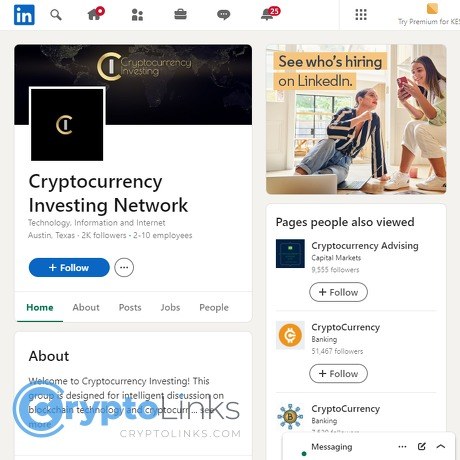
When you land on the Cryptocurrency Investing Network page on LinkedIn, the first thing you’ll notice is that it presents itself as a “cryptocurrency investing community” or “network” rather than an exchange, trading platform, or wallet.
That distinction matters more than most beginners realize.
You’re not dealing with a place where you can actually buy or store coins. You’re looking at a content and brand hub built around crypto investing topics: market updates, “top coins” lists, educational bites, and posts designed to get you thinking about where to put your money next.
On LinkedIn, this type of page usually positions itself as:
- A crypto investing content feed – short posts, charts, headlines, and “here’s what’s happening in the market today” style updates.
- A learning touchpoint – basic explanations of BTC, ETH, altcoins, trends, regulations, NFTs, or Web3, aimed at professionals scrolling LinkedIn during work hours.
- A “community” magnet – a place where people who are curious about crypto investing can follow, comment, and sometimes connect with others.
- A marketing funnel – in some cases, a stepping stone to paid courses, webinars, newsletters, or partner offers.
If you compare it to what you might see on an exchange like Binance or Coinbase, the difference is clear:
- Cryptocurrency Investing Network = information, opinions, and networking.
- Exchanges/wallets = where you actually buy, sell, and hold your assets.
Confusing these roles is where many new investors get burned. A polished LinkedIn company profile can feel “official,” but it’s still just a content brand. It doesn’t automatically mean regulatory oversight, fiduciary duty, or any sort of guarantee.
LinkedIn research backs up why these pages are influential. In multiple surveys, LinkedIn users say they see the platform as a place to learn about industries and “thought leadership.” That’s both a strength and a weakness: when you read a post about Bitcoin from someone with a sharp profile picture and a C‑level job title, you’re more likely to accept their claim at face value than if you read it on some anonymous forum.
That psychological bias is exactly why you need to look behind the logo.
Who is behind Cryptocurrency Investing Network?
Any time I look at a crypto “network” on LinkedIn, the first question I ask is simple:
“Who’s actually running this, and why should I listen to them?”
You’d be surprised how many people skip this step.
On LinkedIn, you can usually trace a page like Cryptocurrency Investing Network back to:
- Page admins – the people who manage the page, visible under “People” or “Employees.”
- Founders/owners – often listed as “Founder,” “CEO,” “Managing Partner,” or similar on their profile.
- Contributors – sometimes you see regular authors or “crypto strategists” who post via their own profiles and share on the company feed.
Here’s how I typically research who’s behind a page like this:
- Click on the “About” tab on the company page and see if any people are highlighted.
- Switch to the “People” tab to view listed employees and admins.
- Open their personal profiles and check:
- How long they’ve been in crypto or finance.
- If they’ve worked at reputable companies or projects.
- Whether they have a pattern of hopping between “get rich” schemes.
- Search their names in Google along with words like “scam,” “complaint,” “review”.
There are some strong positive signals I like to see:
- Real, fleshed-out profiles with consistent work history (not “Crypto Expert – 10x your wealth – DM me”).
- Past roles in areas like fintech, traditional finance, software, or blockchain startups.
- Content they’ve posted outside the company page that shows they actually understand risk, security, and long-term investing.
- Connections or endorsements from people who are known and respected in the space.
And there are red flags that instantly make me cautious:
- Founders who only appeared in crypto during the last bull run, with nothing before that.
- Profiles full of generic motivational posts and no real educational value.
- Links to obvious Ponzi-like projects, MLMs, or endless “VIP signals” groups.
- No real person clearly standing behind the brand at all.
This isn’t about finding “perfect” people; it’s about pattern matching. In one study on online financial scams, researchers found that scam pages often relied on “borrowed credibility”—stock photos, fake endorsements, and buzzwords—without any verifiable history behind the team. LinkedIn makes it easier for you to check that history; ignoring it is like buying a used car without even lifting the hood.
“In crypto, you’re not just investing in coins. You’re constantly investing in people’s judgment. Make sure you know whose judgment you’re leaning on.”
Once you understand who runs Cryptocurrency Investing Network (or any similar page), the next question is: what exactly are they promising you?
What does the network say it will help you do?
Pages like Cryptocurrency Investing Network are very good at positioning. The language is usually confident but broad, something along the lines of:
- “Helping investors make sense of the crypto markets.”
- “Guiding you through Bitcoin, Ethereum, and the top altcoins.”
- “Giving you the insights you need to invest smarter.”
- “Building a community of serious crypto investors.”
In practice, that typically translates to promises such as:
- Helping you understand crypto investing – posts explaining what Bitcoin is, how Ethereum differs, what altcoins are, how bull/bear cycles work, and why risk management matters.
- Keeping you updated on market trends – recurring content about price moves, regulatory news, ETF headlines, on-chain activity, and sentiment.
- Highlighting top coins – mentions of well-known names like BTC, ETH, XRP, BNB, SOL, TRX, DOGE, ADA and others, often in “top X for YEAR” formats.
- Offering a “community” feeling – encouraging followers to comment, ask questions, and connect with each other.
All of that sounds attractive, especially if you’re at the stage where you’re thinking:
“I’m ready to learn, I just don’t want to be overwhelmed with noise.”
But here’s the filter I always apply to any LinkedIn crypto network:
- How exactly do they plan to help me “understand” crypto?
Are they breaking topics down in plain language, or just posting buzzword-heavy graphics and price charts without context? - What’s their incentive?
Are they monetizing via:- Paid courses or mastermind groups?
- Affiliate links to exchanges or wallets?
- Sponsored posts from specific projects?
- Building their personal brand to sell consulting later?
- Do they disclose promotions?
If they highlight a coin or a project, do they mention whether they’re being paid or have a financial interest?
These questions aren’t about cynicism; they’re about staying grounded. A 2022 study on social-media-based financial advice found that people who understood the poster’s incentives were significantly less likely to follow bad recommendations blindly. Awareness changes behavior.
If a page like Cryptocurrency Investing Network is open about how it makes money and clear about what it does not offer (like guaranteed returns), that’s a good sign. If everything is vague, emotionally charged, and always pushing you to “act fast” without any nuance, your guard should go up.
So you know what they say they’ll do. The next test is whether they’re actually active and engaging, or just shouting into the void.
How active and engaged is the page?
One of the fastest ways to judge the health of any LinkedIn crypto page is to look at its activity pattern. I don’t just mean how often they post, but how they show up when they do.
Here’s what I usually check when I’m evaluating a page like Cryptocurrency Investing Network:
- Posting frequency
Are they posting:- Several times a week or at least once a week – healthy for a content-based brand.
- Once every few months – usually a sign the project is abandoned or purely passive.
- Dozens of times a day – could be signal-spam or low-value content farm.
- Type of posts
I like to see a mix, for example:- Short educational posts on concepts like volatility, security, or dollar-cost averaging.
- Market summaries: “Here’s what moved BTC and ETH this week and why it matters.”
- Opinion posts with a clear argument, not just “Bitcoin is going to the moon.”
- Occasional curated links to serious analysis, not just clickbait.
What worries me:- Endless “Motivational Monday – HODL and get rich” quotes.
- Single‑coin shilling: every post is about the same obscure token.
- Posts with aggressive FOMO language: “Last chance to buy before 100x!”
- Engagement quality
I pay attention not just to likes, but to:- Real comments asking real questions.
- Whether the page actually replies to those comments.
- If followers challenge ideas and get thoughtful responses—or if everything is just “To the moon!” and “100x soon!”
- Consistency over time
Did they only show up during the bull market, then vanish? Or have they been present through both bullish and bearish seasons, talking about risk and patience even when prices are down?
There’s an interesting behavioral twist here. Research on social networks shows that people tend to trust content more when they see conversations rather than one-way broadcasting. When a page takes time to answer questions like “Is $100 enough to start?” or “What’s the safest way to begin?” it sends a powerful signal: they care enough to engage, not just to collect followers.
A page that looks like a billboard—pretty graphics, zero interaction—can still be useful for scanning headlines, but it rarely helps you grow as an investor. You learn a lot more from spaces that allow nuance, disagreement, and “stupid questions” (which usually turn out not to be stupid at all).
So the real question is: if you hit “Follow” on Cryptocurrency Investing Network, what kind of content and interaction are you actually stepping into? Is it education, hype, or something in between?
That’s where things start to get interesting—because the difference between “news,” “opinion,” and genuine education is exactly what can make or break your early crypto journey. Let’s take a closer look at what you really get once you’re inside.
What you actually get from following Cryptocurrency Investing Network
When you hit “Follow” on a LinkedIn page like Cryptocurrency Investing Network, you’re not buying a course or joining a private group – you’re signing up for a content feed. The real question is:
does that feed actually help you become a better crypto investor, or just keep you scrolling?
Let’s look at what you can realistically expect from it, based on the kind of posts these pages usually publish, how they present information, and how that lines up with what beginners and growing investors really need.
Types of content: News, opinions, or real education?
There’s a huge difference between:
- “Bitcoin up 5% today! ” and
- “Here’s why Bitcoin moved 5% today – and what that means for your risk.”
One is hype. The other is education.
When I look at a crypto LinkedIn page like Cryptocurrency Investing Network, I’m usually checking for three broad content buckets:
- Basic education – wallets, exchanges, security, portfolio sizing, risk
- Market updates – price moves, news, macro events, regulatory headlines
- Opinion takes – “I think BTC goes to X”, “Altcoin season is coming”, etc.
Most “investing” pages lean heavily toward the last two. That’s fun to read, but if you’re still asking “How do I even buy my first coin safely?”, you need more than fun.
Here’s the kind of content that actually moves you forward as a learner, and what you want to see them post regularly:
Foundational explainers
Things like:- “What’s the difference between a custodial and non-custodial wallet?”
- “How crypto exchanges make money (and where you pay hidden fees)”
- “What 2FA is and why it’s non‑negotiable for crypto accounts”
That’s the kind of content that reduces the “I’m going to mess this up” anxiety.
Risk and money management, not just coin names
I watch whether they ever talk about:- Position sizing (how much to put into a single coin)
- Volatility and how to emotionally handle red days
- Why putting everything into one microcap is a bad idea
One academic study published in the Journal of Behavioral Finance found that retail investors tend to over-concentrate in a few assets and underestimate risk, especially when influenced by social media signals. A useful crypto page helps you fight that instinct, not feed it.
Concrete “start small” frameworks
Even if they don’t give personal financial advice, they can still share:- Sample allocation ideas for someone starting with small amounts
- Checklists like “5 things to do before you buy your first crypto”
- Step-by-step examples such as “How a beginner might use $100 to learn safely”
If their posts are only “Top 5 altcoins to explode this month” with no context, that’s a warning sign. You’re being entertained, not educated.
The gold standard is when a page uses news as a hook, but turns it into a mini-lesson. For example:
- Instead of “ETH pumps 7%”, they post “ETH pumped 7% after this ETF rumor – here’s how rumors can trap beginners and what confirmation actually looks like.”
- Instead of “New coin launch!”, they post “New token launch – here are 5 questions to ask before touching any ICO.”
If you scroll through a page like Cryptocurrency Investing Network and mostly see prices, charts with no explanation, and motivational slogans, you know exactly what you’re going to get: entertainment, not a foundation.
“In investing, what is comfortable is rarely profitable.” – Robert Arnott
Real education is often uncomfortable: it tells you to slow down, question hype, and accept that you don’t know everything yet. Look for content that does that, not just what feels exciting in the moment.
Do they answer beginner questions or just talk at you?
Crypto beginners don’t struggle with charts. They struggle with questions they’re almost embarrassed to ask:
- “Is $100 even worth putting into crypto?”
- “Am I too late to Bitcoin?”
- “What if the exchange disappears with my money?”
- “How do I know a coin isn’t just a scam?”
A good LinkedIn crypto network doesn’t pretend these questions are silly; it leans into them.
When I look at how a page like Cryptocurrency Investing Network behaves, I pay more attention to the comments than the posts. That’s where you see the real culture:
Are beginners being answered or ignored?
Check a few recent posts and scan the comments:- Does anyone actually respond to “Can I start with $100?”
- Are answers specific (e.g., “here’s what fees might do to small amounts”) or just “Anything is possible”?
- Do they link to resources when someone is confused about wallets or security?
Is there any Q&A culture?
Some serious pages will:- Host live sessions or LinkedIn events
- Run polls, then discuss the results and misconceptions
- Ask followers what they’re struggling with, then answer in future posts
That’s a sign they actually care about teaching, not just broadcasting.
How do they handle fear and FOMO?
When someone comments “I’m scared I missed the boat, is now a terrible time?”, watch the reply:- Responsible tone: “Nobody can time the market perfectly; here are some basics on dollar-cost averaging and not risking rent money.”
- Irresponsible tone: “The boat is leaving, don’t miss this bull run!”
There’s research backing why this matters. Studies on online investment communities repeatedly show that social proof and emotional language can push people into riskier decisions than they’d usually take alone. If the page answers fear with hype, it’s pushing you in that direction. If it answers with realism and practical steps, it’s doing you a favor.
Think of it this way: are they talking with you, or just talking at you?
How useful is it if you already know the basics?
If you’re past the “what is a wallet” stage, a page like Cryptocurrency Investing Network can still be handy – but for different reasons.
Once you understand exchanges, private keys, and that leverage can nuke your account, you tend to use LinkedIn pages more like:
- Sentiment indicators – What are people excited or scared about this week?
- News filters – Which stories keep appearing (ETFs, regulations, large hacks)?
- Idea sparks – New sectors (L2s, RWA, DePIN, etc.) or coins to research later
Used properly, a page like this can be part of your daily “what’s going on in crypto?” routine:
- Scroll the feed in the morning
- Note any recurring topics (e.g., “everyone’s suddenly talking about SOL staking again”)
- Pick 1–2 topics for deeper research off LinkedIn: whitepapers, long-form articles, on‑chain data, independent news
But there’s a trap here: if you already know the basics, you might start using LinkedIn content as a shortcut – a kind of mental autopilot:
- “They’re bullish on XRP, comments love it, maybe I should just buy some too.”
- “Everyone seems excited about TRX yield, maybe I’m missing out.”
That’s where experience should kick in. Social feeds can be great for:
- Spotting themes (e.g., AI tokens, restaking, L3s)
- Tracking macro sentiment (fear/greed, regulation panic, ETF euphoria)
- Finding questions you didn’t think to ask
But they’re terrible as a replacement for your own decision-making. One paper on social trading platforms found that people who copied others’ trades blindly tended to underperform those who used other traders only as signals to investigate. The same idea applies here: treat LinkedIn networks as signals, not instructions.
If you already have a framework for:
- How you size positions
- What your time horizon is
- How much risk you’re comfortable with
Then the value of a page like Cryptocurrency Investing Network is in surfacing things you might want to research, not things you should blindly buy.
What this network is NOT (very important)
LinkedIn can make everything look official and polished, which is exactly why this part matters.
Even if a page has thousands of followers and professional branding, it is not any of the following:
It’s not a licensed financial advisor
Unless the page clearly states licenses and regulatory oversight (and even then, you’d want to verify), you should assume:- Posts are general opinions, not tailored advice
- Nobody there knows your income, debts, or goals
- If something goes wrong, you can’t say “But LinkedIn told me…”
It’s not a wallet or exchange
Following a page does nothing to secure your money. It doesn’t:- Store your coins
- Protect your private keys
- Offer deposit insurance
Any time they promote an exchange, wallet, or platform, it’s on you to:- Check if it’s regulated in your country
- Read independent reviews
- Start with small test amounts
It’s not a guaranteed profit machine or “signals” service
If you spot phrases like:- “Guaranteed returns”
- “Risk-free income”
- “We haven’t had a losing month”
…that’s a massive red flag. No serious educator talks like that.
Well-run pages sometimes share ideas or analyses, but they should be comfortable saying things like:- “Here’s one possible scenario, but it can also go the other way.”
- “This is not financial advice; do your own research.”
- “Only risk what you can afford to lose.”
It’s not a shortcut past learning the basics
Perhaps the most dangerous illusion is this: “If I just follow the right LinkedIn page, I don’t need to actually learn this stuff.”
Crypto doesn’t care who you follow. If you:- Never learn how to secure a wallet
- Keep your life savings on a random exchange
- Chase every coin mentioned in a post
…your account balance will eventually remind you why that was a bad idea.
The emotional pull is strong here. It feels good to think, “I’ve joined a serious ‘investing network’ – I’m finally doing something smart with crypto.” But you’re only really doing something smart when you:
- Question what you read
- Protect your accounts
- Use small amounts to learn, not to gamble
So if a page like Cryptocurrency Investing Network isn’t a magic advisor, a wallet, or a guarantee of profit… what can it realistically help with when you’re staring at $100 and wondering where to start, which coins to pick, and whether you’re too late?
That’s where things get interesting – because those “small” questions shape your entire crypto journey.
In the next part, I’m going to take those exact questions head‑on and show you how a network like this fits into answering them without wrecking your risk profile.
So, if you had to put that first $100 to work today… how would you actually do it?
Can this network help with the big questions: $100, best crypto, and timing?
If you’re like most people who land on a page called “Cryptocurrency Investing Network,” you’re not looking for philosophy. You want straight answers to very specific questions:
- Is $100 even worth putting into crypto?
- Which coin should I buy first?
- Is now a terrible time to start… or the opportunity of a lifetime?
Those are exactly the questions I look for when I judge whether a crypto-focused LinkedIn page is useful or just more noise. Not whether they share fancy charts, but whether they help you make calm, rational decisions about these three things: amount, coin choice, and timing.
Let’s break those down and see where a LinkedIn network like Cryptocurrency Investing Network can actually help you — and where you’re still very much on your own.
Is $100 enough to start crypto?
Short answer: yes, $100 is enough to start. But the way you use that $100 matters a lot more than the amount itself.
I’ve seen people turn $100 into years of experience, confidence, and solid habits. I’ve also seen people blow $5,000 in a week because they treated crypto like a casino. The difference isn’t the money. It’s the mindset and the process.
“Your first goal in crypto isn’t to get rich. It’s to stop being clueless.”
Here’s how I’d think about starting with $100, and how a network like this can fit into that journey.
1. Pick a reputable exchange, not the newest shiny app
That $100 is useless if you lose it to a shady platform. For most beginners, the first step is a well-known, regulated exchange in your region — think of names like Coinbase, Kraken, or Binance (where allowed).
A LinkedIn page like Cryptocurrency Investing Network might occasionally share posts about exchanges, regulation news, or security updates. That’s helpful, but don’t just follow one post. Cross-check anything you see with independent reviews and official sites.
2. Watch the fees like a hawk
With small amounts, fees are your silent enemy. For example:
- If you put in $100 and pay $3 in fees, you’ve instantly lost 3%.
- Do that again when you move coins from the exchange to a wallet, and you might be down 5–7% before you even start investing.
Good educational content (including from a network like this) should warn you about:
- Deposit/withdrawal fees
- Trading fees (maker/taker)
- Network fees (especially on chains like Ethereum at busy times)
If you follow the page and they never mention costs, risk, or fees, only “opportunities” and “massive upside,” that’s a yellow flag.
3. Start with simple, liquid coins — not lottery tickets
With $100, your first goal is to understand how this world works, not to guess the next 100x memecoin.
That usually means starting with large, liquid coins like:
- Bitcoin (BTC) – the oldest and most battle-tested
- Ethereum (ETH) – the leading smart contract platform
Some networks will also talk about coins like XRP, BNB, SOL, TRX, DOGE, ADA, and others. That’s fine as long as the focus is on:
- What the coin actually does
- What risks come with it
- Why someone might choose it over just BTC or ETH
If you see posts hyping tiny, unknown coins with phrases like “next Bitcoin,” “guaranteed,” or “don’t miss this,” be careful. Your $100 becomes marketing fuel at that point.
4. Treat it as “learning capital,” not miracle money
Think of that $100 as the cost of a course you never got in school. You’re paying to:
- Learn how to buy and sell
- Understand what volatility feels like
- Practice security basics (2FA, withdrawals, wallets)
There’s a 2022 study from the Bank for International Settlements that showed many new crypto users enter close to local price peaks, then panic sell on the way down. Why? Because they expected quick profit, not a bumpy education.
A good LinkedIn network should encourage you to see that $100 as tuition, not a lottery ticket. If it feeds your “get rich this month” mindset, it’s not helping you. It’s exploiting you.
So where does Cryptocurrency Investing Network fit in?
At best, it’s a reminder board:
- Occasional tips for beginners
- Market updates that give you context for what your $100 is experiencing
- Posts that nudge you to think about risk, not just upside
But the hard parts — understanding fees, choosing an exchange, learning basic security — are still on you. No LinkedIn page can replace that.
“What’s the best crypto to invest in?” – what you should really ask
This is the question I see everywhere: in Quora threads, YouTube comments, LinkedIn posts — and it almost always starts the same way:
“I have $X. What is the best crypto to invest in right now?”
It sounds simple, but it’s the wrong question. There isn’t a universal “best” coin. There’s only “best for you, given your situation.”
Networks like Cryptocurrency Investing Network often share content like “Top 10 Coins to Watch in 2025,” featuring familiar names like:
- BTC, ETH, XRP, BNB, SOL, TRX, DOGE, ADA, etc.
These lists can be useful as long as you understand what they really are: starting points for research, not shopping lists.
What you should actually be asking:
- What’s my risk tolerance?
Can I emotionally handle a 50% drop without panic selling? If not, maybe stick with BTC/ETH and smaller allocations. - What’s my time horizon?
Am I thinking in weeks, or in years? Most people say years… then react in days. - How much am I willing to lose?
If losing this money ruins your sleep, you put in too much.
A serious educational network should push you toward those questions. For example:
- Instead of “BUY SOL NOW,” you see “Here’s why some investors consider SOL — and what risks they accept.”
- Instead of “Top 5 coins to 10x,” you see “How to build a simple starter portfolio with BTC, ETH, and 1–2 higher-risk coins.”
How to use “top coin” posts without getting burned
When you see a post listing BTC, ETH, XRP, BNB, SOL, TRX, DOGE, ADA and friends, try this rule:
- Pick one coin from the list
- Spend an hour researching:
- What it does
- Who develops it
- How it makes money or delivers value
- What could go wrong
If the network helps by linking whitepapers, official websites, or balanced pros/cons, that’s a good sign. If all you see is slogans and moon emojis, treat the list as entertainment, not education.
The better question isn’t “What’s the best coin?” It’s “What’s the best approach for me?” That’s where the next piece comes in.
How should a beginner invest in cryptocurrency in 2025 and beyond?
The market changes, new narratives appear, regulators crack down, new chains launch… but the core of a beginner-friendly strategy hasn’t really changed over the last few years.
If a LinkedIn network is genuinely trying to help, its content will regularly reinforce a simple path like this:
1. Learn how blockchain, wallets, and keys work
You don’t need to be a developer. You just need to understand these basics:
- What is a blockchain?
- What’s the difference between a custodial exchange account and a non-custodial wallet?
- What are private keys and seed phrases — and why you never share them with anyone?
If Cryptocurrency Investing Network posts simple explainers, infographics, or beginner threads about these topics, that’s useful. It helps you build a foundation, not just chase prices.
2. Choose a reputable exchange for your region
Different countries have different rules. A responsible network might share:
- News about regulation
- Warnings about hacked or unsafe platforms
- Tips on KYC, withdrawal issues, or new security features
Use that as a pointer, then confirm everything through independent reviews and official announcements.
3. Lock down your security from day one
Before you worry about 10x gains, worry about not losing your account. A basic security checklist:
- Unique, strong password for your exchange and email
- Two-factor authentication (preferably with an app, not SMS)
- Turn on withdrawal confirmations and alerts
- Later: consider a hardware wallet once your balance grows
Smart networks talk about this often because hacks and phishing never stop. If you see posts warning about fake support accounts, airdrop scams, or “send me 1 BTC and I’ll send back 2,” that’s actually great content — it keeps beginners from learning the hard way.
4. Start small, diversify slowly
Instead of throwing $1,000 into five random coins, a more sane starting approach in 2025 might look like:
- $50 in BTC
- $30 in ETH
- $20 in one additional coin you’ve actually researched (maybe ADA, SOL, or another large-cap you understand)
Then you watch. You learn what it feels like when prices move. You read posts from networks like Cryptocurrency Investing Network to understand why things might be up or down. You add slowly as your understanding grows.
5. Never invest money you can’t afford to lose
This line gets repeated everywhere for a reason. Crypto is still high risk. A survey published by the CFA Institute pointed out that many retail investors underestimate drawdowns and overestimate their own emotional resilience. Translation: people think they can handle a crash… until it happens.
A good crypto page doesn’t just post rocket emojis when prices are green. It also reminds you of the downside and shows how to think about risk in a grown-up way.
6. Avoid leverage and complex DeFi until you understand the basics
If you don’t yet fully understand spot trading, stablecoins, and basic wallets, you have no business touching:
- Perpetual futures
- Options
- High-yield DeFi farms
- Obscure lending platforms
Any LinkedIn page that pushes these at beginners as “easy passive income” should immediately go on your red-flag list.
Networks like Cryptocurrency Investing Network can be helpful by:
- Highlighting risks in leverage and DeFi
- Sharing breakdowns of major blowups (like Terra/LUNA, FTX, etc.) and what went wrong
- Encouraging slow, steady learning instead of gambling
But again, they’re a reminder, not your only teacher. The tough lessons come from your own research and decisions.
Is it a good idea to invest in crypto now?
This is the question that never goes away. 2017, 2021, 2025 — everyone asks the same thing: “Is now a good time?”
The honest answer: nobody knows the perfect time. Not me, not you, not some stranger on LinkedIn with a nice banner and a few thousand followers.
What we do know:
- Crypto is still high-risk, high-volatility.
Price swings of 20–30% in a short period are normal, not bugs. - The industry is still growing.
More institutions, more infrastructure, more regulation — that’s all real. It doesn’t kill risk, but it changes the shape of it. - Timing the exact bottom or top is almost impossible.
If you only feel comfortable buying when everyone is excited, you’re probably late. If you only feel like selling when everyone is terrified, you’re probably late too.
So what should a serious network on LinkedIn promote?
1. Long-term mindset over “last chance” hype
Any page shouting “This is your last opportunity!” is playing on fear and greed. That might get clicks, but it doesn’t help you build a sustainable strategy.
Look instead for posts that talk about:
- Accumulating over years, not weeks
- Past cycles and how brutal they were
- Emotional discipline, not just “diamond hands” slogans
2. Dollar-cost averaging (DCA) instead of hunting the perfect entry
DCA simply means putting in a fixed amount at regular intervals, no matter what the price is. For example:
- $25 every week into BTC and ETH
- Or $100 every month across a small set of coins you understand
There’s research showing that DCA can smooth out volatility and reduce the impact of bad timing, especially for volatile assets. It won’t magically make you rich, but it helps you avoid the classic “I bought everything at the peak” story.
If Cryptocurrency Investing Network shares content about steady investing, DCA, and realistic expectations, that’s a huge plus. It means they’re not just there for the hype cycles.
3. Diversification beyond crypto
Here’s something many crypto-focused pages won’t tell you: it’s usually smart to hold other assets too. That might be:
- Cash or a savings buffer
- Broad stock index funds or ETFs
- Retirement accounts, depending on your country
Crypto can be one part of your financial life, not the whole thing. Any page encouraging you to go “all in” or borrow money to invest is not on your side.
So… is now a good time?
Here’s the way I look at it:
- If you’re thinking in years, and you only invest what you can afford to lose, then “now” can be as good a time as any to start learning with real skin in the game.
- If you’re thinking in weeks, hoping for a quick flip because someone on LinkedIn seems confident, “now” is probably the wrong time — no matter what the price is.
Crypto-focused LinkedIn pages like Cryptocurrency Investing Network can help by:
- Giving you context about market sentiment
- Reminding you when things are overheated or fearful
- Showing different viewpoints so you don’t live in an echo chamber
Just remember: timing is where people lose the most money and the most sleep. No page, no influencer, no network can carry that responsibility for you.
Now the real question becomes: how do you actually use a LinkedIn network like this without getting dragged into the hype, and what should you pair it with so you’re not relying on a single source?
That’s exactly what I’m going to break down next — who this kind of community is really best for, how to use it safely, and which other tools and sites I’d put right beside it. Ready to see how to fit it into a smart, low-stress crypto setup?
How I’d Personally Use Cryptocurrency Investing Network (And What I’d Combine It With)
When I look at any crypto community, including Cryptocurrency Investing Network on LinkedIn, I never ask, “Is this perfect?”
I ask, “Where exactly does this fit into my learning and decision-making process?”
If you get that one question right, you stop expecting magic signals and start using these networks as tools. That’s really how I’d approach this LinkedIn page: as one tool on the workbench, not the entire toolbox.
Who This LinkedIn Network Is Actually Best For
From what I’ve seen across hundreds of crypto communities, this kind of LinkedIn network tends to work best for a very specific type of person.
Here’s who I’d say it’s suited for:
- You’re already living on LinkedIn.
You’re used to scrolling LinkedIn between emails, you’re okay seeing crypto mixed with business content, and you like the “real name and profile picture” vibe more than anonymous Discord nicknames.
- You’re in the beginner-to-intermediate range.
You know what Bitcoin is, you’ve heard of Ethereum, maybe you own a bit already. But you still want simple explanations like:
- “What’s the difference between a centralized exchange and a DEX?”
- “Why are people talking about staking right now?”
- “Should I worry about regulation headlines?”
You don’t need a 40-page research report every time; you want bite-sized takes that nudge you in the right research direction.
- You like seeing what other investors are watching.
Not because you want to copy them blindly, but because it’s useful to see, “Okay, people are discussing BTC, ETH, SOL this week instead of obscure microcaps. Why?”
Think of it as a “radar screen” for what’s getting attention, not a “buy button.”
- You can separate content from advice.
You can read a post like “Top 5 cryptos for 2025 (BTC, ETH, XRP, BNB, SOL)” and NOT instantly jump onto your exchange app and go all-in. You treat it as a starter list to research, not your final portfolio.
On the flip side, this LinkedIn network is probably NOT ideal if:
- You’re a hardcore trader.
If you’re doing intraday scalping on Binance futures, staring at 5-minute charts, and throwing Fibonacci levels all over the place, a LinkedIn feed like this will feel too slow and too shallow. That’s not an insult; it’s just not built for you.
- You want institutional-grade research.
If you’re used to 30-page PDF reports with on-chain metrics, tokenomics breakdowns, and discounted cash flow models on protocols, a company-style LinkedIn page won’t cut it.
- You’re looking for regulated financial advice.
No LinkedIn crypto page is your financial planner. If you need someone to look at your entire financial life (debts, income, retirement plans, risk tolerance) and build a full strategy, that’s a job for a licensed professional in your country, not a social media feed.
- You want guaranteed gains or “signals”.
If you’re still hunting for that “secret group that always wins,” you’re going to be disappointed here, and honestly, everywhere else too. The people who chase guaranteed signals usually end up as exit liquidity for someone else.
So if you’re a LinkedIn-based, curious, early-stage investor who wants to stay plugged into crypto conversations without drowning in noise, this network can definitely play a role. The real question is how you use it.
How To Use It Safely And Actually Get Value
Just following a page doesn’t make you smarter. How you interact with the content does.
Here’s how I’d personally use a page like Cryptocurrency Investing Network without getting sucked into hype.
- Rule #1: Never FOMO into a coin just because it’s mentioned.
If you see a post saying something like:
“SOL is the future of finance. Don’t miss the next 100x opportunity.”
A normal brain reaction is: “Wait, am I missing out?”
This is where a study from the University of Zurich on crypto trading behavior is helpful: they found that FOMO-driven buying often leads to buying near local tops, followed by panic selling when prices correct. In plain English: buying when everyone is loud usually means you’re late.
So instead of buying, I’d do this:
- Bookmark the post.
- Search for “Solana” on a neutral source (docs, whitepaper, independent reviews).
- Check how long the project has been around and how it handled bad times, not just bull runs.
The post becomes a research trigger, not a trade signal.
- Rule #2: Treat every post as the start of research, not the end.
Say they share a graphic: “Top 10 coins to watch in 2025: BTC, ETH, XRP, BNB, SOL, TRX, DOGE, ADA, etc.”
Here’s how I’d squeeze value out of that:
- Pick one or two coins you don’t know well yet.
- Look up the project’s main website and documentation.
- Search for one positive review and one critical review (you want both sides).
- Ask yourself: “What problem is this actually solving?”
The real learning happens off LinkedIn. The page is just the signpost.
- Rule #3: Cross-check anything that sounds “too good”.
If a post is promising low risk and high returns, you should get suspicious instantly. There’s a reason a lot of academic work on Ponzi schemes and frauds shows the same pattern: unrealistic consistency and “safe high yield.” Crypto is volatile by nature; nothing is smooth forever.
At minimum, I’d:
- Google the project + “scam” or “complaints”.
- See if any reputable outlets or regulators have mentioned it.
- Check if the comments are full of bots or real people asking genuine questions.
- Rule #4: Watch for disclosures and incentives.
On LinkedIn, a lot of content is subtle marketing. That’s fine, as long as you know it.
Ask yourself:
- Is this post tagged as “sponsored” or “paid partnership”?
- Is the author affiliated with the project they’re praising?
- Do they only ever post positive things, never risks?
There’s a classic bias called “source credibility bias”: people trust information more just because it comes from a professional-looking profile. Don’t fall for the suit and headshot. Look at the incentives, not just the presentation.
- Rule #5: Use comments as a mini stress-test.
One underrated trick: scroll the comments.
- If people ask hard questions (“What about regulatory risk?” “How is TVL calculated?”) and the page actually answers, that’s a good sign.
- If critics get deleted or ignored, and only cheerleaders are visible, that’s a red flag.
A real “network” tolerates questions. A pure marketing funnel doesn’t.
If you stick to those rules, you can use the page as a useful filter for topics and sentiment without letting it control your wallet.
Other Resources I’d Personally Pair It With
On its own, a LinkedIn network gives you short-form takes and a sense of what people are talking about. What it usually doesn’t give you is depth, structure, or a complete view of the ecosystem.
That’s where pairing it with a few high-quality resources makes a huge difference.
If you’ve checked out the resources I’ve curated here: {{longresources}}, you already know my philosophy: build a small, trusted “bundle” of tools instead of chasing every shiny new group or channel.
Here’s how I’d structure things around Cryptocurrency Investing Network as just one piece:
- Use the LinkedIn network for:
- Awareness of what coins and topics are trending.
- Short, digestible posts that remind you to keep learning.
- Seeing how other investors frame certain narratives (“institutional adoption”, “ETFs”, “layer 2s”, “AI + crypto”, etc.).
- Use curated exchange lists and comparison tools for:
- Picking where to actually buy and sell (fees, regulation, security history).
- Checking if the token you saw on LinkedIn is even safely tradable on reputable platforms.
- Use beginner education hubs for:
- Step-by-step guides on wallets, seed phrases, and basic security.
- Understanding why self-custody matters and when it makes sense to move off exchanges.
- Learning what realistic risk management looks like (position sizing, not going all-in, avoiding leverage early on).
- Use more in-depth news and research sites for:
- Context behind big headlines you see on LinkedIn (“ETF approval”, “regulation in X country”, “major hack”).
- Independent takes that might disagree with the optimistic tone of a social post.
- Use security-focused tools and guides for:
- Checking contract addresses instead of clicking random links in posts.
- Learning how phishing works in 2025 (fake airdrops, fake customer support, malicious browser extensions).
When you put all of this together, the LinkedIn network becomes something like a “front page” that points you toward topics, while your other trusted resources give you depth, safety, and real understanding.
One interesting thing a lot of behavioral finance research agrees on: people who build a simple, repeatable information process tend to make calmer decisions than those who react to whatever post hits their feed. That’s exactly what you’re building here—a process, not a guessing game.
Now, there’s still one big question I haven’t fully tackled yet: if you follow a page like Cryptocurrency Investing Network and you start with, say, $100… how much can that realistically help you become a better investor, and what are the biggest mistakes to avoid in those first few months?
That’s what I’m going to unpack next, along with some straight answers in a FAQ style—so if you’ve ever wondered whether simply following this network can “level you up,” or how to treat those “top coin” lists you see there, keep reading.
FAQ about Cryptocurrency Investing Network and starting your crypto journey
Does following Cryptocurrency Investing Network make me a better investor automatically?
No page, group, or “network” will magically turn you into a good investor – including this one.
Following Cryptocurrency Investing Network on LinkedIn can:
- Expose you to new ideas and coins
- Keep you aware of big market moves and narratives
- Remind you to keep learning when crypto is “out of the news”
But that’s just raw material. What actually makes you better is what you do with that material:
- Do you click away from a post and read the project’s whitepaper or at least its official site?
- Do you check a second and third source before acting?
- Do you size your positions based on risk, not emotion?
- Do you keep a record of your decisions and review what worked and what didn’t?
There’s a nice parallel from traditional investing: a 2012 study from the University of California looked at retail investors who traded based on “attention grabbing” stocks (the ones heavily mentioned in media and online feeds). Those investors tended to underperform, not because the information was bad, but because they reacted impulsively instead of building a process around that information.
Crypto isn’t different here. If you treat every LinkedIn post as a trigger to buy or sell, you’re basically letting the algorithm run your portfolio.
What I’d do instead:
- Use the feed as a radar, not a remote control
- Bookmark posts that mention a project or trend you don’t understand yet
- Schedule time once or twice a week to sit down and study those topics properly
So, can following Cryptocurrency Investing Network help you become better? Yes – if you combine it with your own research, risk rules, and a bit of self-discipline. If you just scroll, like, and FOMO, nothing changes.
Can I really start with just $100 and use this network to learn?
Yes, starting with $100 is not only possible – it’s actually a smart way to learn.
With $100 you can:
- Open an account on a reputable exchange
- Buy a small amount of a major coin like BTC or ETH
- Experience deposits, withdrawals, and basic security steps
- Feel real emotions when your balance goes up and down (this is important)
The key is how you mentally label that $100.
If you call it “my first step to becoming a crypto millionaire”, you’re setting yourself up for frustration. If you call it “tuition money for learning how crypto works”, you’re on a much healthier path.
Here’s how I’d combine that $100 with what you see on Cryptocurrency Investing Network:
- See a post about Bitcoin?
Use it as a trigger to:- Read the original Bitcoin whitepaper (or a simple summary of it)
- Learn what “halving” means and why people talk about it
- Understand why fees go up and down
- See a post about Ethereum or smart contracts?
Take that as a nudge to:- Learn what a smart contract actually is, with a real example
- Understand gas fees and why they matter for your small portfolio
- See a post about a smaller altcoin?
Instead of instantly buying, ask:- What problem is this coin trying to solve?
- Is there a real product or just hype?
- Is liquidity high enough that I can exit without crazy slippage?
Psychology studies show we learn faster when real money is involved, even in small amounts. Losses hurt more than gains feel good (this is called loss aversion), which is exactly why $100 can teach you discipline in a way a fake demo account never will.
Just keep one rule in front of you at all times:
That $100 is not rent money, not grocery money, and not “I’ll be in trouble if I lose this” money.
Use the network as a stream of topics to study, not a stream of trades to copy. Your $100 is a lab, not a lottery ticket.
Should I follow any coin picks or “top lists” shared there?
Use them as research prompts, not instructions.
You’ll likely see lists along the lines of:
- “Top 10 cryptos to watch this year”
- “Best coins to hold long-term”
- “Undervalued altcoins the market is ignoring”
The usual suspects show up a lot: BTC, ETH, XRP, BNB, SOL, TRX, DOGE, ADA, and then a rotating cast of smaller names depending on the current narrative.
Here’s how I’d handle those lists:
- Step 1: Ask what kind of list this is.
Is it clearly labeled as opinion? Are there any disclosures like “we hold X” or “this is sponsored”? If the post never mentions risk and reads like a sure-thing sales pitch, be extra careful. - Step 2: Pick one coin and research it outside LinkedIn.
For example, if they mention Solana:- Check CoinGecko or CoinMarketCap for basic stats
- Visit the official website and documentation
- Look up independent critiques, not just fans
- Step 3: Identify the main risk for that coin.
Every project has a “main way this could go wrong”: regulation, centralization, token unlocks, tech risks, reliance on a single founder, etc. If you can’t clearly say, “This is the key risk,” you’re not ready to buy. - Step 4: Decide if it fits your strategy, not your emotions.
If your plan is “mostly large caps with one or two higher risk bets”, maybe that new small-cap doesn’t fit, even if everyone is hyped about it.
Research in behavioral finance shows people love “lists” because they reduce complexity. The problem is, they also trick your brain into thinking someone else already did the hard work for you.
Reality check: nobody cares about your capital as much as you do. Not me, not a LinkedIn page, not a YouTuber. Treat every “Top X coins” post as someone handing you a pile of tickers with a note saying, “This might be interesting. Go investigate.”
If you can’t explain, in your own words, why a project like XRP or ADA might succeed and why it might fail, you’re not investing – you’re just following a shopping list you found on social media.
Final thoughts: Is Cryptocurrency Investing Network worth following?
Here’s my honest take.
Reasons I think it can be worth a follow:
- You’re already on LinkedIn a lot and prefer that environment over anonymous forums
- You want a steady reminder that crypto exists beyond short bull-market crazes
- You like bite-sized content that points you toward coins, trends, or questions you can research further
- You’re in the beginner-to-intermediate stage and still piecing together the big picture
What I see as the main limitations:
- It’s still social media – the algorithm rewards engagement, not nuance
- Depth is limited; you won’t get full strategies, only fragments
- There can be promotional bias, especially when projects or influencers want attention
- It’s easy to mistake “seeing lots of crypto posts” for “doing real crypto work”
How I’d personally use it:
- As a sentiment gauge: What are people excited or nervous about right now?
- As a topic generator: If a certain coin, narrative, or regulation keeps showing up, I’d add it to my research list.
- As a reminder: Even during quiet markets, posts popping up in my feed keep me thinking long-term instead of only during hype phases.
How I would not use it:
- As my sole source of crypto information
- As a signal service
- As justification to ignore basic risk management (“But everyone on LinkedIn is bullish…”)
If you decide to follow Cryptocurrency Investing Network, go in with this mindset:
“This is one of several voices I’ll listen to. I’m responsible for connecting the dots, managing my risk, and saying ‘no’ when something doesn’t fit my plan.”
Crypto rewards people who are curious, patient, and brutally honest with themselves. If you use networks like this as tools – not as crutches – they can absolutely help you build those habits.
Start small, treat your early capital as a learning budget, question everything you read (including this), and keep your time horizon long. The noise will always be there. Your edge comes from how you filter it.
CryptoLinks.com does not endorse, promote, or associate with LinkedIn groups that offer or imply unrealistic returns through potentially unethical practices. Our mission remains to guide the community toward safe, informed, and ethical participation in the cryptocurrency space. We urge our readers and the wider crypto community to remain vigilant, to conduct thorough research, and to always consider the broader implications of their investment choices.