
Bitcoin Inc Review
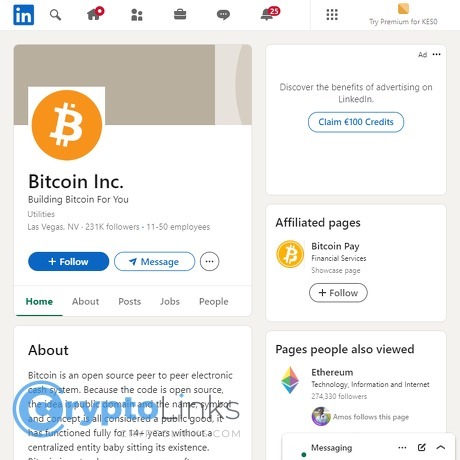
Bitcoin Inc
www.linkedin.com
Bitcoin Inc Review Guide: What This “Bitcoin Company” Really Is (And What It Isn’t)
Have you ever typed “Bitcoin Inc” into Google or LinkedIn thinking you’d finally found the official company behind Bitcoin… and then thought, “Wait, is this it?”
If that’s you, you’re definitely not alone. A huge number of people quietly assume Bitcoin works like Apple, Tesla, or PayPal: there’s a headquarters, a board, a CEO, maybe even a customer support line where you can complain about the price.
Then they hit a slick LinkedIn page called something like Bitcoin Inc, see a clean logo and some corporate-sounding text, and think:
- “So this is the real Bitcoin company?”
- “Do they set the price?”
- “Is this where I’m supposed to buy Bitcoin?”
That quiet confusion is exactly what this guide is here to clear up.
The confusion around “Bitcoin Inc” and the real Bitcoin network
Let’s get one core thing straight right from the start:
Bitcoin has no official company, no CEO, no headquarters, and no customer service department.
Bitcoin is an open, decentralized network. It runs on thousands of computers around the world, maintained by a mix of miners, developers, businesses, and everyday users. No one “Inc.” is in charge of all that.
So why does it feel like there must be a “real Bitcoin company” somewhere?
Because everything else in your life that’s big and important is structured that way:
- Your phone? Apple, Samsung, Xiaomi.
- Your car? Toyota, Ford, Tesla.
- Your payment app? PayPal, Revolut, Cash App.
It’s natural to assume Bitcoin fits the same mental model. Except it doesn’t.
That gap between “how Bitcoin actually works” and “how your brain thinks it should work” is where LinkedIn pages like Bitcoin Inc slip in and unintentionally (or sometimes very intentionally) confuse people.
How a LinkedIn page can make you think you’ve found “the real thing”
Imagine you’re new to crypto. You search “Bitcoin company” on LinkedIn. You see:
- A company called Bitcoin Inc or something very close.
- A nice logo in orange and black.
- A tagline like “Leading the global Bitcoin revolution” or “Official Bitcoin solutions for enterprises”.
- Maybe a few employees listed with titles like “Head of Blockchain Strategy” or “Chief Crypto Officer”.
Without any Bitcoin background, it’s completely reasonable to think:
- “Okay, these must be the people behind Bitcoin.”
- “They probably control the network.”
- “If I want to cash out, this is who I should talk to.”
This is where problems start.
Why this confusion actually hurts people
This isn’t just a harmless misunderstanding. Thinking a random “Bitcoin Inc” is the official Bitcoin authority can lead to some very real issues:
Bad financial decisions
If you assume a LinkedIn company is “the official Bitcoin”, you might:
- Send money to them thinking you’re “buying directly from Bitcoin”.
- Trust their price screenshots or “exclusive offers”.
- Believe their claims about “guaranteed returns” because they look official.
Falling into scams
Scammers love this confusion. They set up:
- Companies with “Bitcoin” in the name.
- Corporate-looking profiles and fake team members.
- Promises like “We work closely with Bitcoin’s founders” or “We stabilize Bitcoin’s price for our clients”.
There was a UK fraud case a few years ago where scammers simply used the word “Bitcoin” and some borrowed photos of offices to trick people into sending them savings. The pattern hasn’t stopped; it just keeps changing logos.
Over-trusting brands and under-checking facts
In traditional finance, a polished brand often does signal a certain level of regulation and oversight. In crypto, that’s not automatically true.
Anyone can:
- Buy a nice logo from Fiverr.
- Launch a LinkedIn company page.
- Register a domain like bitcoin-something-inc.com.
None of that guarantees they’re regulated, safe, or even telling the truth.
Getting wrong price and market information
I’ve seen “Bitcoin companies” post:
- Old price screenshots as if they’re live.
- “Special internal rates” that are way off market.
- Misleading charts that conveniently support their product.
If you don’t know how Bitcoin pricing actually works, it’s easy to accept those numbers as official data “from the source”.
All of this feeds a dangerous belief: that somewhere, there’s a corporate office that can fix your Bitcoin problems with a phone call. There isn’t.
Promise: a straightforward, no-BS guide
So here’s what I’m going to do in this guide.
I’m going to treat Bitcoin Inc on LinkedIn exactly as what it is: one brand in the wider Bitcoin ecosystem. Not “the owner of Bitcoin”. Not “the headquarters”. Just a company using the Bitcoin name.
Along the way, I’ll walk you through:
- What Bitcoin Inc (the LinkedIn presence) actually represents.
- How it positions itself and what that really means for you.
- How to check if any Bitcoin-flavored company is credible or just good at marketing.
- What you should actually be using when you want to:
- Buy Bitcoin.
- Hold Bitcoin safely.
- Sell or cash out your Bitcoin into real-world money.
This isn’t going to be a sugar-coated promo for any platform. I’m not here to impress a marketing department; I’m here to keep you from getting fooled by logos and buzzwords.
Who this is really for
If any of these sound like you, you’re exactly who I’m writing this for:
- You’ve searched “Bitcoin Inc” on Google, LinkedIn, or Facebook and wondered if you’d found the “official” Bitcoin company.
- You’re a beginner or casual investor who just wants straight answers without feeling stupid.
- You’ve seen friends post screenshots of “Bitcoin profits” and want to know what’s real and what’s marketing.
- You’re curious about how to:
- Check the real Bitcoin price in US dollars.
- Buy Bitcoin without getting ripped off.
- Actually cash out if you need the money.
If you’ve been bouncing between ten tabs trying to piece everything together, relax. I’ll weave the answers into this review so you’re not forced to play research ping-pong between random sites.
One important note: this is not a paid ad. No “Bitcoin Inc” sent me a check to say nice things. If something looks shady, I’ll say so. If something’s useful, I’ll say that too.
What readers usually want to know (and will get answers to)
When people stumble onto things like Bitcoin Inc, they usually have three core questions in their head, even if they don’t say them out loud:
- “How much is 1 Bitcoin in US dollars right now?”
- “If I buy some, can I actually cash out later, or is it stuck forever?”
- “What’s the most trusted site to buy Bitcoin without getting scammed?”
Those questions are completely reasonable. You’re not being “too basic” by asking them. In fact, people who pretend they know all this and never ask questions are usually the ones who get burned the hardest.
Here’s how I’ll handle it:
- When I talk about pricing, I’ll show you how to check the real USD value of 1 BTC in seconds.
- When I talk about companies, I’ll connect that to how you actually turn Bitcoin into money you can use.
- When I mention exchanges or tools, I’ll stick to those that are widely recognized, regulated, or battle-tested.
The idea is simple: you shouldn’t have to read one article about “Bitcoin Inc”, another about “how to cash out”, and a third about “where to buy” and try to stitch them together yourself. That’s how people get lost and end up trusting the wrong platform.
Quick warning: branding ≠ authority in crypto
Now, there’s one mental trap I really want you to avoid, because it hits beginners the hardest.
In most of your life, branding is a shortcut for trust. When you see:
- A Visa or Mastercard logo on a card.
- A well-known bank logo on a branch.
- A recognizable phone brand in a store.
Your brain goes, “Okay, this is probably legit.”
In crypto, that shortcut is dangerous.
Here’s why:
- Anyone can slap “Bitcoin” into their company name.
There is no central authority that approves who gets to call themselves “Bitcoin Something”. You could register “Bitcoin Global Holdings Inc” tomorrow in some jurisdictions and no one would stop you.
- A slick LinkedIn page is cheap.
A logo, a few stock photos, and some corporate-style messaging take a few days and a few hundred dollars at most. That’s not proof of anything except a basic marketing budget.
- The word “Inc” doesn’t mean what you think it does.
“Inc” just means “incorporated” in some legal form somewhere. It does not mean:
- That they’re regulated as a financial institution.
- That they’re recognized by any Bitcoin developers.
- That they have special power over the Bitcoin network.
In fact, some of the biggest crypto scams in recent years looked extremely polished on the surface:
- They had professional websites.
- They were active on LinkedIn, Twitter, Instagram.
- They showed fake offices and fake staff profiles.
What they didn’t have was:
- Regulation that you can verify.
- A long track record of doing what they say.
- Independent reviews and real user feedback.
And that’s really the point I want to drive in before we move on:
In crypto, logos and LinkedIn pages are marketing. Not authority. Not official status. Not proof.
The rest of this guide is going to give you a simple mental framework you can reuse every time you bump into a “Bitcoin company” online:
- How to check if they’re useful.
- How to spot basic red flags before you send money.
- How to separate “Bitcoin the network” from “Bitcoin the brand on a business card”.
So, now that we’ve cleared the mental fog a bit, the obvious next question is this:
When you land on the actual “Bitcoin Inc” page on LinkedIn… what exactly are you looking at, and how should you treat it?
That’s where we’re heading next, and this is where things get a lot more practical.
What is “Bitcoin Inc” on LinkedIn, exactly?
Let’s start with what you actually see when you land on a “Bitcoin Inc” LinkedIn page.
It usually looks like any other corporate profile:
- A clean logo with the orange ₿ or some variation of it
- A tagline like “Empowering the future of digital money” or “The global leader in Bitcoin solutions”
- A short description that feels official enough to pass a quick glance test
- Some listed employees, maybe a few posts about “adoption,” “innovation,” and “blockchain”
For someone new, that can absolutely feel like, “Ah, so this is the company behind Bitcoin.”
But here’s the truth:
“Bitcoin Inc” on LinkedIn is just a private company that chose to put the word “Bitcoin” in its name. It’s not the organization that controls Bitcoin, it’s not the “official headquarters,” and it’s not the main development team. There is no single corporation that owns or governs the Bitcoin network.
In practice, a company using that name is usually doing something around Bitcoin, not being Bitcoin:
- Consulting: helping businesses understand how to accept Bitcoin payments or hold BTC on their balance sheet
- Education: selling courses, webinars, or “Bitcoin for beginners” programs
- Branding & media: content, newsletters, or marketing services for crypto projects
- Services: maybe a wallet app, analytics tools, or payment integrations
Nothing wrong with that by itself. The problem is when the branding pushes you into believing it’s something “official,” and you start giving it a level of trust it hasn’t earned.
“In crypto, the scariest risks don’t always come from obvious scams. They often come from things that look professional enough to quiet your doubts.”
I’ve seen people send money to totally random “Inc” brands because they thought they were dealing with the real thing. No hacking, no clever exploit — just misunderstanding and marketing.
So when you see “Bitcoin Inc” on LinkedIn, treat it like any other company profile: a business with its own goals, products, and incentives — not the keeper of the Bitcoin network.
How companies use the Bitcoin name
Here’s a key detail most beginners don’t know: “Bitcoin” isn’t locked up as a private corporate trademark the way “Coca-Cola” or “Apple” is.
That means almost anyone can create a company called “Bitcoin Something” and register it in many jurisdictions. “Bitcoin Solutions,” “Bitcoin Technologies,” “Bitcoin Investments,” “Bitcoin Inc” — you name it, someone has already set it up somewhere.
So you’ll see all kinds of businesses using the word “Bitcoin” in their name, including:
- Wallet and exchange providers
Offering apps or platforms to buy, sell, and store BTC. Some are legit, regulated firms. Others are two guys with a landing page and a Stripe account.
- Mining companies
Running warehouses full of ASIC machines to secure the network and earn BTC block rewards. Again, some are public companies, some are backyard operations, some are outright Ponzi schemes pretending to “mine” for you.
- Payment processors
Helping merchants accept Bitcoin in stores or online. Think Stripe-like services but for crypto. These can be super useful — but the name doesn’t guarantee the quality.
- Education, media, and “thought leadership” brands
Blogs, YouTube channels, “academies,” or coaching services. Some give fantastic education. Others just funnel you into shady investments with a nice logo slapped on top.
The important part: the name tells you almost nothing about whether they’re competent, safe, or honest.
There’s even some data behind this. In multiple studies on consumer trust, people consistently rate brands with familiar or authoritative-sounding names as more trustworthy — even when they know nothing else about them. Crypto scammers and low-effort projects exploit exactly that bias.
So every time you see “Bitcoin Inc,” “Global Bitcoin Holdings,” or anything that sounds official, ask yourself a really simple question:
“If this had a totally boring name — say ‘XYZ Digital Services’ — would I still feel this urge to trust it?”
Is Bitcoin Inc affiliated with the Bitcoin protocol or core devs?
Now we’re getting to the heart of the confusion.
No company on LinkedIn, including anything called “Bitcoin Inc,” controls the Bitcoin protocol.
Bitcoin works very differently from traditional companies:
- It’s open source: The reference software (often called Bitcoin Core) is public. Anyone can review the code, propose changes, or even run their own version.
- Development is community-driven: Changes go through a process called Bitcoin Improvement Proposals (BIPs). Developers submit ideas, the community debates them, and node operators ultimately decide what to run.
- No central command: There’s no CEO of Bitcoin, no board, no official head office. What “wins” is whatever enough of the network decides to run.
If a LinkedIn company called “Bitcoin Inc” shut down tomorrow, Bitcoin wouldn’t care. Blocks would still be mined, nodes would still validate transactions, and your BTC would still be there.
At absolute best, a company like that is just one participant in the much larger ecosystem — maybe as a service provider, educator, or promoter. It is not:
- The owner of the Bitcoin brand in some magical global sense
- The manager of the Bitcoin supply (“we control inflation” is pure fiction)
- The authority on what Bitcoin “really” is, above the open-source code and the network of users
So if you ever see wording like:
- “We manage the Bitcoin protocol for our clients”
- “As the official Bitcoin company…”
- “We can guarantee how Bitcoin will behave in the market”
That’s your cue to step back, take a breath, and remember: Bitcoin doesn’t belong to any single company, “Inc” or not.
How to check any crypto company on LinkedIn
Now, just because a company uses “Bitcoin” in its name doesn’t automatically make it bad. Some are genuinely useful. The point is to stop treating LinkedIn like a badge of authenticity and start using it as a clue board.
Here’s a simple way to check any “Bitcoin company” on LinkedIn before you trust it:
1. Look at the basics: founding date, location, people
- Founding date: A brand-new crypto company isn’t automatically a scam, but if they’ve existed for 3 months and claim to be “the world leader,” you should be skeptical.
- Location: Check where they say they’re registered. Then, if you’re serious, cross-check if that company actually appears in official business registries for that country.
- Real people: Click on the leadership profiles. Do they have a history in tech, finance, cybersecurity, or related fields? Or is it all generic “entrepreneur” and “visionary” with no track record?
2. Follow the links off LinkedIn
- Website: Is there a real site, with clear explanations of what they do? Or is it all slogans like “We are transforming the future of wealth” with no specifics?
- Docs, blog, or GitHub: Serious companies usually show something:
- Technical docs or whitepapers
- Clear FAQs
- Blog posts that actually teach you something
- Code repositories if they claim to build tech
If the entire online footprint is just one LinkedIn page and a splashy homepage, that’s thin.
3. Check their public footprint
- Search for them outside of their own channels: Google the company name with words like “review,” “complaints,” or “scam.” Look for neutral discussions on Reddit, BitcoinTalk, or independent blogs.
- Look for substance, not just noise: Are founders giving real interviews explaining how their product works? Are there technical writeups, not just motivational quotes and price memes?
- Beware of copy-paste praise: If every “review” sounds like the same sales pitch, you’re probably reading paid shill content, not honest feedback.
4. Read the language like a human lie detector
- Do they promise “guaranteed returns” or “stable daily profits” from Bitcoin?
- Do they talk about “secret strategies” or “exclusive access” that normal exchanges don’t offer?
- Are they trying to hurry you into action with “limited time only” or “spots are almost full” on something that clearly could scale?
That’s classic pressure-selling behavior. Real infrastructure companies don’t need to push that hard — they just explain what they do and let users come.
5. Treat LinkedIn as a clue, not proof
LinkedIn is easy to fake around the edges:
- Logos are easy to design
- Company descriptions can be written in an hour
- Endorsements and connections can be shallow
What’s hard to fake is consistency over time: real team members, real shipped products, real user feedback, real regulatory standing.
So next time you land on a “Bitcoin Inc” page that looks super polished, ask yourself:
“If LinkedIn vanished tomorrow, what real-world proof would I still have that this company knows what it’s doing?”
Because when we start talking about price, value, and your actual money — which is where people often assume “Bitcoin Inc” pulls the strings — that question becomes even more important.
And that’s exactly what we’re about to look at: who (or what) really decides how much 1 Bitcoin is worth in US dollars, and why no LinkedIn company gets to control that… ready to see how that actually works in the real world?
Bitcoin price, value, and what people think “Bitcoin Inc” controls
A lot of people land on something like “Bitcoin Inc” on LinkedIn and quietly assume: “Oh, that must be the company that sets the Bitcoin price.”
It sounds logical… until you understand how Bitcoin actually works.
There is no Bitcoin headquarters adjusting a master price board. There’s no CEO waking up and deciding, “Today 1 BTC is $50,000.”
Bitcoin’s price is messy, global, and completely outside the control of any single company — including anything calling itself “Bitcoin Inc”.
If you’ve ever stared at the chart and thought, “Who is doing this to the price?”, this is the part you’ll want to read twice.
How much is 1 Bitcoin in US dollars today?
Let’s start with the question everyone secretly types into Google:
“How much is 1 Bitcoin in USD right now?”
The honest answer: it changes every second. Literally.
Bitcoin trades on hundreds of exchanges across the world: big, small, regulated, gray-area, spot markets, derivatives, P2P… all of them constantly matching buyers and sellers. Every new trade is someone answering the question “What is 1 BTC worth to me right now?”
So instead of one “official” price controlled by a company, we get what markets always give us:
- Different prices on different exchanges
- Small spreads between buy and sell quotes
- Constant movement as orders are filled
To keep your sanity, you don’t want to chase every tick. You want a clean, averaged view.
That’s where price aggregators come in. Think of them as “crypto weather reports”:
CoinGecko – Shows the global average BTC price based on thousands of trading pairs across exchanges.
Check: CoinGecko Bitcoin page
CoinMarketCap – Similar idea: collects prices from multiple exchanges and calculates a volume-weighted average.
Check: CoinMarketCap Bitcoin page
FX-style converters – Sites like Xe’s BTC to USD converter give you a live snapshot like “1 BTC = X USD” at that exact moment.
You’ll sometimes see slightly different numbers between them. That’s normal. The key thing is:
Never trust a random screenshot on LinkedIn, Twitter, or some “Bitcoin Inc” marketing post as your main source of price truth.
Screenshots can be:
- Old (but made to look fresh)
- Cherry-picked to show “crazy” gains
- Or just edited to lure greedy beginners
There’s an old line in markets:
“Numbers don’t lie, but people who show you numbers often do.”
In crypto, your defense is simple: keep a couple of reliable, independent price sources bookmarked and ignore the rest of the noise.
Does any “Bitcoin company” control the price?
This is where a lot of people get trapped emotionally.
When the price pumps, they imagine some secret “Bitcoin company” flipping the switch to make everyone rich.
When it crashes, they look for a villain. A CEO. A board. A “Bitcoin Inc” to blame.
But here’s the uncomfortable truth:
No single company, no matter what it calls itself, controls the BTC/USD price.
Bitcoin’s price is set the same way a house price or stock price is set:
- Buyers and sellers placing orders on exchanges
- Supply and demand meeting in open markets
- Fear and greed swinging back and forth
Of course, some things influence that push-and-pull:
Market sentiment – Bullish news, ETF approvals, big companies adding BTC to their balance sheet… or on the flip side, hacks, bans, and scary headlines.
Regulation news – When the US, EU, or major economies tighten or loosen crypto rules, the market reacts fast.
Bitcoin halvings – Roughly every 4 years, the block reward halves, cutting the rate of new BTC entering circulation. Historically, this has lined up with big bull cycles as supply issuance slows while demand keeps building.
Whales – Large holders and institutions can move markets when they place big buy/sell orders, but they still have to play inside the same open order books as everyone else.
The important part: these are market forces, not “company policies”.
If you ever see a brand — whether it’s calling itself “Bitcoin Inc”, “Official Bitcoin Group”, or something equally fancy — promising things like:
- “We stabilize the Bitcoin price.”
- “We guarantee a minimum Bitcoin price of X.”
- “We protect you from Bitcoin crashes with our secret system.”
Treat that as a massive red flag.
No company can promise that on a real, open market.
What they can do is:
- Run a fund that tries to manage volatility (you take the risk)
- Offer some kind of derivative or structured product (also risk)
- Or just lie and hope your fear or greed does the rest
From 2017 ICO scams to 2021–2022 “yield” platforms promising fixed returns in Bitcoin, regulators have repeatedly stepped in after the damage was done. Many of those pitches leaned on the idea of special control or protection over the BTC price. It didn’t end well.
So when you see a company using the Bitcoin name, remember:
They might offer services around Bitcoin, but they do not control Bitcoin’s price. If they say they do, they are either lying or don’t understand what they’re talking about.
How to track Bitcoin like a pro (even as a beginner)
You don’t need an “official” Bitcoin company to stay on top of the market.
You just need a simple toolkit and the discipline to stick to it.
Here’s a straightforward setup I recommend to people all the time:
One or two price sites/apps
Pick your favorites and stop jumping between 15 different tabs:
– CoinGecko
– CoinMarketCap
Both have mobile apps so you can glance at the price instead of doom-scrolling.
A basic portfolio tracker
If you hold BTC (and maybe a couple of other coins), use a tracker like:
- Blockfolio (now FTX app, though many moved away post-collapse)
- Delta
- CoinGecko’s built-in portfolio feature
This helps you see your gains/losses without constantly logging into exchanges.
Optional alerts
Most apps let you set alerts like:
- “Notify me when BTC drops below $X”
- “Alert me when BTC breaks above $Y”
This is way healthier than refreshing charts every 30 seconds and making emotional trades.
There’s actually some behavioral research backing this up: the more frequently traders check prices, the more likely they are to overtrade and underperform. Constant monitoring feeds anxiety, not good decisions.
A better approach:
- Know your time frame (months/years, not minutes)
- Use alerts so you don’t have to babysit the chart
- Stick with a couple of trusted data sources and ignore hype posts
All of this is completely independent of any “Bitcoin Inc” or branded “official” company.
You don’t need their permission to watch the market. You don’t need their updates to know the price. You definitely don’t need their opinion to decide what your Bitcoin is worth to you.
Bitcoin’s value is ultimately a personal equation:
What are you willing to pay, or accept, for 1 BTC — knowing no one can print more on a whim, and no company can quietly change the rules on you?
Once you get that, the next logical question is: “Okay, I know how to track the price… but how do I actually buy some safely without getting tricked by some random ‘Inc’ that looks official?”
That’s where things get practical — and that’s exactly what I’m going to walk you through next.
Buying Bitcoin safely: what to use instead of random “Inc” brands
Let’s get practical for a second.
If you typed “Bitcoin Inc” because you were really just trying to figure out where to actually buy Bitcoin… you’re in the right place now.
The truth is, you don’t need any mysterious “official” Bitcoin company. You need something much more boring and much more important: a platform that is regulated, secure, and has a long track record of not losing people’s money.
In crypto, boring is underrated. Boring is safe. Boring is what lets you sleep at night.
“In the short run, markets are a voting machine. In the long run, they are a weighing machine.” – Benjamin Graham
The same applies to crypto platforms. In the short run, hype and logos win attention. In the long run, only the exchanges and services that actually protect users survive.
So let’s talk about where people actually buy Bitcoin safely, how to judge a platform yourself, and why a random “Inc” with a shiny logo is not a magic shortcut.
The most trusted places to buy Bitcoin (and why)
When people ask, “What’s the most trusted site to buy Bitcoin?” they’re usually hoping for one simple name so they don’t have to think too hard.
Reality: there is no single “best for everyone” platform. But there are a handful of exchanges and brokers that consistently show up in serious reviews, are regulated, and have survived real stress tests.
Here are a few that are widely used as entry points (availability depends on your country):
Coinbase – Based in the US, publicly listed on Nasdaq, known for being beginner-friendly.
Why people like it:
- Very simple interface for buying your first BTC with a bank card or bank transfer
- Strong regulatory footprint in the US and several other regions
- Good security record, with the majority of customer funds in cold storage
Kraken – One of the oldest active Bitcoin exchanges, operating since 2011.
Why people trust it:
- Serious approach to security and transparency (they’ve supported proof-of-reserves style checks)
- Well-regarded in the US and Europe, with a focus on compliance
- More advanced order types when you grow beyond simple “buy/sell” buttons
Binance – Historically the largest exchange by trading volume worldwide.
Why it’s popular:
- Huge liquidity (easy to buy and sell without much slippage)
- Low trading fees compared to many competitors
- Lots of extra features (futures, staking, etc.) for people who later want to do more than just buy and hold
Important: Binance’s regulatory situation has changed in some countries, so always check whether it’s allowed and licensed where you live.
Gemini – US-based, with a strong focus on regulation and institutional clients.
Why it stands out for some:
- Heavy emphasis on compliance and security
- Clean interface aimed at both beginners and pros
- Regulated in New York (one of the stricter jurisdictions)
If you’re in the USA, overviews like Bitbo’s guide to the best sites to buy Bitcoin are actually pretty useful. They compare fees, features, and regulatory status, instead of just shouting “this is the best” with zero proof.
That word “trusted” gets thrown around a lot, so here’s what I actually mean when I use it:
- Years in business without disappearing or locking users out “for maintenance” every time the price moves
- Real regulatory licenses you can verify, not just a logo slapped on their footer
- Audits and public scrutiny – especially proof-of-reserves or third‑party security assessments
- Transparent leadership with real names, not anonymous “visionary founders” hiding behind stock photos
- Serious security practices: cold storage, 2FA options, withdrawal protections
Trusted is boring, documented, and verifiable. Not “we care about your security” in a banner image.
How to check if a Bitcoin buying platform is legit
Even if a platform isn’t a big name, you can still make a pretty good judgment with a simple checklist. Think of this as your quick BS filter.
1. Regulation: who’s watching them?
- Check if the platform is regulated or registered in your country or state.
- Look for specific licenses: in the US it might be a Money Services Business registration or state-level licenses; in Europe it could be registration as a Virtual Asset Service Provider (VASP).
- Don’t just trust a logo – search the regulator’s database for the company’s legal name.
2. Security features: can they protect you from yourself?
- Do they support two-factor authentication (2FA) with apps like Google Authenticator, not just SMS?
- Do they mention using cold storage for the majority of user funds?
- Is there a way to set withdrawal whitelists (approved addresses only) or withdrawal confirmation by email?
There’s a clear pattern in most major exchange hacks analyzed in security reports: platforms that neglected basic controls got hit the hardest, while those with layered security often limited damage or avoided it entirely.
3. Clarity of fees: are you being quietly skinned?
- Do they clearly list trading fees, deposit fees, and withdrawal fees on a public page?
- Is the BTC price they quote roughly in line with global averages on sites like CoinGecko or CoinMarketCap, or is it mysteriously higher?
- Beware of platforms that boast “zero fees” but hide everything in a terrible exchange rate or spread.
4. Support and transparency: is there a real company behind the screen?
- Is there an actual support email, chat, or ticket system – or just a Telegram group with no accountability?
- Do they publish a clear About page with names, locations, and some company history?
- Can you find the company mentioned on neutral sources: news outlets, independent reviews, maybe even GitHub if they build tools?
5. Real-world test: start small and see what breaks
- Deposit a small amount first and see how long it takes to credit.
- Then withdraw a small amount – either fiat to your bank, or crypto to your own wallet.
- If anything feels sketchy at the smallest scale, don’t scale up. There is no “it’ll be better with more money” in crypto. It’s usually the opposite.
This little test transaction is worth more than any shiny promo video or aggressive influencer campaign. Scams are good at marketing, terrible at passing simple reality checks.
Bitcoin Inc vs real exchanges: what’s the difference in your daily use?
Now, where does something like “Bitcoin Inc” fit into all this?
Even if Bitcoin Inc (or any similar brand) is a totally honest company, it’s important to understand what they probably aren’t for you:
- They are probably not where you’ll actually go to connect your bank account and buy BTC.
- They are probably not the place that holds regulatory licenses as a cryptocurrency exchange in multiple jurisdictions.
- They are almost certainly not the gatekeeper of the Bitcoin network or your only path into it.
Companies with “Bitcoin” in the name might be doing:
- Consulting for businesses that want to accept BTC
- Marketing or branding around crypto products
- Education, events, or training sessions
- Software tools or analytics related to the Bitcoin ecosystem
All of that can be useful. But for your daily reality as a person who wants to buy and hold some Bitcoin, your most important tools will almost always be:
- A regulated exchange or broker to move between fiat and BTC
- A wallet (custodial or non-custodial) to actually hold your coins
- A price tracker or app so you’re not relying on stale screenshots on social media
Think of “Bitcoin Inc” and similar brands as optional accessories, not core infrastructure. They might help you learn, they might sell something on top, but they’re not the engine that powers your ability to buy, hold, or sell BTC.
Once you separate “Bitcoin the asset” from “companies using Bitcoin in their name,” the whole space becomes much less confusing – and a lot safer.
Custodial vs non-custodial: who holds your keys?
Buying Bitcoin is only half the story. Where you keep it matters just as much as where you bought it.
There are two main ways to hold BTC:
1. Custodial: they hold your keys
This is when you keep your Bitcoin on an exchange or in an app where the company controls the private keys behind the scenes.
- Pros: Very easy for beginners; password reset options; sometimes insured against certain types of losses.
- Cons: You’re trusting the platform not to get hacked, go bankrupt, or freeze your funds. If they lose access to their wallets, you lose your coins.
Events like the collapse of FTX in 2022 were a painful reminder: even a giant brand with stadium ads can fail spectacularly. People who left large amounts in custodial accounts paid the price.
2. Non-custodial: you hold your keys
This is when you move your Bitcoin to a wallet where you control the private keys directly.
- This could be a hardware wallet (like Ledger, Trezor, etc.).
- Or a software wallet on your phone or computer (like Sparrow, BlueWallet, Phoenix, etc.).
- Pros: Nobody can freeze your funds or “turn off” your wallet. You are in full control.
- Cons: You are also fully responsible. Lose your backup phrase, and there’s no “forgot password” link to save you.
That’s where the classic rule comes from:
Not your keys, not your coins.
No “Bitcoin Inc,” no exchange, no CEO needs to approve your self-custody. That’s literally what Bitcoin was created for – value you can hold and move without needing permission.
A practical path many beginners take is:
- Start by buying on a trusted, regulated exchange (custodial, simple).
- Learn slowly about non-custodial wallets and backups.
- Move a portion of your BTC to your own wallet once you’re comfortable.
You don’t have to rush to become your own bank on day one. But you should at least understand that you can, and that you don’t need any “official Bitcoin company” to grant you that power.
Now, there’s one big question almost everyone asks right after buying their first Bitcoin: “Okay… but can I actually get this money back into my bank if I need it?”
That’s where the idea of “off-ramps” comes in – the reverse side of buying. And yes, that’s also where a lot of scams and bad deals tend to appear.
Want to know how cashing out really works, which routes are safest, and what kind of tricks to watch for when turning BTC back into dollars or euros?
Let’s take a look at that next.
Cashing out: turning Bitcoin into real-world money
One of the biggest fears I see from beginners is this:
“What if I buy Bitcoin and then I can’t get my money back out? What if it’s just numbers on a screen forever?”
Let’s kill that fear right now.
Yes, you can cash out Bitcoin. You don’t need some “official” Bitcoin Inc. You don’t need a secret contact. You just need a reliable way to move from BTC to fiat (USD, EUR, GBP, etc.) and then to your bank or card.
If someone is making this sound mystical or complicated, they’re either selling something or hiding something.
Yes, you can cash out Bitcoin
Cashing out is basically the reverse of buying. Instead of giving a platform your dollars to receive BTC, you give them BTC and receive dollars (or your local currency).
Most people use centralized exchanges for this. These are platforms that sit in between you and other traders and handle all the matching and settlement for you.
Some of the biggest examples include:
- Coinbase – popular in the US and Europe, heavy on regulation, beginner-friendly interface.
- Binance – global exchange with lots of pairs and features (availability depends on your country).
- Kraken – strong on security and reputation, supports many fiat currencies.
- Gemini – regulated US exchange, more conservative, decent for people who want a “Wall Street” feel.
The actual process to cash out is fairly simple, and it usually looks like this:
- 1. Send BTC to the exchange
You create an account, pass KYC (identity check), and get a Bitcoin deposit address. You send your BTC from your wallet to that address. After confirmations on the blockchain, your BTC balance shows up in your exchange account.
- 2. Sell BTC for fiat
On the exchange, you choose a trading pair, for example BTC/USD or BTC/EUR. You can:
- Place a market order (sell immediately at the current market price).
- Place a limit order (set your own price and wait for a buyer).
When the trade executes, your BTC turns into a fiat balance in your exchange account.
- 3. Withdraw to your bank or card
From your fiat balance, you request a withdrawal:
- Bank transfer (ACH, SEPA, wire) – usually lower fees, but can take 1–5 business days.
- Card withdrawal – faster in some regions, often higher fees.
Once processed, the money lands in your bank account like any other transfer.
Services like BitPay’s cash-out guides walk beginners through different ways to turn crypto into fiat, and they all boil down to the same idea: sell BTC → receive fiat → withdraw.
The key thing to understand is this: Bitcoin doesn’t trap your money. Platforms do. So you pick platforms carefully.
Popular off-ramps and how they compare
Not everyone wants to use a big exchange every time they cash out. Thankfully, you’ve got options. Each one comes with its own mix of speed, privacy, and hassle.
- Centralized exchanges (CEXs)
These are the Coinbases, Krakens, Binances of the world.
- Pros: high liquidity, smoother user experience, clear fiat withdrawal options, usually solid help docs.
- Cons: KYC is mandatory, you trust them with your data and funds while you use them, withdrawals can be delayed if compliance flags something.
For most beginners, this is the default off-ramp.
- Crypto debit cards
Some companies offer cards that let you spend your crypto like cash. Under the hood, they usually:
- Convert your BTC (or stablecoins) to fiat at the time of purchase.
- Let you withdraw fiat from ATMs, depending on the provider.
Pros: super convenient for small, frequent spending.
Cons: fees can add up, your crypto is often held custodially by the issuer, and terms can change fast if regulators step in.
- Peer-to-peer (P2P) platforms
These match you directly with another person who wants to buy or sell Bitcoin. Classic examples are P2P sections on big exchanges or dedicated P2P-only sites.
- Pros: more privacy in some cases, lots of local payment methods (cash deposits, mobile money, local bank transfers), sometimes better rates.
- Cons: higher risk if you’re not careful, potential for fake buyers, disputes, and chargeback scams.
On P2P, the number one rule is: use escrow and never settle deals “off-platform” after you meet someone online.
- Bitcoin ATMs
These are physical machines that let you buy or sell Bitcoin for cash. When selling:
- You select the amount to sell.
- The ATM gives you a QR code or address to send BTC to.
- After confirmation, it spits out cash (or gives you a redeemable code).
Pros: can be fast, available late/24-7 in some places, works well if you want paper cash.
Just keep in mind: studies on Bitcoin ATM fee structures consistently show much higher fees than online exchanges, sometimes in the 8–15% range for smaller amounts. You’re paying for convenience and anonymity.
Risks and fees when cashing out
Cashing out is straightforward, but it’s not risk-free. The trick is to know where people usually get hurt.
- High spreads and hidden fees
Some platforms show “no commission!” in big letters, then quietly make money on a huge spread between the market rate and the price they give you.
For example, if the real market price is $60,000 per BTC and a platform is effectively giving you $58,000 when you sell, that’s a $2,000 “invisible fee” on a single Bitcoin. Always:
- Compare their rate with a neutral price tracker like CoinGecko or CoinMarketCap.
- Check if there are separate withdrawal fees on top.
Research by consumer groups in traditional FX and crypto has shown that many people lose the most money not on explicit fees, but on bad conversion rates.
- P2P scams and chargebacks
With P2P, the classic scam patterns include:
- Buyer sends you fiat (bank transfer, PayPal, etc.), you send BTC, then the buyer reverses or disputes the payment.
- Buyer pressures you to release BTC before you see cleared funds.
- Buyer tries to move the deal off the official platform to avoid escrow and tracking.
The safer way:
- Use platforms with proper escrow and reputations.
- Only release BTC when the platform says payment is final, not just “initiated.”
- Avoid methods with easy chargebacks unless you really trust the counterparty.
It sounds harsh, but in P2P: paranoia beats regret.
- Regulatory and banking friction
Banks and regulators sometimes treat large crypto-related transfers as suspicious. That can mean:
- Temporary holds on withdrawals.
- Extra questions or documents about “source of funds.”
- In extreme cases, account closures if the bank has a strict anti-crypto policy.
This is another reason to:
- Use regulated exchanges that are already on your bank’s radar.
- Keep transfers reasonable and gradual rather than giant lump sums, especially at first.
Some surveys of crypto users show a common pattern: people who cash out slowly and consistently have fewer problems than those who try to move everything in one dramatic shot.
- Taxes: the invisible “partner” in your trade
In many countries, the moment you sell Bitcoin for fiat, you create a taxable event. That can mean:
- Capital gains tax on profits if you sold higher than you bought.
- Different rates for short-term vs long-term holding.
- Obligations to report even small amounts, depending on local rules.
This isn’t legal advice, but it is real-world advice: keep a basic record of:
- When you bought (date, price, amount).
- When you sold (date, price, amount).
- Which platform and which bank you used.
Even a simple spreadsheet can save you a lot of stress if your tax office ever asks questions.
“Freedom without responsibility is just chaos.” Cashing out is financial freedom, but the responsibility part is: choosing honest platforms, understanding fees, and respecting your local tax laws, even if you don’t love them.
Where “Bitcoin Inc” fits into this, if at all
Now, let’s connect this back to that confusing “Bitcoin Inc” branding you might have seen on LinkedIn.
Unless a company that calls itself something like “Bitcoin Inc” is:
- Running a properly licensed exchange you can verify with regulators, and
- Open about its team, licenses, and withdrawal policies, and
- Backed up by real user reviews and a history of actually processing fiat withdrawals
…it’s not your main cash-out route. It’s just another brand in the ecosystem.
If a company like this ever tells you they offer:
- “Managed exits” where they cash out for you but keep control of your funds until “the right time.”
- “Guaranteed returns” if you let them hold your Bitcoin “for a while” before cashing out.
- “VIP liquidation services” that always magically beat the market rate.
…your internal alarm should go off instantly.
Legit off-ramps don’t need fancy promises. They just need to work, consistently. If you understand how to use a normal exchange and a normal bank account, you already have everything you need to move between Bitcoin and your everyday money.
So the real question isn’t “Can I cash out?” You can. The real question is: who am I trusting in the middle?
And that leads to something way more important than any single company: a simple way to research any “Bitcoin” brand you bump into online — including that polished “Bitcoin Inc” profile. Want to know the exact checklist I use before I trust any of them with a single satoshi?
How I Personally Research Any “Bitcoin Company” (Including Bitcoin Inc)
Whenever someone sends me a shiny new “Bitcoin company” link on LinkedIn and asks, “Is this legit?”, I don’t start by looking at their logo. I start by assuming they might be dangerous to my readers’ money until they prove otherwise.
I’m not saying every Bitcoin-branded company is a scam. Far from it. But in this space, trust is something you earn with proof, not design. So let me walk you through exactly how I research any Bitcoin-related brand I come across online — whether it’s “Bitcoin Inc” on LinkedIn, a new exchange, or some “AI Bitcoin trading bot” promising 4% a day.
You can copy this exact process any time you run into a crypto company that feels promising… or just a bit too perfect.
Step 1: Check the fundamentals
First thing I do: I zoom out and ignore the hype. I want to know if there’s a real business here, or just a well-polished promise. Here’s how I break it down.
1. Domain age and website quality
I always check how long their main domain has existed. You can use tools like WHOIS or simple domain age checkers for this.
- Good sign: Domain registered for several years, regular content, working pages, no broken links.
- Suspicious sign: Domain registered a few weeks ago, but they claim to be “industry leaders since 2016.”
There was a study published by the Better Business Bureau and FINRA a few years ago that showed a common pattern in investment scams: they tend to pop up fast, run hard with aggressive marketing, and disappear within months. A fresh domain doesn’t automatically mean “scam,” but when a company claims a long glorious history and their website is barely older than your last haircut, that’s a problem.
On top of that, I look at basic website quality:
- Is the site professionally built or obviously a $20 template with stock photos?
- Does it explain clearly what they do, or just throw around phrases like “revolutionizing the blockchain space” without detail?
- Are legal pages like Terms, Privacy Policy, and company details easy to find?
A real company wants to be understood. A fake one often wants you confused and emotionally hyped so you click “Deposit.”
2. Real names and faces of the team
Next, I look for human beings.
- Are founders and key team members listed with full names and roles?
- Do those names match real profiles on LinkedIn or other platforms?
- Can I see a track record that makes sense? (past jobs, projects, companies)
Red flags I look for immediately:
- No founders at all — only “Our team of experts” with no faces or links.
- Stock photos being passed off as “team members.” Reverse image search is your friend here.
- Profiles with no history before this project, or 20 different “crypto founder” roles stacked in a year.
When someone wants you to trust them with money but hides who they are, that’s not “privacy,” that’s a business decision: they want upside without accountability.
3. Clear description of what they actually do
I like to play a simple game when I check a new Bitcoin company: I read their homepage and ask myself, “If I had to explain their business in one sentence to a friend, could I?”
For a good platform, that sentence comes easily:
- “This one is a Bitcoin exchange, you send fiat in and buy BTC.”
- “This is a non-custodial Bitcoin wallet, you control your keys.”
- “This is an analytics tool that tracks Bitcoin on-chain metrics.”
With questionable companies, it sounds more like this:
“We are building AI-driven, quantum-secure, Web3 metaverse liquidity solutions to optimize your financial freedom and passive income opportunities.”
That’s not a description. That’s a smoke bomb.
Immediate red flags in their copy:
- Overuse of buzzwords with no specific product: “AI blockchain metaverse DeFi yield aggregator” all in one breath.
- “Guaranteed” or “fixed” high returns: 3% daily, 40% monthly, “no risk profits.”
- Vague “partnerships” with no links, no official announcements, and no way to verify them.
Any time I see guaranteed returns in Bitcoin or crypto, I mentally move that company into the “probably a Ponzi” bucket until proven otherwise. Markets don’t guarantee anything. The only thing fixed in this world is gravity and eventually taxes.
Step 2: Look for independent proof
Once a company passes the basic sniff test, I start hunting for signals outside their own marketing bubble.
1. Mentions on trusted, neutral sources
I search the company name together with words like “review,” “complaints,” “Reddit,” and “scam.” I want to see what shows up when they’re not in control of the narrative.
- Are they mentioned on established crypto news outlets or neutral tech sites?
- Is the coverage balanced (pros and cons) or obviously a paid press release praising everything?
- Do they show up in community discussions on forums or social media, and what’s the tone there?
Pattern I’ve seen again and again: scams either have no outside footprint at all, or they’re only mentioned in low-quality press-release farms that post anything for a fee. Real projects tend to attract organic discussion, support, and yes, sometimes criticism.
2. Any public contribution to Bitcoin or open-source
If a company presents itself as some major Bitcoin innovator, I expect to see something to back that up:
- A GitHub profile with code contributions
- Open-source tools, libraries, or wallets they’ve released
- Technical blog posts, research, or talks at reputable conferences
Now, not every honest Bitcoin business writes code. Some are simple brokers, educators, or service providers. That’s fine. But when a company makes big claims about “revolutionizing Bitcoin infrastructure” or “building the next layer of the Bitcoin protocol” and I can’t find a single line of related code, paper, or technical explanation, I move into “this is just marketing” mode.
3. Honest reviews vs obvious shills
This is where things get tricky. There’s a whole mini-industry of fake reviews and paid shill content in crypto. I’ve seen “review sites” that push whatever project pays the highest affiliate fee that week, calling everything “the best, safest, most trusted” with zero critical thought.
When I read reviews, I look for:
- Specifics: What exactly works well? What’s annoying? How are withdrawals? How fast is support?
- Balance: A real review mentions downsides. Pure praise with zero flaws is almost always sponsored or fake.
- Consistency: If 100 people say withdrawals are slow and support is unresponsive, I listen to that pattern.
If a Bitcoin-branded company seems to live only on its own LinkedIn posts and its own glowing testimonials, I treat it as untested. That doesn’t automatically make it bad, but it does mean I’d never recommend it as someone’s first stop in crypto.
Step 3: Compare with known, vetted resources
I don’t judge a new company in a vacuum. I always compare it to platforms, tools, and resources that have already proven themselves over time.
On my main site, I’ve spent years curating:
- Reputable Bitcoin exchanges and brokers
- Legit Bitcoin wallets (custodial and non-custodial)
- Educational sites that explain Bitcoin in plain language
- Price trackers, conversion tools, and security guides
When I research a new “Bitcoin company,” I basically ask:
- Is their transparency at least as good as the exchanges and wallets I already list?
- Do they explain risks as clearly as they explain potential benefits?
- Are their fees and terms easier or harder to understand than the trusted platforms?
If they can’t even match the clarity, honesty, and basic security practices of established services, they’re not getting anywhere near my recommended list. And I’d never use them as my main way to buy, hold, or cash out Bitcoin — not when there are better options that already exist.
Think of it like this: if you already know a handful of highways that are safe and well-lit, why would you rush onto a brand-new, half-built shortcut through the dark just because it has a cooler logo?
Why you should think like a reviewer, not a fan
This is the mindset shift that protects people more than anything else: stop approaching Bitcoin-branded companies like a fan. Start approaching them like a reviewer.
Fans ask:
- “How fast can this make me rich?”
- “How do I get in before everyone else?”
- “What if this is the next big thing?”
Reviewers ask:
- “How exactly could this lose me money?”
- “What happens if they shut down tomorrow?”
- “Who’s on the hook if something goes wrong?”
When something feels a bit off — rushed, pushy, full of FOMO — I’ve learned to treat that feeling as a signal, not a bug in my thinking. Some of the biggest crypto disasters started with platforms that felt slightly off, but people ignored the discomfort because the returns looked too good.
There’s a classic pattern in fraud psychology: scammers push urgency (“limited spots,” “act now,” “before the halving,” “before the bull run”) because they know that once you slow down and think, the spell breaks. So your best defense is boring: go slow, ask hard questions, and be okay walking away.
Here’s the simple rule I use myself:
If a Bitcoin-related company can’t survive my curiosity, it doesn’t deserve my money.
Now, all of this raises a bigger, practical question that a lot of readers have at this point:
Once you’ve picked a safe platform and figured out who to trust, how do you actually use Bitcoin day-to-day — check the price, buy some, move it, cash it out — without getting lost or overcomplicating everything?
That’s exactly what I’m going to break down next, along with a straight answer to one of the biggest questions I get: “Can I really get my money back out of Bitcoin when I need it?” Keep reading — this is where everything comes together.
FAQ, key takeaways, and my honest verdict on “Bitcoin Inc”
If you’ve made it this far, you already know the punchline: Bitcoin doesn’t have a headquarters, a CEO, or an “Inc” behind it. But I also know people still leave articles like this with a few simple, nagging questions in their head.
So let’s clear those up quickly, recap what actually matters for you as a user, and then I’ll give you my straight, no-spin verdict on Bitcoin Inc as a brand.
Quick FAQ: simple answers for common questions
These are the exact questions I see beginners ask on Google, Reddit, and even in my inbox. Let’s keep the answers short and useful.
“How much is 1 Bitcoin in US dollars?”
There is no fixed price. It changes every second.
The safest way to check is to use a live price or conversion tool, such as:
- CoinGecko – Bitcoin page
- CoinMarketCap – Bitcoin
- Xe: BTC to USD converter
Those sites aggregate data from multiple exchanges instead of relying on one company’s “official” number. That’s important in a market that trades 24/7.
“Can I really cash out my Bitcoin?”
Yes. If you can buy it, you can sell it.
The usual route looks like this:
- Send BTC to a regulated exchange account in your name
- Sell BTC for your local currency (USD, EUR, etc.)
- Withdraw to your bank account or card
Millions of people do this every year. For example, Coinbase reported over 100 million verified users in its filings, and a big chunk of that activity is simply people buying and later cashing out to fiat.
You don’t need anything called “Bitcoin Inc” in that process. You just need an exchange that actually supports your region and bank rails.
“What is the most trusted site to buy Bitcoin?”
There isn’t a single “winner,” because laws and access differ by country. But a few names consistently show up in regulatory filings, independent reviews, and user stats, including:
- Coinbase – highly regulated in the US and EU, very beginner-friendly
- Kraken – strong security record, long track record
- Gemini – New York trust company, heavy on compliance
- Bitstamp – one of the oldest exchanges still operating
If you like structured research, guides such as Bitbo’s “best sites to buy Bitcoin” for US users are a solid way to compare options side by side.
What matters more than the brand name:
- Is it regulated where you live?
- Has it survived at least one bear market?
- Does it have a clear, public team and real addresses?
- Do independent sites and forums talk about it honestly?
“Is Bitcoin Inc the official Bitcoin company?”
No. Bitcoin doesn’t work like that.
There is no “official” company that owns the protocol, controls the price, or can approve or block your transactions. Anything on LinkedIn called “Bitcoin Inc” (or any variation of that) is just a private business using the Bitcoin name.
If any company ever tells you “we are the official Bitcoin organization,” treat that as a massive red flag.
When (if ever) should you care about Bitcoin Inc?
So where does a company like Bitcoin Inc (the LinkedIn brand) actually fit into your Bitcoin life?
The honest answer: only if they’re offering something specific that you actually need, and they pass basic sanity checks.
They might be useful if…
- They publish educational content that helps you understand Bitcoin better
- They build tools (analytics, wallets, apps) that have good independent feedback
- They run a service (for example, consulting or development) that you’ve researched and decided is worth paying for
In that case, treat them like any other tech or finance company. Name aside, you’re just asking: “Is this a legit business that offers value?”
They are not something you must use if you:
- Want to buy Bitcoin – use a trusted exchange or peer-to-peer platform
- Want to track the price – use aggregators and price apps
- Want to store your coins – use your own wallet (hardware or software)
- Want to cash out – use regulated off-ramps that connect to your bank
Your whole Bitcoin life can run perfectly fine without ever touching a company called “Bitcoin Inc.”
Be very careful if they say things like:
- “We guarantee a fixed monthly return on your Bitcoin”
- “We can recover any lost BTC for a small fee”
- “We stabilize or control the Bitcoin price”
- “Send us Bitcoin, we’ll manage it for you, no risk”
History is full of polished brands that looked “professional” and still collapsed or turned out to be scams. Think of names like OneCoin, BitConnect, or Celsius. All had logos, websites, catchy slogans – none of that stopped users from losing billions.
Branding isn’t a shield against bad incentives.
Bottom line: you can care about Bitcoin Inc if they do something genuinely useful and transparent. You never need them to use Bitcoin itself.
How to keep learning and stay safe in the Bitcoin world
Most of the real risk in Bitcoin doesn’t come from Bitcoin itself. It comes from:
- Not knowing how custody works
- Trusting the wrong platforms
- Clicking “buy” or “send” without understanding the basics
You don’t have to turn into a hardcore cypherpunk to stay safe, but you should follow a simple learning path.
Step 1: Understand what Bitcoin is (and what it isn’t)
- Bitcoin is a network and protocol, not a company
- It’s rules-based money, not something a CEO can change at will
- Transactions are recorded on a public ledger (the blockchain) that anyone can inspect
When you really get this, marketing phrases like “official Bitcoin organization” instantly stop making sense.
Step 2: Learn how to use a wallet and an exchange
- Pick one reputable exchange and learn the basics: buy, sell, deposit, withdraw
- Pick a beginner-friendly wallet and practice small test transactions
- Understand that fees, confirmation times, and addresses are normal parts of the system
This is like learning online banking the first time. It feels weird for a week, then it’s just part of life.
Step 3: Get serious about security
- Enable 2FA (app-based, not SMS) on every account that touches your money
- Write down your wallet seed phrase on paper and store it offline – never in screenshots or cloud notes
- Consider a hardware wallet if you hold more than you’d be comfortable losing in a worst-case exchange hack
Incident after incident shows that human mistakes are the biggest risk. Chainalysis found that a huge portion of stolen funds in crypto come from phishing, SIM swaps, and compromised credentials. Technology is getting better; attackers are just shifting to social engineering instead.
Where do you find trustworthy learning material?
- Curated lists of exchanges, wallets, and tools on sites like Cryptolinks
- Neutral news and research from long-running crypto media
- Open-source projects and documentation (for example, Bitcoin.org, Bitcoin Core docs)
Notice what’s not on that list: random LinkedIn companies with big “Bitcoin” logos and zero track record.
You don’t need permission from anyone – not a company, not a government, not a bank – to use Bitcoin as intended. You just need decent information and a bit of patience.
Conclusion: Bitcoin Inc is a brand, Bitcoin is a network – know the difference
Let’s wrap this up with the one mental filter I want you to keep for life:
Bitcoin Inc is just a company name. Bitcoin is a public, decentralized network. Do not mix the two in your head.
Companies will come and go with “Bitcoin” in their branding:
- Some will be harmless marketing projects
- Some will be genuinely useful businesses
- Some will be straight-up scams wrapped in shiny logos
The network doesn’t care. Blocks keep getting mined. Transactions keep getting confirmed. The protocol doesn’t wake up one day and say, “We’re under new management; see our LinkedIn.”
If you remember nothing else from this entire guide, remember this little rule set:
- Trust code and incentives more than branding. A multisig wallet and a hardware device protect you more than any “Inc” ever will.
- Trust real markets more than promises. The Bitcoin price is messy, volatile, and honest. Anyone promising to smooth that out for you is selling something.
- Trust verified platforms more than logos. Regulation, audits, and years in business beat a cool name every time.
Use Bitcoin on your own terms. Use companies only when they clearly earn your trust. And whenever you see a new “Bitcoin Inc”–style brand pop up, ask yourself:
“If this didn’t have ‘Bitcoin’ in the name, would it still look worth my time and money?”
If the answer is no, you already know what to do: close the tab, keep your coins safe, and focus on the tools and platforms that actually help you – not just the ones with the flashiest names.
CryptoLinks.com does not endorse, promote, or associate with LinkedIn groups that offer or imply unrealistic returns through potentially unethical practices. Our mission remains to guide the community toward safe, informed, and ethical participation in the cryptocurrency space. We urge our readers and the wider crypto community to remain vigilant, to conduct thorough research, and to always consider the broader implications of their investment choices.