Best Crypto News Aggregators in 2026: Feeds, Alerts and Filters
By Nate Urbas
Last updated: June 29, 2026
A crypto news aggregator collects headlines, announcements, market updates and sometimes social posts from multiple sources in one feed. I use these tools to discover stories, monitor specific assets and compare how different publishers cover the same development without opening dozens of websites.
For most readers, CryptoPanic remains the clearest starting point because it is built primarily around cryptocurrency news aggregation. CryptoRank is a stronger fit when news needs to sit beside token data, fundraising information and research tools. CoinStats makes more sense for portfolio-linked monitoring, while Feedly is better for readers who want full control over their source list.
The main limitation applies to every service in this category: aggregation does not verify a story. A headline can appear quickly and still be incomplete, recycled, commercially influenced or wrong. I always open the original source before relying on a claim that could affect a financial decision.
My Quick Picks
| Best for | My selection | Why I chose it |
|---|---|---|
| Best dedicated crypto news aggregator | CryptoPanic | Focused multi-source feed, useful filters, community voting and mobile access |
| Best for research and market data | CryptoRank | Combines aggregated news with token, fundraising, unlock and market information |
| Best for portfolio-linked news | CoinStats | Personalized asset feeds, portfolio tools, social posts and multi-source summaries |
| Best free market-data companion | CoinGecko | Convenient news access alongside prices, token pages and market data |
| Best for existing CoinMarketCap users | CoinMarketCap | News, watchlists, portfolio functions and market alerts in one platform |
| Best for mobile-first monitoring | The Crypto App | Coin-specific feeds, widgets and configurable push notifications |
| Best for custom RSS feeds | Feedly | Complete control over publishers, official blogs, newsletters and research sources |
| Best for social sentiment | LunarCrush | Tracks social narratives, engagement, creators and sentiment around crypto assets |
| Best hybrid for coin-specific research | CoinCodex | Combines news with token data, price alerts, watchlists and market tools |
I have not labelled any platform the fastest. A credible speed comparison requires monitoring the same breaking events across all services and recording the original publication time, first aggregator appearance and alert-delivery time. Marketing terms such as “instant” and “real-time” are not enough to prove that one service is consistently faster.
Crypto News Aggregator Comparison
| Aggregator | Best for | Alerts | Personalization | Mobile access | Free access | Main limitation |
|---|---|---|---|---|---|---|
| CryptoPanic | Dedicated crypto news monitoring | Yes | Coins, sources and feed preferences | Yes | Yes | Community votes can reflect popularity rather than accuracy |
| CryptoRank | Research and market analysis | Yes | Topics, assets, watchlists and research tools | Yes | Yes | More complex than a simple news reader |
| CoinStats | Portfolio-linked news | Yes | Assets, portfolio, sources and topics | Yes | Yes | Summaries and social posts still require verification |
| CoinGecko | News beside market data | Mainly market alerts | Coins and market categories | Yes | Yes | News is secondary to the wider market-data platform |
| CoinMarketCap | Existing CMC users | Yes | Watchlists, portfolio and interests | Yes | Yes | Mixes several types of internal and external content |
| CoinCodex | Coin-specific market research | Yes | Coins, watchlists and portfolio | Yes | Yes | News appears beside predictions, guides and other content types |
| The Crypto App | Mobile feeds and widgets | Yes | Selected coins and events | Yes | Yes | Best features may depend on mobile use or a paid plan |
| Feedly | Custom sources and RSS | Plan-dependent | Full source and folder control | Yes | Yes | Requires manual setup and source selection |
| LunarCrush | Social narratives and sentiment | Workflow-dependent | Assets, creators, topics and collections | Web and integrations | Limited | Advanced social data and API access can be expensive |
How I Evaluated These Crypto News Aggregators
For this update, I checked the public feeds, official product pages, available documentation and current mobile information for the leading services. I looked at whether each platform was still operating, how it displayed sources, what type of content it aggregated and whether it offered useful filters, alerts, watchlists, mobile access, summaries, sentiment tools or portfolio integration.
I gave the most weight to source visibility. I want to know who originally published a story and whether the aggregator links directly to that source. A feed that displays thousands of headlines is not useful when sponsored content, press releases and low-transparency websites are mixed together without clear labels.
I then considered filtering and personalization. A useful aggregator should let me reduce the feed to the coins, sectors and sources that matter. I also looked at duplicate handling, alert options, ease of use, account requirements, free-plan restrictions and the difference between a genuine aggregator and a market-data platform that happens to include news.
I did not buy every paid subscription, connect an exchange account, import a complete portfolio or execute every available API. I also did not complete a recorded multi-day latency test for this update. I therefore avoid presenting invented performance statistics or claiming that every feature was personally tested under identical conditions.
What Is a Cryptocurrency News Aggregator?
A cryptocurrency news aggregator is a platform that collects, organizes and displays content from several external sources.
Depending on the service, it may gather information through:
- RSS feeds.
- Publisher APIs.
- Website crawlers.
- Official company and project announcements.
- Social-media integrations.
- Community submissions.
- Human curation.
- Automated topic clustering.
- AI-generated summaries.
A basic aggregator may show little more than a chronological list of headlines. More advanced platforms can categorize stories by cryptocurrency, blockchain, topic, source, region or sentiment. Some also add price data, watchlists, portfolio information and configurable alerts.
The main purpose is discovery. Instead of checking twenty individual websites, I can scan one feed and open the stories that appear relevant.
That convenience should not be confused with fact-checking. Most aggregators reproduce a publisher’s headline and short description without independently verifying the underlying claims.
Crypto News Aggregator Versus Crypto News Website
A crypto news aggregator and a crypto news publisher perform different jobs.
| Feature | News aggregator | Crypto news publisher |
|---|---|---|
| Main purpose | Collects content from several sources | Produces its own reporting and analysis |
| Source diversity | Usually broad | Primarily its own journalists and contributors |
| Original reporting | Usually limited | Can include interviews, investigations and exclusive reports |
| Story comparison | Makes it easier to compare several publishers | Presents one publication’s editorial coverage |
| Verification | Depends on the linked source | Publisher assumes editorial responsibility for its work |
| Best use | Discovery and monitoring | Context, reporting and detailed analysis |
CoinDesk, Decrypt and Cointelegraph are publications rather than pure aggregators. They may be valuable sources inside an aggregated feed, but they primarily publish their own content.
I normally use an aggregator together with a small selection of trusted crypto news websites. The aggregator helps me discover a story, while the original publisher and primary documents help me verify it.
The Different Types of Crypto News Aggregators
Pure Headline Aggregators
A pure aggregator is built mainly to collect and organize headlines from external cryptocurrency publications.
This type is best for quickly scanning what has been reported across the market. The strongest platforms let users filter by coin, source or topic and clearly identify where each story originated.
The weakness is repetition. Ten publishers can rewrite the same company announcement, creating the impression that ten independent events have occurred. Good duplicate handling matters more than a large headline count.
Community-Ranked Aggregators
Community-ranked services let users vote on whether a story is important, positive, negative, bullish or bearish.
These votes can help reveal which stories are receiving attention, but they are not objective analysis. A large token community may vote positively on favourable coverage and negatively on criticism regardless of the evidence.
I treat community reactions as another information layer, not as a prediction of what the price will do next.
Market-Data Platforms With News
CoinGecko, CoinMarketCap, CoinCodex and CryptoRank combine news with token prices, charts, watchlists and market information.
This is convenient when I want to move directly from a headline to a project’s market data. However, news is only one part of these platforms, and the interface may include many unrelated tools.
Readers mainly interested in prices should also compare dedicated cryptocurrency price trackers. A strong price platform is not automatically the best source-filtering or news-monitoring service.
Portfolio-Based News Feeds
Portfolio platforms can personalize the news feed around assets a user holds or follows. This removes unrelated stories and can make a large feed easier to manage.
The trade-off is privacy. A public news feed does not need access to a wallet, exchange account or portfolio. Connecting those services may disclose holdings and account relationships that are unnecessary for simply reading headlines.
I would first try a manual watchlist. Readers who need deeper portfolio functionality can compare the dedicated crypto portfolio trackers reviewed on CryptoLinks.
AI Summary Aggregators
AI summaries attempt to combine several reports or reduce a long article to a few key points.
I find this useful for deciding which stories deserve closer attention. I do not rely on a generated summary as the final source for a regulatory, security, legal or financial claim.
A summary may remove an important condition, confuse a proposal with a completed decision or combine reports that do not fully agree. The original articles should remain visible and easy to open.
Social-Intelligence Platforms
Social-intelligence platforms monitor posts, creators, engagement and sentiment across social networks.
They can reveal that discussion around a cryptocurrency is accelerating, but they cannot prove that the underlying claims are accurate. Increased engagement may result from genuine news, controversy, spam, coordinated promotion or a sudden price move.
Readers who monitor social announcements directly can also compare the most useful crypto accounts on X.
RSS Readers and Custom Feeds
A general RSS reader lets users create their own aggregator rather than accepting a source list chosen by someone else.
I can build separate feeds for regulation, exchange announcements, security research, Bitcoin development, DeFi protocols and general cryptocurrency publications. This gives me more control over quality and reduces the chance of seeing the same low-value sources repeatedly.
The disadvantage is setup and maintenance. I must decide which publishers deserve inclusion and replace feeds when websites change their RSS structure.
Professional Monitoring Tools and APIs
Developers, researchers and institutions may require structured delivery, archives, automatic alerts or integration with internal dashboards.
Some market-data and intelligence platforms offer APIs, although news access, licensing, attribution and request limits vary. A market-data API does not automatically include unrestricted article content.
Developers should compare dedicated cryptocurrency APIs before selecting a service for production use.
The Best Crypto News Aggregators in 2026
CryptoPanic: My Best Starting Point for Most Readers
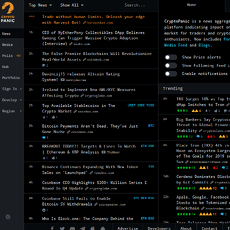
CryptoPanic remains one of the clearest examples of a dedicated cryptocurrency news aggregator. Its primary purpose is collecting crypto-related stories and helping users filter, rank and monitor them.
The interface makes it possible to scan headlines, identify sources and see how the community has reacted. Users can follow selected currencies, save stories and use mobile access rather than relying only on the desktop website.
I find the community-voting system useful for understanding which stories are attracting attention. I do not treat positive, negative, bullish or bearish votes as trading signals. They represent user reactions and can be influenced by the popularity of a project.
CryptoPanic is the option I would suggest first to someone who wants a straightforward aggregated feed without the complexity of a full institutional research platform. The main questions are whether its free filters are sufficient and whether its source selection matches the user’s preferred level of quality.
Read my complete CryptoPanic review for a closer examination of its interface, features and limitations.
Best for: General crypto news monitoring.
Main strengths
- Dedicated cryptocurrency-news interface.
- Visible publisher attribution.
- Coin and source filtering.
- Community reactions.
- Mobile access.
- Free entry point.
Main limitations
- Community sentiment can be biased.
- Repeated coverage may still appear.
- Some personalization may require an account or upgrade.
- It does not replace the original article.
CryptoRank: Best for News Combined With Market Research
CryptoRank combines an active aggregated news feed with token data, fundraising information, unlock schedules, market analytics, research, alerts and watchlists.
I would choose it over a simple news reader when I need to investigate the wider context around a project. A headline about a token unlock, exchange listing or funding round can be compared with related data without leaving the platform.
The news feed identifies publishers and separates internally produced or sponsored material in ways readers can examine. That distinction is important because a press release, paid campaign and independent report should not be treated as equivalent sources.
The main limitation is complexity. A beginner who only wants a clean headline feed may find the number of market and research tools excessive. Some advanced features also sit behind paid access.
Best for: Researchers and data-focused investors.
Main strengths
- Aggregated external news.
- Token and market research.
- Fundraising and unlock information.
- Watchlists and alerts.
- Mobile access.
- API and professional-data options.
Main limitations
- More complex than a dedicated headline reader.
- Some advanced functions require payment.
- News, research and sponsored content must be distinguished carefully.
CoinStats: Best for Portfolio-Linked News and Summaries
CoinStats combines aggregated articles, social posts, portfolio tracking and multi-source market summaries.
Its feed can be useful for readers who want news connected to particular assets or an existing portfolio. The platform also groups information from several sources into shorter market-intelligence summaries.
I use that type of summary for triage: it helps me decide which topic deserves further reading. I still open the original sources before relying on the details.
CoinStats also demonstrates one of the main quality problems in aggregation. A broad feed may include established publishers, small websites, promotional stories and social posts in the same interface. The user still needs to judge each source.
I would not connect a portfolio solely to gain access to personalized news. A manually created watchlist may provide enough personalization without disclosing actual holdings.
Best for: Users who already use CoinStats for portfolio tracking.
Main strengths
- Portfolio-linked personalization.
- Coin and topic feeds.
- Multiple external publishers.
- Social posts and community reactions.
- Multi-source market summaries.
- Mobile apps and API access.
Main limitations
- Source quality varies.
- Social content adds noise.
- AI summaries can omit context.
- Portfolio connections introduce additional privacy considerations.
CoinGecko: Best Free Companion for Market-Data Users
CoinGecko is primarily a market-data platform, but its news feed makes it possible to view external stories alongside prices, token pages and broader market information.
The main advantage is convenience. Many readers already use CoinGecko to check prices and market capitalization, so opening a separate account or learning another interface may not be necessary.
I would use CoinGecko for broad discovery rather than as my only professional news-monitoring system. Its feed can cover stories that extend beyond narrowly focused cryptocurrency reporting, and source control is not the platform’s only priority.
CoinGecko belongs in this comparison as a hybrid platform, not as a pure headline aggregator.
My detailed CoinGecko review covers the platform’s market-data features and wider role in crypto research.
Best for: Readers already using CoinGecko for prices and token data.
Main strengths
- Free access.
- News beside market information.
- Familiar token pages.
- Wide asset coverage.
- Mobile access.
- No need to connect a portfolio for basic reading.
Main limitations
- News is a secondary product.
- Source mix can feel broad or noisy.
- Specialist alert and source-control options may be limited.
CoinMarketCap: Best for Readers Already Inside the CMC Ecosystem
CoinMarketCap combines market data, watchlists, portfolio features, educational content and news.
The platform is convenient for readers who already use its website or mobile app. News can be viewed in the same environment as token prices and watchlists, reducing the number of separate tools required.
I classify CoinMarketCap as a hybrid platform because it distributes several types of content rather than operating only as an external-news index. Readers should check whether an item comes from an outside publisher, an internal editorial product, a community channel or another source type.
Convenience is the main reason to use CoinMarketCap for news. It is not automatically the best choice for readers who want maximum control over publishers.
See my CoinMarketCap review for a broader assessment of its market, portfolio and tracking functions.
Best for: Existing CoinMarketCap users.
Main strengths
- News beside prices and watchlists.
- Mobile applications.
- Portfolio tools.
- Broad asset coverage.
- Market alerts.
- Familiar interface for many crypto users.
Main limitations
- Not a pure aggregator.
- Several content types appear in the same ecosystem.
- Users must check the original source and content label.
CoinCodex: Best for Coin-Specific Hybrid Research
CoinCodex combines external and internally produced content with market data, price alerts, watchlists, portfolio tools and token information.
It can be useful when I want to move from a story directly to the relevant asset page. The platform covers a wide selection of coins and provides additional market context.
The main drawback is that news appears beside predictions, guides, reviews and other editorial content. Those content types serve different purposes and should not be treated as equally objective reporting.
I consider CoinCodex a research companion rather than my only aggregated news feed.
The CryptoLinks CoinCodex review examines its broader price-tracking and market-data features.
Best for: Coin-specific research and price monitoring.
Main strengths
- News linked with token data.
- Wide cryptocurrency coverage.
- Watchlists and portfolio functions.
- Price alerts.
- Mobile access.
- Market research tools.
Main limitations
- Mixes multiple content types.
- News is only one part of the platform.
- Prediction content should not be confused with reporting.
The Crypto App: Best for Mobile Monitoring
The Crypto App is designed around mobile access, coin-specific feeds, price information, widgets and push notifications.
It is a sensible choice for someone who monitors cryptocurrency primarily from a phone. Selected assets and important market information can be brought into a personalized mobile view.
The main test is notification quality. A useful app should allow enough control to prevent repeated, promotional or low-priority alerts. More notifications do not automatically create a better information system.
I recommend testing the free version before considering a paid plan. A subscription makes sense only when a particular premium feature solves a real limitation.
Best for: Mobile-first users who value widgets and push alerts.
Main strengths
- Designed for mobile use.
- Coin-specific news.
- Home-screen widgets.
- Configurable notifications.
- Price and market information.
- Free starting option.
Main limitations
- Desktop-focused researchers may prefer another tool.
- Excessive alerts can become distracting.
- Some useful functions may require payment.
Feedly: Best for Controlling the Source List
Feedly is not specifically a cryptocurrency platform. That is also
Feedly: Best for Controlling the Source List
Feedly is not specifically a cryptocurrency platform. That is also why it can be one of the strongest options for experienced readers.
Instead of accepting a preselected group of publishers, I can build my own folders from RSS feeds, newsletters, company blogs and research websites. I can maintain separate feeds for Bitcoin, regulation, security, exchanges, DeFi and institutional adoption.
This approach provides greater source control than most ready-made crypto aggregators. It also requires more work. Feedly does not decide which crypto publishers are credible, and I must maintain the list myself.
Feedly is especially useful when paired with official cryptocurrency project websites, regulator pages and established research sources.
Best for: Researchers who want complete control over sources.
Main strengths
- Custom RSS feeds.
- Newsletter collection.
- Folders and topic organization.
- Source-level control.
- Mobile and desktop access.
- Useful beyond cryptocurrency.
Main limitations
- Requires setup.
- No built-in crypto source-quality guarantee.
- Advanced search and automation can require payment.
- The user must maintain broken or changed feeds.
LunarCrush: Best for Crypto Social Intelligence
LunarCrush is better understood as a social-intelligence platform than a conventional news aggregator.
It tracks social posts, engagement, creators, topics and sentiment around cryptocurrency assets. I would use it to investigate which narratives are gaining attention rather than simply to read the latest articles.
This can provide useful context around a developing story, but social activity is easy to misread. A rise in mentions does not confirm adoption, accuracy or future price direction. It may reflect controversy, spam or coordinated promotion.
LunarCrush is more relevant to professional research and social monitoring than to a beginner who only wants a free headline feed.
Best for: Social sentiment, narrative tracking and professional workflows.
Main strengths
- Social-engagement data.
- Creator and topic tracking.
- Asset-level sentiment.
- Custom collections.
- API and integration options.
- Useful for narrative research.
Main limitations
- Not a pure news aggregator.
- Sentiment is not a price forecast.
- Advanced data can be expensive.
- Social activity can be manipulated.
How to Choose the Right Crypto News Aggregator
1. Decide What You Actually Need
A casual reader, active trader and professional researcher do not need the same product.
Start by choosing the main priority:
- Scanning general headlines.
- Following a small group of cryptocurrencies.
- Receiving breaking-news alerts.
- Monitoring regulation.
- Tracking security incidents.
- Comparing several publishers.
- Connecting news with market data.
- Studying social sentiment.
- Accessing news through RSS or an API.
A simpler platform is often better when the goal is only to read the main stories once or twice per day.
2. Examine the Source List
I check whether the feed includes:
- Official announcements.
- Established financial publications.
- Established crypto publications.
- Specialist research sources.
- Project and company blogs.
- Press releases.
- Social posts.
- Sponsored articles.
- Low-transparency publishers.
The platform should identify these sources clearly. A sponsored press release should not appear as though it received the same editorial review as an independently reported article.
3. Check the Original Links
A strong aggregator makes it easy to open the original publication.
I avoid relying on services that copy a headline without clearly identifying its source, display a summary without citations or send users through several unnecessary redirect pages.
The closer I can get to the primary document, the more useful the feed becomes.
4. Test Filters With Real Topics
Generic filter lists can look impressive without working well.
I test the platform using topics that matter to me, such as:
- Bitcoin.
- Ethereum.
- Stablecoins.
- Regulation.
- Exchange security.
- DeFi exploits.
- Token unlocks.
- Protocol governance.
- Geographic regions.
- Specific publishers.
A useful filter should remove irrelevant stories without hiding important related coverage.
5. Compare Alert Relevance Rather Than Alert Quantity
Fast alerts are useful only when they are accurate and relevant.
I check:
- Whether the same story generates several notifications.
- Whether the alert names the source.
- Whether I can control the frequency.
- Whether coin-specific alerts work properly.
- Whether promotional posts trigger notifications.
- Whether alerts remain useful on the free plan.
One correctly sourced alert is more useful than ten repeated headlines.
6. Review Duplicate Handling
Many crypto articles originate from one announcement.
A good aggregator should help the reader see that several reports concern the same event. Ideally, it identifies a lead source and provides alternative coverage underneath.
A feed that displays every rewrite separately creates noise and false urgency.
7. Examine Privacy Requirements
Most crypto news aggregators do not need wallet access merely to show headlines.
I become cautious when a service requests:
- A wallet connection.
- Exchange API keys.
- Portfolio permissions.
- Trading permissions.
- Withdrawal permissions.
- A seed phrase.
- A private key.
- Excessive mobile permissions.
A legitimate portfolio feature may use read-only access, but that should remain optional. No news service should ever require a seed phrase or private key.
8. Start With the Free Plan
A free plan is usually enough to determine whether the feed, source mix and filters are useful.
Paid plans may provide:
- More alerts.
- Advanced filters.
- Larger watchlists.
- Historical search.
- AI summaries.
- API access.
- Professional dashboards.
- Team functions.
- Advertisement removal.
Paying does not make the underlying news more accurate. I subscribe only when a specific paid feature solves a clearly identified problem.
How I Verify Breaking Cryptocurrency News
A news aggregator helps me discover information. I use the following process to verify it.
Open the Complete Article
I do not make a decision from the headline alone. Headlines are often shortened, simplified or written to attract clicks.
Find the Primary Source
I look for the original:
- Regulatory notice.
- Court filing.
- Company announcement.
- Exchange status page.
- Protocol proposal.
- Developer repository.
- Project blog.
- Financial report.
- Official social account.
CryptoLinks maintains directories of crypto regulation resources and official project websites that can help locate primary information.
Check the Date and Timestamp
Old stories are regularly recirculated as though they were new. I confirm both the article’s publication date and the date the underlying event occurred.
Identify the Actual Status of the Event
I check whether something was:
- Discussed.
- Proposed.
- Filed.
- Approved.
- Signed.
- Scheduled.
- Implemented.
- Completed.
- Delayed.
- Cancelled.
An ETF filing is not an ETF approval. A governance proposal is not an implemented protocol change. A partnership discussion is not a signed agreement.
Look for Independent Confirmation
Several headlines do not always mean several independent sources. They may all repeat one post.
I look for a second credible publication that conducted its own reporting or obtained confirmation directly.
Verify On-Chain Claims
When a headline refers to a wallet transfer, token movement or exchange flow, I check the transaction using reputable blockchain explorers.
A wallet transfer does not prove that an asset was sold. It may be an internal exchange transfer, custody reorganization, collateral movement or movement between addresses controlled by the same entity.
More complex claims can be examined using on-chain analytics tools, although wallet labels and attribution should still be treated cautiously.
Check for Corrections
Breaking stories can change quickly. I check whether the publisher added a correction, clarification or later update.
Avoid Acting on Sentiment Alone
A bullish label, bearish vote or positive social score is not evidence that a price will rise or fall. It only describes how a community or model interpreted the information.
Risks and Limitations of Crypto News Aggregators
Recycled Headlines
Several websites may rewrite one report without adding new evidence. I trace the claim back to the earliest credible source.
Duplicate Stories
Repeated headlines can make one event seem more important than it is. Story clustering and source filtering help reduce this.
Weak Sources
Large aggregators may include low-transparency websites because they prioritize volume. I block or ignore sources that repeatedly publish misleading material.
Sponsored-Content Contamination
Press releases and sponsored articles can look similar to editorial reporting. I check for labels and commercial relationships.
Delayed Updates
An old article can remain visible after the situation changes. I check timestamps and later announcements.
Misleading Sentiment
Community votes and automated sentiment can oversimplify complex news. I treat them as reactions rather than conclusions.
AI-Summary Errors
Automated summaries may remove legal qualifications, regional restrictions or disagreements between reports. I use them to locate stories, not replace them.
Confirmation Bias
A personalized feed may repeatedly show stories about assets I already own. I keep a broader market feed alongside any portfolio-specific feed.
False Urgency
Words such as “breaking” and “urgent” are often used for ordinary updates. I check whether the information is genuinely new.
Privacy Risks
Portfolio connections and exchange integrations reveal more personal information than a public feed. I grant the minimum access required.
Suspicious Projects and Sources
A professional-looking article does not prove that a token, platform or investment is legitimate. Readers can compare suspicious names against the CryptoLinks cryptocurrency scam warning list and examine contracts using reputable token security scanners.
Advantages and Disadvantages of Using a Crypto News Aggregator
Advantages
- Several sources appear in one feed.
- Important topics are easier to monitor.
- Coin and sector filters reduce irrelevant content.
- Alerts can highlight selected developments.
- Comparing coverage becomes faster.
- Watchlists personalize the feed.
- Market data can provide immediate context.
- RSS and APIs support professional workflows.
Disadvantages
- Several headlines may come from one original source.
- Low-quality websites can enter the feed.
- Sponsored material may not always be obvious.
- Headlines remove context.
- AI summaries can introduce errors.
- Sentiment labels can create false confidence.
- Personalized feeds reinforce existing views.
- Notifications can become overwhelming.
- Portfolio connections create privacy concerns.
The main benefit is better organization, not guaranteed investment performance.
Who Should Use a Crypto News Aggregator?
Beginners
Beginners benefit from a simple public feed with visible sources. They should avoid connecting wallets or exchanges merely to personalize the news.
Casual Readers
A free aggregator or a few selected RSS feeds may be enough for someone checking the market once or twice per day.
Long-Term Bitcoin Holders
Bitcoin holders may prefer filters covering regulation, custody, mining, development and institutional adoption rather than continuous altcoin coverage.
Altcoin Investors
Altcoin investors need coin-specific filters but face more promotional and low-quality content. Source verification is especially important.
Active Traders
Traders may value alerts and market-data integrations. They should measure actual alert relevance and avoid assuming every “real-time” service is equally fast.
DeFi Participants
DeFi users need filters for governance, smart-contract exploits, stablecoins, bridges and protocol updates. Official project channels and security sources often matter more than general publications.
Researchers
Researchers benefit from source control, archives, RSS, structured search and APIs. Feedly or a data-focused platform may suit them better than a basic app.
Developers and Institutions
Developers may need structured endpoints, attribution rights and predictable limits. Institutions may also require team features, archives and documented methodology.
Frequently Asked Questions
What Is the Best Crypto News Aggregator in 2026?
CryptoPanic is my best starting point for someone who wants a dedicated cryptocurrency news feed. CryptoRank is better for deeper market research, CoinStats suits portfolio-linked monitoring and Feedly provides the greatest control over sources. The right choice depends on whether the priority is simple discovery, alerts, market data, RSS, portfolio news or social sentiment.
What Is a Cryptocurrency News Aggregator?
It is a platform that collects cryptocurrency news from several external sources and organizes it into one feed. Some services also provide filters, watchlists, alerts, prices, social posts, AI summaries or sentiment indicators.
Which Crypto News Aggregators Are Free?
CryptoPanic, CryptoRank, CoinStats, CoinGecko, CoinMarketCap, CoinCodex, The Crypto App and Feedly provide some form of free access. The limits differ, so users should check which alerts, filters, watchlists and advanced functions remain available without payment.
Which Crypto News App Has the Fastest Alerts?
I cannot credibly identify the fastest app without measuring the same breaking events across every service. Alert relevance, duplicate frequency, source quality and configuration options matter as much as raw delivery speed.
Is CryptoPanic Still a Good Crypto News Aggregator?
Yes. CryptoPanic remains one of the clearest dedicated options for aggregated cryptocurrency headlines, filters, community reactions and mobile access. Its sentiment votes should be treated as community opinions rather than objective market signals.
What Are the Best CryptoPanic Alternatives?
CryptoRank is a strong alternative for research and market data. CoinStats provides portfolio-linked feeds and summaries. The Crypto App focuses on mobile notifications, while Feedly is better for manually selecting sources. LunarCrush is more suitable for social intelligence than conventional headline monitoring.
Can I Receive Alerts for One Cryptocurrency?
Several platforms provide coin-specific watchlists, feeds or notifications. I recommend starting with a small group of assets and limiting alerts to important events to prevent notification overload.
Are Cryptocurrency News Sentiment Scores Accurate?
They may show how users or automated models classified a headline, article or collection of social posts. They do not reliably predict price direction. Their usefulness depends on the data sources, classification method, time frame and transparency of the platform.
Can an Aggregator Replace Individual Crypto News Websites?
No. An aggregator can reduce the need to visit every publisher manually, but it cannot replace original reporting, complete articles or primary documents. Important claims should still be checked at their original source.
Are AI Crypto News Summaries Reliable?
They are useful for quickly identifying topics, but they can omit conditions, merge conflicting reports or reproduce source errors. I use them as discovery tools and open the underlying articles before relying on important details.
Do Crypto News Aggregators Offer RSS Feeds?
Some platforms provide RSS access or consume publisher RSS feeds. Feedly is specifically designed for building custom source collections. Availability can change, so users should confirm whether an aggregator offers a personal RSS output or only uses RSS internally.
Do Crypto News Aggregators Offer APIs?
Several market-data and intelligence platforms offer APIs, but news endpoints, article rights and usage limits vary. Developers should confirm exactly which data is included before choosing a paid plan.
My Final Recommendation
For most readers, I would begin with CryptoPanic as a dedicated aggregator and combine it with one trusted market-data platform or a carefully selected RSS feed.
I care more about visible sources, useful filters and sensible duplicate handling than the total number of websites monitored. A platform that collects hundreds of weak or repetitive sources is not automatically better than a smaller, cleaner feed.
I configure alerts selectively, use AI summaries and sentiment as discovery aids and keep portfolio connections optional. When a headline could influence a financial decision, I open the full article, find the primary source and confirm exactly what happened.
That process takes slightly longer than reacting to the first alert, but it provides something no aggregator can guarantee on its own: context.