


What is actually live, rolling out or still planned?
The first distinction I would make is between what Robinhood has switched on and what it has merely announced. The company’s own HOOD Summit documentation says products in the current wave are beginning to roll out now and that account access may arrive over time.
| Product | Current status | What that means |
|---|---|---|
| Robinhood 24 Hour Market for equities | Live | Eligible stocks and ETFs trade from Sunday 8 p.m. ET through Friday 8 p.m. ET, effectively 24/5. |
| U.S. crypto perpetual futures | Phased rollout | Beginning to roll out to eligible U.S. customers; broader access may arrive over time. |
| Robinhood external Agentic Trading / MCP | Live | Technical users have been able to connect third-party AI agents since May 2026. |
| In-app Robinhood Agents | Rolling out | Robinhood is moving agent construction and interaction into the consumer app. |
| Agent Apps | Rolling out | Specialized third-party data and tools are being connected to Robinhood Agents. |
| Agent Loops | Coming soon / limited rollout | Recurring automated workflows should not be treated as universally available yet. |
| Weekend U.S. equities | Planned | Selected stocks and ETFs are expected to gain weekend sessions through Bruce ATS, subject to regulatory review. |
| AI trading of crypto perps | Not confirmed | Do not assume Agents can trade perpetuals simply because both products were announced together. |
| AI trading during weekend equity sessions | Not confirmed | This remains potential future convergence rather than a documented live feature. |
Primary status sources: Robinhood HOOD Summit product announcements and Robinhood’s September 29 launch release.
Robinhood crypto perpetual futures are the biggest immediate change
Robinhood’s initial U.S. perpetual-futures lineup covers eight crypto assets: Bitcoin, Ethereum, Solana, XRP, Dogecoin, Cardano, Chainlink and HYPE.
BTC and ETH get the highest announced leverage, at up to 10x. The other six launch assets are initially capped at up to 3x.
| Contract | Maximum announced U.S. leverage | Rollout status |
|---|---|---|
| BTC | 10x | Phased rollout |
| ETH | 10x | Phased rollout |
| SOL | 3x | Phased rollout |
| XRP | 3x | Phased rollout |
| DOGE | 3x | Phased rollout |
| ADA | 3x | Phased rollout |
| LINK | 3x | Phased rollout |
| HYPE | 3x | Phased rollout |
A perpetual future is a derivative contract that provides long or short exposure without a fixed expiration date. Unlike buying spot Bitcoin, opening a BTC perpetual does not mean the trader necessarily owns Bitcoin. The trader holds a derivative position whose gains and losses depend on the contract price, margin and funding mechanics.
If you want to compare the broader market before using any derivatives venue, our Crypto Futures & Derivatives Exchanges guide covers leverage limits, funding, fees, liquidation controls and exchange structure, while our crypto margin trading guide explains how leverage changes both potential gains and potential losses.
BTC and ETH get 10x leverage—but that does not mean every Robinhood perp is 10x
The 10x number will probably dominate headlines, but it needs context.
A simple 10x illustration means $1,000 of margin can control roughly $10,000 of notional exposure. That does not mean Robinhood is lending someone $9,000 to buy $10,000 of Bitcoin. The customer is taking a leveraged derivatives position.
It also does not mean a 10% adverse move automatically produces liquidation at exactly the same price in every situation. The actual liquidation point depends on maintenance margin, collateral, fees, funding, mark-price methodology and the venue’s risk controls.
Robinhood’s perpetual-position documentation explicitly says higher leverage increases both potential gains and losses and moves the liquidation price closer to the current market. Traders should therefore think about 10x primarily as a risk-amplification mechanism, not a return multiplier.
Another easy mistake is importing Robinhood Europe’s perpetual leverage limits into U.S. coverage. Robinhood’s European product already operates under a separate framework and has different specifications for several assets. Those EU tables should not be used to claim that SOL, DOGE or other U.S. launch contracts have 10x leverage.
How are Robinhood’s U.S. perpetual futures actually regulated?
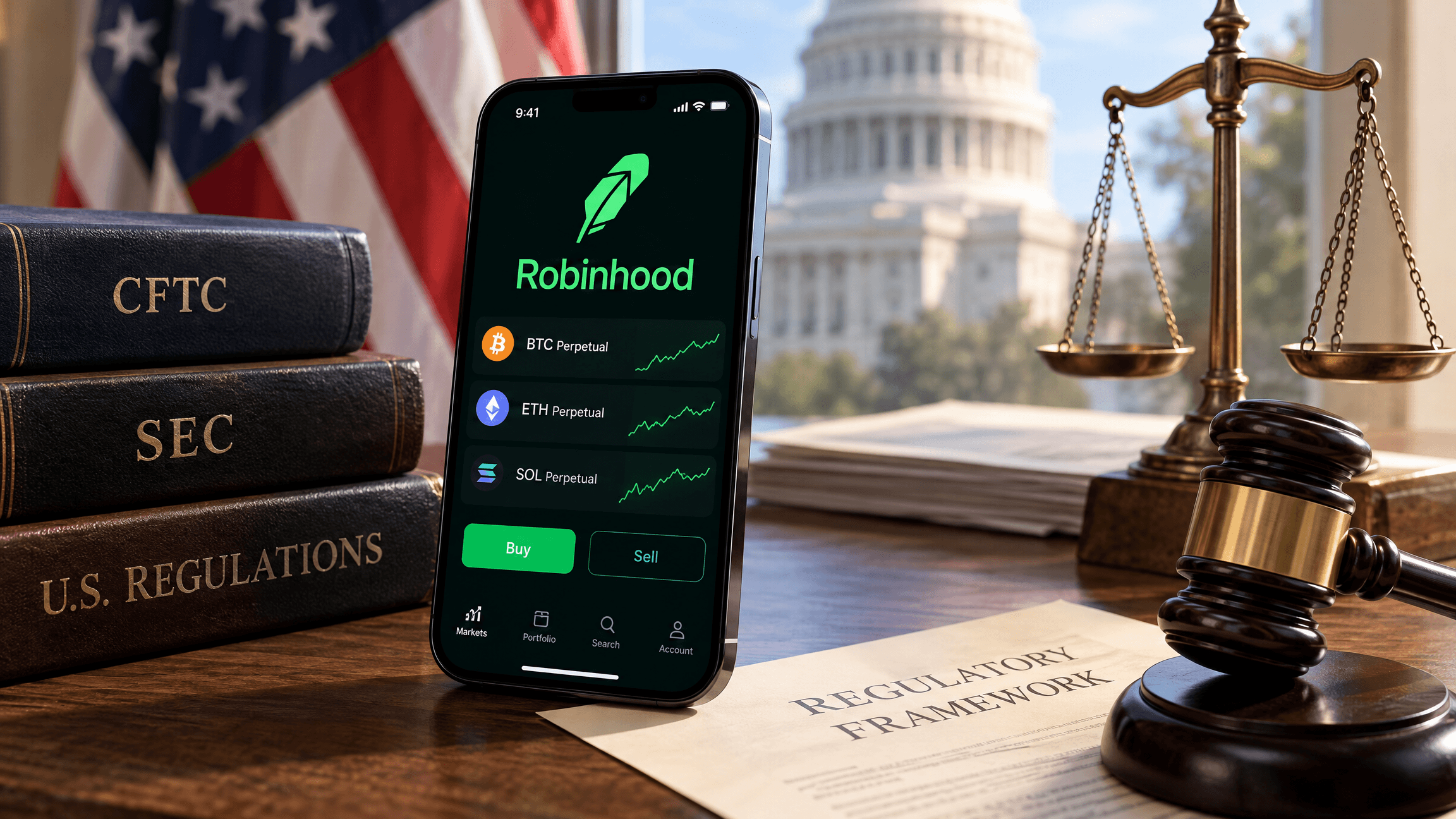
Robinhood says the new U.S. perpetuals are offered by Robinhood Derivatives through Bitstamp.
Robinhood Derivatives LLC is a CFTC-registered Futures Commission Merchant and an NFA member. Robinhood’s broader disclosures identify Robinhood Derivatives as the affiliate handling futures and cleared-swaps trading.
That does not automatically make Robinhood Derivatives the exchange where each perpetual is listed.
An FCM is a regulated intermediary that can handle customer futures business. A Designated Contract Market is the regulated exchange venue. A Derivatives Clearing Organization performs the clearing function. Those are distinct roles.
At the time of this review, Robinhood’s public Summit and support material identified Robinhood Derivatives and Bitstamp but did not clearly identify the underlying U.S. DCM/listing venue or DCO/clearing organization for the new perpetual contracts.
I would therefore not describe Bitstamp itself as “the CFTC exchange” without additional legal documentation.
That distinction matters because Bitstamp already has derivatives infrastructure outside the United States. A U.S. Robinhood contract being offered “through Bitstamp” does not automatically mean an American customer is trading the same legal contract that exists under Robinhood or Bitstamp’s European framework.
Why Bitstamp matters to Robinhood’s derivatives strategy
Robinhood completed its acquisition of Bitstamp in June 2025, bringing in a long-running crypto exchange with institutional customers, global infrastructure, APIs and established order books.
For a deeper look at the exchange itself, see our CryptoLinks Bitstamp review. Readers comparing venues more broadly can also use our Best Crypto Exchanges directory.
Bitstamp is becoming more important inside Robinhood’s overall crypto business rather than remaining a separate acquisition. Robinhood’s August 2026 operating data showed approximately $17.5 billion of total crypto notional volume, including about $7.4 billion in the Robinhood app and $10.1 billion at Bitstamp.
That does not mean Bitstamp generated $10.1 billion of revenue. Notional trading volume and corporate revenue are completely different measurements.
The more interesting question is whether Robinhood can use Bitstamp’s infrastructure to move beyond straightforward spot crypto brokerage and distribute increasingly sophisticated crypto products through the Robinhood app.
The 0.01% perp fee is not the entire cost of trading
Robinhood announced a promotional charge of one basis point per trade, or 0.01%, through the end of 2026.
The arithmetic is simple.
A hypothetical $10,000 notional transaction at 0.01% produces a base charge of:
$10,000 × 0.0001 = $1.
That example should not be read as “a $10,000 perpetual trade costs only $1 in total.”
The economic cost of a perpetual position can also include the bid/ask spread, slippage, funding payments, potential liquidation-related costs and any applicable exchange or regulatory charges. A position also has to be closed eventually, creating another transaction whose notional amount may be different if the market has moved.
Perpetuals also use funding to keep the contract price anchored to the underlying market. When funding is positive, longs generally pay shorts; when it is negative, the direction reverses. Funding therefore becomes an additional carrying cost or payment for positions held across funding intervals.
Readers who want to track venue volumes, exchange activity and market statistics can also use our Crypto Market Data & Exchange Stats directory.

Robinhood versus Coinbase and Hyperliquid
The new product puts Robinhood into a derivatives market already occupied by very different types of competitors.
Coinbase represents regulated U.S. crypto-market infrastructure. Hyperliquid represents a crypto-native, on-chain trading architecture. Robinhood is attempting to compete using a third model: mainstream brokerage distribution across multiple asset classes.
| Feature | Robinhood | Coinbase | Hyperliquid |
|---|---|---|---|
| Core customer model | Multi-asset retail brokerage | Crypto-native regulated consumer platform | On-chain crypto-native venue |
| U.S. perpetual access | Beginning phased rollout | Regulated U.S. derivatives offering | Different regulatory/access architecture |
| Initial Robinhood asset count | 8 | Product specific | Much broader perpetual market list |
| BTC leverage | Up to 10x | Contract/margin dependent | Higher maximums available under protocol margin tiers |
| 24/7 crypto market | Yes, product dependent | Yes, product dependent | Yes |
| Stocks and options in same broader customer ecosystem | Yes | Not equivalent to Robinhood’s brokerage stack | No conventional U.S. brokerage equivalent |
| Fiat integration | Strong | Strong | Crypto-native |
| AI execution layer | Robinhood Agents / Agentic Trading | API and automation ecosystem | API and third-party automation ecosystem |
CryptoLinks covered the U.S. regulatory shift in more depth in our analysis of Coinbase and regulated U.S. crypto perpetual futures.
For the on-chain side, our analysis of perpetual DEX volume and liquidity explains why volume, open interest and raw leverage are not enough to judge a derivatives venue. Spread quality, order-book depth, funding and liquidation mechanics matter too.
HYPE creates an unusual competitive link
Robinhood’s inclusion of HYPE is particularly interesting because HYPE is the native token of Hyperliquid, one of the largest crypto-native perpetual trading ecosystems.
Robinhood is therefore offering a perpetual contract tied to the token of a platform whose identity was built around perpetual futures.
That should not be sensationalized as Robinhood “attacking” or “shorting” Hyperliquid. The more useful question is whether a mainstream regulated brokerage can attract U.S. active traders who value simpler fiat access, familiar brokerage UX and multiple asset classes in one account over the maximum leverage and product breadth offered by crypto-native venues.
The real competitive advantage may be distribution
Robinhood does not need to beat every crypto-native exchange on raw derivatives volume immediately for the launch to matter.
Its biggest advantage may simply be the ability to put a new derivatives product in front of an enormous existing customer base.
Robinhood reported 28.6 million funded customers and approximately $384 billion of Total Platform Assets at the end of August 2026. August equity notional trading volume was about $335 billion, while total crypto notional volume was $17.5 billion and event-contract volume reached 4.7 billion contracts.
Those figures do not predict perpetual-futures adoption. They explain the distribution opportunity.
A crypto-native perpetual venue normally has to acquire derivatives traders. Robinhood can place a new derivative next to products customers may already use: stocks, options, spot crypto, traditional futures and prediction markets.
That “single front end, multiple markets” model is the strategic difference.
AI trading did not begin at Robinhood in September
Robinhood Agents are new as an integrated consumer experience, but agentic trading itself did not start at HOOD Summit.
In May 2026, Robinhood opened Trading MCP infrastructure that allowed customers to connect third-party AI agents to dedicated Robinhood Agentic accounts.
Model Context Protocol, or MCP, is a standard that allows an AI system to interact with external tools and services instead of merely producing text responses.
In trading, that changes the role of the model.
An ordinary chatbot can explain a market. An agent connected to brokerage tools can potentially analyze account information, formulate a strategy and submit an order.
Robinhood’s September announcement is therefore best understood as a distribution and usability shift: moving agent construction and interaction away from a developer-style setup and into Robinhood’s consumer interface.
If you want broader background on automated markets, see our AI in Crypto Trading guide and our directory of crypto trading tools, analytics and automation platforms.

What can Robinhood’s trading agents actually do today?
This is one area where product documentation should be read carefully because Robinhood is transitioning from its earlier MCP architecture toward the new integrated Agents experience.
Robinhood’s Agentic Trading overview says a connected third-party AI agent can access portfolio and account information, analyze market data and automate supported trading strategies. It also documents a process for enabling crypto trading inside the dedicated Agentic account.
A separate current “Trading with your agent” support page explicitly says agents can currently place long-equity and options orders and that support for more assets is being added.
That means the safest description during the rollout is:
Robinhood’s agentic infrastructure already supports real brokerage execution, but exact asset support can differ by product version, account and rollout stage.
There is no current basis for assuming the new Robinhood Agents can already trade perpetual futures merely because the two products appeared at the same Summit.
Dedicated Agentic accounts and trade approvals are the important safety layer
An agent connected to a brokerage account is not simply a research assistant.
Robinhood’s architecture uses a dedicated Agentic account for execution. Current documentation states that a connected agent can have read access to information across the customer’s Robinhood accounts—including positions, balances, transactions and watchlists—but trading authority is restricted to the Agentic account.
That separation matters.
Trade approvals add another control. When approval is required, the user can review the proposed action before the order is submitted. Robinhood also warns that if a customer instructs an agent to act without asking for confirmation, the agent can place permitted trades without approval for each transaction.
Robinhood’s own risk disclosure is unusually important here. It warns that AI agents can:
- misinterpret instructions;
- act on incomplete or outdated information;
- produce incorrect output;
- behave in unexpected ways;
- execute strategies quickly; and
- be difficult to monitor or stop in real time.
That creates two separate risk categories.
Market risk means the agent executes the strategy correctly but the market moves against it.
Agent or model risk means the software misunderstands what the user wanted, uses bad information, calculates an incorrect quantity or repeats an action incorrectly.
Those are not the same failure mode.
Agent Apps could make data as important as the AI model
Robinhood also announced Agent Apps from 11 third-party providers, aiming to connect agents to specialized datasets and analytical tools.
The announced ecosystem includes names such as Nasdaq, Unusual Whales, SpotGamma, Quiver Quantitative, Token Terminal, Visual Crossing, SkyFi and other providers.
The strategic point is larger than the individual vendors.
Robinhood is trying to connect:
specialized data → AI analysis → brokerage execution.
That is closer to the workflow of an institutional research and trading stack than a traditional retail chatbot.
Loops could eventually add another layer by letting an agent run a strategy on a recurring schedule or repeatedly check for a condition. But demonstrations and roadmap descriptions should not be treated as proof that every customer can already run an autonomous strategy indefinitely.

Robinhood stocks are 24/5 today, not 24/7
The weekend-stock announcement is the easiest part of the Summit to overstate.
Robinhood already operates a 24 Hour Market, but “24 Hour” does not currently mean seven days per week.
Eligible securities can trade from approximately Sunday at 8 p.m. ET through Friday at 8 p.m. ET.
That is effectively 24/5.
| Session | Current Robinhood access | Planned selected-equity access |
|---|---|---|
| Monday–Friday regular session | Live | Live |
| Weekday premarket | Live | Live |
| Weekday after-hours | Live | Live |
| Weekday overnight | Live for eligible securities | Live |
| Friday night | Current cutoff applies | Planned expansion |
| Saturday | Closed | Planned |
| Sunday daytime | Closed | Planned |
| Sunday after 8 p.m. ET | Live | Live |
Robinhood says it intends to extend selected U.S. stocks and ETFs into weekend sessions in partnership with Bruce ATS. Reuters reports the expansion remains subject to regulatory review.
So the correct description is:
Robinhood plans to move selected equities from 24/5 toward 24/7.
It is not accurate to say Robinhood stocks already trade seven days a week.
Bruce ATS does not mean Nasdaq or NYSE is open on Saturday
This distinction is more than semantics.
An Alternative Trading System is a regulated trading venue, but it is not necessarily the primary exchange on which a security is listed.
A Tesla trade occurring on Bruce ATS on Saturday would not mean Nasdaq itself had opened a normal Saturday session.
That creates a price-discovery problem.
During regular U.S. trading hours, prices are formed through a much broader ecosystem that includes primary exchanges, multiple market makers, institutional order flow, options markets, ETFs, futures and arbitrage relationships.
On Saturday, many of those connected markets may be closed or significantly thinner.
The result could be:
wider spreads, shallower books, greater price gaps, fewer hedging routes and larger differences between a weekend print and the price eventually established when the deeper Monday market returns.
More trading hours do not automatically mean more liquidity
Consider a company that releases market-moving news on Saturday afternoon.
A weekend trading venue could let Robinhood customers react immediately instead of waiting until Sunday night or Monday.
That sounds like better price discovery, and sometimes it may be.
But another possibility is that the weekend price is based on a relatively small number of trades in a thin market. When options, institutional desks and the primary exchanges reopen, the security could rapidly reprice.
That is why I would judge the success of weekend equities using market-quality data rather than the headline “24/7.”
| Metric to measure | Regular session | Weekday overnight | Saturday after launch |
|---|---|---|---|
| Median spread | Baseline | Measure | Measure |
| Order-book depth within ±1% | Baseline | Measure | Measure |
| Trade count | Baseline | Measure | Measure |
| Median trade size | Baseline | Measure | Measure |
| Realized volatility | Baseline | Measure | Measure |
| Gap to next regular open | N/A | Measure | Measure |
A seven-day market with tiny order books would still improve access, but it would not necessarily become the main venue for price discovery.

Weekend U.S. stocks are not Robinhood stock tokens
Robinhood is separately building tokenized-asset infrastructure internationally and developing Robinhood Chain.
Those products should not be merged with the U.S. weekend-equity announcement.
The planned weekend stock service concerns native U.S. securities traded through brokerage and ATS infrastructure. It is not a plan to give U.S. customers synthetic stock tokens instead of ordinary securities.
For more on the blockchain side of Robinhood’s strategy, see our recent analysis of Robinhood Chain, Arbitrum and its emerging revenue model.
What happens when AI agents meet always-on markets?
This is where the three Summit announcements stop looking separate.
Today, the pieces are not fully joined. Weekend stock trading is not live. Agent execution of perpetual futures has not been confirmed. Loops are still part of a developing product roadmap.
But the direction is clear.
If an agent can monitor a market continuously and the underlying market can also execute continuously, the human sleep cycle becomes less relevant to the trading system.
That can be useful. An agent can monitor information or conditions when the account owner is not actively watching a screen.
It also creates a new type of market-structure risk.
Imagine thousands of agents using similar models, similar prompts, the same third-party datasets and the same technical indicators. A shared piece of news arrives. Many agents independently reach a similar conclusion at nearly the same moment.
That could create crowded order flow, synchronized exits, correlated stop execution or short-lived feedback loops—particularly during thinner overnight or weekend markets.
There is no evidence that Robinhood Agents have already caused this. It is a risk worth measuring as automated retail execution scales.
AI plus leverage changes the loss profile
Agent risk becomes even more important if automation eventually reaches leveraged products.
An incorrect order in an unleveraged cash position can lose money.
An incorrect order in a leveraged perpetual can lose money much faster because leverage magnifies the economic effect of a price movement and brings liquidation closer.
That does not mean automated leveraged trading is inherently unworkable. Professional markets have used algorithmic execution for decades.
The difference is distribution.
Robinhood is trying to move tools previously associated with specialist trading desks into the same consumer app used by ordinary retail customers.
That makes permission controls, risk limits, audit trails, stale-data protection and reliable kill switches essential product features rather than technical details.

Why HOOD investors care about the active-trader push
Robinhood already has the scale needed to test this model with a large customer base.
Its August 2026 operating report showed:
28.6 million funded customers, approximately $384 billion in Total Platform Assets, $335 billion in monthly equity notional, $17.5 billion in total crypto notional and 4.7 billion event contracts traded.
Bitstamp alone accounted for roughly $10.1 billion of that August crypto volume.
Those numbers explain why adding perpetuals inside Robinhood can matter even before the product approaches the scale of a crypto-native derivatives venue.
The possible business effects are also broader than a simple trading commission.
| Product | Potential business mechanism |
|---|---|
| Crypto perpetuals | Trading fees, venue economics and higher active-trader engagement |
| Robinhood Agents | Model usage, premium functionality and higher product engagement |
| Agent Apps | Subscription or partnership economics |
| Weekend equities | Incremental order flow and additional trading sessions |
| Prediction markets | Separate contract-related economics |
| Robinhood Gold | Existing subscription revenue |
More trading volume does not automatically mean more profit. Exchange fees, clearing costs, liquidity incentives, AI-compute costs, compliance and customer-support expenses all matter.
HOOD shares also moved higher in September 30 trading following the Summit announcements, but a one-day stock move should not be treated as proof that investors approved every element of Robinhood’s strategy. Broader equity-market conditions were also moving at the same time.
What would a successful perpetual rollout look like?
I would not judge the product by the price of Bitcoin or by HOOD stock.
The important measurements over the next 30 and 90 days are customer access, actual perpetual volume, open interest, bid/ask spreads, depth, liquidation rates, repeat usage, uptime and eventually revenue contribution.
For Agents, the better metrics are active Agentic accounts, assets held inside them, recurring usage, error and cancellation rates, customer retention and—if Robinhood eventually discloses it—the percentage of execution that occurs with approvals disabled.
For weekend equities, the key measurements are supported securities, Saturday/Sunday volume, spreads, depth, institutional participation and the size of the gap between weekend prices and the next full regular session.
Three ways Robinhood’s always-on strategy could develop
Scenario 1: Robinhood becomes a meaningful active-trader derivatives platform
In this path, the perpetual rollout reaches a broad eligible base, spreads and depth become competitive, Bitstamp provides useful infrastructure, Agents attract meaningful usage and weekend equity trading clears regulatory review. Robinhood increasingly looks like a genuine multi-asset trading platform rather than a stock broker that happens to offer crypto.
Scenario 2: Robinhood wins convenience but liquidity stays elsewhere
The products work, but the deepest crypto derivatives activity remains concentrated on crypto-native venues. Weekend equities technically trade but remain relatively shallow, while most customers use Agents primarily for analysis rather than fully autonomous execution.
Robinhood still succeeds at simplifying access, but it does not become the primary market for price discovery.
Scenario 3: regulation and risk slow the convergence
Perpetual eligibility remains narrow, leverage requirements change, weekend-equity approval takes longer than expected or agentic trading receives tighter controls after operational incidents elsewhere in the industry.
The “always-on” vision still advances, but the individual products remain separated by regulation and market structure.
These are scenarios, not predictions.
My conclusion: Robinhood is building a trading operating system
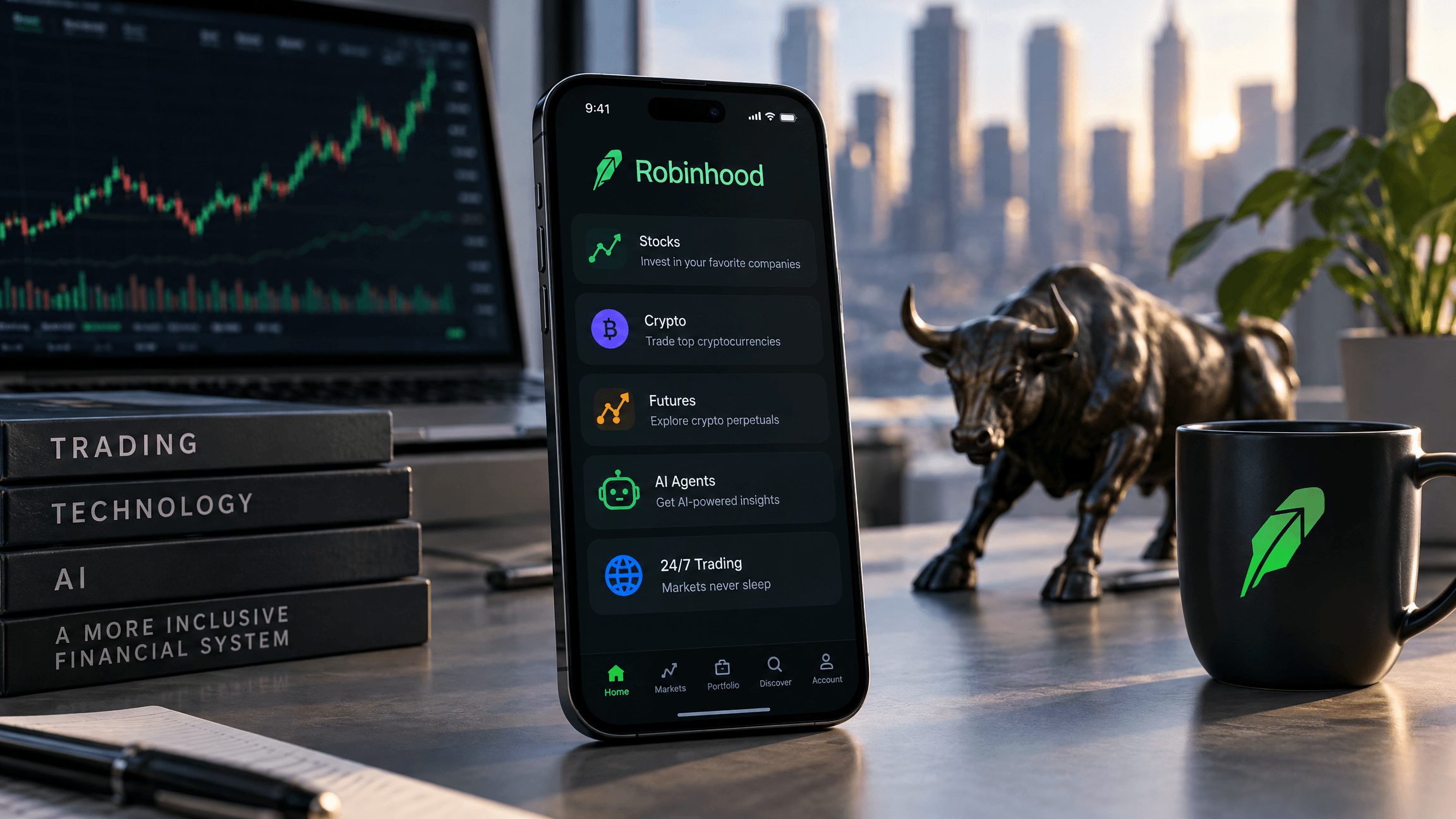
The most important point from HOOD Summit is not that Robinhood added another crypto contract.
It is that Robinhood increasingly looks less like one exchange and more like an orchestration layer across multiple financial markets.
The customer sees one Robinhood interface.
Behind that interface sit different legal entities and venues: Robinhood Financial, Robinhood Securities, Robinhood Crypto, Robinhood Derivatives, Bitstamp, Bruce ATS and other market infrastructure.
That architecture lets Robinhood pursue a strategy built around:
one customer identity + multiple regulated entities + multiple execution venues.
Crypto perpetuals attack the expiration constraint and bring continuous leveraged exposure. Weekend equities aim to remove the remaining Saturday/Sunday closure from selected stock markets. Robinhood Agents reduce the need for the customer to personally research, monitor and submit every permitted trade.
Together, Robinhood is attacking time, leverage and human attention.
The ambitious version of the strategy is an app where stocks, options, crypto, derivatives and prediction markets increasingly remain accessible around the clock while software agents keep monitoring conditions even when the customer is asleep.
The harder question is whether market plumbing can keep up with that vision.
Continuous access is not the same as continuous liquidity. AI execution is not the same as correct execution. Ten-times leverage is not the same as ten-times return. An ATS being open on Saturday is not the same as the primary U.S. equity market operating normally.
That is why I would watch the next set of data rather than the marketing labels: which perpetuals become broadly available, where the contracts are actually listed and cleared, how good their spreads become, how customers use agent permissions, whether Loops reach production, and whether weekend equity books develop enough depth to become meaningful rather than merely technically open.
If those pieces come together, Robinhood will have built something materially different from the extended-hours brokerage it was only a few years ago.
It will have built an always-on retail trading operating system.
Frequently asked questions
Did Robinhood launch crypto perpetual futures in the U.S.?
Robinhood has begun a phased rollout of U.S. crypto perpetual futures. The company says access may become available to eligible customers over time, so it should not yet be described as universally available to every eligible U.S. account.
Which cryptocurrencies have Robinhood perpetual futures?
The announced initial U.S. lineup is BTC, ETH, SOL, XRP, DOGE, ADA, LINK and HYPE.
How much leverage does Robinhood allow on crypto perps?
Robinhood announced up to 10x leverage on BTC and ETH perpetuals and up to 3x initially on SOL, XRP, DOGE, ADA, LINK and HYPE.
Does Robinhood offer 10x leverage on SOL?
Not under the announced U.S. launch structure. SOL is initially capped at up to 3x for the U.S. product. European Robinhood perpetual specifications should not be applied to U.S. customers.
What is a crypto perpetual future?
A perpetual future is a derivative contract that provides long or short exposure to an underlying asset without a fixed expiration date. The trader does not necessarily own the underlying cryptocurrency.
Can losses on leveraged perpetual futures exceed the initial margin?
Leveraged futures involve substantial risk, and Robinhood’s derivatives disclosures warn that losses can exceed the amount initially invested depending on the product and market conditions.
How much does a Robinhood perpetual trade cost?
Robinhood announced a promotional charge of one basis point, or 0.01%, per trade through the end of 2026. A $10,000 hypothetical transaction at 0.01% equals $1, but total economic cost can also include spread, slippage, funding and other applicable costs.
Does Robinhood own Bitstamp?
Yes. Robinhood completed its acquisition of Bitstamp in June 2025.
What role does Bitstamp play in Robinhood’s U.S. perpetual futures?
Robinhood says the products are offered by Robinhood Derivatives through Bitstamp. The public launch material reviewed for this article does not fully identify Bitstamp’s operational role or name the underlying U.S. DCM and DCO.
Are Robinhood crypto perpetual futures available 24/7?
Perpetual crypto markets are designed for continuous trading, subject to product availability, maintenance and the specific contract rules. Account access remains subject to Robinhood’s phased rollout.
What are Robinhood Agents?
Robinhood Agents are AI-powered tools designed to research markets, analyze account information, develop strategies and, where supported and authorized, interact with brokerage execution tools.
Can Robinhood AI trade automatically?
Robinhood’s Agentic Trading architecture can execute supported orders through a dedicated Agentic account, and users can configure workflows where a permitted order does not require approval for every transaction. Exact asset support depends on the current product and account rollout.
Can Robinhood Agents trade crypto perpetual futures?
Robinhood has not publicly confirmed general Agent execution support for its new U.S. crypto perpetuals. Until that changes, AI plus perpetuals should be treated as strategic convergence rather than a live combined product.
Does Robinhood currently offer 24/7 stock trading?
No. Its existing 24 Hour Market runs approximately from Sunday at 8 p.m. ET through Friday at 8 p.m. ET, making it effectively a 24/5 service. Weekend trading for selected stocks and ETFs is planned and remains subject to regulatory review.
Sources and methodology
Research cutoff: September 30, 2026. Product availability, market data, account eligibility and rollout status may change after publication.
- Robinhood — Robinhood Puts the Power of Hedge Funds in Every Trader’s Pocket
- Robinhood — HOOD Summit 2026 product announcements
- Robinhood — Open a perpetual position
- Robinhood — Agentic Trading overview
- Robinhood — Trading with your agent
- Robinhood — 24 Hour Market
- Robinhood Investor Relations — August 2026 operating data
- Reuters — Robinhood weekend trading and Bruce ATS
This article is for informational and educational purposes only and does not constitute investment, trading, legal or financial advice. Leveraged derivatives can magnify losses and may not be appropriate for all investors.