Perpetual DEX Volumes Jumped 11%: Why It Happened, and What It Means for DeFi Liquidity
When markets get messy, where does leveraged money run first: centralized futures… or onchain perpetuals? And if perpetual DEX volume can jump 11%+ in just 48 hours (with Hyperliquid printing roughly +11.85% on the headline surge), are we looking at real liquidity showing up—or just a fast, fragile churn that breaks the moment it’s tested?
I want to put this spike into plain English. Not “number-go-up” hype—actual mechanics and what it means if you trade perps, provide liquidity, build DeFi products, or just want to know where the risk is flowing right now.
Listen to this article:
The promise: by the time you’re done with this section, you’ll understand why perpetuals keep turning into DeFi’s default battleground during volatility—and which signals matter before you trust any “volume” chart.

The pain: DeFi liquidity gets fragile exactly when traders need it most
DeFi liquidity has a nasty habit: it can look perfectly fine… right up until the moment it isn’t.
In calm markets, the UI shows tight spreads, slippage calculators look reasonable, and depth charts make everything feel “deep.” Then volatility hits, and suddenly:
- Spreads widen because market makers back off or reprice risk.
- Slippage spikes because the “real” depth isn’t where you thought it was.
- Liquidations cluster because many traders use the same obvious leverage levels.
- Order books and AMM curves get stress-tested in minutes, not hours.
This is not just a DeFi thing. Traditional markets have studied liquidity under stress for decades. A classic example is the idea that liquidity is state-dependent—it disappears when volatility and uncertainty rise. One widely-cited reference is “Liquidity and Volatility” by Chordia, Roll, and Subrahmanyam, which shows how liquidity conditions and volatility are tightly linked in real trading venues. Crypto just compresses the timeline and adds leverage on top.
Now add perpetuals to the mix and you get a multiplier effect.
Perps amplify liquidity stress because they combine:
- High leverage (small price moves become huge PnL shifts)
- Instant margin pressure (positions can flip from “fine” to “liquidated” quickly)
- Liquidation engines (forced buying/selling at the worst possible time)
- Fast-moving collateral flows (stablecoins and majors get yanked around as traders top up or get wiped)
That’s why a volume spike during a choppy 48-hour window can be a good sign or a danger sign—depending on what’s driving it.
And it also explains why traders keep choosing perps as the “default battlefield” in chaos. People hate the old expiration headaches of dated futures. Nobody wants to roll contracts at the worst time, manage calendar spreads, or get forced out just because time passed. Perps solve that part.
But they replace it with new costs and new failure modes—ones that show up most clearly when the market is moving fast.
So here’s the core question I’m framing this whole discussion around:
Is this 48-hour volume spike a healthy sign of real liquidity… or a short-lived rush that increases systemic risk?
Promise: what I’m going to map out for you
I’m going to walk through the most likely triggers behind this 11%+ jump, what it signals for DeFi liquidity in February 2026, and how I judge perpetual platforms (pure DEX and hybrid models) when the tape gets aggressive.
Not in a theoretical way—more like a checklist mindset:
- What kind of volume is this (organic trading vs forced liquidations)?
- Is liquidity actually improving, or is it just “busy”?
- Where do funding rates and liquidation behavior fit into the story?
I’ll also answer the stuff people keep searching because it’s the part that quietly drains accounts:
- fees that don’t look big until you trade size
- funding rates that turn into a nightly rent payment
- liquidations that feel “random” until you know what to track
- safety and platform risk when everyone rushes to the same venue
What this article will answer (the “People Also Ask” stuff)
When perp volume suddenly rips higher, I see the same questions pop up across search and social. I’m going to answer them directly, including the practical versions traders message me about:
- Why do perp volumes explode during volatility?
- Does higher volume mean deeper liquidity or just more churn?
- What’s the difference between perp DEX liquidity and CEX liquidity?
- How does funding rate pressure change liquidity?
- Is Hyperliquid’s growth sustainable, and what’s the risk model?
- What metrics should I track daily to avoid getting chopped up?
If you’ve ever thought, “Volume is up, so it must be safer to trade,” I’m going to challenge that assumption—with simple ways to sanity-check what you’re seeing.
Quick context: what “perpetuals” really changed (no expiry, but new costs)
Perpetuals (perps) are basically futures without a fixed expiration date. That’s the feature everyone loves: you can stay in a position as long as your margin holds, without dealing with contract expiry and rolling.
That “no expiry” design is exactly why perps attract two very different crowds at the same time:
- Hedgers who want quick, flexible protection (miners, LPs, long-only spot holders hedging downside)
- Speculators who want maximum exposure with minimum upfront capital
But the tradeoff is important, and it’s where most of the real cost lives:
- Funding rates: the mechanism that keeps perp price anchored near spot. It’s also a constant pressure on crowded trades.
- Liquidation systems: when leverage meets fast moves, liquidations become a major source of “volume” and sometimes chaos.
- Real-time margin: your position isn’t just about direction—it’s about surviving volatility.
Think of it like this: perps removed the “calendar problem,” but added a market structure problem. The cost isn’t an expiry date—it’s what you pay (and risk) to keep leverage on during turbulence.
And that brings us right back to today’s question. An 11%+ volume surge in 48 hours looks exciting, but the real story is what kind of flow created it—and whether it made DeFi liquidity stronger or just louder.
So what actually triggered this jump across perpetual DEXs in the last 48 hours… and why does February 2026 make it the perfect setup for these spikes?

Why perpetual trading volumes spiked 11% in 48 hours (and why February 2026 is the perfect setup for it)
When I see perpetual DEX volume jump 11%+ in just 48 hours (with Hyperliquid flashing around 11.85% on the headline numbers), I don’t treat it as “traders suddenly got bullish.”
I treat it like a crime scene: volume is the footprint, not the motive.
In February 2026, the setup is almost too perfect for a fast perp-volume burst: macro jitters, fast rotating narratives, and a market that’s reactive instead of confident. In that environment, perps become the easiest “instant expression” tool onchain: hedge fast, flip fast, or get forced out fast.
Here are the main drivers that can stack together and create a clean-looking +11% print that’s actually a mix of real demand and reflexive mechanics.
1) Volatility + direction uncertainty = shorter holding time and more hedging
Perp volume often spikes when traders stop believing in clean trends.
If you think price will trend for weeks, you don’t need to click in and out all day. But if you think price is going to whip around (and you’re not sure which way the next leg goes), you start doing the “tactical” stuff:
- Short-term hedges (especially for spot bags, LP positions, and alt exposure)
- Reduce duration (more entries/exits, more stop-outs, more re-entries)
- Trade the range instead of marrying a direction
That behavior alone can inflate volume fast because one trader can generate 5–20 “prints” in a day without increasing long-term risk exposure much.
There’s also a real market microstructure reason this happens. A lot of research across tradfi and crypto points the same way: in higher volatility regimes, holding periods compress and turnover rises. In equities, studies on volatility and trading activity repeatedly show a strong relationship between uncertainty and volume (classic work in this area includes models like Mixture of Distributions Hypothesis and sequential information arrival; the practical takeaway is simple: uncertainty creates churn).
So yes—some of this +11% is organic. It’s the market switching into “shorter breath” mode.
2) Liquidation cascades: forced volume that makes spikes look “healthy” (until it isn’t)
This is the one most people underestimate.
In perps, liquidation is not just a trader getting punished—it’s also a market order being slammed into the book (or into the venue’s liquidation mechanism). That’s volume. It counts. It prints.
Here’s how the reflex loop works in real life:
- Price jolts → weak positions get margin-called/liquidated
- Liquidations create aggressive market flow → pushes price further
- That move tags the next leverage cluster → more liquidations
- Volume explodes, even if “real” discretionary trading didn’t change much
In other words, you can get a huge volume candle that’s basically the market eating its own leverage.
And the scary part: liquidation-driven volume can feel like “liquidity is amazing!” right up until the moment spreads widen and you realize it was just forced flow moving through a few levels.
3) Basis/funding opportunities: arbitrageurs rotate capital to wherever the funding is juiciest
When perp volumes jump across venues, I always check if it’s partly a funding trade season.
Because funding isn’t just a cost. It’s also a yield stream—if you can hedge it correctly.
Two common plays that expand volume fast:
- Cash-and-carry: long spot (or spot proxy) + short perp to collect positive funding (or to lock basis)
- Cross-venue funding arb: long perp where funding is cheap, short perp where funding is rich (neutral-ish delta, profit from differential)
These strategies are bot-friendly, capital-efficient, and they scale. When funding spreads widen for even a day or two, the smart money rotates quickly—and perps are where they rotate first because execution is fast and hedging is clean.
This is one reason a +11% spike can happen without any new “belief” entering the market. It’s not conviction; it’s capital efficiency.
4) CEX trust / latency / friction moments: traders temporarily shift onchain
Every time centralized venues have a “moment”—risk-off sentiment, random restrictions, KYC friction, API instability, withdrawal delays, or simple fear—onchain perps get a short-term tailwind.
Sometimes it’s dramatic. Sometimes it’s subtle. But the pattern is consistent: if traders think access might get messy, they shift the active book to wherever they feel execution is most reliable for them.
And “reliable” doesn’t always mean the best matching engine in the world. It can mean:
- They can trade without permission
- They can self-custody collateral
- They can move funds in/out without waiting on anyone
Those are psychological advantages, but they show up as volume.
5) Airdrop/points/meta incentives: “incentive volume” vs organic volume
I’m not anti-incentives. They bootstrap liquidity. They attract market makers. They help a venue get to critical mass.
But incentives also create a special kind of volume that looks bullish on a chart and confusing in real life: points farming churn.
It usually has fingerprints:
- High volume, but oddly flat open interest (in-and-out loops)
- Lots of activity at specific times (campaign windows, multipliers, leaderboard resets)
- Volume concentrated in a few pairs with the best reward-to-fee math
So if part of this 48-hour jump was driven by incentives, I don’t automatically dismiss it—but I label it correctly. Incentive volume is not fake, it’s just strategic. And it fades fast if execution, risk, and trust don’t keep users around once the points aren’t “free money.”
The real trick is figuring out what percent of the +11% was:
- Hedging demand
- Arbitrage rotation
- Liquidation mechanics
- Incentive churn
That mix matters more than the headline number.
Hyperliquid and the “perp DEX flywheel”: why traders pile in during chaos
When a single venue starts grabbing attention during chaotic days, it’s almost never random. Perp traders are pack animals. They go where:
- Execution feels tight (or at least predictable)
- UX is fast (fast routing, clear margin readouts, clean order controls)
- Risk controls feel fair (liquidations that don’t feel like a coin flip)
- There’s social proof: “the other killers are trading here”
That’s the flywheel: more traders → more liquidity → better execution → more traders. And once it starts spinning during a volatility window, the volume can accelerate in a way that looks like pure growth.
But here’s the translation of “Hyperliquid +11.85%” into what I actually care about:
Did liquidity deepen… or did churn rise?
Because those two things can look identical on a volume chart.
When I’m watching a venue grab share quickly, I’m looking for a few tells:
- Volume composition: is it concentrated in one pair, or spread across majors/alts?
- Open interest behavior: is OI expanding with volume or staying oddly muted?
- Funding stability: does funding reflect real positioning, or does it swing wildly with tiny moves?
- Uptime + execution quality during the spikiest minutes
- Liquidation “cleanliness”: do we get nasty wicks and chaos prints, or orderly unwinds?
If those look good, a volume surge is often a sign of a venue becoming a default battlefield. If they look bad, a volume surge can be a warning flare: the platform is attracting flow, but the flow is stress-testing it hard.
The DeFi liquidity angle: does higher perp volume help the ecosystem or drain it?
This part is tricky because both can be true at the same time.
How perp platforms can attract liquidity:
- Market makers deploy capital where they can earn: spreads, rebates, incentives, and clean fills
- Arbitrageurs keep prices aligned across venues, which can improve efficiency across DeFi
- Traders keep stablecoins and collateral onchain because there’s finally something “worth doing” with it
When this happens, perps act like a magnet. Capital doesn’t just churn—it sets up shop.
How perp platforms can consume liquidity:
- Violent liquidation windows can pull stablecoins and collateral into margin, away from lending/LPs
- Risk spikes make LPs and lenders defensive (higher borrow rates, less aggressive quoting)
- Big hedging demand can create sudden collateral shortages in the rest of DeFi
The optimistic thesis is that perps keep capital “working” onchain when spot trading is sleepy. The skeptical thesis is that perp volume is sometimes a liquidity mirage: lots of activity, but not the kind that makes DeFi healthier.
And the only way to tell which story we’re in is to watch the mechanics under the hood.
The mechanics most readers miss: funding rates, open interest, and liquidation quality
I’ll keep this practical, because these three metrics explain why the 48-hour spike happened—and whether it’s sustainable.
Funding rates tell me:
- Is the market crowded one way? (one-sided positioning)
- Is leverage getting expensive to hold?
- Is the current volume driven by panic hedging (temporary) or trend chasing (can persist)?
Open interest vs volume tells me whether the spike is “new risk” or “hot potato.”
- If volume spikes and OI rises, new positions are being built (more commitment)
- If volume spikes and OI is flat/down, it’s mostly churn, liquidations, or fast in-and-out trading
Liquidation quality is the silent killer metric. Two venues can show the same volume, but one will leave traders feeling “that was fair,” and the other will leave them feeling “this thing hunts stops.”
Clean liquidations matter because they protect:
- Liquidity providers (less toxic flow, fewer sudden gaps)
- Traders (less slippage shock during forced events)
- The venue itself (less chance of a confidence spiral)
If liquidation handling is sloppy, volume spikes become a stress fracture, not a success story.
What this means for perpetual trading platforms (DEXs, hybrids, and new entrants)
If you build or operate a perp venue, this 48-hour burst is the market telling you something blunt:
Liquidity is a product feature now. Not a “nice to have.” Not “we’ll get market makers later.” During chaos, users experience your platform as:
- How fast they can adjust margin
- How predictable their fills are
- How funding behaves under pressure
- How painful liquidation is when the tape gets violent
Risk controls are also marketing, whether teams like it or not. Traders remember exactly what happened in the worst 5 minutes of the week.
Incentives can bootstrap volume, but retention comes from trust plus execution. And the moment a venue experiments with cross-margin, portfolio margin, or more collateral types, they’re trading “better UX” for “bigger systemic blast radius.” That’s not bad. It just needs serious engineering and transparency.
How I’d “stress-test” a perp venue as a user before I trust it with size
If you’re reading this as a trader, here’s how I personally test a perp venue before I scale up. I’m not trying to be clever—I’m trying to avoid platform risk pretending to be “skill issue.”
- Uptime during spikes: did it lag, freeze, or reject orders when it mattered?
- Execution quality: do limit orders behave like you expect, and do market orders slip more than peers?
- Slippage by size: test small, medium, and “uncomfortable” size and note the curve
- Funding stability: does it stay sensible or get weird and jumpy?
- Insurance fund / backstop design: is there a real plan for bankrupt accounts and extreme moves?
- Oracle design: what feeds it, how often updates happen, and how it handles outliers
- Transparency: can you verify key stats (OI, funding, liquidations), or are you trusting vibes?
Do this once and you’ll immediately feel the difference between “popular” and “robust.”
Resources I used / posts worth checking (quick mentions)
If you want to see some of the chatter and data points that helped shape my read on this spike, here are the posts I checked while researching:
- https://x.com/X_Four_iv/status/2020437448107667817
- https://x.com/Lumen0x/status/2019935938068025426
- https://x.com/scalpingod53730/status/2020171550717276406
- https://x.com/whiteXflameX/status/2020415808229298481
- https://x.com/PerpetualCow/status/2020577480638415130
- https://x.com/NikolaosDarmls/status/2020524563302396288
- https://x.com/NikolaosDarmls/status/2020187695100969402
- https://x.com/Crypto_LedgerX/status/2020423174945403034
- https://x.com/the_tax_intern/status/2020423037166956663
- https://x.com/CreatinuzZ/status/2020423708788326796
One question to keep in your head: if volume can jump 11% in 48 hours, what tells you whether it’s real depth showing up… or just leverage getting recycled faster?
Because the answer isn’t “more volume = safer.”
Next, I’m going to show you the exact signals I track over the following weeks—so you can tell whether this was a one-off frenzy, or the start of a repeatable onchain liquidity shift. And I’ll be specific: which charts to watch together, and what “good” vs “danger” looks like when the market heats up again.
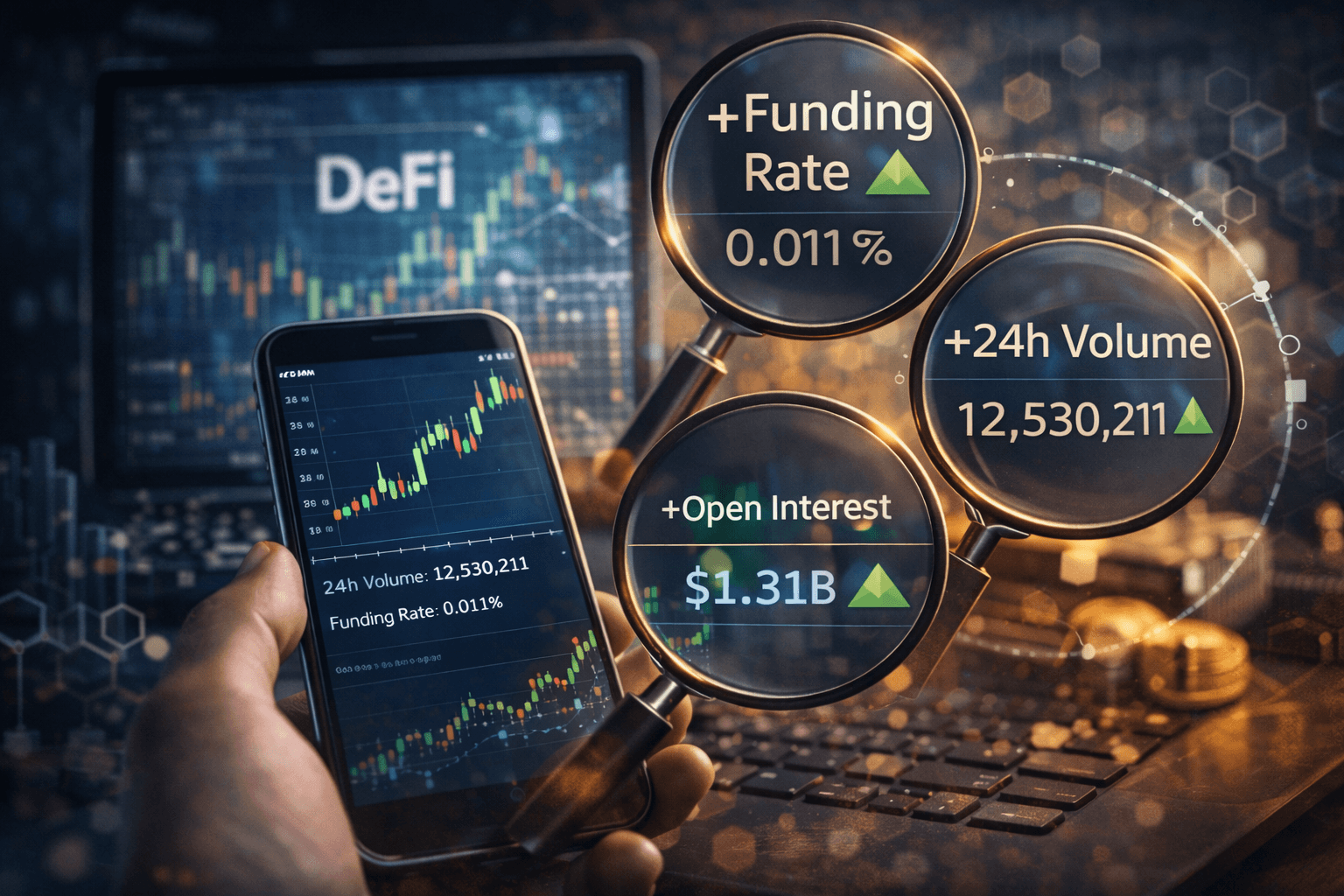
What to watch next (the signals that tell you if this volume spike is real, repeatable, and good for DeFi liquidity)
An 11% volume jump in 48 hours is loud… but it’s not automatically “healthy.” I treat it like a fire alarm: it tells you something changed fast, but you still have to walk the building and see what’s actually burning.
Here’s the exact watchlist I’m keeping for the next 2–4 weeks (February 2026), and how I interpret each signal when I’m deciding whether perp liquidity is deepening or just getting noisier.
- Does open interest (OI) rise with volume… or does it fade fast?Volume can spike from churn (bots, liquidations, in-and-out scalps). OI tells you whether traders are actually staying in positions.What I want to see: volume up + OI up (or at least holding steady). That usually means the venue is becoming a real home for risk, not just a drive-through.Red flag: volume up + OI down. That often screams “forced exits” or “hot potato trading.” During stressed markets, that’s when liquidity can look fine… right until it isn’t.Real-world sample: In past volatility events across crypto derivatives, it’s common to see volume explode while OI whips around as liquidations hit. That’s why I track the relationship, not the raw numbers. (If you want the academic angle: derivatives research has long shown that volume spikes frequently cluster around volatility and forced repositioning, which can inflate prints without improving market depth.)
- Do funding rates normalize or stay extreme?Funding is the quickest “crowding meter” you’ll ever get. When funding stays extreme, it’s the market telling you positioning is one-sided—and one-sided markets are where liquidation cascades love to start families.What I want to see: after a spike, funding calms down toward neutral as the market finds balance.Red flag: funding stays elevated for days, especially if price goes sideways. That’s where traders get bled out slowly, and then one move triggers a nasty unwind.Practical example: If you’re long and paying funding every 8 hours (or whatever interval the venue uses), your “trade idea” can be right and you still lose. I’ve watched too many solid directional calls die from death-by-funding during choppy weeks.
- Do spreads/slippage improve (real liquidity) or worsen (stress liquidity)?I care less about the headline volume number and more about what it costs to actually execute when things get spicy.What I want to see: tighter spreads and predictable slippage at common sizes during the busy periods—not only when everything is calm.Red flag: the UI looks fine for small orders, but medium-size market orders suddenly move price hard, or limit orders don’t fill unless you chase. That’s often the moment you realize the “liquidity” was just a thin layer of quotes.Quick test I run: I’ll simulate two order sizes (one small, one “adult sized”) and compare expected vs realized execution. If the larger one gets punished way more than it should, I stop trusting the depth.
- Are liquidations orderly, or are there nasty wicks and cascading events?Liquidations are not just trader pain—they’re the platform’s real stress test. Orderly liquidations usually mean the venue’s risk engine, backstop, and pricing are doing their job.What I want to see: liquidations happen, but price doesn’t print absurd wicks that immediately snap back. Losses look “normal-bad,” not “something broke.”Red flag: sudden wick-downs/up that take out clustered leverage levels, then instantly revert. That can happen from thin books, oracle issues, or liquidation throttles that don’t match market speed.
Rule of thumb: If you see repeated wick-and-revert liquidation events on a venue, assume the next one will be worse, not better.
- Stablecoin flows: is leverage pulling collateral into perps or pushing it out?This is the “DeFi liquidity health” tell. If collateral is flowing into perp ecosystems and staying there, that can support deeper markets and better execution over time.What I want to see: steady net inflows to margin/collateral vaults, and no panic withdrawals after volatile sessions.Red flag: big inflows followed by rapid outflows (especially after a liquidation-heavy day). That often means traders are treating the venue like a temporary casino, not infrastructure.
If you only track one “combo signal,” make it this:
Healthy: volume up + OI steady/up + funding calming down + execution stable.
Unhealthy: volume up + OI down + funding extreme + slippage widening.
Practical playbook for traders: how to use this info without getting wrecked
I’m going to be blunt: most perp losses in high-volatility weeks aren’t caused by being “wrong.” They’re caused by sizing too big, ignoring funding, and getting clipped by obvious liquidation levels.
- Cut your size before you cut your standardsWhen vol spikes, I reduce leverage first. Not because I’m scared—because the distribution of outcomes changes. A move that used to be “noise” becomes a liquidation event.Simple guideline I actually follow: if the market feels twice as fast, I trade half as big until liquidity proves itself again.
- Be funding-aware (funding can be the real trade killer)If you’re holding a position and paying heavy funding, that’s not a footnote—that’s your P&L leaking in real time.My habit: before I hold any perp position overnight, I check:
- current funding rate
- how long it has been extreme
- whether price is trending or just chopping
If price is sideways and funding is expensive, I either reduce exposure, switch to spot (if that fits my plan), or I wait. “Paying to be early” is a great way to go broke slowly.
- Avoid liquidation clusters (obvious levels are the danger zone)The crowd loves round numbers and obvious support/resistance. So do liquidation engines.If I can point at a clean level on the chart and say “everyone’s stop is right there,” I assume it’s a magnet. I either:
- use less leverage, or
- place my invalidation where it hurts (and size down), or
- skip the trade
Skipping is a skill. Most people don’t practice it.
- Track volume + OI + funding together (one chart won’t save you)If you do nothing else this month, build a 60-second daily routine:
- Volume: is activity rising or falling?
- OI: are positions accumulating or getting flushed?
- Funding: is the market leaning too hard one way?
When those three disagree, I get defensive. When they align, I press only if execution stays clean.

Practical playbook for platforms/teams: how to turn volatility into long-term liquidity
If you run a perp venue (or you’re building one), volatility is your audition. It’s also where you either earn trust for a year… or lose users in a day.
- Tune the risk engine like your reputation depends on it (because it does)When volumes spike, the wrong margin settings or liquidation pacing can turn normal volatility into platform-specific wicks. I’d rather see a venue tighten risk controls slightly than pretend it’s “all good” and then blow out the book.Things I expect strong teams to adjust intelligently:
- initial/maintenance margin on the most volatile pairs
- liquidation throttles that match market conditions
- circuit breakers that are transparent and consistent
- Ship transparency dashboards fast (trust compounds)During chaos, people stop trusting marketing and start trusting numbers.Minimum dashboard set I like to see:
- open interest by market
- funding history (not just the current rate)
- liquidation stats (count, size, and whether backstop was used)
- insurance fund / reserve metrics (with clear rules)
- uptime + incident logs
If a venue hides the messy parts, traders assume the messy parts are worse than they are.
- Reward depth, not just printsIf incentives only reward volume, you’ll get volume—often the worst kind. Washy, botted, liquidation-chasing churn that disappears the second the incentives cool off.Better: pay market makers for time-at-best, spread quality, and depth near price. That’s what users actually feel.
- Protect users with defaults that assume they’re humanIn high-vol weeks, “advanced” UX becomes a liability if it nudges new traders into accidental leverage.Easy wins:
- clear funding and estimated cost shown before opening a position
- warnings when funding is extreme
- defaults that start with lower leverage
- liquidation price shown prominently (and updated instantly)
These aren’t nanny features. They reduce blowups, which reduces chaos, which makes liquidity stick around.
My take: perps are becoming DeFi’s liquidity shock absorber—if risk systems hold
My bottom line: this 11%+ jump is a loud signal that leveraged traders are getting more comfortable living onchain when markets get messy.
That’s bullish for DeFi liquidity only if execution stays clean and liquidations stay controlled. If the spike is mostly churn plus forced liquidations, then it’s not a liquidity engine—it’s a stress multiplier wearing a “growth” mask.
What I’m doing next (and what I recommend you do too): pick 2–3 perp venues and track them daily for the rest of February. Not obsessively—just consistently. Watch volume, OI, funding, spreads/slippage, liquidation behavior, and stablecoin flows. You’ll start seeing patterns fast.
Don’t confuse “busy” with “safe.” The best venues prove themselves when you’re most tempted to trade big.
If you want, tell me which perp DEX you trust most right now and which metrics you want me to benchmark next on Cryptolinks.com/news/. I’ll build the comparison readers actually need—based on how these platforms behave when the market is trying to break them.