LSK’s Wild Short Squeeze Explained: 100M Burn, Chain Shutdown and Lisk’s New Business Model
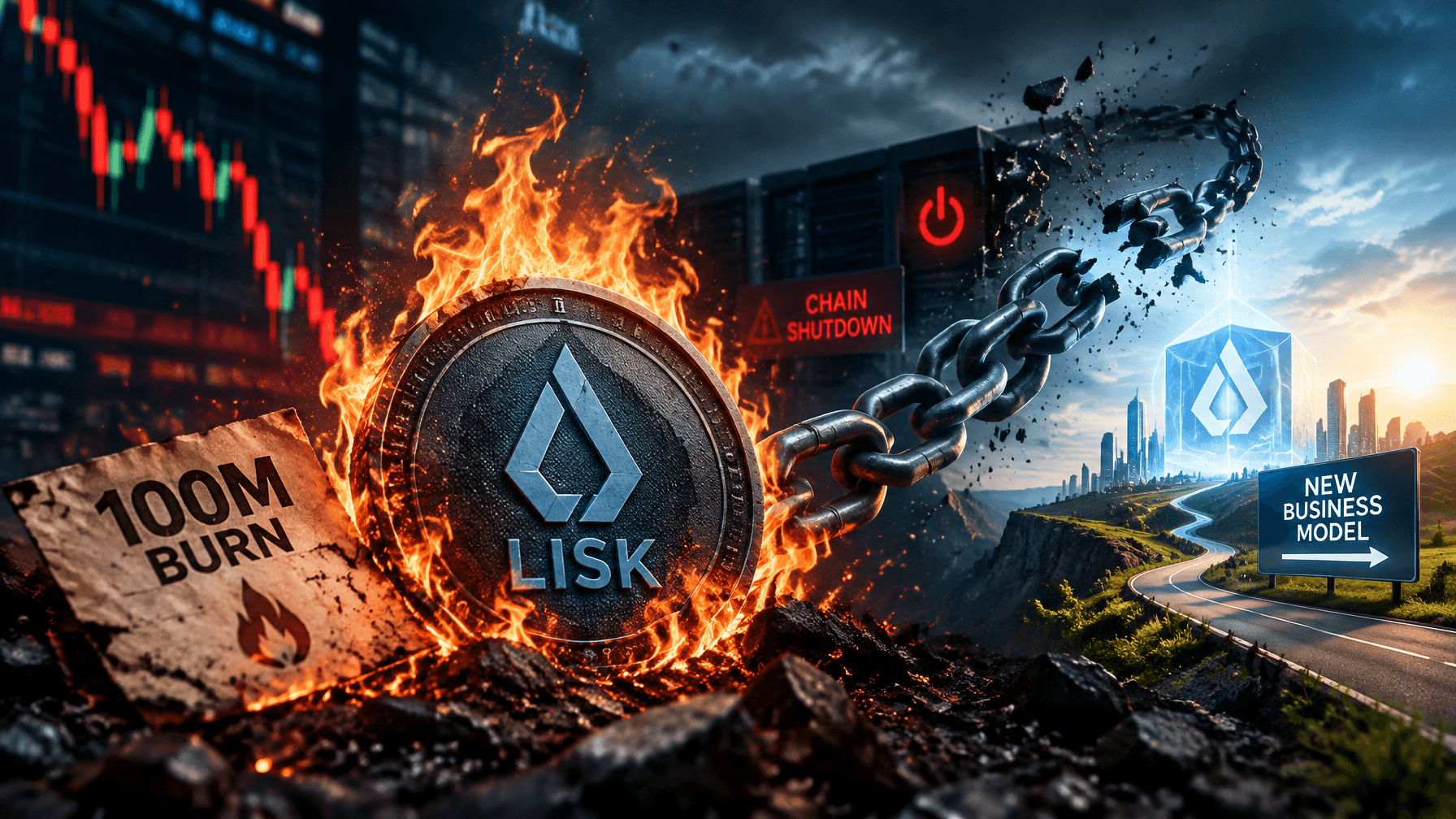
LSK exploded from below $0.20 to as high as $2.00 on Binance and $2.24 on Kraken before violently reversing, while tens of millions of dollars in leveraged positions were liquidated. Behind that extraordinary candle is a much bigger story: Lisk’s approved 100 million LSK burn is still being executed, Lisk Chain will close on October 31, and LSK is being repurposed from a blockchain ecosystem token into a loyalty asset for a stablecoin-enabled business-finance platform.
Market-data snapshot: September 14, 2026. LSK remains exceptionally volatile, and live prices, volume, open interest and liquidation figures may change rapidly after publication.
At the latest CoinMarketCap snapshot captured for this analysis, LSK was trading around $0.687, down roughly 17% over 24 hours, after Binance’s LSK/USDT market had printed an extraordinary $2.00 intraday high on September 13. Kraken went even higher, reaching approximately $2.24.
The price move alone would make LSK one of the most interesting altcoin stories of September. But the real paradox is much bigger:
LSK is experiencing its largest burst of speculation in years precisely while Lisk prepares to shut down the blockchain the token was built to support.
For readers following the broader market, you can find our latest coverage in CryptoLinks News, or return to the CryptoLinks homepage for our curated crypto exchanges, wallets, market-data tools, blockchain resources and research.
Key Takeaways
- LSK’s exact September 13 peak depends on the venue. Binance reached approximately $2.00, Kraken approximately $2.24, while CoinMarketCap captured a lower composite high around $1.81.
- Short liquidations were a major mechanical amplifier. One September 13 CoinGlass-based snapshot showed $34.54 million of 24-hour LSK liquidations, including approximately $30.67 million in shorts. A later rolling snapshot reached $53.70 million in total LSK liquidations.
- The 100M LSK burn has passed governance but is not yet something I would describe as fully executed. Lisk says the burn is in progress and will reduce total supply from 400M to 300M once completed.
- The 100M tokens were primarily future DAO supply scheduled for 2027–2033. This is not the same as removing 100M freely traded tokens from exchanges overnight.
- Approximately 47M other DAO-related LSK is moving to Lisk Ltd. That is a separate and important tokenomics change.
- Lisk Chain closes October 31, but LSK does not disappear. Ethereum becomes the token’s primary network and LSK is being repositioned as the loyalty token of the new Lisk.
LSK Exploded Hundreds of Percent Before Violently Reversing
The first thing I would refuse to do with this candle is quote one percentage without naming the exchange and measurement window.
A Binance historical LSK/USDT feed recorded a September 13 low around $0.1916 and a high of approximately $2.00. Measured from that intraday low, the move was roughly 944%.
Kraken’s LSK/USD market recorded a range from approximately $0.306 to $2.24, while CoinMarketCap’s composite data captured a high around $1.81.
| Venue / Index | Reference Low | Captured High | Approx. Low-to-High Move |
|---|---|---|---|
| Binance LSK/USDT | $0.1916 | $2.00 | ~944% |
| Kraken LSK/USD | ~$0.306 | $2.24 | ~631% |
| CoinMarketCap composite | ~$0.193 | $1.81 | ~839% |
That explains why readers saw headlines claiming LSK was up 400%, 500%, 700% or considerably more. Those numbers can describe different snapshots without describing the same return.
A rolling 24-hour return is not the same thing as an intraday low-to-high move. Nor is a Binance spot price necessarily identical to a composite index or perpetual-futures print.
A contemporaneous report also cited an LSK price around $2.70 using CoinGlass data. I would not use $2.70 as the canonical LSK spot high unless the exact venue and trade type can be established. The cleanest reference for this article is Binance’s approximately $2.00 spot print, while acknowledging that Kraken traded higher.
The Short Squeeze Behind LSK’s Extraordinary Candle
The derivatives evidence makes it difficult to explain September 13 as a simple reaction to tokenomics news.
Before the largest move, LSK perpetual-futures funding had already become deeply negative on several exchanges. That matters because negative funding generally means perpetual contracts are trading with enough bearish positioning that shorts are paying longs to keep the contract aligned with spot.
Negative funding alone does not prove that every trader was short. But combine severe funding distortions with a rapidly rising price, thin spot liquidity and tens of millions of dollars in short liquidations, and the mechanics become much clearer.
The sequence looked like this:
- LSK begins breaking out of its previous trading range.
- Short positioning builds or remains heavily exposed.
- Price pushes into thinner order-book liquidity.
- Leveraged shorts hit liquidation prices.
- Liquidations create forced market buying.
- That buying pushes price even higher.
- Higher prices trigger the next liquidation levels.
- Momentum traders join the move.
- Open interest and turnover explode.
- The move eventually exhausts and late leveraged longs become vulnerable on the way back down.
CryptoLinks recently examined the same mechanism on a much larger asset in our Bitcoin short-squeeze analysis. The important difference with LSK is market depth: a similar leverage feedback loop can have a much more violent price impact when the underlying spot market is smaller.
For readers comparing venues and leverage products, our crypto futures and derivatives exchange guide covers the broader market structure behind perpetual contracts, funding and leveraged trading.

How Tens of Millions in Liquidations Amplified a Thin Spot Market
One September 13 CoinGlass-based snapshot showed $34.54 million in LSK liquidations over the preceding 24 hours. About $30.67 million came from shorts, equivalent to approximately 88.8% of that snapshot.
At that moment, LSK reportedly ranked first among individual crypto assets by 24-hour liquidation value.
That does not mean LSK produced the biggest liquidation event in crypto history. It means LSK briefly generated more 24-hour liquidations than the other individual assets in that particular CoinGlass snapshot.
A later anomaly snapshot at approximately 16:34 UTC recorded $53.70 million of rolling 24-hour LSK liquidations and about $4.60 billion in trading volume.
Those figures must not be added together. They are changing snapshots of overlapping rolling periods.
CoinGlass also captured an event-stage dashboard showing roughly:
| Metric | Event Snapshot |
|---|---|
| Futures volume | ~$4.08B |
| Spot volume | ~$514.55M |
| Futures / spot ratio | ~7.9x |
| Open interest | ~$106.74M |
The derivatives data explain why a genuine supply narrative could produce an absurdly disproportionate price response.
When billions of dollars of futures notional trade around a token whose underlying spot market is far smaller, leveraged positioning can temporarily become an important part of price discovery.
But there is a crucial distinction:
- Futures volume is gross contract notional traded.
- Open interest is outstanding derivative exposure.
- Liquidations are forced closures of leveraged positions.
- Spot volume measures token turnover.
- None of those numbers equals net capital inflow.
So “$4 billion flowed into LSK” would be wrong. The same capital can turn over repeatedly in derivatives markets.
If you want to compare these types of statistics across exchanges, CryptoLinks maintains a curated crypto market data and exchange statistics section.
The Timing Is Critical: The Burn Was Not Announced on September 13
The timing is one of the most important parts of this story.
Lisk’s strategic reset, chain shutdown and DAO restructuring were already public before the September 13 candle. The DAO cessation proposal detailing the 100M-token burn was published in August, and the governance vote passed before the most violent phase of the squeeze.
So I would not write that “LSK pumped immediately because Lisk announced a 100M burn.”
The more defensible interpretation is that the burn and strategic pivot created a powerful background narrative, while derivatives positioning supplied the immediate mechanical amplifier.
That distinction becomes even clearer when we examine what is actually being burned.
The 100M LSK Burn Is Real — But Widely Misunderstood
Lisk says the approved DAO cessation plan is now being implemented. Under that plan, 100 million LSK is being burned, taking total supply from 400 million to 300 million LSK once execution completes.
At the September 14 research cutoff, I would describe the burn status as:
| Stage | Status |
|---|---|
| Governance approval | Passed |
| Implementation | In progress |
| Final Ethereum burn independently verified | Not yet established for this publication |
| Canonical total supply at ~300M | Not yet treated as final |
This wording matters. “Lisk has approved and begun executing a 100M-token burn” is accurate. “Lisk already burned 100M LSK” should wait until final execution is visible in canonical Ethereum supply.
Lisk Is Eliminating Future Dilution — Not Removing 100M Spot Tokens
The second distinction matters even more.
The 100M LSK being removed was allocated to the DAO Treasury for vesting between 2027 and 2033:
| Year | Original DAO Allocation |
|---|---|
| 2027 | 15M LSK |
| 2028 | 15M LSK |
| 2029 | 15M LSK |
| 2030 | 15M LSK |
| 2031 | 15M LSK |
| 2032 | 15M LSK |
| 2033 | 10M LSK |
| Total | 100M LSK |
To me, this is fundamentally a future-dilution story, not evidence that 100 million exchange-traded LSK suddenly disappeared overnight.
The old structure allowed those DAO tokens to vest gradually and fund ecosystem activity. The governance proposal itself acknowledges a problem: incentives paid in LSK created selling pressure while the L2 strategy struggled to generate enough economic value flowing back to the token.
Under the new structure, that future 100M allocation disappears and future project costs are instead expected to be financed by the Onchain Foundation.
That is a considerably more sophisticated scarcity thesis than simply saying “burn bullish.”
A 25% Supply Reduction Does Not Mechanically Explain a 900% Candle
If total supply falls from 400M to 300M, that is a 25% supply reduction.
If we make the artificial assumption that market capitalization remains exactly constant, the theoretical value represented by each remaining token would rise by:
400 / 300 – 1 = approximately 33.3%
That calculation is not a price target. Demand can change, market capitalization is not fixed and most of the burned tokens were future supply rather than current market float.
But it illustrates something important: a 25% total-supply reduction cannot mechanically explain a 600%, 800% or 900% intraday repricing.
That is where leverage and liquidity matter.
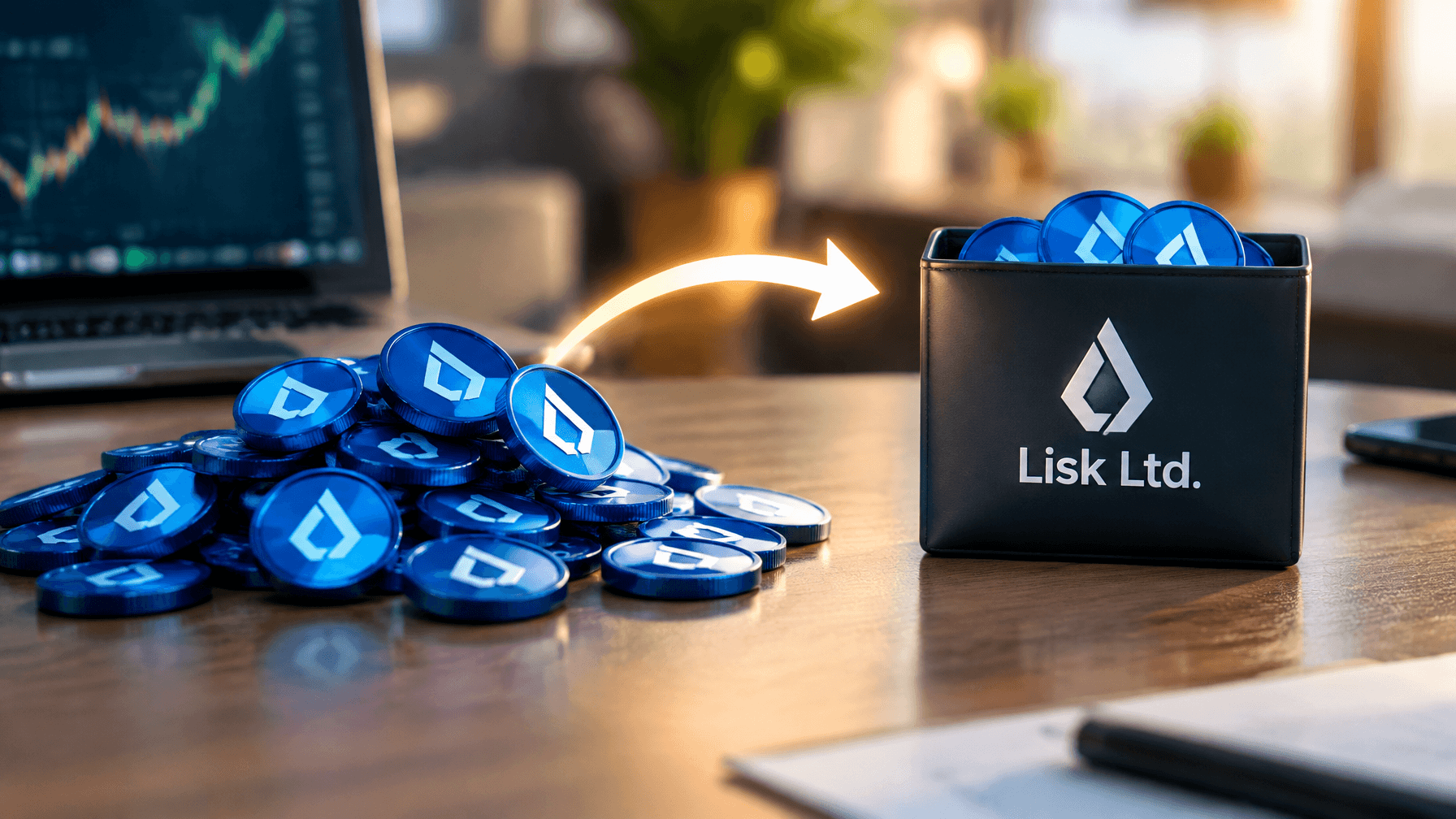
The Other Tokenomics Change: Roughly 47M LSK Moves to Lisk Ltd.
The 100M burn receives most of the attention, but the same DAO restructuring contains another major tokenomics change.
The approved proposal provides for approximately 47 million LSK that had vested through 2026 or were already liquid in the DAO Treasury to be transferred to Lisk Ltd.
The exact amount is to be fixed at execution time.
| DAO Restructuring | LSK | Economic Effect |
|---|---|---|
| 2027–2033 DAO allocation | 100M | Burned; eliminates future supply |
| Through-2026/current DAO treasury | ~47M | Moves to Lisk Ltd. |
| Arrakis liquidity vault management | Existing liquidity | Moves from DAO to Lisk Ltd. |
| Future project financing | External funding | Onchain Foundation replaces future DAO-LSK financing |
If the eventual total supply is 300M, 47M represents roughly 15.7% of that amount.
That does not mean 15.7% of LSK suddenly becomes liquid insider supply, and there is no evidence that Lisk Ltd. intends to sell those tokens.
But it does mean the tokenomics story contains two simultaneous changes: less future DAO dilution and greater token concentration under the operating company.
Why Current LSK Supply Figures Do Not Yet Reconcile
Another issue deserves transparency.
At the September 14 snapshot, CoinMarketCap was still reporting approximately 372.46M circulating LSK and a 400M maximum supply.
Yet Lisk says the completed burn will bring total supply down to 300M.
Obviously, a final circulating-supply figure above a final 300M total supply cannot exist once the restructuring is fully reflected.
For now, that conflict is not surprising because Lisk still describes the burn as being in progress. Aggregators can also differ in how they account for canonical Ethereum tokens, bridge representations, vesting contracts and circulating supply.
Once execution completes, I would give the canonical Ethereum ERC-20 supply state priority over stale aggregator fields.
Lisk Chain Shuts Down October 31
The tokenomics story is unusual enough. The strategic transition is even bigger.
Lisk Chain will shut down on October 31, 2026.
Until then, Lisk says the chain and its underlying infrastructure will remain supported. Users with assets on Lisk Chain need to move them before closure.
This applies not only to LSK but also to:
- ETH;
- stablecoins;
- bridged assets;
- DeFi positions;
- and other tokens residing on Lisk Chain.
This is effectively the end of Lisk’s current Ethereum Layer 2 strategy. Celo Core Co. is offering a migration route and technical assistance to applications that want to move from Lisk Chain to Celo, but Lisk Chain is not becoming Celo and LSK itself is not migrating to a new Celo token.

What LSK Holders Actually Need to Do Before the Deadline
Penalty-free emergency unstaking is now live, but Lisk says a three-day waiting period still applies before funds can be unlocked. Bridging to Ethereum requires at least approximately seven days.
That means October 31 should not be treated as a sensible date to begin the process.
The most important distinction is simple:
The chain is shutting down. The LSK ERC-20 token is not.
Ethereum becomes LSK’s primary network. There is no replacement coin that Ethereum or exchange holders need to buy.
The DAO and Staking Model Are Disappearing With the Chain
Lisk’s DAO infrastructure is also being wound down, including governance contracts and the Lisk Governance Forum. Staking is ending as part of the chain transition.
That means the market is not simply repricing a scarcer version of the old LSK.
It is repricing a token whose previous governance and staking functions are disappearing at almost the same time its supply is being restructured.
That is why the next question matters much more than the burn percentage:
What is LSK actually for once the blockchain and DAO disappear?
What the New Lisk Actually Is
The new Lisk describes itself as a modern money-operations platform for finance teams.
It is currently in Early Access and combines accounts, payments, approval workflows and business workspaces across fiat and stablecoin rails.
| Dimension | Old / Closing Lisk | New Lisk |
|---|---|---|
| Core product | Ethereum L2 | Money-operations platform |
| Main user | Dapp builders and blockchain users | Finance teams and businesses |
| Dedicated blockchain | Lisk Chain | None after closure |
| LSK staking | Yes | Ending |
| DAO governance | Yes | Ending |
| LSK future role | Ecosystem / staking / governance asset | Loyalty, rewards and future fee-payment token |
| Primary LSK network | Lisk/Ethereum architecture | Ethereum |
| Money rails | Blockchain ecosystem | Fiat + stablecoin rails |
This is not a normal blockchain roadmap update. It is a fundamental business-model reset.
The new target customer is a company operating across multiple countries, legal entities and currencies while managing both fiat and stablecoins.
That makes Lisk increasingly relevant to the broader business-payments market rather than just the L2 ecosystem. Readers researching that infrastructure can also compare our curated crypto payment gateways and merchant-payment tools.

USDL Powers the Dollar Accounts — Not LSK
One of the easiest mistakes in the new Lisk story is to confuse the two tokens.
USDL and LSK perform completely different jobs.
USDL is the dollar-pegged stablecoin used underneath Lisk’s dollar-account experience. It is issued by Bridge and backed by USD-denominated reserves.
The stablecoin is largely abstracted from users. A business sees a dollar-denominated balance while USDL functions as the settlement asset underneath.
| Asset | Role |
|---|---|
| USDL | Internal dollar/stablecoin settlement asset behind payment-account balances |
| LSK | Loyalty/reward token with future optional fee utility |
| Supported stablecoins | Deposit/payment rails |
| Fiat | Banking and payment rails |
LSK does not back USDL. LSK is not the collateral behind business accounts, and Lisk has not said that USDL usage automatically burns or purchases LSK.
LSK Is Becoming a Loyalty Token — But What Utility Is Actually Live?
Lisk now describes LSK as the loyalty token of the new Lisk.
The announced model says businesses will earn rewards for running money operations and referrals, with LSK rewards and the ability to pay fees in LSK expanding over time.
Those two words matter.
| LSK Utility | Status |
|---|---|
| Ethereum ERC-20 token | Continues |
| Lisk Chain staking | Ending |
| DAO governance | Ending |
| Mandatory ownership to use Lisk product | No |
| Loyalty / referral rewards | Planned / phased rollout |
| Pay platform fees in LSK | Future utility |
| Equity in Lisk Ltd. | No |
| Revenue share | None disclosed |
| Automatic LSK buyback | None disclosed |
| Product-revenue burn | None disclosed |
This is where the post-squeeze fundamental question gets much harder.
Why does the new Lisk product need LSK at all?
Rewards, referrals and optional fee payments are legitimate possible uses. But optional loyalty-program relevance is not the same thing as unavoidable transactional demand.
I would not give LSK credit for business-payment demand until the mechanics show how that business activity actually creates demand for LSK.

A Successful Lisk Company Would Not Automatically Mean a Valuable LSK Token
This distinction gets lost surprisingly often in crypto.
Lisk Ltd. could build a useful finance product. It could attract customers, process more payments and generate growing revenue.
None of those outcomes automatically belongs economically to an LSK holder.
LSK does not represent equity in Lisk Ltd. No disclosed mechanism gives LSK holders dividends, company profits or a direct claim on revenue.
If future customers can use the product without touching LSK, company growth does not necessarily create token buying.
To establish durable LSK value capture, I would want answers to questions such as:
- Where will reward LSK come from?
- Will Lisk buy LSK in the market to distribute rewards or use existing treasury tokens?
- What happens when a business eventually pays a platform fee in LSK?
- Who receives those tokens?
- Does fee payment remove any LSK from circulation?
- Does using LSK actually provide a measurable discount or other economic advantage?
Until those mechanics are live and measurable, a speculative price candle is not evidence that the new commercial model works.
Binance’s Monitoring Tag Adds Another Risk
There is another factor LSK traders should keep in view.
Binance added LSK to its Monitoring Tag on July 24, 2026.
Binance says tokens carrying the tag exhibit comparatively higher volatility and risk and are subjected to more frequent review. Tokens under the Monitoring Tag can face eventual delisting risk if they stop meeting Binance’s standards.
But that must be stated correctly:
Binance has not announced that LSK will be delisted simply because Lisk Chain closes.
A Monitoring Tag is a risk designation, not a delisting announcement.
For background on the venue itself, see our full CryptoLinks Binance review. You can also compare platforms in our best cryptocurrency exchanges guide.
Fundamental Change vs. Mechanical Amplification
| Factor | Direction | Timing | Evidence |
|---|---|---|---|
| 100M burn | Bullish for total supply | Known before squeeze | Strong |
| Future dilution eliminated | Bullish structurally | Long term | Strong |
| ~47M transfer to Lisk Ltd. | Mixed | Structural | Strong |
| Lisk Chain closure | Removes old utility | Known before squeeze | Strong |
| New business platform | Potentially constructive | Early Access | Medium |
| New LSK utility | Potential future demand | Not fully live | Medium / early |
| Short squeeze | Strong upside amplifier | Contemporary | Strong |
| Thin liquidity | Volatility amplifier | Contemporary | Strong |
| Binance Monitoring Tag | Risk factor | Ongoing | Strong |
The important thing is not to invent a neat percentage attribution such as “60% squeeze and 40% fundamentals.” Markets do not offer us that precision.
What the evidence does support is a simpler conclusion: the supply thesis was genuine, but derivatives made the price response vastly more violent.

Three Ways LSK’s Post-Squeeze Story Could Develop
Scenario A: The New Lisk Gains Commercial Traction
The constructive case is not simply that LSK keeps rising.
Evidence would include the 100M burn completing on Ethereum, a successful chain migration, stable exchange support, disclosed growth in business adoption and live LSK reward or fee functionality.
If LSK can retain part of its repricing after leverage normalizes while those fundamentals improve, there would be stronger evidence that the token is successfully transitioning from blockchain ecosystem asset to commercial loyalty token.
Scenario B: Lisk Succeeds but LSK Value Capture Remains Weak
This may be the most important scenario to understand.
Businesses could use Lisk’s accounts and payment rails. Revenue could grow. Stablecoin settlement could expand.
But if customers predominantly use fiat and USDL while LSK stays optional, the company could succeed without creating correspondingly strong demand for the token.
A successful company does not automatically imply a valuable token.
Scenario C: The Rally Proves Primarily Mechanical
The bearish interpretation would become stronger if open interest collapses, spot volume disappears, LSK retraces most of the move, completion of the burn produces little durable demand and commercial adoption remains limited or undisclosed.
In that scenario, the scarcity narrative supplied the story while leverage supplied most of the candle.

My Conclusion: Scarcity Changed, but Leverage Explains the Violence
I think two things can be true simultaneously.
First, LSK’s supply structure genuinely improved in one important respect. Eliminating 100M tokens scheduled for DAO vesting between 2027 and 2033 removes a major future dilution overhang and eliminates a mechanism through which ecosystem spending could progressively add selling pressure.
Second, that change cannot realistically explain the shape and magnitude of September 13 by itself.
The timing, deeply negative funding, enormous futures turnover, open-interest expansion, tens of millions of dollars in forced short closures, thin spot liquidity and violent reversal all point to derivatives acting as an extreme amplifier.
The strange part is what comes next.
The blockchain, staking system and DAO that historically framed LSK’s economic purpose are disappearing. In their place is an Early Access money-operations business where USDL handles the internal dollar settlement layer and LSK is being repositioned as an optional loyalty and rewards asset with more fee utility planned later.
So the fundamental question is no longer simply:
How many LSK tokens will exist?
It is:
What creates durable demand for the 300 million LSK that are supposed to remain?
Until Lisk answers that question through live product economics rather than a speculative candle, scarcity remains only half of the valuation equation.
Follow CryptoLinks News for our continuing coverage of crypto markets, tokenomics, exchanges and blockchain transitions, or use the CryptoLinks homepage to explore our independently reviewed crypto resources.

Frequently Asked Questions
Why did LSK suddenly pump?
The evidence points to a combination of a genuine supply-restructuring narrative and an extreme derivatives squeeze. The burn and strategic pivot were already known before September 13, while deeply negative funding, rapidly expanding futures activity and forced short liquidations amplified the actual candle.
How high did LSK actually trade?
Binance’s LSK/USDT market reached approximately $2.00, while Kraken’s LSK/USD market reached roughly $2.24. CoinMarketCap captured a composite high around $1.81. Reported prices around $2.70 should be treated as venue/index-specific until the exact market is established.
Did LSK really rise 500%?
It did at some rolling snapshots, but that is not the only valid measurement. Binance’s September 13 intraday low-to-high move was considerably larger. Any LSK percentage should therefore state the exchange, starting point and measurement window.
How much LSK was liquidated?
An earlier CoinGlass-based September 13 snapshot showed approximately $34.54 million in 24-hour liquidations, including roughly $30.67 million in shorts. A later rolling snapshot recorded approximately $53.70 million total. Those overlapping windows should not be added together.
Was LSK primarily a short squeeze?
Short liquidations were clearly a major mechanical amplifier. That does not mean the fundamental supply changes were irrelevant. A better interpretation is that the burn and strategic reset created a narrative that an unusually leveraged, thin market then magnified.
Has Lisk already burned 100M LSK?
The DAO cessation proposal passed and Lisk says the burn is in progress. Lisk says total supply will fall from 400M to 300M once execution completes. Until final Ethereum execution is confirmed, describing all 100M as already burned would be premature.
Does the burn reduce circulating supply by 25%?
Not necessarily. The 100M LSK being removed was mainly scheduled to vest into the DAO Treasury from 2027 through 2033. The clean description is a 25% reduction in total supply and elimination of a large future vesting schedule, not a 25% overnight reduction in freely tradable LSK.
What happens to the other roughly 47M LSK?
The approved DAO proposal transfers approximately 47M LSK vested through 2026 or already liquid in the DAO Treasury to Lisk Ltd. The exact amount is fixed at execution. The transfer should not be interpreted as evidence that those tokens will be sold.
When does Lisk Chain close?
October 31, 2026. Users with LSK, ETH, stablecoins, DeFi positions or other assets on Lisk Chain should migrate or withdraw them before closure.
Is LSK being discontinued?
No. Lisk Chain is being discontinued, but the existing LSK ERC-20 continues. Ethereum becomes LSK’s primary network.
Do Ethereum or exchange holders need a new LSK token?
No. Lisk says holders whose LSK is already on Ethereum or a supported exchange do not need a token swap. Beware of fake “new LSK” migration schemes.
Is Lisk becoming Celo?
No. Celo Core Co. is offering a migration path and support to applications leaving Lisk Chain. Lisk Chain itself is not being converted into Celo.
What is the new Lisk?
The new Lisk is an Early Access money-operations platform designed for finance teams managing accounts, payments, approvals, multiple entities and fiat/stablecoin rails.
Is USDL the same as LSK?
No. USDL is a dollar-pegged stablecoin issued by Bridge and used underneath Lisk’s dollar-account experience. LSK is a separate ERC-20 token being positioned as the loyalty and rewards asset of the new product.
Do businesses need LSK to use the new Lisk platform?
No. Current Lisk materials do not make owning LSK a requirement for using the product. Rewards and future fee-payment functionality are intended to create loyalty-token utility over time.
Does LSK give holders equity or revenue from Lisk Ltd.?
No such mechanism is disclosed. LSK is not company equity and does not automatically give holders dividends, profit share or legal ownership of Lisk Ltd.
Is Binance delisting LSK?
No delisting decision has been announced. Binance placed LSK under its Monitoring Tag in July 2026, meaning the asset receives closer review because of comparatively higher volatility and risk. That creates delisting risk if standards are not maintained, but it is not itself a delisting announcement.
Sources and methodology: CryptoLinks reviewed Lisk’s official transition announcement, Lisk DAO governance materials, current Lisk product and USDL documentation, CoinGlass derivatives data, CoinMarketCap market data, venue-specific historical pricing and Binance’s Monitoring Tag announcement. Price, volume, funding, open interest and liquidation data are time-sensitive and can change after publication. Futures volume is gross notional turnover and should not be interpreted as capital inflow.
Disclaimer: This article is for informational and educational purposes only and does not constitute investment, trading or financial advice. LSK has experienced extreme volatility, and leveraged cryptocurrency trading can result in rapid and substantial losses.