MiCA Deadline Hits July 1: What Binance EU Users Can Still Do as Coinbase and OKX Compete for Transfers

Key takeaways
- The final MiCA grandfathering period ends on July 1, 2026.
- Providers without authorization must stop onboarding and marketing to EU customers.
- Binance withdrew its Greek MiCA application and did not secure authorization before the deadline.
- Existing Binance assets are not expected to be automatically frozen or lost.
- Reported restrictions include new deposits, spot orders, staking, Earn products and new registrations.
- Coinbase is promoting a reported 5% transfer bonus in selected European markets.
- OKX is advertising an 8% deposit bonus, but it is paid gradually over 52 weeks and comes with detailed conditions.

What the July 1 MiCA deadline actually changes
The Markets in Crypto-Assets Regulation, better known as MiCA, created a common authorization system for crypto companies operating across the European Union.
Before MiCA, exchanges often relied on separate national registrations. A company could be registered in one country, operate under a different arrangement in another and provide services across Europe without a single EU-wide crypto license.
MiCA replaces that fragmented structure with one authorization regime.
Companies that were already operating legally before MiCA became fully applicable were allowed to continue temporarily under national grandfathering arrangements. The longest possible transition period ends on July 1, 2026.
According to the European Securities and Markets Authority, or ESMA, an unauthorized crypto-asset service provider must immediately:
- Stop onboarding new EU customers.
- Stop opening new accounts and customer relationships.
- Stop marketing or soliciting EU customers.
- Limit its services to actions required for an orderly exit.
- Allow customers to sell, transfer or reallocate assets and close positions where applicable.
- Communicate the wind-down plan and relevant deadlines clearly.
- Continue protecting customer interests while assets are moved.
This last point is particularly important.
An unauthorized platform may retain limited functionality so that customers can leave in an orderly manner. That does not give the platform permission to continue operating as normal.
ESMA also advises customers to verify the exact legal entity serving their account in the official MiCA register. The public register was last updated on June 26 at the time of this article.

Is Binance really leaving the EU?
I would not interpret the situation as a confirmed permanent Binance exit.
Binance pursued MiCA authorization through Greece but withdrew its application shortly before the deadline. The company said it would seek authorization through another EU member state and maintained that Europe remained an important market.
Binance has also said that it expects to secure a MiCA license in the coming months.
That is Binance’s stated expectation, not a guaranteed outcome.
Until authorization is granted, Binance cannot continue providing its normal regulated services across the EU. Reports indicate that customers in countries including France, Italy, Poland and Spain received notices explaining that some Binance services would be suspended.
The more accurate description is therefore a temporary regulatory lockout while Binance’s authorization remains unresolved.
Binance is not closing globally. It has not announced that all European accounts will be deleted, and it has not said that customers will automatically lose their cryptocurrency.
The restrictions may also differ according to the customer’s country, account type, legal entity and products held. Users should treat the notice sent directly to their account as more relevant than a generalized social-media post or headline.
Readers who want broader context on the platform can also check our detailed Binance review.
What Binance EU users can and cannot do after July 1
Binance has not published one universal public notice covering every country and account configuration. However, customer communications and current reporting point to the following general division.
| Reported as stopping or being restricted | Reported as remaining available |
|---|---|
| New EU registrations | Logging into an existing account |
| Opening new accounts | Viewing balances and transaction records |
| New crypto or fiat deposits | Withdrawing supported crypto assets |
| Placing new spot orders | Withdrawing fiat where the relevant route remains supported |
| Staking products | Transferring crypto to another platform or wallet |
| Earn and yield services | Selling, converting or closing positions where required |
| Other regulated services | Customer support during the wind-down |
| Marketing to EU customers | Exporting account and trading history |
The continued availability of withdrawals is consistent with ESMA’s requirement that an unauthorized provider conduct an orderly exit and allow customers to transfer or dispose of their assets.
It should not be interpreted as a guarantee that every asset, network and withdrawal method will remain available indefinitely.
The first things I would check are:
- The latest email sent to the address connected to the Binance account.
- In-app notifications and account banners.
- The Binance legal entity named in the account terms.
- Whether open spot orders remain active.
- Whether any staked assets have an unstaking period.
- Whether crypto and fiat withdrawals are working.
- Whether Binance has provided a deadline for residual positions.
Users should not wait until the last moment to discover that a staked asset needs several days to redeem or that the receiving exchange does not support the same blockchain network.
What ESMA expects Binance customers to do
ESMA is not telling every customer to immediately sell all crypto.
Its guidance is more measured. Customers should determine whether the provider serving them is authorized and, if it is not, consider transferring assets to an authorized provider or a self-hosted wallet.
The right decision depends on how the customer uses cryptocurrency.
| User situation | Immediate concern | What to verify | Sensible next step |
|---|---|---|---|
| Funds held on Binance | Service restrictions | Country notice and withdrawal availability | Review the notice and test account access |
| Open spot order | Cancellation or inability to trade | Order status and deadline | Cancel or close if necessary |
| Staked assets | Redemption delay | Unstaking period | Start early if a transfer is planned |
| USDT balance | Reduced trading support | Withdrawal network and conversion cost | Compare transfer and conversion options |
| Moving to another exchange | Wrong address or network | Supported asset, chain and memo | Send a small test transaction |
| Moving to self-custody | Loss of keys | Wallet compatibility and backup | Secure the recovery phrase before transferring |
Moving to an authorized exchange preserves the convenience of custodial trading. Moving to self-custody removes exchange counterparty exposure but makes the user fully responsible for private keys, wallet security and recovery.
Neither option is automatically right for everyone.
Our guide to the best non-custodial crypto wallets explains the practical differences between holding assets on an exchange and controlling them through a personal wallet.

Coinbase and OKX move quickly to attract Binance users
The MiCA deadline is not only a regulatory event. It is also a major customer-acquisition opportunity.
Users who can no longer deposit or trade normally on Binance may be more willing than usual to open a new account elsewhere. Coinbase and OKX have responded by placing transfer bonuses at the center of their European campaigns.
That does not mean a promotion should determine where someone stores a large crypto balance.
Before transferring, I would compare:
- The legal entity operating the exchange.
- Its entry in the ESMA register.
- Supported assets and networks.
- Deposit and withdrawal fees.
- Trading spreads and liquidity.
- Fiat deposit and withdrawal routes.
- Stablecoin availability.
- Staking and Earn restrictions.
- Customer-support history.
- Promotion withdrawal conditions.
The headline percentage is only one part of the decision.
Coinbase’s 5% transfer offer: what users need to check
Coinbase is reportedly offering eligible new users a reward equal to 5% of qualifying funds transferred to the platform before July 13.
The promotion has been advertised to users in Germany, France, Italy, Belgium, Poland and Sweden. The United Kingdom has also been included separately, although the UK is not a member of the European Union and does not fall under MiCA.
The promotion sounds simple at headline level, but several details matter:
- Which assets qualify?
- Is there a minimum transfer?
- What is the maximum reward?
- Is the promotion limited to new accounts?
- Must customers use a special registration page?
- How long must the transferred assets remain on Coinbase?
- Do withdrawals reduce or cancel the reward?
- When is the bonus paid?
- In which asset is the reward distributed?
I would not describe this as “Coinbase gives every European user 5%.” Eligibility is limited, and the complete terms should be checked before any transfer is initiated.
Coinbase says it provides its European crypto services through an authorized Luxembourg entity. That gives it access to the MiCA passporting system, but authorization does not remove normal exchange, custody or market risks.
Our Coinbase review covers the exchange’s regular features, fees and limitations beyond this temporary campaign.

OKX’s 8% bonus is paid over 52 weeks
OKX’s promotion is easier to examine because the company has published a detailed campaign page.
The page was updated on June 29 and currently states that eligible EEA residents can receive an 8% bonus on qualifying net deposits.
The published conditions include:
- Campaign period from June 29 to July 31, 2026.
- Availability to qualifying residents of the European Economic Area.
- In-app participation and identity verification.
- A minimum qualifying net deposit of €10.
- An 8% reward on the qualifying net deposit.
- A maximum reward of €20,000.
- Payment through 26 biweekly installments over 52 weeks.
- A separate new-user welcome bonus of up to €400.
The most important detail is the payment schedule.
A user does not receive the entire 8% immediately. The reward is distributed over one year, meaning the customer retains exposure to the platform and any conditions connected to the qualifying net deposit throughout the campaign period.
What the OKX bonus means in practice
| Qualifying deposit | Nominal 8% reward | Approximate amount per installment |
|---|---|---|
| €5,000 | €400 | €15.38 |
| €50,000 | €4,000 | €153.85 |
| €200,000 | €16,000 | €615.38 |
| €250,000 | €20,000 maximum | €769.23 |
These calculations divide the nominal reward into 26 equal installments. Actual payments may depend on the complete campaign terms, qualifying net balance and any withdrawals made during the reward period.
The promotion may be attractive to someone who already intended to use OKX for an extended period. It is much less attractive to someone who expects an immediately withdrawable 8% return.
OKX says its European entity holds MiCA authorization from the Malta Financial Services Authority. Readers can compare the platform’s wider product range in our OKX review.
Promotion warning: Campaign eligibility and terms can change. A transfer bonus is not a guaranteed investment return and does not eliminate exchange, custody, liquidity or market risk.

What MiCA means for USDT, USDC and euro stablecoins
USDT does not suddenly become illegal to own on July 1.
This is one of the most misunderstood parts of the MiCA transition.
There is a difference between:
- Holding USDT in a personal wallet.
- Holding USDT on an exchange.
- Depositing or withdrawing USDT.
- Trading a USDT pair.
- Using USDT as a quote currency.
- The USDT issuer meeting MiCA requirements.
- The exchange holding its own CASP authorization.
Several regulated European exchanges had already removed or restricted USDT trading before the final transition deadline. The July 1 date therefore does not create every stablecoin restriction overnight.
USDC and EURC have gained an advantage because Circle secured authorization through an EU-regulated electronic-money institution. That has made these assets easier for authorized exchanges to support within the MiCA framework.
Users still need to consider conversion costs.
Moving from USDT to USDC or EURC may create:
- A trading spread.
- Slippage on a large conversion.
- Blockchain network fees.
- Withdrawal fees.
- Tax or accounting records.
- A change in available trading pairs.
- New issuer or counterparty exposure.
Someone holding USDT on Binance may be able to withdraw it directly to a compatible wallet or exchange without converting it first. But the destination must support both USDT and the exact network being used.
Sending USDT over TRON to an address that supports only Ethereum-based USDT can result in delayed recovery or permanent loss.
Our previous analysis of the MiCA deadline, USDT delistings and the rise of USDC examines the stablecoin side of the transition in more detail.
A MiCA-authorized exchange is not automatically authorized to offer every financial product.
MiCA covers crypto-asset services such as:
- Custody.
- Spot trading.
- Operating a crypto trading platform.
- Executing orders.
- Transferring crypto assets.
- Exchanging crypto for fiat or other crypto assets.
Crypto derivatives can fall under MiFID II and other financial-market rules.
This means an exchange may hold MiCA authorization for spot trading but still be unable to offer perpetual futures, options or leveraged products to every EU customer.
Staking and Earn products can also be treated differently from basic spot trading and custody. Their availability may depend on the exact structure of the product, the country and the licensed legal entity providing it.
Users moving from Binance should therefore not assume that another exchange offers the same product range simply because it holds a MiCA authorization.
The ESMA register should be treated as the deciding source for authorization status.
Examples of established exchanges operating through MiCA-authorized European entities include:
| Exchange | European regulatory base |
|---|---|
| Coinbase | Luxembourg |
| OKX | Malta |
| Kraken | Ireland |
| Bitstamp | Luxembourg |
| Bitpanda | Austria |
| Crypto.com | Malta |
| Bybit | Austria |
This is not a safety ranking or a recommendation to move funds to any particular platform.
MiCA authorization introduces requirements covering governance, capital, custody, complaints and customer disclosures. It does not guarantee that an exchange cannot experience a security incident, operational failure, liquidity problem or insolvency.
Users can compare fees, features and account requirements in our cryptocurrency exchange directory and our detailed Kraken review.
Before depositing, search the ESMA register for the exact legal entity shown in the exchange’s account agreement. A familiar global brand name is not enough by itself.
How to move crypto without losing funds
Regulatory uncertainty creates urgency, but rushing a blockchain transfer can produce a much more immediate loss.
Before moving any asset:
- Confirm that the destination supports the exact cryptocurrency.
- Confirm that it supports the exact blockchain network.
- Copy the address from the authenticated destination account.
- Check whether a memo, tag or payment identifier is required.
- Compare the withdrawal fee across supported networks.
- Send a small test transaction first.
- Wait for the test deposit to arrive.
- Transfer the remaining balance only after verification.
- Export account, trading and transaction history.
- Record conversion prices, fees and cost basis.
- Save relevant notices and confirmation emails.
- Ignore unsolicited support messages.
A legitimate exchange support employee will not need a wallet seed phrase, password or two-factor authentication code.
Periods of forced customer migration are ideal for phishing attacks. Scammers can create fake MiCA notices, Binance migration pages, Coinbase promotions and OKX support accounts within hours.
Use bookmarked websites or manually typed addresses rather than links received through direct messages.

Three possible outcomes for Binance in Europe
I see three plausible scenarios. These are scenarios, not predictions.
Binance could obtain authorization through another EU member state and begin restoring regulated services.
Customers might be migrated to a new European legal entity and asked to accept new terms. Some products could return, but the EU version of Binance might still offer fewer stablecoins, staking products and derivatives than the global platform.
A longer gap would give Coinbase, OKX, Kraken and other authorized exchanges more time to capture Binance customers and trading volume.
Liquidity could become more fragmented, while users who need active trading access would have little reason to leave substantial balances on a platform limited to wind-down functions.
Binance could still return eventually, but winning migrated customers back would become more difficult.
Scenario 3: Binance faces another regulatory refusal
A second failed application could force a deeper restructuring.
Binance might need to create a more independent EU entity, change its ownership or governance structure, acquire an authorized company, form a partnership or permanently reduce the services offered to European customers.
The longer Binance remains outside the authorized perimeter, the less accurate it becomes to describe the disruption as a brief technical delay.
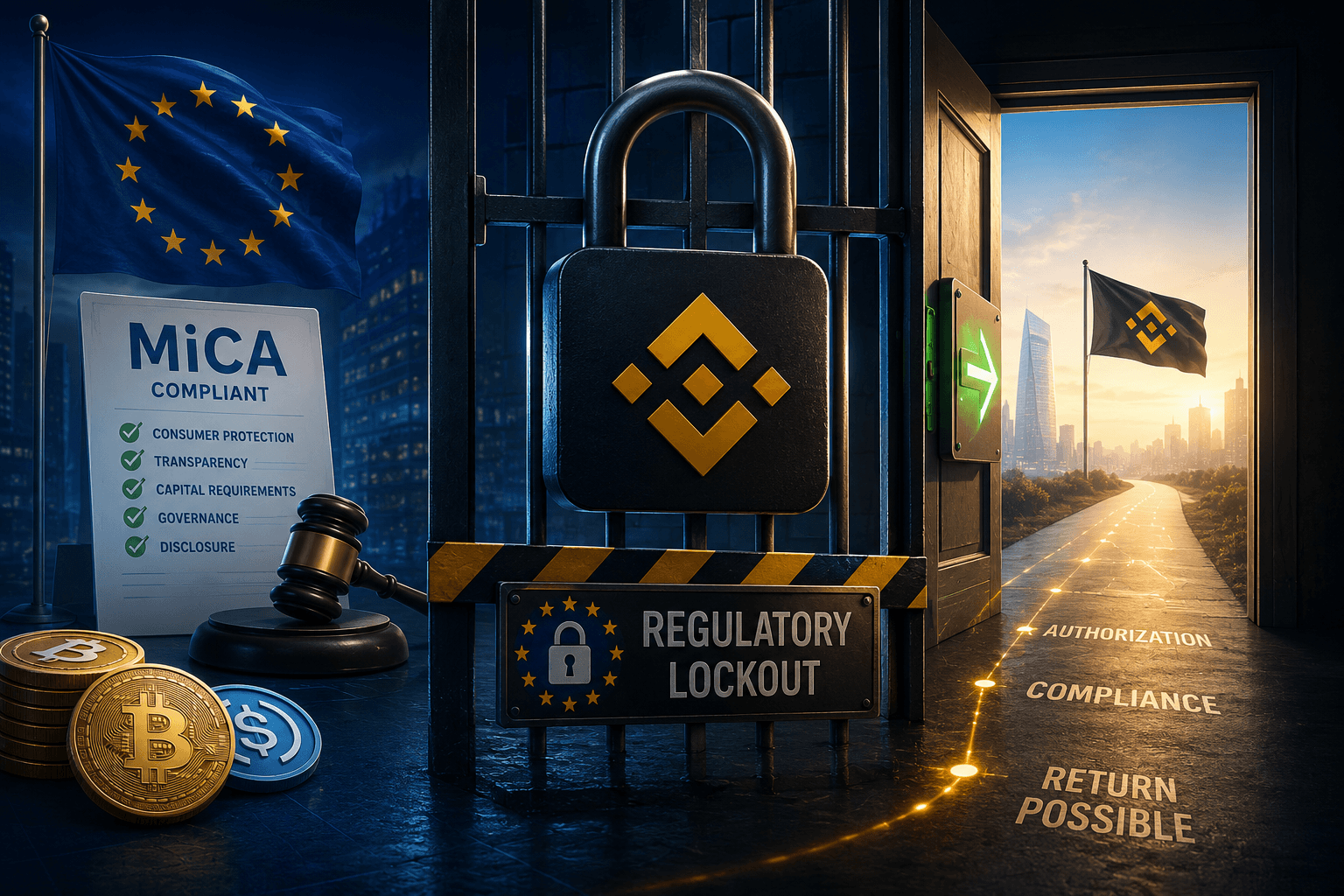
My view: a regulatory lockout, not necessarily a permanent exit
The part many headlines miss is that Binance has not simply decided to abandon Europe.
It failed to obtain the authorization required to continue operating normally after the MiCA transition. That distinction matters, but it does not make the disruption insignificant.
What is confirmed is that the transition ends on July 1 and unauthorized providers must stop normal onboarding, marketing and regulated activity. ESMA expects them to limit continuing services to what is necessary for customers to sell, transfer, reallocate assets or close positions.
What has been reported, but may remain account-specific, is the precise combination of deposits, spot orders, conversions, staking products and withdrawal methods available to each Binance user.
What remains unknown is how quickly Binance can secure authorization elsewhere and which services would return under a future licensed European entity.
I would not panic, but I would not ignore the deadline either.
Check the latest Binance notice. Verify that withdrawals work. Review any open orders or staked assets. Export the account history. If transferring, verify the destination platform and send a small test transaction first.
Coinbase and OKX are clearly competing for this customer movement, but a promotional reward should never replace proper due diligence.
Frequently asked questions
Is Binance leaving Europe permanently?
No permanent exit has been confirmed. Binance says Europe remains an important market and intends to pursue authorization through another EU member state. The timing and outcome remain uncertain.
Can EU users still withdraw from Binance after July 1?
Reported notices indicate that existing assets should remain accessible and withdrawals should continue during the orderly wind-down. Users must check their own account because availability can vary by asset, network, country and withdrawal method.
Will Binance freeze existing EU customer assets?
Existing assets are not expected to be automatically frozen because of the MiCA deadline. ESMA expects unauthorized providers to let customers transfer, sell, reallocate assets or close positions as part of an orderly exit.
Which Binance services reportedly stop?
New registrations and EU marketing must stop. Current reporting also points to restrictions on new deposits, new spot orders, staking, Earn products and other regulated services.
Binance did not appear to hold the authorization required to continue normal EU services at the publication cutoff. Users should check the latest ESMA register because authorization status can change.
Is USDT illegal in Europe after July 1?
No. Holding USDT is different from an exchange being permitted to offer USDT deposits, trading pairs, conversions or other services.
Does MiCA cover perpetual futures?
Not automatically. Derivatives may fall under MiFID II and require separate authorization. A MiCA license alone does not give an exchange permission to offer every leveraged product.
Should Binance users move to another exchange or self-custody?
It depends on how the assets are used. Active traders may prefer an authorized exchange, while long-term holders may prefer self-custody. Self-custody removes exchange counterparty risk but makes the user responsible for protecting private keys and recovery phrases.
This article is for general information only and does not provide financial, investment, tax or legal advice. Promotion terms, service availability and regulatory status can change. Verify current information through the relevant exchange, national regulator and ESMA register before moving funds.