r/Polkadot Review
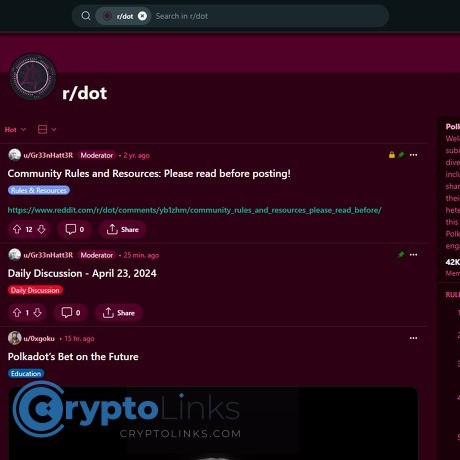
r/Polkadot
www.reddit.com
r/Polkadot Review Guide: How to Use Reddit’s Top Polkadot Hub (And Actually Get Value From It)
Have you ever opened r/Polkadot, stared at a wall of posts, memes, on-chain drama, price hopium, and thought:
“Is there actually anything useful here… or am I just wasting time?”
If you’re holding DOT, thinking about buying it, or just trying to understand what’s really happening with Polkadot beyond the headlines, Reddit can be either:
- A free, real-time intel feed on tech, sentiment, and opportunities
- Or the fastest way to get lost in noise, bad takes, and emotional price fights
The difference isn’t the subreddit. It’s how you use it.
In this guide, I want to show you how to treat r/Polkadot like a tool — not a distraction — so you can:
- Find useful threads in minutes instead of scrolling for an hour
- Spot when people are actually sharing signal vs just yelling “DOT to $200!”
- Use the sub to answer questions like “Can Polkadot reach $100 or $200?” in a logical way, not an emotional one
- Feel comfortable asking questions without getting roasted for being “new”
Let’s be honest: crypto Reddit is messy by design. You’ve got anonymous accounts, strong opinions, changing narratives, and a lot of people who either want to pump their bags or farm karma. If you just open the subreddit and scroll, you’re at the mercy of whatever the algorithm puts in front of you.
But if you know what you’re doing, you can turn that chaos into a serious edge.
The Problems Most People Have With r/Polkadot (And Crypto Subreddits in General)
When I talk to DOT holders or curious newcomers, they always say the same thing about r/Polkadot and other crypto subs:
- “There’s just too much going on.”
- “Everyone says something different.”
- “I don’t know who to trust.”
That’s not your fault. It’s how open communities work. Let’s break down the main issues you’re probably running into and why they matter.
Problem #1: Overwhelming amount of posts, no idea where to start
On any active crypto subreddit, you’ll see a mix of:
- Breaking news
- Serious on-chain or technical analysis
- Basic newbie questions
- Memes and inside jokes
- Low-effort “what’s happening with price?” posts
When everything is mixed together in one feed, your brain has to constantly switch context: governance → meme → detailed staking issue → “DOT is dead” rant.
That constant switching is mentally expensive. A 2019 study from the American Psychological Association linked task switching and fragmented information with higher stress and lower comprehension. That’s exactly what’s happening when you bounce between totally different post types without any structure.
Result? You feel “busy” reading, but you’re not actually learning much or making better decisions.
Problem #2: Conflicting takes – moon boys vs hardcore skeptics
On r/Polkadot, you can find two posts on the same day:
- One screaming “DOT easily going to $200 this cycle, just hold!”
- Another insisting “Polkadot is finished, no one cares anymore.”
Both have upvotes. Both have comments. Both seem confident.
Welcome to the extremes of crypto psychology.
This kind of environment creates what psychologists call information ambiguity — you get so many strong but opposing views that your brain either shuts down or just grabs onto whatever matches your existing belief.
That’s dangerous. If you’re bullish, you’ll only read “DOT to the moon” posts and ignore valid criticism. If you’re worried, you’ll obsess over doom takes and miss solid progress in the ecosystem.
Problem #3: Hard to know who to trust (or what’s actually based on data)
Reddit is pseudonymous. A random account with a cartoon avatar can sound as convincing as someone who’s been building on Polkadot for three years.
That means:
- Smart people and clueless people can look identical at first glance
- Shills can position themselves as “helpful” community members
- Well-written nonsense can spread faster than boring but accurate analysis
In 2021, a study from MIT found that emotionally charged, misleading content spreads faster than factual content on social media — and crypto is full of emotional topics: fear of missing out, fear of losing everything, “this is the next ETH,” and so on.
So if you don’t have a way to evaluate who’s talking and what their claims are based on, you’re going to absorb a lot of noise disguised as “alpha.”
Problem #4: Price questions like “Can Polkadot reach $100 or $200?” answered with pure emotion
One of the most common thread types you’ll see in any coin subreddit is some version of:
“Realistically, can DOT hit $100 / $200 / $500?”
The answers usually look like this:
- “Yes, easily. Just zoom out.”
- “No chance, project is dead.”
- “If BTC goes to X, then DOT goes to Y, trust.”
There’s nothing inherently wrong with people speculating. The problem is how they do it:
- No market cap math
- No comparison to previous cycles
- No look at actual ecosystem growth
- No discussion of competition or macro conditions
It’s mostly vibes.
That can be fun, but it’s not helpful if you’re trying to decide whether to hold, buy more, or rotate into something else. Without context, “$100” or “$200” is just a number that sounds nice or scary — not a reasoned target.
Problem #5: New users scared to ask “basic” questions
I see this pattern constantly: someone new comes to r/Polkadot, wants to ask something simple like:
- “How do I stake DOT safely?”
- “What’s a parachain in plain English?”
- “Where do I follow governance changes?”
Then they scroll for five minutes, see super technical threads, see people mocking “low-effort questions,” and decide to just lurk silently.
The result? They don’t stake properly, don’t understand what they’re holding, and are more likely to panic sell or fall for scammers. Ironically, the people who most need to ask questions are the ones who feel the least welcome to do it.
That’s a loss for them and for the community. The best ecosystems grow when newcomers can learn fast and safely.
The Solution: Using r/Polkadot as a Tool, Not a Distraction
So how do you fix all of this?
You can’t change the subreddit. You can change how you use it.
Instead of treating r/Polkadot as a random scrolling feed, think of it as your real-time Polkadot signal board. Your goal isn’t to read everything. Your goal is to:
- Pull out what actually matters to you
- Ignore the rest without guilt
- Cross-check key info before acting on it
Here’s the mindset shift that makes a massive difference:
Reddit is not your teacher, not your financial advisor, and not your oracle. It’s a giant, noisy focus group you can mine for ideas, sentiment, and sometimes genuinely sharp insight.
When I use r/Polkadot effectively, here’s what I do differently from the average scroll-and-hope user:
- I filter – I don’t read the raw front page; I use flairs, search, and sorting on purpose.
- I cross-check – If I see a bold claim, I look for data, on-chain stats, or outside sources to confirm or reject it.
- I ignore emotional bait – Anything written to trigger greed (“we’re all gonna be rich”) or panic (“it’s over, sell now”) without details goes straight to the mental trash can.
- I focus on patterns, not single posts – One hype thread means nothing. Ten separate posts over a week about the same upcoming upgrade or issue? That’s interesting.
Used like this, r/Polkadot becomes incredibly powerful:
- You catch early mentions of new parachain projects or tools.
- You see real user feedback on wallets, staking methods, and dApps before you try them.
- You get a live sense of community mood around governance decisions, treasury spending, and roadmap changes.
- You can answer questions like “Is $100 or $200 for DOT even realistic?” by combining sentiment threads with actual numbers and external research.
In other words, you stop being dragged along by the feed and start using the sub like a curated intel source.
Who This Guide Is For (And What You’ll Get Out of It)
You don’t need to be a hardcore dev or full-time trader to get real value from r/Polkadot. You just need a clear idea of what you want from it.
This guide is especially useful if you fall into one of these groups:
DOT holders who want to stay updated on upgrades, governance, parachains
If you’re already holding DOT, your main questions are probably:
- What’s actually being built right now?
- What upgrades are coming and how might they affect value or usage?
- What’s happening with governance and treasury decisions?
Used well, r/Polkadot can act like your early-warning radar for:
- Major upgrade announcements
- Governance referenda that might shift token economics or fee models
- New parachain projects that could expand demand for DOT or attract new users
Instead of relying only on official announcements (which are often slower and more polished), you get a raw look at how the community and builders are reacting in real time.
Traders and investors asking “Is DOT undervalued? Can it reach $100 or $200?”
If you’re here mainly for price, that’s fine — as long as you approach it like a strategist, not a gambler.
What you’ll be able to do after learning how to use r/Polkadot properly:
- Quickly find threads where people actually break down market cap math, cycle behavior, or ecosystem metrics when talking about $100 or $200 targets
- Separate “we’re going to be rich” posts from those that at least attempt a serious framework
- Spot when sentiment is extremely bullish or extremely bearish, which can sometimes be a contrarian signal
Think of Reddit here as a tool for:
- Measuring sentiment
- Sourcing new perspectives
- Finding research you might have missed
Not for copying someone’s entry or exit plan based on a comment.
Builders and devs looking for technical discussions and Polkadot news
If you’re on the building side — whether you’re working on a parachain, tooling, or integrations — r/Polkadot can help you:
- See what real users are struggling with: wallets, staking UX, bridges, fees, etc.
- Follow discussions around protocol design, XCMP, governance mechanics, and performance upgrades
- Listen in on what other teams are sharing about their milestones or pain points
Sometimes, a single comment thread about a bug, UX issue, or integration idea is more valuable than a polished blog post. Reddit surfaces that kind of unfiltered feedback every day — if you know where to look.
Newcomers who just want a safe place to learn without getting roasted
If you’re new to Polkadot or even to crypto in general, this guide will help you:
- Identify which types of posts and flairs are “safe learning zones”
- Spot threads where others ask the same beginner questions you have (and read the best answers)
- Ask your own questions in a way that increases the chance of constructive replies instead of sarcasm
You don’t have to silently lurk and hope you pick things up. There’s a way to engage that gets you real help without exposing yourself to scammers or toxic replies.
What you’ll actually walk away with
By the time you go through the full guide, you’ll be able to:
- Open r/Polkadot and immediately know where to click based on your goal that day: price insight, tech learning, governance, or sentiment check
- Use simple filters and habits to avoid getting sucked into pointless arguments
- Turn random threads into a structured info stream you can rely on weekly
- Use the sub as a key input when you ask bigger questions like:
- “Is DOT actually undervalued?”
- “Does $100 or $200 for DOT even make sense in terms of market cap?”
- “Is Polkadot still innovating or falling behind other ecosystems?”
Most people treat r/Polkadot like a timeline to entertain them. You’re going to treat it like a research tool that just happens to also have memes.
Now that we’ve set the stage — the problems, the mindset, and who this is really for — the next step is simple:
What exactly is r/Polkadot, who’s actually posting there, and which parts are worth your attention?
That’s where things start getting practical. Ready to break down the anatomy of the subreddit and see how to plug into the right corners of it?
What r/Polkadot Actually Is (And Why It Matters)
If you care about Polkadot at all – price, tech, or just whether this ecosystem is actually going somewhere – r/Polkadot is one of the few places where everything collides in real time.
Think of it like this: Polkadot has its official channels, docs, and announcements… and then there’s the messy, honest, “unfiltered” version of reality. That second part is what shows up on Reddit.
On the surface, r/Polkadot is just a subreddit where people post about:
- DOT price, staking, and wallets
- Parachains, governance, and upgrades
- New projects and partnerships
- Memes, rants, and the occasional meltdown
But under that, it’s something more important: a live sentiment feed for the Polkadot ecosystem. You see what the community actually thinks before the polished blog posts and YouTube takes catch up.
That’s the core difference between r/Polkadot and the official Polkadot channels:
- Official sources (like polkadot.network or their X/Telegram) give you the “what” – upgrades, releases, roadmaps.
- r/Polkadot gives you the “so what?” – are people excited, confused, angry, or completely ignoring it?
In crypto, that emotional layer matters. A 2023 study from the University of London looked at crypto-related Reddit communities and found that spikes in subreddit activity and sentiment often lined up with big price moves in major coins. It wasn’t perfect prediction, but it showed one thing clearly: Reddit still moves markets, even in 2025.
There’s also speed. By the time a mainstream site writes “Polkadot upgrade impresses community,” r/Polkadot has already spent 48 hours arguing about it, posting bugs, guides, and yes, memes roasting the UI.
“Markets move on stories before they move on numbers. Reddit is where those stories get written in real time.”
If you want to understand where DOT might be heading – not just price, but adoption, developer energy, and trust – you can’t ignore where thousands of real users hang out and react together. That’s why this subreddit still matters.
Who hangs out on r/Polkadot?
One of the biggest mistakes people make is treating every Reddit account like it has the same weight. It doesn’t. On r/Polkadot, you’ll usually see a mix of:
- Long-term DOT holders – They’ve been in since the ICO or early listings, talk a lot about staking, governance, and “long-term vision.” They often comment on how changes affect rewards, security, or decentralization.
- Short-term traders – Focused on charts, funding rates, and “When $100?” threads. They tend to show up more when DOT is volatile.
- Developers – Sometimes clearly marked, sometimes not. They’ll talk in technical terms about XCMP, runtime upgrades, pallets, ink!, and Substrate. Their comments often correct misunderstandings.
- Parachain teams and project reps – Sharing updates about their own projects, launches, UI changes, crowdloans, integration news, or audits.
- Curious newcomers – Asking things like “Is Polkadot dead?” or “Should I stake on-chain or use an exchange?”
The trick is learning how to tell them apart so you don’t treat every hot take like gospel. Some simple patterns I look for:
- Actual builders and team members often:
- Use consistent usernames across platforms (Reddit, X, GitHub, Discord)
- Speak in specifics: “runtime 1.2.0 introduced X,” “this pallet change affects Y logic”
- Link to GitHub repos, Polkadot{.js} issues, or official documentation
- Random accounts with weak signals usually:
- Are very new or have almost no comment history
- Only post about price, hype, or a single project over and over
- Avoid details – just say “big news coming,” “trust me,” or “insider info”
Here’s a common real-world pattern I’ve seen many times:
- A minor bug is found after a Polkadot upgrade.
- Within minutes, you see:
- Technical comments from devs linking to the exact GitHub issue.
- Holders asking if funds are at risk.
- A trader screaming “RUG! I’M OUT.”
All reacting to the same event. Whose reaction you pay attention to will shape your decision. That’s why understanding who is talking is almost more important than what they’re saying.
If you only listen to emotional posts, you’ll feel like DOT is either going to $0 or $1000 every week. If you learn to notice the calm, highly technical, or consistently useful voices, you’ll start seeing a much clearer picture.
Types of content you’ll see on r/Polkadot
Once you scroll the sub for a bit, you’ll notice the same kinds of posts popping up again and again. Knowing what bucket a post falls into helps you decide in seconds whether it’s worth your time.
- 1. News and announcements
These are usually about:
- Runtime upgrades and major releases
- New parachain leases, crowdloan results, or auctions
- Partnerships or integrations (exchanges, wallets, DeFi protocols)
They often link to official Polkadot channels or well-known ecosystem teams. I pay close attention to these, because they’re early signals of where attention and developer energy are going.
- 2. Technical explainers and debates
This is where you see people breaking down:
- How parachains actually connect to the relay chain
- What XCMP is and why cross-chain messaging matters
- How nomination pools work and what’s happening with staking rewards
- Pros and cons of different governance proposals
These threads can be gold if you’re trying to understand whether Polkadot has real technological edge, or just narrative. You’ll often see detailed back-and-forth between devs and power users here.
- 3. Price talks and speculation
Things like:
- “Is DOT undervalued?”
- “Can Polkadot reach $100?”
- “$200 DOT when???”
- “I sold everything, here’s why”
Some of these are just emotional venting. Others actually use:
- Market cap comparisons (“If DOT hits $100, that’s a $X billion market cap”)
- On-chain data (active addresses, staking rates, TVL)
- Ecosystem growth stats (number of parachains, dev activity, GitHub commits)
Those better posts are worth reading, especially if they also link to external research, like full Polkadot price analysis or macro market overviews. I treat them as ideas to weigh, not signals to act on instantly.
- 4. Memes and sentiment posts
On paper, memes look “useless.” In reality, they’re one of the best raw sentiment tools you have.
When DOT is bleeding and all you see are:
- Sarcastic “Polkadot is a science project” memes
- People joking about leaving for other chains
…that tells you a lot about how tired or frustrated the community is. On the flip side, when every other post is a rocket emoji or “We’re so early,” you’re likely in a hype phase where people underestimate risk.
Professional traders actually use social platforms as sentiment indicators. It’s not exact science, but it helps to know whether people are euphoric, fearful, or just bored.
- 5. AMAs, dev threads, and community calls
Every so often you’ll see:
- “Ask Me Anything” sessions with teams from parachains or tooling projects
- Threads where a specific dev answers questions about an upgrade
- Announcements for community calls and post-call summaries
These are some of the highest signal pieces of content in the whole sub. You see how transparent teams are, what problems they’re actually facing, and what the community is pressing them on.
If I see a serious project avoiding questions in these threads, that’s a red flag. If they handle criticism well and share clear roadmaps or timelines, that’s a green flag.
How active is r/Polkadot and how that affects you
Activity levels matter. A ghost town subreddit is useless; a firehose of posts is overwhelming. r/Polkadot usually sits in a healthy middle zone: active enough that news doesn’t go unnoticed, not so insane that everything gets buried in 10 minutes.
On a typical stretch (outside of crazy bull or bear extremes), you’ll see:
- Multiple new posts each day about tech, news, or price
- Comment threads that stay active on bigger topics for days
- Spikes in activity on:
- Major runtime upgrades
- Big DOT price moves (especially sudden 10–20% swings)
- Hot governance referenda or controversial proposals
- High-profile parachain launches or issues
This steady stream is both a blessing and a curse:
- Good side: You rarely miss major Polkadot events if you check the sub regularly.
- Bad side: It’s easy to get pulled into useless mini-dramas or repetitive “Is DOT dead?” threads.
Timing your visits can make a huge difference. For example, I tend to get the best signal when:
- There’s a marketed Polkadot event – like a big conference, dev update, or major runtime upgrade. Reactions on r/Polkadot show whether it landed well with the actual community.
- DOT has just had a strong move up or down – the ratio of panic posts to rational analysis says a lot about market maturity.
- Important governance referenda go live – discussions here often summarize pros and cons in plain language faster than official channels do.
When you understand who is posting, what kind of content you’re looking at, and when the subreddit tends to be most useful, r/Polkadot stops feeling like random noise and starts acting like a live dashboard for the ecosystem.
But that still leaves one big question: with all these posts flowing in every day, how do you actually find the good stuff without wasting hours scrolling? In the next part, I’m going to show you the exact filters, flairs, and tricks I use so that within a few minutes on r/Polkadot, I can pull out only the most useful threads. Ready to see how to do that without getting lost?
How to Navigate r/Polkadot Like a Pro
If you open r/Polkadot and everything looks like noise, that’s normal. The trick isn’t to read more. It’s to see better.
Reddit gives you the raw, unfiltered Polkadot stream: smart devs, real users, frustrated stakers, hype, fear, and the occasional gem that can literally save you money or months of research. The goal here is to turn that chaos into a clean, usable information feed that actually helps your DOT decisions.
Understanding flairs, filters, and sorting
Think of r/Polkadot as a giant Polkadot terminal. Flairs and filters are your first set of buttons.
On most crypto subs, including r/Polkadot, you’ll usually see flairs like:
- News – protocol updates, partnerships, ecosystem headlines
- Discussion – general talk, opinions, debates
- Tech or Development – code, architecture, proposals, bug talk
- Governance – referenda, OpenGov, treasury, voting
- Price or Market – charts, sentiment, “where next?” posts
- Help or Support – staking issues, wallet problems, how-to questions
Once you learn to use those flairs properly, the sub stops being a wall of noise and starts acting like a filterable knowledge base.
Here’s how I use it in practice:
- Short on time? Filter by News and Governance. That gives you the “what actually changed” feed.
- Trying to learn the tech? Filter by Tech and Discussion. That’s where you’ll find breakdowns of parachains, staking design, XCMP, and so on.
- Just checking the mood? Filter by Price or scroll without filters and see what people are emotionally stuck on.
Then you combine flairs with sorting. This is where most people mess up.
Reddit sort orders you actually need:
- Hot – what’s getting attention right now. Good for sentiment and anything breaking. Also full of knee-jerk reactions.
- New – raw, unfiltered timeline. Good when you want to see issues as they happen (for example, if a wallet is bugging out and you want to know if others are seeing it too).
- Top – I treat this like a highlight reel. Use the time filters:
- Top – Today: what mattered in the last 24 hours
- Top – This Week: great for catching big threads you missed
- Top – This Month: where the best explainers and deeper discussions tend to live
For example, if I want to quickly understand what’s been important in the Polkadot ecosystem this month, I’ll:
- Go to r/Polkadot
- Sort by Top → This Month
- Skim only posts with News, Tech, or Governance flairs first
It takes 5–10 minutes and gives a real snapshot of what the community cared about, not just what one influencer tweeted.
Then there’s the search bar — the most underrated feature on the entire sub.
Useful search terms I actually use:
- “staking” – to find how-tos, reward discussions, nomination pool questions, and current best practices
- “governance” or “referendum” – to see how people react to OpenGov proposals and treasury decisions
- “parachains” – for ecosystem projects, crowdloan history, and new launches
- “wallets” or specific ones like “Talisman”, “SubWallet”, “Ledger”
- “DOT $100” or “DOT $200” – this is where price targets, speculation, and some decent analysis threads live
One pro move: search for a topic and then sort those results by Top and set the time range to Past Year. That will surface the most upvoted, community-tested discussions on that question, not just the loudest opinions from yesterday.
Reading the room: upvotes, comments, and age of posts
Numbers on Reddit can easily trick you. A high-upvote post is not always a high-quality post. Sometimes it’s just a good meme posted at the right time, or a confident-sounding opinion that matches what people emotionally want to hear.
“In markets, popularity and truth rarely show up to the party at the same time.”
When I open any r/Polkadot thread, I do a fast “health check” in under 20 seconds:
- Upvotes – Nice to see, but I treat them as a sentiment signal, not a quality signal.
- Comments – This is where the real value usually lives.
- Age of the post – Crypto time moves brutally fast; a 1-year-old prediction can be pure junk today.
How I scan comments fast:
- Scroll the top 3–5 comments first.
- Watch for people linking to:
- Charts and on-chain data
- Official docs or GitHub issues
- Well-known tools and explorers (e.g. Polkadot.js, Subscan, etc.)
- Look for pushback like:
- “This is wrong because…” + explanation
- “Source?” or “Link?”
- Corrections with actual references
When multiple experienced members are correcting a claim, that’s a huge signal. It shows the sub’s immune system is still working.
There’s also the time factor, especially with Polkadot price predictions and ecosystem takes. Studies on online financial discussions, including Reddit stock communities, consistently show that older predictions rarely age well, yet they keep getting resurfaced and believed by new readers. Crypto is even more brutal.
So whenever I see a post like “DOT to $150 is inevitable,” my first move is to:
- Check the timestamp (was it posted at the previous cycle top?)
- Check edit history if there is one
- Scroll the comments and look for people revisiting it later: “So… how’d this work out?”
Same with tech: a “staking guide” from 2021 might be completely outdated after changes in nomination pools or UI updates. Always match the advice to the protocol’s current state.
Building your own info stream
At some point, you want r/Polkadot to feel less like a random feed and more like your custom Polkadot HQ. Reddit actually gives you enough tools to do that inside the platform.
Step 1: Subscribe and tune notifications (properly)
Subscribing is obvious. The real edge is in how you handle notifications.
- Turn on notifications for New posts only if you’re actively trading or building and need real-time info. Otherwise it’s just noise.
- What I prefer: no constant pings. Instead, I set my own schedule (for example, check Top – Today once or twice a day).
If you really want alerts on something specific, use keyword notifications via the Reddit app or third-party tools (e.g. for “referendum”, “runtime upgrade”, or “crowdloan”). That way, you only get pinged when things you truly care about show up.
Step 2: Spot and follow high-signal users
Not everyone on r/Polkadot is equal. Over time you’ll notice a few patterns:
- Accounts that write clear, technical answers without hyping price
- Users who consistently link to official sources or code
- Devs or project members who speak on behalf of a parachain or tool (often with an obvious connection in their history)
When you see a great comment, click the username and scan:
- Are they active in other Polkadot or Web3 dev subs?
- Do they repeat the same shill everywhere?
- Do they sometimes say “I don’t know” or change their mind with new info? That’s usually a good sign.
If someone keeps popping up with high-value answers, follow them. Reddit’s follow feature means their top posts and comments can appear in your home feed, giving you a curated layer of Polkadot content without you doing extra work.
Step 3: Use “Saved” like your personal Polkadot notebook
The Save button is ridiculously powerful if you use it with intention. Instead of thinking “I’ll remember this later” (you won’t), build your own mini-library.
I like to organize saved content mentally into buckets:
- Explainers – anything that clearly explains:
- How staking actually works right now
- What nomination pools are and who they’re for
- How parachain auctions used to work versus now
- Changes in governance (like OpenGov)
- How-to threads – step-by-step guides:
- Staking via specific wallets
- Connecting Ledger to Polkadot apps
- Fixing common wallet/account issues
- Big-picture discussions – posts that compare:
- Polkadot vs other L1s in terms of design, security, and scaling
- Different staking strategies and their risk/reward balance
- Polkadot’s long-term positioning
- Price & macro – not to trade on, but to track sentiment and narratives over time
Over a few months, your Saved list turns into a custom Polkadot handbook built from real conversations and problems people actually had — not just polished marketing pages.
When to not trust what you see
Polkadot has solid tech, but the ecosystem is not magically immune to crypto’s dark side. Scams, low-effort shills, and emotionally loaded price posts all show up on r/Polkadot too. The edge is not in pretending they don’t exist; it’s in training your brain to spot them fast.
Red flags that make me instantly cautious:
- Brand-new accounts pushing:
- “Insane APY” staking services you’ve never heard of
- “New DOT-related token” with no real references
- External links with no explanation or context
- Extreme price claims with zero structure, like:
- “DOT to $200 in 3 months guaranteed”
- “This will 100x, don’t miss it”
No chart. No discussion of market cap. No mention of cycle context. Just pure emotional bait.
- Urgency everywhere:
- “Only a few hours left”
- “Don’t think, just act”
- “Everyone who knows is already in”
- DM offers after you post a problem:
- “I can help you recover your wallet, just connect here”
- “Official support, send me your address and seed phrase”
No legitimate support will ever ask for a seed phrase, anywhere, anytime.
There’s plenty of behavioral research showing that when people are under stress (like during a crash) or in euphoria (during a pump), they’re way more susceptible to scams and bad decisions. Crypto amplifies both emotions. That’s why emotional tone is a huge part of my filter.
When I feel a post trying to grab my fear or greed first, my guard goes up. When a post pushes me to think — comparing numbers, timelines, trade-offs — then I pay attention.
Here’s a quick mental script I use before taking anything seriously on r/Polkadot:
- Who is posting?
- Check the account age and comment history
- Is this their first post about Polkadot, or do they live here?
- What are they asking me to do?
- Click a suspicious link?
- Send funds or connect a wallet?
- Just think differently about a topic?
- Is there verifiable data?
- Can I cross-check it with an explorer, an official doc, or an external tool?
- Does anyone in the comments successfully challenge it?
If something feels off, I sometimes do the simplest, most underrated thing: ask publicly in the comments, “Is this legit?” The crypto crowd loves catching scams. When something is dodgy, experienced members usually jump in fast and call it out.
Once you train this filter, everything on r/Polkadot becomes easier to handle — including the loudest topic of all: DOT’s price and those $100 and $200 targets everyone is obsessed with.
So the real question is: when you see someone on r/Polkadot claiming DOT is “definitely” going to $100 or $200, how do you tell if it’s just wishful thinking… or if there’s actually a structured case behind it? Let’s look at that next.
Using r/Polkadot for DOT Price Questions (Like $100 and $200 Targets)
When DOT holders talk about price, the same questions keep coming up:
- “Can Polkadot realistically hit $100 again?”
- “Is $200 DOT just wild hopium?”
On r/Polkadot, those questions show up in every market cycle. Sometimes it’s excitement, sometimes it’s pure cope after a red week. The trick is not to avoid those posts, but to use them as raw material:
- To understand what the community is thinking right now
- To collect different models, charts, and arguments
- To stress-test your own thesis instead of just scrolling and nodding
Price talk is emotional by nature. You’re not just scrolling numbers; you’re scrolling people’s hopes, regrets, and bags. That’s why I like to keep one sentence in mind whenever I’m reading those threads:
“Markets are a voting machine in the short run and a weighing machine in the long run.” – Benjamin Graham
Reddit shows you the votes. Your job is to figure out if anything there helps you understand the actual weight of Polkadot.
“Can Polkadot reach $100?” – how to research that on r/Polkadot
The $100 question is everywhere on the sub, especially when DOT wakes up or Bitcoin is flirting with new highs. I don’t just look at the answers; I look at how people answer.
Here’s a simple way to research this question properly.
1. Use the search bar like a sniper, not a tourist
On r/Polkadot, I’ll literally type:
$100"100$"(people type it both ways)“price prediction”“ATH”or“all time high”
This usually surfaces:
- Threads from bull markets full of excitement
- Bear market threads where people ask “will we ever see $100 again?”
- Occasional deep-dive posts with actual numbers, charts, and explanations
Those are the ones I care about – not just “wen moon,” but “here’s my math.”
2. Filter for posts with real analysis, not vibes
When you open a “Can DOT reach $100?” thread, scroll fast and ask yourself:
- Is anyone talking about market cap?
For example, if DOT is at $7 and someone claims it can go to $100 “soon,” a basic question is: what market cap would that mean and how does that compare to ETH or other L1s? - Is anyone mentioning previous highs?
DOT already reached high double digits in the past. People who anchor to those numbers often build more grounded arguments than those who ignore history entirely. - Is there any mention of ecosystem growth?
Things like: parachain adoption, number of active developers, volume on key parachains, cross-chain integrations, new tooling.
If a comment just says:
“Yes, easily. Institutions will pile in. Just HODL.”
…that’s not analysis, it’s a pep talk. Pep talks don’t pay the bills.
Compare that to something like:
“At $100, DOT would be roughly a $X billion market cap at today’s supply. That would place it at Y% of Ethereum’s current cap. Is that insane? Not necessarily, but it would require Z levels of TVL, developer adoption, and narrative shift. Here are three potential catalysts…”
This kind of comment is what I “bookmark with my brain” and often save on Reddit.
3. Cross-check with external price research (not just Reddit karma)
When I see a structured argument on r/Polkadot, I like to see how it lines up with outside research. For example, you might come across external analysis like the CryptoNews Polkadot price prediction that argues DOT could reach $100 under certain conditions.
Here’s how I use that:
- I read the article and note the key assumptions: market cycle, BTC behavior, Polkadot adoption, regulatory climate.
- Then I go back to Reddit and see if anyone is talking about the same drivers or if they’re ignoring them completely.
- If a Reddit bull post says “$100 easy” but doesn’t acknowledge any of those constraints, I mentally downgrade it to entertainment.
This mix – subreddit sentiment + a structured external view – stops you from getting trapped in the “this time is different because I really need it to be” mindset.
4. Watch how posts age over time
One of the most useful things you can do is scroll back to a “$100 DOT is inevitable” thread from a previous bull run and then see:
- What actually happened afterwards
- Which commenters turned out to be closer to reality
- Who was wildly off but very confident
You start to recognize patterns:
- Accounts that always say “we’re early” regardless of price
- Thoughtful users who factor in risk, timing, and competition
- People who vanish after the cycle ends
That history is gold. It trains your brain to ask: “Is this post new information, or just a recycled script with fresh enthusiasm?”
“Can Polkadot reach $200?” – spotting speculation vs serious analysis
$100 DOT is hot. $200 DOT? That’s where things get really emotional.
The higher the number, the more the line between reality and fantasy gets blurry. On r/Polkadot, you’ll see everything from carefully reasoned long-term theses to full-on “retirement at 35” memes.
Here’s how I separate serious thinking from pure hopium when people start throwing $200 targets around.
1. Search for $200 threads and sort by quality, not optimism
I’ll search:
$200"200$"“next Ethereum”“10x from here”
Then I usually sort by:
- Top (all time / past year) – to see which discussions the community found most valuable
- New – to see how the narrative is evolving with current market conditions
From there, I’m looking for posts where people at least try to connect the $200 number to reality.
2. Look for actual reasoning: on-chain, tech, and adoption
In $200 discussions, I pay attention to whether someone is asking:
- What would DOT’s market cap be at $200?
Is that a top-3, top-5, or world-dominating position? Does the argument treat that as trivial or as something that requires huge structural change in crypto? - What fundamental shift would justify it?
For example:- Polkadot becoming the default interoperability layer for major blockchains
- Mass migration of developers building parachains instead of standalone L1s
- Significant real-world use (enterprise, gaming, DeFi TVL, institutional-grade infrastructure)
- Is anyone using on-chain activity as evidence?
Metrics like active addresses, number of active parachains, volume on XCMP-enabled apps, or bridge usage.
If someone is calling for $200 and can’t name a single metric or catalyst beyond “next bull run will be huge,” I don’t hate on them – I just file it under “optimistic fan fiction.”
3. Cross-compare with long-form outside analysis
When I see a thoughtful $200 thread, I like to balance it with something like the article from Archway Finance titled “Is Polkadot the Next Big Thing? Analyzing the $200 Speculation.”
Whether I agree or not doesn’t matter. What matters is:
- Do they treat $200 as a long-term, high-conviction scenario with lots of “ifs” – or as guaranteed?
- Do they discuss macro conditions, Bitcoin dominance, competition from Ethereum, Solana, Cosmos, etc.?
- Do their assumptions line up with what smart commenters are saying on r/Polkadot, or are they living in different universes?
If the Reddit bulls are far more aggressive than any serious external research, that’s a huge signal that sentiment might be overheated.
4. Watch for narrative-driven speculation
Price posts that hype “$200 DOT” often rely on stories more than facts:
- “Institutions will love Polkadot’s architecture.”
- “Once people understand parachains, we moon.”
- “Interoperability is the future, and DOT is interoperability.”
These are not inherently wrong – narratives do move markets. But I like to see if anyone follows up with:
- Actual institutional adoption news or pilots
- Real examples of parachain success stories, not just promises
- Data on how DOT is positioned vs other “interoperability” plays
The gap between the story and the data is where your personal risk lives.
Turning r/Polkadot talk into your own price view
Reading hundreds of takes on DOT’s future is fun. Turning that mess into a coherent view is where the real value is.
Here’s how I use r/Polkadot to build my own price perspective instead of outsourcing my brain to anonymous users.
1. Treat Reddit as sentiment + ideas, not trading signals
I go to r/Polkadot to see:
- What people are excited or scared about
- Which narratives are just starting to form (e.g., new parachain success, fresh tech upgrades)
- Which price levels are psychologically important ($10, $50, $100, etc.)
Then I go to my charts and tools to decide if any of that actually matters for my strategy.
2. Combine three layers of information
When thinking about something like “Can DOT reach $100 or $200?,” I use a quick three-layer stack:
- Reddit threads – to gather arguments, see what the crowd thinks, spot good questions
- External research – long-form articles, on-chain reports, market analysis from sites that actually show data
- My own charting and risk profile – time horizon, entry points, exit strategy, position sizing
If Reddit sentiment and external research totally disagree, that’s a warning signal. When both broadly line up, I pay closer attention – but I still run it through my own risk filter.
3. Use a simple checklist for every price prediction you see
Whether it’s $50, $100, or $200, I mentally put every price call through this four-question checklist:
- Is there data?
Market cap math, on-chain trends, developer stats, comparison with past cycles. If there’s no numbers at all, that’s a red flag. - Is there a timeframe?
“DOT will hit $200” means nothing without “by when?” A 5–10 year thesis is very different from “this cycle.” - Is the implied market cap realistic?
I’ll ask: “At that price, where would DOT sit among all crypto assets? Does the argument treat that position seriously?” - Does it consider competition and macro?
Is Bitcoin’s halving, interest rates, Ethereum upgrades, and other L1s even mentioned? No asset lives in a vacuum.
If a post fails this checklist, I don’t rage at it – I just downgrade its credibility and move on.
4. Let good Reddit posts shape questions, not answers
Some of the best value I’ve gotten from r/Polkadot wasn’t “buy here, sell there,” but questions like:
- “If DOT did reach $100 again, what would have to change in the ecosystem compared to last cycle?”
- “Which parachain metrics would actually justify a $200 target?”
- “What would make Polkadot clearly stand out from other interoperability plays?”
Those questions push you to research tech, governance, and ecosystem progress – the stuff that actually supports price, not just the number on the chart.
Avoiding classic price discussion traps
Now for the part that saves you money and mental health: knowing what to ignore.
r/Polkadot can be incredibly helpful, but like any crypto subreddit, it has patterns that trap people into bad decisions or endless arguments.
1. The “we will all be rich” and “DOT is dead” extremes
Spend enough time on the sub and you’ll notice something funny: both of these post types tend to be wrong in practice:
- “We will all be rich” posts usually show up near local tops or after strong rallies.
- “DOT is dead” posts show up near local bottoms or after nasty dumps.
That’s not just anecdotal. Behavioral finance studies have shown for years that retail sentiment tends to exaggerate at extremes – people overreact to both good and bad news. Reddit is a live exhibit of that phenomenon.
Whenever I see a post that sounds like:
“If you’re selling now, you’ll regret it forever”
or
“It’s over, DOT will never recover. I’m out.”
…I treat it as a sentiment datapoint, not truth. The stronger the emotion, the more I slow down.
2. Confirmation bias echo chambers
One of the most dangerous things on Reddit is also the most subtle: your own tendency to only upvote and interact with posts that agree with what you already think.
If you’re bullish, you’ll naturally click on:
- “Why DOT is easily going to $200 this cycle.”
- “Polkadot is the most underrated L1, here’s why.”
If you’re bearish, you’ll lock onto:
- “Polkadot had its chance, here’s why it’s over.”
- “Why I sold all my DOT and moved to [insert competitor].”
Either way, you end up in a mental cul-de-sac where everything you read just reinforces your bias. To avoid that, I make a point to:
- Read at least one strong argument against my current view
- Ask: “What would I need to see to change my mind about DOT’s upside?”
- Pay attention to smart skeptics, not just smart bulls
3. Emotion-only posts: my personal skip rule
I use a very simple rule on any crypto subreddit:
If a post only triggers emotion (fear or greed) and doesn’t trigger any thinking, I skip it.
Signs of an emotion-only post:
- All caps, lots of exclamation marks
- No numbers, no charts, no links, no specifics
- Urgency: “NOW,” “last chance,” “never again,” “it’s over”
- Author telling you what to do instead of what to think about
Those posts aren’t written to help you; they’re written to pull you into someone else’s emotional state. That’s how people FOMO in at the top and capitulate at the bottom.
I’d rather spend my time on one good, calm comment with a few numbers and thoughtful caveats than ten loud threads with hundreds of comments but zero substance.
Now, here’s the interesting twist: the users who consistently post grounded, data-backed takes on price… often show up again in threads about tech, governance, and real usage. That’s where the real edge lives.
So the question is: if the smartest price insights on r/Polkadot tend to come from people who understand the tech and ecosystem better than average, what exactly are they seeing under the hood that the rest of the crowd is missing?
Let’s unpack that next.
Learning Polkadot Tech, Governance, and Ecosystem Through r/Polkadot
If you only use r/Polkadot to check price threads, you’re leaving 80% of its value on the table.
What makes that subreddit powerful isn’t just “Will DOT hit $100?” posts – it’s that you get a front-row seat to how Polkadot actually works: the tech, the governance, the real users breaking things, fixing things, and arguing about what should come next.
Think of it as a constantly updating classroom, but with devs, validators, and power users sitting in the same room as you.
Technical Threads Worth Following
Some of the best posts on r/Polkadot never mention price at all. They’re the ones where someone says:
- “Can someone explain nomination pools like I’m 5?”
- “Here’s a visual guide to how the relay chain and parachains interact.”
- “XCMP vs HRMP: what actually changes for users?”
These aren’t just theory. They’re often written by people who are building tools, running nodes, or testing new features on Kusama or testnets.
Typical technical themes you’ll see:
- Parachains – how auctions work, how crowdloans used to function vs the new funding models, and how projects are planning to sustain themselves.
- Relay chain – what lives on the relay chain, what doesn’t, and why Polkadot’s security model is different from “just another L1.”
- Staking and nomination pools – which setups are profitable, what minimums actually work in practice, and how changes in staking parameters affect rewards.
- XCMP and interoperability – real-world examples of assets and messages moving between parachains, and the problems that come with that.
Here’s the key: these threads let you see which features are actually being used in the wild, not just talked about in glossy marketing decks.
When you read a thread where someone posts a step-by-step guide for staking through nomination pools, and 50 people reply with “worked for me” or “here’s a bug I hit,” you’re getting real field data.
Over time, I’ve spotted new ecosystem opportunities this way:
- A tool that keeps getting linked whenever someone asks “what’s the best way to monitor my validators?”
- A small parachain project that keeps appearing in technical Q&As with helpful, detailed answers.
- Early mentions of new wallets or dashboards long before they show up on mainstream crypto news.
Those recurring patterns are often the first signal that something in the Polkadot ecosystem is actually gaining traction.
How to recognize strong technical replies
Not every “technical” comment is worth trusting, so I usually look for:
- Context, not just claims – good answers reference docs, GitHub repos, or specific runtime versions instead of saying “it just works like this.”
- Nuance – real builders admit trade-offs: higher security but slower iteration, better UX but some centralization, and so on.
- History – users who say “this changed after v1.0” or “since OpenGov” usually show they’re following the project long-term.
- Clean track record – a quick look at their comment history often shows them answering similar Polkadot questions over months, not just showing up once to sound smart.
When you start seeing the same usernames patiently explaining staking, parachain onboarding issues, or XCMP updates, you mentally whitelist them as “signal sources.” That alone can save you hours of confusion down the line.
“In crypto, the people who can explain complex things simply are usually the ones who actually understand what’s going on.”
Governance, Referenda, and Community Decisions
Polkadot loves on-chain governance – but raw on-chain data can feel cold. r/Polkadot is where you see the human side of those votes.
Whenever there’s a big referendum, you’ll usually see:
- A megathread explaining what the proposal does in plain English.
- Comments from people who like it, people who hate it, and people who are just confused.
- Links to the on-chain proposal, dev notes, GitHub issues, and sometimes Twitter debates.
That’s where you start to understand how decentralized Polkadot feels in practice:
- Treasury spends – when ecosystem teams request funds for tools, marketing, or education, you can see the community judge: “Is this worth paying for?” or “This is just a cash grab.”
- Runtime upgrades – you’ll see users break down how an upgrade affects fees, staking, or parachains, and whether it introduces new risks.
- Parameter changes – such as altering staking requirements or adjusting inflation; people quickly point out who benefits and who loses.
In traditional finance, you rarely get to see this raw feedback loop. Here, you can watch in real time as someone posts:
“I’m voting against this treasury spend because it duplicates an existing tool and doesn’t share a roadmap.”
And then others chime in, agree or disagree, and refine the argument. That back-and-forth is where you pick up:
- How informed the average voter actually is.
- Which topics the community is sensitive about (treasury, inflation, governance centralization, etc.).
- Which accounts consistently show up with detailed governance analysis.
It’s one thing to say “Polkadot is governed on-chain.” It’s another to watch a treasury proposal get roasted in the comments and then fail on-chain for the exact reasons people predicted on r/Polkadot a week earlier.
Staking, Wallets, and Security Questions
If you’re using Polkadot “for real” – not just holding DOT on a centralized exchange – you’re going to run into practical questions:
- “Why are my staking rewards not showing up?”
- “I bonded DOT but now I can’t transfer – what happened?”
- “Which wallet should I use for staking vs governance?”
r/Polkadot is full of these “Help” posts, and they’re way more valuable than they look at first glance.
Patterns that show up again and again:
- Users not understanding bonding/unbonding periods.
- People delegating to validators with poor performance and getting lower rewards.
- Confusion between controller/accounts (historically) and newer approaches.
- Wallet UI quirks causing panic (funds safe on-chain, just not visible in the app yet).
By reading through a few of these threads, you start building a mental “error library” of what not to do with your own DOT. It’s like learning from a hundred small mistakes you didn’t have to make yourself.
Whenever I explore a new staking method or wallet setup, I’ll often search the sub first with queries like:
- “staking rewards not showing”
- “unbonding stuck”
- “wallet issue” + the wallet name
You can usually find at least one thread where someone already hit the problem you’re about to create – and got talked through it.
Security: the line you should never cross
Crypto has one rule that never changes, no matter how helpful someone seems:
- Never share your seed phrase or private key.
On r/Polkadot, you’ll sometimes see posts like:
- “I lost access to my wallet, can someone help?”
- “Support DM’d me after asking a question, is this real?”
That’s exactly where scammers try to slide in. They might comment publicly or send you a DM pretending to be:
- Official wallet support
- Polkadot “help team”
- A kind stranger offering to “restore” your funds
They will eventually ask for your seed phrase, or tell you to click a link and “connect your wallet to fix the issue.” The second you do that, your DOT is gone.
Even on a serious subreddit like r/Polkadot, that risk is always there. So while the tech and help threads can save you money, they can also expose you if you forget the basics. I’ll come back to this in the next section, because it’s important enough to treat as its own topic.
Combining Reddit With External Resources
Reddit is where ideas, questions, and real-world issues show up first. But I almost never stop there.
When I see a strong explanation or claim on r/Polkadot, I like to cross-check it with:
- Official docs – the Polkadot Wiki and official documentation to confirm how the protocol is supposed to work.
- Explorers – tools like Subscan or other Polkadot explorers to verify transactions, staking status, and governance actions.
- Price trackers – for seeing whether hype around some new feature or parachain is actually reflected in usage or just pure narrative.
- Trusted research and review sites – long-form guides, audits, and ecosystem overviews that give more structured context than a comment thread ever will.
My rule of thumb is simple:
- Use r/Polkadot for discovery and sentiment.
- Use external tools and docs for verification and numbers.
That mix works especially well for understanding complex things like staking design, OpenGov changes, or the state of parachain projects. Someone might post a great summary, but I still want to see the on-chain data and the official specs. When both line up, I know I’m not just getting someone’s “hot take.”
And here’s the emotional part that often gets ignored: learning this stuff makes you feel less like a helpless speculator and more like a participant. When you understand how parachains connect, how governance votes go through, and how to keep your DOT safe, you’re no longer just hoping things work out – you actually know what’s happening under the hood.
Of course, the more active and confident you get, the bigger the target you can become for scammers and low-quality “advice givers” on any crypto subreddit… including r/Polkadot.
So the real question is: how do you keep using all this community power without becoming an easy mark for shills, fake support, and giveaway traps? That’s exactly what I’m going to explore next.
Staying Safe: Scams, Shills, and Low-Quality Content on r/Polkadot
If you hang around any crypto subreddit long enough, you’ll eventually see it: someone posts a basic question about DOT or wallets… and a few hours later there’s an edit at the top of their post saying:
“EDIT: I got scammed by someone who DMed me pretending to be support. Don’t do what I did.”
I’ve been reviewing crypto sites and communities for years, and this pattern never disappears. The tools change, the chains change, but human psychology doesn’t. r/Polkadot is no different: there’s fantastic content, but also traps designed to separate you from your DOT.
Let’s break down how those traps usually work and how to build a simple “mental firewall” so you can use the subreddit confidently without getting burned.
Common scam patterns to watch out for
Scammers don’t need advanced exploits; they just need you distracted, stressed, or greedy for a moment. That’s enough.
Fake “support” accounts sliding into your DMs
This is the most common pattern I see when people post about:
- Staking or bonding not working
- Funds not showing up after a transfer
- Wallet issues (forgot password, seed phrase confusion, extension glitch)
The flow usually looks like this:
- You post on r/Polkadot: “Help, my DOT is not showing in my wallet.”
- Within minutes, a “support” account comments something like:
“Sorry you’re facing this. Contact official Polkadot support, they’ll fix it quickly: @PolkadotHelpDesk on Telegram.”
- Or they send you a direct message with a similar pitch.
On Telegram/Discord/wherever, the “support” agent will then:
- Ask for your seed phrase or private key “to verify ownership”
- Ask you to install a “diagnostic” tool or connect to a shady website
- Tell you to send a “small fee” in DOT to “unlock” or “recover” your funds
Once you do any of this, the DOT is gone. No appeal. No recovery. Nothing.
Research backs up how common this is. Chainalysis reported that in 2023, phishing-style scams and fake “tech support” attacks were some of the fastest-growing crypto fraud methods, often targeting users in social communities first. Reddit, Telegram, Discord — same playbook, different platform.
How I handle this personally:
- Never trust anyone who contacts you first offering help
- Assume any “support” account on Reddit, Telegram, or Discord is fake until proven otherwise
- Only use links to support or docs from official Polkadot channels (website, docs, or GitHub)
- Remember: no legit support will ever ask for your seed phrase, private key, or to send funds
“Airdrops” and “giveaways” that want your wallet first
In bull markets this becomes a plague. But it still shows up even when markets are flat.
Typical bait looks like:
“Exclusive DOT airdrop for early community members! Just connect your wallet and claim your tokens!”
or
“Polkadot foundation is giving back! Send 10 DOT and receive 30 DOT back instantly (limited time).”
If you’ve been in crypto a while, these sound obviously fake. But when prices are pumping, your brain switches from “is this safe?” to “don’t miss it.” And that’s all scammers need.
In 2022 and 2023, several security firms flagged “airdrop farming” scams as a huge problem. Many of them were just web pages that asked you to sign malicious transactions with your wallet. One approval, and they could move your funds.
Red flags to watch for on r/Polkadot:
- Brand-new accounts posting huge “giveaway” offers
- Comments filled with low-effort replies like “it worked!” or “thank you sir!” from also-new accounts
- Any “event” that requires:
- Sending DOT first
- Connecting your wallet to an unverified site
- Signing multiple weird transactions
The boring rule that always wins: if you didn’t see it announced on official Polkadot channels or major reputable sites, it’s safer to assume it’s fake.
Impersonation of projects and team members
Scammers love pretending to be:
- Polkadot core devs
- Parachain founders
- Known influencers or community mods
They’ll use variations of names and logos, then play the authority card:
“As part of the Polkadot core team, we’re introducing a PRIVATE staking pool with higher yields. Only serious holders.”
Or they reply under a technical thread to gain trust, then later pivot to pitching a fake tool, staking service, or token.
How to protect yourself:
- Click the username and check:
- Account age
- Posting history
- Subreddits they hang out in
- Compare their Reddit name to their known identity (Twitter/X, GitHub, official site)
- Look for mod flairs or verified tags, but don’t rely on that alone
If you’re about to send money or give permissions based on “who” someone is online, stop. Re-check across multiple channels first.
Shilling and hidden marketing
Not every threat is a straight-up scam. Some are just attempts to hijack your attention and push you into bad trades or risky projects.
Stealth shills pretending to be “just sharing”
These posts usually sound casual:
“Anyone else looking at this new parachain project? The tokenomics look insane, could easily 50x.”
Then you look at the comments, and it’s a weird echo chamber:
- “Yes, I bought today!”
- “This is the best project in the ecosystem!”
- “Team is amazing, no brainer.”
When you check the accounts, they only talk about that one project, across multiple subs. That’s not organic interest; that’s marketing.
There was an academic paper published by the University of Amsterdam that looked at coordinated “astroturfing” (fake grassroots support) in online communities. Crypto was one of the sectors highlighted: lots of newly created accounts, repetitive praise, and no real criticism around the same tokens or projects. Exactly what you’ll sometimes see around low-cap Polkadot ecosystem coins.
How I spot these:
- Click the user’s profile and scan:
- Do they mention the same token everywhere?
- Do they ever talk about anything else?
- Is the account brand new but already obsessed with one ticker?
- Look for the absence of reality:
- No one mentions risk
- No one asks hard questions
- No comparisons with other projects
- Check if the ticker is being spammed on other crypto subs the same day
Legit community reviews feel different. They sound like real humans with mixed feelings.
“I like what this parachain is doing with X, but I’m not convinced about Y. Also the token inflation worries me. Anyone else looked into this?”
Real reviews have tension, nuance, and often link to docs or code. Shills are just pure cheerleading.
Coordinated hype during news or listings
Whenever a Polkadot-related project lists on a new exchange or announces some partnership, you’ll often see a wave of posts and comments trying to push everyone into FOMO mode:
- “Last chance before it moons!”
- “I put everything into this, zero risk!”
- “Only idiots are still selling at this price.”
This is classic “pump” language. Notice how it’s all emotion and no data.
Studies on social trading behavior (there are a few from MIT and other universities) show that people heavily overreact to highly emotional posts — they trade more and think less right after reading them. That’s exactly what shillers want.
Whenever I see this kind of language, I force myself to do one thing first: close Reddit, open a chart, and check the actual price and volume history on a neutral platform. It instantly cuts through 80% of the hype.
Building your own skepticism filter
You don’t need to turn into a paranoid robot to stay safe on r/Polkadot. You just need a simple, repeatable filter you apply before trusting anything that asks for your money, your wallet connection, or your attention.
1. Who is posting?
Before you even read the details of a post or comment, click the username and scan:
- Account age: Is this a 2-day-old account shilling huge returns?
- History: Do they post in multiple crypto subs, or only pushing one specific project?
- Pattern: Are they always praising, never questioning?
A year-old account that talks about different topics and sometimes criticizes things is usually less suspicious than a fresh account only screaming about one token.
2. What are they asking you to do?
Strip away all the fancy words and spot the core “ask.” Is it:
- “Send DOT here and get more back”
- “Connect your wallet to this random site to claim something”
- “Share your seed phrase so we can help”
- “Stake through this unknown platform for extra yield”
Pretty much every scam boils down to that. If the post is steering you toward any of those actions, your default answer should be “no” until you’ve checked it from multiple independent sources.
3. Is there anything you can verify?
Good posts usually have:
- Links to official docs, GitHub, or reputable blogs
- On-chain data, screenshots, or transaction hashes (that you can cross-check)
- Logical reasoning, not just “trust me bro”
If someone makes big claims but refuses to link to anything verifiable, step back.
You can use explorers, official Polkadot resources, and trusted news or review sites to cross-check what you see on Reddit. Whenever I see a new Polkadot ecosystem project or tool being shilled, I’ll usually leave Reddit for a minute, Google it, and see what comes up outside the echo chamber.
4. Ask the crowd instead of trusting the individual
One underrated safety move on r/Polkadot: when something smells off, don’t just ignore it — ask the community.
For example:
“Has anyone used [project/tool]? I see a lot of posts about it but can’t tell if it’s legit or just shilling. Any real experiences?”
Experienced members are usually quick to:
- Point out known scams or rug pulls
- Link to threads where issues were already discussed
- Share warnings about contracts, teams, or shady behavior
The power of a subreddit is not the loudest voice; it’s the collective memory. You just have to tap into it.
5. Use a hard rule for irreversible actions
I have one personal rule that has saved me a lot of pain:
If an action is irreversible (sending funds, signing unknown contracts, exposing keys), I never do it based on information from a single Reddit post.
I always:
- Check at least two other independent sources
- Wait at least a few hours if it’s “urgent” (real opportunities survive that)
- See if any respected community members or devs have commented on it
Scams need you to rush. Good opportunities don’t mind if you think for a bit.
Now that you know how to spot the traps, here’s the real fun part: using r/Polkadot as a kind of “control center” for your Polkadot journey without getting overwhelmed or tricked.
How do you turn all this into a simple weekly habit so you stay informed, avoid scams, and still have time to live your life outside of Reddit? Let’s talk about that next…
r/Polkadot as Your Ongoing Polkadot HQ
If you’ve made it this far, you already know how powerful r/Polkadot can be when you stop treating it like an endless scroll and start treating it like a tool.
Now let’s turn it into something even better: your personal Polkadot HQ.
That means a simple routine, a way to grow from silent observer to someone who actually gets answers (and gives them), and a mindset that keeps you from getting dragged into drama or bad decisions.
Simple weekly routine for using r/Polkadot
You don’t need to live on Reddit to get value from r/Polkadot. In fact, the less time you mindlessly scroll, the better your signal-to-noise ratio will be.
Here’s a practical weekly routine you can follow in 15–30 minutes that will keep you up to speed without burning your brain.
1. Start with “Top” posts of the week
Once or twice a week, set your sorting to:
- Sort: Top
- Time range: This week
This instantly filters out a ton of low-effort stuff and pushes up:
- Big upgrade announcements
- Important community discussions
- High-quality explainers that people found useful
For example, when Polkadot introduced nomination pools and a lot of people were confused, the top weekly posts were things like:
- “How nomination pools actually work (simple explanation)”
- “Is it still worth staking solo compared to pools?”
Those posts didn’t just get upvotes. They attracted long threads where people shared real numbers, screenshots, and experiences. That’s the kind of stuff you want at the top of your week.
2. Scan for governance and upgrade threads
Next, look for posts with flairs or titles mentioning things like:
- Governance
- Referendum / Referenda
- Runtime upgrade
- Treasury
- OpenGov
These are your “how the protocol is actually changing” signals.
You’ll often see megathreads like:
- “Referendum #XYZ Discussion Thread – Treasury spend for ecosystem tooling”
- “OpenGov: What do you think about the new proposal to change staking params?”
These threads tell you:
- What the community supports or hates
- How teams are requesting funds from the treasury
- What long-term holders are worried about
There’s an interesting parallel here with research on online political forums. Several studies have shown that when communities discuss and criticize proposals openly, participation and understanding go up significantly over time, even if people don’t vote directly on everything. The same pattern happens in crypto governance subs: exposure to debate makes you sharper, even if you never click “vote”.
So even if you’re not directly participating in votes, just reading these governance threads once a week already puts you ahead of most DOT holders who only watch price charts.
3. Sense-check the mood with a couple of price/sentiment posts
After that, take a quick look at a few price or sentiment posts. Not because you should trade based on them, but because they’re a live emotional barometer of the community.
Titles often look like:
- “Is DOT seriously undervalued right now?”
- “I’m done. Selling all my DOT.”
- “Can we still hit $100 this cycle or is that fantasy?”
Why check these?
- If everyone is euphoric and screaming about $200 DOT “soon”, you know greed is high.
- If half the posts are “DOT is dead”, you’re probably near some kind of emotional bottom.
Behavioral finance research backs this up. Studies on investor forums show that extreme sentiment online tends to lag real price moves but can still help you understand whether you’re in a fear or greed environment. It’s not a trading signal, but it’s a context signal.
My rule: read these posts, note the mood, then close them. Don’t let them override your own plan.
4. Save high-value explainers and resources
As you scroll through “Top” and key discussions, anytime you see something that:
- Explains a complex topic in plain language
- Links to solid external docs, explorers, or dashboards
- Breaks down a new parachain, tool, or staking approach
Hit Save.
Over a few weeks, you’ll accidentally build your own mini Polkadot library inside Reddit. Things like:
- “Beginner-friendly guide to setting up a DOT staking strategy”
- “Visual overview of how XCMP actually routes messages”
- “Step-by-step for checking if a parachain is legit before using it”
When you later research DOT’s long-term potential, or ask yourself if $100 or $200 targets are realistic, these saved posts give you a technical and ecosystem foundation most traders simply don’t have.
Bonus move: every couple of months, go through your Saved posts and build your own note/outline in a doc or Notion page. This turns scattered Reddit info into an actual structured knowledge base you own.
Growing from lurker to active community member
Most people stay lurkers forever. That’s fine… but you miss out on a lot of upside.
There’s a pattern in learning research: when you go from passive consumption to active participation (asking questions, explaining things, summarizing), your understanding and retention jump fast. Psychologists call this the “generation effect” – you remember way more when you generate information yourself instead of just reading it.
So if you want to really benefit from r/Polkadot, at some point you should step out of the shadows a bit.
1. Start with clear, honest questions
Forget trying to look smart. The best posts often start with:
- “Can someone explain X like I’m new?”
- “I read A and B about staking; what am I missing?”
- “What are the realistic pros/cons of DOT compared to [other chain]?”
Just be specific:
- Explain what you already tried (docs you read, tools you used).
- Show a screenshot if it’s about a wallet or staking problem (with sensitive info hidden).
- Mention your level (total beginner, mid-level user, builder, etc.).
You’ll notice something: communities almost always treat honest effort with respect. Low-effort or lazy posts get roasted; specific questions usually get good replies.
2. Share your own research or summaries
Once you’ve spent some time reading, start posting things like:
- “Here’s what I learned comparing three DOT wallets”
- “My notes from the latest governance call”
- “Summary of arguments for and against DOT hitting $100 in the next cycle”
Structure helps. A simple format works well:
- Intro: what you looked into and why
- Data: links, numbers, charts, references to articles or dashboards
- Takeaways: your personal conclusion (and what you’re still unsure about)
On other crypto subs, I’ve watched people go from “I’m just trying to understand staking” to being tagged in by others whenever staking questions come up. That reputation doesn’t just feel nice; it creates a feedback loop: people share better tools and ideas with you, you learn faster, and your conviction in your own decisions becomes way stronger.
3. Help others avoid the mistakes you already made
This is where things get really powerful for both you and the community.
Did you:
- Lock funds incorrectly for staking?
- Use a sketchy wallet once (and realize later)?
- Misunderstand unbonding times and panic?
Turn that into a short post:
“I messed this up so you don’t have to: here’s what happened when I [mistake] and how to avoid it.”
People love these posts because they’re real, and they cut straight through theory.
There’s also a selfish benefit: explaining your mistakes to others forces you to understand what actually went wrong. That’s exactly what education studies consistently show – teaching is one of the most effective ways to solidify your own knowledge.
Final thoughts: using r/Polkadot the smart way
Let’s zoom out for a second.
At its worst, r/Polkadot is:
- An echo chamber for max bullish or max bearish takes
- A stream of memes, low-effort FUD, or moon calls
- A place where people look for “quick answers” to questions that actually need real research
But used right, it becomes something completely different.
It turns into a live, constantly updating dashboard of:
- Real-time sentiment from actual DOT holders
- Technical explanations from devs and advanced users
- Community reactions to governance and treasury decisions
- Early hints about which parachains, tools, and upgrades are getting traction
When you ask big questions like:
- “Is DOT really undervalued?”
- “Can Polkadot reach $100?”
- “Is $200 completely crazy, or just aggressive?”
r/Polkadot shouldn’t be your oracle. It should be your input stream.
Use it to:
- See what arguments people are using (good and bad)
- Collect links to external analysis, on-chain data, and charts
- Understand what the builder and long-term holder crowd actually thinks
Then cross-check what you find with:
- Official Polkadot documentation and announcements
- Blockchain explorers and dashboards
- Price trackers and serious research articles
- Independent review and education sites that aren’t trying to pump anything
And on top of all that, layer your own thinking:
- What time horizon are you looking at?
- What market cap would those prices imply?
- How does Polkadot stack against its competition?
- What are the actual catalysts that would get it there?
If you treat r/Polkadot like a tool instead of a trading signal, it stops being noise and becomes one of the most useful inputs you have:
- A weekly pulse check on the community
- A learning engine for Polkadot tech and governance
- A space where you can ask, share, and test your own ideas in public
That’s how you turn a busy subreddit into your personal Polkadot HQ – and how you make sure that every time you open it, you come out smarter than when you went in.
CryptoLinks.com does not endorse, promote, or associate with subreddits that offer or imply unrealistic returns through potentially unethical practices. Our mission remains to guide the community toward safe, informed, and ethical participation in the cryptocurrency space. We urge our readers and the wider crypto community to remain vigilant, to conduct thorough research, and to always consider the broader implications of their investment choices.