r/ico Review
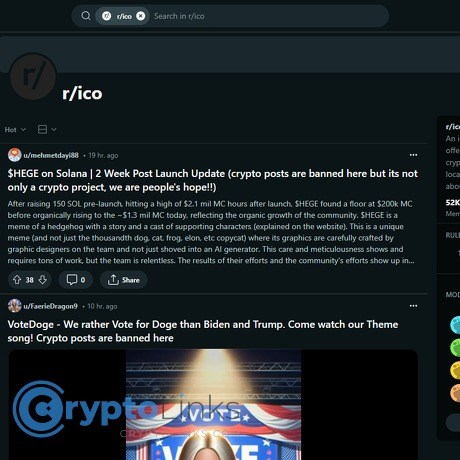
r/ico
www.reddit.com
r/ico Reddit Review Guide: How to Use It to Spot Legit ICOs (and Avoid Scams)
Feeling Lost With ICOs? You’re Definitely Not Alone
Have you ever stared at a flashy new ICO website thinking, “This looks amazing… but why does something feel off?”
Maybe the promo video is slick, the token promises “next‑gen utility,” and random people on Reddit are yelling “100x or more!”—but you still don’t really know what you’re buying.
That uneasy feeling? That’s your best friend in crypto.
Initial Coin Offerings can look like golden tickets, especially when you see stories about early investors turning a few hundred dollars into life‑changing money. But for every success story, there are dozens of people who sent funds to a project that:
- Never launched a product
- Disappeared after the token sale
- Or slowly faded into nothing while the token price bled to near zero
And here’s the real problem: from the outside, scams and legit projects often look painfully similar.
Why ICOs Feel So Confusing (Even for Smart People)
Let’s be honest. ICOs are built to look exciting. That’s the point. But when you peel back the marketing, most new investors hit the same wall.
1. Everything looks shiny, nothing looks clear
Landing pages brag about:
- “Revolutionary blockchain protocols”
- “AI + DeFi + Web3 metaverse ecosystems”
- “Guaranteed community growth and massive adoption”
But when you try to answer a simple question like “What does this project actually do?”, you get lost in buzzwords.
In one academic study on ICO whitepapers (University of Luxembourg, 2019), researchers found that scam projects often used more technical jargon and longer documents than legit ones—because complexity can hide the lack of real substance. That lines up with what I see every week: the worst scams often have the most impressive websites.
2. Marketing is loud, but real information is buried
ICOs don’t fail because they can’t build hype. They fail because they can’t build value.
On social media, you’ll see:
- “Influencers” promoting projects for undisclosed payments
- Twitter accounts doing retweet‑to‑win giveaways of the token
- Telegram groups filled with copy‑paste “To the moon!” messages
All of that noise makes it hard to spot real red flags like:
- Unclear token use
- Anonymous team
- Zero product, just a PDF and a countdown timer
3. Technical docs feel like they’re written to scare you away
You open the whitepaper, scroll through fifteen pages of math and network diagrams, and close it again. You’re not stupid, it’s just not written for you.
Most beginners don’t have a background in cryptography or protocol design. Even experienced investors struggle to tell whether complex tokenomics are smart or just smoke and mirrors.
4. Reddit is supposed to help… but it can also confuse you more
So you head over to Reddit. That’s where real people talk honestly, right?
Kind of.
On crypto subreddits, including those focused on ICOs, you’ll see:
- Genuine warnings from people who’ve seen this type of scam before
- Thoughtful breakdowns of tokenomics and legal risks
- But also: coordinated shilling, bot accounts, and fake “honest reviews”
A 2020 analysis of crypto‑related Reddit activity found strong signs of astroturfing—manufactured “grassroots” hype by coordinated accounts. That means some threads are closer to marketing campaigns than real discussion.
So you end up stuck between two extremes:
- “Everything is a scam, stay away from all ICOs.”
- “This is the next Ethereum, don’t miss it.”
Neither of those helps you make smart decisions with your money.
5. You’re told to “do your own research”… but nobody explains how
DYOR gets thrown around a lot in crypto. It sounds empowering until you realize:
- You don’t know what to check
- You don’t know which sources to trust
- You don’t know how to spot fake reviews and paid shills
Before putting even $50 into an ICO, you should be able to answer basic questions like:
- Who is behind this project, and can I verify that?
- What problem does this token actually solve?
- What happens after the ICO ends—what’s the real plan?
But most people never get that far. They see green candles, FOMO kicks in, and by the time they realize something’s wrong, the team has stopped posting updates, the Telegram group is silent, and the token is down 90%.
Where r/ico Comes In – And Why It Can Be a Game-Changer
This is where Reddit’s ICO‑focused community can either save you—or mislead you—depending on how you use it.
Used the right way, r/ico can help you:
- Catch red flags before you send a single transaction
- See what skeptics, not just fans, are saying about a project
- Find questions you hadn’t even thought to ask yet
Used blindly, it can push you into:
- Hyped projects that look “community‑approved” but are actually shilled
- Echo chambers where only positive posts survive
- FOMO decisions based on upvotes instead of facts
The trick is to treat r/ico as a tool, not as an answer machine.
How This Guide Will Help You Use r/ico Without Getting Burned
This isn’t another “trust Reddit, avoid scams, good luck” kind of article. I want you to have a practical way to use r/ico every single time you look at a new ICO.
Here’s what you’re going to get as you keep reading:
- Clear understanding of what r/ico actually is – who hangs out there, what gets posted, and what you should pay attention to.
- A smarter way to read posts and comments – how to spot shills, bots, and manufactured hype, and separate them from thoughtful analysis.
- A real‑world checklist for ICO red flags – based on patterns seen in past scams: vague roadmaps, shady teams, nonsense tokenomics, “dark periods,” and more.
- Simple explanations of crypto and ICO basics – so you don’t feel like you need a PhD to understand what’s going on.
- Extra research tools beyond Reddit – including educational hubs and explainers that help you check what you’re seeing on r/ico.
- A no‑nonsense FAQ – answering the questions people hesitate to ask publicly, like “Should I even touch ICOs as a beginner?”
You’ll see a mix of practical tips, real patterns I’ve watched play out across countless token sales, and lessons from the many people who’ve posted “I knew something felt off…” after losing money.
By the time you’re done, you should be able to look at any ICO and say, with confidence:
- “This looks reasonably solid, and I understand why.” or
- “This gives me bad vibes, and I know exactly which red flags I’m seeing.”
Not perfect certainty—nobody gets that in crypto. But a huge upgrade from “I have no idea, but Twitter loves it.”
What You Can Expect Next
You now know the core problems: ICOs are confusing, the marketing is noisy, Reddit can help but also mislead, and “do your own research” is useless advice unless someone shows you how.
So the next logical step is simple: understand the battlefield.
If you’re going to use r/ico as your early‑warning system, you need to know:
- What exactly this subreddit is
- Who posts there (and why)
- Which parts of it you can trust—and which parts you absolutely shouldn’t
Ready to see how r/ico actually works under the hood and how you can use its structure to your advantage, instead of getting swept away by hype?
Let’s look into that next.
What Is r/ico and Why Do Crypto Investors Use It?
If you’ve ever stared at a shiny new ICO and thought, “This could make me rich… or completely wipe me out,” you’re not alone. That exact mix of curiosity and fear is why a lot of people end up on r/ico on Reddit.
r/ico isn’t some secret alpha group or VIP channel. It’s a messy, brutally honest, sometimes chaotic crowd of people who care about token sales. That’s exactly why it’s so useful.
Before we talk about how to use it, let’s make sure we’re talking about the same thing when we say “ICO.”
Quick refresher: What does ICO actually stand for?
ICO stands for Initial Coin Offering.
Think of it like this:
- Crowdfunding – people send money to support a project early
- + Early token sale – instead of a T-shirt or early access, they get tokens
In an ICO, a crypto project creates a new token and sells a part of its supply to early supporters. In return, the project usually collects funds in established coins like BTC, ETH, USDT, or sometimes fiat.
In practice, a typical ICO transaction looks something like this:
- You register or pass KYC on the project’s website (in some cases).
- You get a deposit address or a smart contract address.
- You send ETH/USDT/BTC from your wallet to that address within a specific time window.
- The smart contract (or project team) allocates you a certain number of tokens based on the rate – for example, 1 ETH = 5,000 NEWTOKEN.
- Tokens are either:
- sent to your address right away, or
- locked/vested until a specific date (common for ICOs trying to look more serious).
That’s the simple version. The tricky part is that, unlike regulated public offerings, many ICOs operate in a grey area. Some are legit attempts to fund real products. Some are half-baked ideas. Some are straight-up rug pulls.
And this is where r/ico enters the story.
What is r/ico on Reddit?
r/ico is a subreddit focused on ICOs, token sales, and newer launch formats like IDOs (Initial DEX Offerings) and IEOs (Initial Exchange Offerings). If it’s about raising money by selling tokens, it tends to show up there.
Here’s what you’ll usually see when you scroll through r/ico:
- Project announcements – teams sharing their token sale, whitepaper, website, and asking for feedback (or attention).
- Reviews and “what do you think of X?” posts – users asking others to sanity-check a project they found on Twitter/Telegram/YouTube.
- Warnings and scam alerts – “I lost funds,” “Team disappeared,” “Copied whitepaper,” and similar posts that can save people real money.
- News and regulatory updates – discussions about new rules, SEC actions, or jurisdictions cracking down on token sales.
- General questions – “How does vesting work?”, “Is it safe to send from Binance to this contract?”, “Why is this ICO not listed anywhere?”
Who actually posts there?
- Regular investors – from absolute beginners to experienced ICO hunters who’ve seen multiple cycles.
- Skeptics and “professional doubters” – people who are almost allergic to hype and love breaking down weak projects.
- Project teams – founders, marketers, or “community managers” posting updates or answering questions.
- Shills and scammers – low-effort accounts that spam “100x gem, don’t miss” on anything they’re paid to promote.
That mix of honest people, curious people, and bad actors is exactly why r/ico matters. You get to watch a public battlefield where narratives around a project are pushed, questioned, defended, and sometimes destroyed.
“In crypto, the crowd is not always right, but it’s rarely quiet when something is seriously wrong.”
On r/ico, that noise and conflict can be a signal – if you know how to listen.
What r/ico is good for (and what it’s not)
To use r/ico without getting burned, you have to be honest about what it’s actually good at – and what it’s terrible at.
What r/ico is good for:
- Feeling the community’s “gut reaction” to a project
When a new ICO shows up, you’ll often see:
- some people hyped (“huge potential, strong narrative”),
- some people cautious (“team looks weak, tokenomics weird”),
- and some people furious (“I lost money in their previous project”).
That mix of reactions is more useful than any polished marketing deck.
- Spotting early red flags you might miss alone
A random user might notice:
- that the team photos are stolen from LinkedIn,
- that the smart contract is a fork of a known scam,
- that the whitepaper is copy-pasted from an old project.
One person’s obsession can save hundreds of others from the same trap.
- Hearing opposing views
Marketing keeps telling you, “This is the next big thing.” r/ico often says, “Okay, show me.”
That friction between believers and skeptics is incredibly useful. If a project can’t handle critical questions on r/ico, it probably can’t handle the real market either.
There’s some data to back this idea of crowd warnings. A 2020 academic study published via the SSRN repository looked at social media sentiment around ICOs and found that negative signals and scam accusations online tended to correlate with worse long‑term performance. The crowd doesn’t catch every fraud, but early warnings often show up in public forums before prices collapse.
What r/ico is not good for:
- Signals you can follow blindly
Upvotes are not buy signals. A post can be popular because:
- the project has real, organic interest, or
- the marketing budget is big and the shilling is heavy.
Both look similar at a glance. If you treat “popular thread” as “safe ICO,” you’re playing Russian roulette with your portfolio.
- Guaranteed picks or professional investment advice
Most users are anonymous. You don’t know:
- their background,
- their risk tolerance,
- whether they dumped on you five minutes after posting.
It’s not a research firm. It’s a crowd in a digital room.
- A substitute for doing your own research
r/ico should help you ask better questions, not answer everything for you.
If your entire process is “saw it on Reddit, bought it,” you’re basically outsourcing your money to strangers who may not care if you lose it.
So the mental model is simple:
- Use r/ico to find clues, risks, and angles you didn’t think of.
- Use your own research to confirm or reject what you read there.
When you treat Reddit as a research tool instead of a signal group, the game changes. You stop chasing comments and start collecting evidence.
Basic Reddit features you should know when using r/ico
You don’t need to be a Reddit power user to use r/ico efficiently, but a few features can make a huge difference in how much value you get out of it.
Sorting: “hot”, “new”, “top” – and why it matters
- Hot – Threads that are active and getting engagement right now.
Good for seeing:
- what everyone is currently talking about,
- ongoing drama or breaking news,
- live reaction to a new token sale or listing.
Bad for silent red flags that didn’t get attention yet.
- New – Latest posts in chronological order.
Good for:
- spotting fresh ICO announcements before they’re widely discussed,
- seeing unfiltered content before upvotes/downvotes bury it.
This is where you’ll often catch early shill attempts or new warning posts.
- Top – Posts with the most upvotes in a given time frame (day/week/month/all time).
Good for:
- finding high-quality discussions that stood the test of time,
- reading deep breakdowns and post-mortems on past ICOs,
- learning from previous cycles and mistakes.
Great for education, not necessarily for “what’s hot today.”
A smart move is to switch between these views on the same project. For example:
- Search the project name.
- Sort by new to see the latest noise.
- Sort by top (all time) to see if there were big threads months ago with serious analysis or warnings.
Upvotes, downvotes, and the myth of “karma = credibility”
Every post and comment on Reddit can be upvoted or downvoted. Over time, users accumulate karma – a simple score of how much the community has interacted positively with their content.
A few important things to remember:
- High karma does not automatically mean “this person is an expert.” They might have gotten thousands of points posting memes in a different subreddit.
- Low karma doesn’t always mean “newbie” or “scammer.” Some honest people make fresh accounts just to separate their crypto activity from personal stuff.
- Upvotes can be manipulated. There have been documented cases of vote brigading, where groups coordinate to push certain posts higher to influence sentiment.
So when you read a comment like “This ICO is definitely 100x,” the real question isn’t “How much karma does this person have?” It’s:
- Do they provide specific reasons or just hype?
- Does their posting history look like a human being or a walking advertisement?
- Are other experienced users agreeing, or pushing back hard?
Karma is a tiny signal. Treat it as a hint, not a verdict.
Using search to look up older threads on the same ICO
The search bar in r/ico is one of the most underrated tools you have.
Before you put a single dollar into any token sale, type the project’s name, token ticker, or website into the subreddit search. Then do this:
- Check older posts – Are there discussions from 3–6 months ago? Did the team promise stuff back then? Did they deliver?
- Look for recurring complaints – Multiple users mentioning the same issue (withdrawals blocked, token distribution delayed, KYC abuse) is a serious signal.
- Watch for mass-deleted comments – Sometimes you’ll see threads with lots of “[deleted]” entries. That can mean moderation, user regret, or cleanup attempts by shills who nuked their accounts after things went south.
Across crypto cycles, there’s a pattern: people often say, “I wish I had checked what others were already saying before I sent money.” r/ico’s search function gives you that chance in a few clicks.
Once you get comfortable with these basic Reddit tools, the next step is where things get really interesting: turning r/ico into a kind of “ICO radar” you can use systematically, every single time you look at a new project.
Want to see exactly how to do that – step by step, without getting lost in the noise or tricked by shills? Let’s walk through that process next.
How To Use r/ico Step by Step (Without Getting Lost in the Noise)
If you’ve ever opened r/ico, scrolled for two minutes and thought, “What the hell am I looking at?”, you’re not alone.
There are legit warnings, smart analysis, low-effort shills, straight-up scams and some genuinely good opportunities – all in the same feed. The trick is not to read it like entertainment, but to use it like a research tool.
Here’s the exact process I use every time I check an ICO on r/ico – the same way I’d approach it before putting even $1 into a token sale.
Step 1: Search the project name before you buy anything
Most people land on r/ico after they’ve already fallen in love with a polished website or a slick YouTube promo. That’s backwards. First stop should be the search bar.
At the top of the subreddit, there’s a search field. Use it like this:
- Type the full project name (and ticker if it has one). Example: “ProjectX ICO” or “PXO token”.
- Sort by “new” to see recent threads and by “top” (past month / past year) to spot posts that got real traction.
- Try variations like “[project] scam”, “[project] vesting”, “[project] KYC”. You’d be surprised how often that reveals hidden drama.
Why this matters: academic research on online investor forums repeatedly shows that early warning signs usually surface in community discussions long before they hit mainstream news. In stock markets, this is well documented. In crypto, it’s even louder because there are fewer filters.
When you search, don’t just skim headlines. Look for patterns over time:
- Repeated complaints: Are multiple users calling out the same issue – like locked withdrawals, broken promises, or shady token allocations?
- Repeated shill comments: Do you see a bunch of accounts saying almost the same thing? “This is the next 100x”, “Don’t miss this guaranteed gem”, “Private sale closing soon!!” – all with similar wording?
- Deleted posts: Threads where the original post or many comments are deleted can hint at:
- Mods removing blatant shilling or spam
- Users deleting posts after accusations or uncomfortable questions
- Projects asking people to “clean up” the discussion (yes, this happens)
One example I still remember: a small DeFi ICO that looked polished on its website. On r/ico, the search showed a steady stream of “withdrawals stuck” and “devs not answering” posts over weeks. Individually, each post was easy to dismiss. Together, it was a giant red flag – and sure enough, a few weeks later, the project vanished.
“Where there’s smoke, there’s usually a Telegram admin saying ‘FUD’.”
The search bar is your early-warning radar. Use it before you let any marketing pitch get inside your head.
Step 2: Read comments like an investigator, not a fan
When you’re already excited about an ICO, your brain wants to agree with positive comments and ignore criticism. That’s how people get wrecked. You have to read r/ico like a detective, not a cheerleader.
Here’s what I look for in the comments section:
- Detailed analysis over empty hype
Comments like “To the moon!” or “100x easy” are useless. I pay attention to posts that:
- Break down tokenomics (supply, vesting, allocations)
- Question technical claims (can it actually scale? is it realistic?)
- Compare to similar projects and explain why this one is better or worse
- Checking user history to spot shills
When a comment sounds suspiciously positive, I click their username and look at:
- Do they only post about one project?
- Is every comment some variation of “amazing team”, “insane upside”, “don’t miss out”?
- Is their account very new with low karma but intense activity on a single ICO?
If all three are true, that’s textbook shill behavior. I treat their comments as marketing, not honest opinion.
- Specific, uncomfortable concerns
I really pay attention when users mention things like:
- Tokenomics: “Team gets 40% unlocked on day one,” or “Private sale investors pay 90% less than public buyers.”
- Vesting: “There’s no vesting schedule for the team or advisors,” or “Cliff is only 1 month before huge unlocks.”
- Legal issues: “They’re selling to US investors but have no legal opinion,” or “They claim it’s ‘just a utility token’ but it clearly behaves like a security.”
- Roadmap realism: “They promise a full L2 chain, cross-chain DEX, and mobile wallet in 6 months with a 3-person team.”
One interesting study from the traditional finance world showed that forum posts with specific, verifiable claims were significantly more predictive of future outcomes than vague bullish or bearish comments. That logic applies perfectly here: the more concrete the concern, the more weight I give it.
So when you’re reading r/ico, ask yourself: “If I didn’t already want this ICO to succeed, how would I read this comment?” That small mindset shift can save you from ignoring the obvious.
Step 3: Use r/ico to build a research checklist
Good researchers don’t just consume information; they turn it into repeatable systems. r/ico is a goldmine for that, because people ask smart questions you might not have thought of.
Every time you scroll through a thread and see a sharp comment, think: “Is this a question I should add to my checklist?” Over time, you build a simple framework you can use for any ICO.
Here are classic questions I’ve picked up from r/ico discussions that now sit on my own list:
- Who is on the team?
- Are their names and LinkedIn profiles public?
- Do they have relevant experience (crypto, finance, tech) or just vague buzzword-heavy bios?
- Is there an actual product, or just a whitepaper?
- Is there an MVP, testnet, GitHub repo, or at least a working demo?
- If they’ve been around for more than a year and still have nothing but “concepts”, that’s a concern.
- What is the token actually used for?
- Does it have a clear role (governance, fees, collateral, staking)?
- Or is the “use case” just some vague promise like “ecosystem utility” with no concrete mechanism?
- Are there “dark periods” in the roadmap?
- Are there long stretches of time labeled with things like “marketing expansion”, “ecosystem growth”, “future partnerships” without specific milestones?
- Does it feel like they’ve planned the fundraising stage perfectly, but everything after that is just fog?
Whenever you see a comment that makes you think “Oof, that’s a good point,” write it down. After a few projects, you’ll notice your checklist is doing half the thinking for you.
Pro tip:
- Save useful threads using Reddit’s “save” feature or copy important comments into your own notes.
- Create a small document or Notion page titled “ICO Checklist” and keep updating it with questions sourced from r/ico discussions.
This is how you go from feeling overwhelmed to feeling in control. Instead of “What am I supposed to look at?”, you show up with a clear list: “I know exactly what I’m checking today.”
Step 4: Watch how the project team behaves on Reddit
An underrated part of r/ico is seeing how teams act when they don’t fully control the narrative. Their behavior often reveals more than their whitepaper.
Here’s what I watch for:
- Do they answer hard questions?
When someone asks, “Why does the team get 30% of tokens upfront?” or “How are you handling regulation in the US?”, pay attention:
- Do they respond with specifics and links to docs?
- Or do they dodge with phrases like “Don’t worry, we’re working with top legal partners” but can’t name any?
- Are they transparent or defensive?
Teams that are comfortable with what they’re doing usually:
- Admit what’s not ready yet
- Explain delays instead of pretending everything is “on track”
- Thank people for criticism and sometimes even change things because of it
The sketchy ones:
- Label any concern as “FUD”
- Attack users for asking normal questions
- Encourage people to “ignore Reddit” and “just focus on our Telegram”
- Do they try too hard to control the conversation?
Classic signs include:
- Lots of brand-new accounts defending the project aggressively
- Mods or “community managers” asking people not to discuss certain topics in public
- Deletion of comments that are critical but respectful and specific
I’ve seen projects where the code looked okay, but their behavior on Reddit was basically damage control 24/7. In almost every case, that story ended badly for investors.
Remember: you’re not just investing in technology; you’re investing in people. r/ico lets you see how those people behave under pressure, in real time.
Step 5: Combine what you see on r/ico with off-Reddit research
Reddit is a powerful filter, but it’s not the full picture. Once you’ve gathered notes from r/ico, the next step is to verify everything outside the subreddit.
Here’s how I connect the dots:
- Start with the official sources
- Visit the project’s website and check if it actually matches what people are saying on Reddit.
- Read the whitepaper (or at least the sections on tokenomics, roadmap, and use case).
- Check their social channels (Twitter/X, Telegram, Discord) for consistency in messaging and timelines.
- Verify the team
- Look up founders and key devs on LinkedIn. Do their profiles look real? Any mutual connections? Real work history?
- Search their names plus “scam”, “fraud”, or the names of previous projects they’ve been involved in.
- Check the code and repos (if you can)
- See if they have a public GitHub (or GitLab, etc.). Is there actual activity or just a ghost repo?
- Even if you’re not technical, you can see:
- How many commits there are
- How many contributors
- Whether they’ve just uploaded everything last week before the ICO
- Look for independent reviews
- Search for the project name with “review”, “analysis”, or “ICO report”.
- Check if multiple sources raise the same issues you saw mentioned on r/ico.
- Revisit r/ico with fresh eyes
- After doing your external research, go back to the threads you saved.
- Now ask: “Which comments were actually right? Which ones look wrong or misleading?”
- This helps you train your instincts over time.
Studies on financial decision-making show that people who cross-check community sentiment with independent data make far better investment decisions than those who rely on one source. In other words: you want both the crowd’s raw signal and your own structured research, not just one or the other.
Use r/ico as your early-warning system, your inspiration for what to investigate – then let your own homework be the final judge.
Now, here’s where it gets interesting: even if you follow all these steps, there are still ICOs designed to look “good enough” while hiding serious problems under the hood. So the real edge comes from recognizing the patterns that most beginners miss – the subtle signs that an ICO is more smoke than substance.
So the question is: once you’ve used r/ico the right way, how do you actually spot the scams before they spot your wallet? That’s exactly what I’m going to walk through next.
How To Spot ICO Scams (Using r/ico and Your Own Research)
Every scam I’ve ever looked back on had the same line in the story:
“Something felt off… but I ignored it because I didn’t want to miss out.”
FOMO is exactly what scammy ICOs are designed to trigger. The good news? Once you know what to look for, it gets a lot easier to separate empty hype from real potential.
Here’s how I use r/ico together with my own research to flag bad ICOs before they wreck a portfolio.
Do you actually understand the project?
If you can’t explain an ICO in one or two simple sentences, you’re not investing… you’re guessing.
That sounds harsh, but it’s one of the most reliable filters I use.
I like to ask myself a basic question:
- “What problem does this project solve, and how?”
If my answer turns into a paragraph of buzzwords, that’s a warning light.
You’ve probably seen these descriptions on r/ico and project sites:
- “AI-powered, quantum-ready, multi-chain liquidity aggregator for next-gen Web3 synergy.”
- “Revolutionizing the decentralized meta-economy through tokenized user engagement dynamics.”
Looks fancy. Means nothing.
A real project should sound more like:
- “We’re building a payment app that lets freelancers get paid in stablecoins with lower fees than PayPal.”
- “We’re tokenizing invoices so small businesses can get paid faster by selling their receivables to investors.”
When I’m on r/ico, I scan the comments for people who try to summarize the idea in plain English. If the top replies to a post look like this:
- “I’ve read the whitepaper twice and still don’t get what they actually do.”
- “So… is this just a wallet with a token slapped on?”
…that’s usually a sign the team is hiding a weak idea behind complicated language.
There’s a pattern here that’s been studied in traditional finance too. Scams and low-quality investments often use longer, more complex language and avoid clear explanations. In crypto, it’s the same game, just with Web3 buzzwords.
So, a simple rule:
- If nobody on r/ico can explain the project in simple terms, be extra careful.
Will the project provide real value?
Forget the chart for a second. Ask: “If the token never went up in price, would anyone still use this?”
If the answer is no, then you don’t have a product. You have a speculative chip.
Some of the most honest comments on r/ico sound like this:
- “Who actually needs this?”
- “Why would users switch from existing solutions?”
- “This could work as a normal SaaS product. Why the token?”
Those questions hurt, but they’re exactly the kind you should be asking yourself.
Watch out for ICOs where the only value argument is:
- “Supply is limited so price must go up.”
- “Early adopters will be rewarded when more people join.”
- “Once we’re listed on big exchanges, it’s going to the moon.”
That logic is suspiciously close to how Ponzi and pyramid schemes sell themselves: the value depends on new people entering, not on actual use.
On the other hand, when I see r/ico users asking practical questions like:
- “Are there businesses already interested in integrating this?”
- “How does this save time or money compared to existing tools?”
- “Is there any traction, beta users, or testnet metrics?”
…I know I’m in a more serious conversation.
A helpful test you can try:
- Imagine the token price is frozen forever. Would the idea still make sense? If not, you’re probably looking at speculation wrapped as “innovation.”
Does this project really need a blockchain and a token?
Not everything needs a token. In fact, most things don’t.
I’ve seen projects on r/ico claiming to be:
- “Blockchain for coffee shop loyalty points”
- “Blockchain for your gym membership”
- “Blockchain for bookmarking websites”
Could you use a blockchain for those? Sure. But do you need to? Usually not.
A quick sanity check I use:
- Would this work just as well — or better — as a normal app with a regular database?
If the answer is yes, the token might exist for one reason only: fundraising.
Reddit is often ruthless about this. You’ll see comments like:
- “This is just a to-do list app with a token.”
- “Why does your ride-sharing startup need its own coin instead of using USDC or fiat?”
That’s exactly the right energy.
When reading an ICO pitch, check:
- Is the token essential to the system? For example, used to pay fees, secure the network, govern the protocol, or reward real economic activity.
- Could the same thing be done using an existing crypto like ETH, USDC, or BTC instead of inventing a new token?
If the only role for the token is “you buy it now and maybe sell it higher later,” that’s not utility — that’s a red flag.
Who is the team behind the ICO?
In early-stage projects, you’re not just backing an idea. You’re backing people.
That’s why I spend a lot of time digging into the team whenever I’m reviewing an ICO, and r/ico can be incredibly helpful here.
Here’s my usual process:
- Search their names on LinkedIn and Google. Do they have a real history in tech, finance, or the relevant industry?
- Check for previous projects. Were they successful? Abandoned? Scammy?
- Verify advisors. Are the “advisors” actually aware they’re listed? Are they well-known or just random stock photos?
You’d be surprised how many times r/ico users catch things like:
- Team photos stolen from other websites.
- LinkedIn profiles created weeks before the ICO with almost no real content.
- “Advisors” who publicly deny being involved once someone tags them on Twitter.
There have been cases where Redditors did reverse image searches on “team” photos and found the same pictures used on completely unrelated sites. That’s not just a red flag, that’s a neon sign screaming “run.”
Another small but useful check on r/ico:
- Look for threads where people discuss the founders by name.
- See if anyone has dug up previous business history, lawsuits, or failed ICOs.
- Watch how the team responds when confronted — do they answer calmly with evidence, or do they attack and deflect?
Good teams usually:
- Have verifiable profiles.
- Show their faces in interviews or AMAs.
- Don’t overstate their achievements (“ex-Google intern” turned into “ex-Google engineer” is a classic exaggeration to watch out for).
Are there “dark periods” or gaps in the roadmap?
A roadmap is not just a pretty graphic. It’s a commitment.
One pattern I pay close attention to is what I call “dark periods”: large chunks of time on the roadmap where nothing concrete is planned.
It usually looks like this:
- Q1: Token sale, exchange listing.
- Q2: Marketing, more exchange listings.
- Q3–Q4: “Partnerships,” “ecosystem growth,” “TBA features.”
Translation: we’ll raise money now, pump the token a bit, and then… we’ll see.
When roadmaps are full of vague phrases like:
- “Strategic partnerships”
- “Global expansion”
- “Ecosystem development”
…but no actual deliverables (MVP launch, audited smart contracts, user metrics, open beta, etc.), it’s a problem.
r/ico users are usually quick to ask:
- “What exactly are you shipping in Q3?”
- “Where is the MVP or prototype?”
- “Why is there nothing scheduled after the token sale?”
When those questions get ignored or brushed off with “we will announce later,” I start mentally lowering the project’s credibility.
What I want to see instead:
- Specific milestones with rough timelines.
- Clear separation between tech goals and marketing goals.
- Post-ICO development plans that don’t revolve solely around listings and hype.
A simple check you can use:
- Could you hold the team accountable to the roadmap in 6–12 months? If not, it’s too vague.
If things look fishy, they usually are
Your brain is much better at picking up subtle danger signs than you think. When something feels off, that’s not paranoia — that’s pattern recognition.
Most r/ico warning posts start with a sentence like:
- “I don’t know why, but this project feels shady.”
- “I was excited at first, then the more I read, the more uneasy I got.”
Here are some classic red flags that often show up together:
- Guaranteed returns. “Up to 30% profit per month” or “0% risk” is straight-up scam language.
- Aggressive marketing. Telegram DMs, spammy comments, a flood of low-quality influencers praising it at the same time.
- Huge referral bonuses. Extra tokens for bringing “just one more friend” is how ponzis grow.
- No real company details. No address, no registration, no legal entity you can verify.
- Anonymous everything. Not just pseudonymous devs (which can be okay in some cases), but nobody willing to stand behind the project publicly.
- Overfocus on price talk. If every social channel is “when moon?”, “when Lambo?”, and almost nothing about product progress, that’s a bad sign.
I’ve seen people on r/ico share stories where they felt something was wrong but didn’t want to look “negative” or “salty,” so they ignored it. Months later, the project vanished, the site went offline, and the team went silent.
Learn from that:
- If your gut says “this is off,” walk away. There will always be another ICO.
Protecting your capital is more important than catching every opportunity. Missing one legit 10x hurts a lot less than getting drained in a blatant scam.
“Do your own research” – what that actually means in practice
Everyone loves to say “DYOR” in crypto. But almost nobody explains how to actually do it.
Here’s what “do your own research” means when I use r/ico as a starting point:
- Read the whitepaper like a skeptic. Look for clear explanations, real numbers, and concrete plans. If it’s 30 pages of fluff, that’s telling.
- Check the team’s background. Use LinkedIn, Google, Twitter, and past project history to see who you’re dealing with.
- Verify the code if possible. If you can’t review it yourself, at least check whether the smart contracts were audited by a reputable firm and whether the report is public.
- Look up the legal status. Does the project mention its jurisdiction, corporate entity, or any legal opinions on the token? Or is it just “we are decentralized, lawless, and free”?
- Compare with independent guides and reviews. Use educational resources and neutral articles to see if the project’s narrative matches reality.
- Use r/ico as a cross-check, not a verdict. See what people are praising, what they’re worried about, and whether there are consistent complaints over time.
When multiple strangers on r/ico and multiple external sources all point to the same concerns — fake team, unclear token use, shady tokenomics — you’re not being “paranoid” by walking away. You’re being rational.
And here’s the emotional part that matters more than any checklist:
You don’t have to prove an ICO is a scam to avoid it. You only have to prove to yourself that it’s worth the risk — and most aren’t.
Once you really understand that, your entire approach to ICOs changes. You stop chasing every shiny new token and start asking better questions — including the most basic one…
But what if you’re still not fully comfortable with how crypto and ICOs work under the hood? How do you even start doing this kind of research if the technology itself feels confusing?
That’s where understanding the fundamentals of crypto becomes your secret weapon — and that’s exactly what we’re going to unpack next.
Crypto & ICOs for Beginners: Basics You Need Before Using r/ico
If you’re new to crypto and ICOs, scrolling through r/ico can feel like landing in the middle of a conversation in a language you kind of recognize, but don’t really speak yet.
Before you trust any Reddit thread, you need a basic mental map of how crypto works, why ICOs exist, and what can go wrong. Once that’s in place, r/ico stops being a noisy hype machine and starts becoming a pretty useful early-warning radar.
Quick crypto 101: What is a cryptocurrency?
Let’s strip away the buzzwords for a second.
A cryptocurrency is basically:
- Digital money that only lives on the internet
- Secured by cryptography (math that keeps things safe)
- Recorded on a blockchain – a public list of transactions that everyone can verify
Think of a blockchain like a global spreadsheet that nobody can edit in secret. Every transaction is added in blocks, and once a block is confirmed, it’s locked in. No central bank. No manager. Just code, math, and a network of computers agreeing on the same history.
There’s one key mental shift most beginners miss:
You don’t actually “store coins” in your wallet. You store keys.
- Your public key / address is like your bank account number – you can share it so people can pay you.
- Your private key is your master password – anyone with it can move your funds.
If you lose your private key, your coins are gone. No password reset, no support ticket, no hotline. A study by Chainalysis estimated that about 20% of all Bitcoin might be lost forever because people lost access to their keys. That’s how unforgiving this stuff is.
So when you see people on r/ico talk about wallets, keys, and contracts, they’re really talking about how you control value on a blockchain without a middleman.
What makes ICOs riskier than just buying Bitcoin or ETH?
Buying Bitcoin or Ethereum is like buying into a long-established city. It has problems, sure, but it exists, it works, and millions of people use it.
Buying into an ICO is more like funding a sketch on a napkin that might one day become a city. Or might just… vanish.
Here’s why ICOs are so much riskier:
- They’re new and untested. Most ICO tokens are brand new. No long-term track record, no proven product, often not even a working prototype. You’re paying for promises.
- Liquidity is weak. Bitcoin and ETH trade on almost every major exchange with deep order books. ICO tokens might be traded on one tiny exchange (or none at all for months). That means:
- You may not be able to sell when you want.
- A single big buyer or seller can swing the price like crazy.
- You’re betting on the team’s honesty and execution. With an ICO, you’re funding a small group of people and trusting them to:
- Build the product
- Handle the money responsibly
- Not vanish when things get tough
There’s a classic pattern you’ll see in r/ico threads: early supporters praising the team, then months later, the same users posting angry updates about delays, broken promises, or founders going quiet.
- Regulation is murky. In many countries, ICO tokens can legally count as securities. That means they should be regulated like stocks – registered, disclosed, audited. A lot of ICOs simply skipped that part.
In 2018, the U.S. SEC reviewed dozens of token sales and stated that most ICOs they looked at were likely unregistered securities offers. Some projects ended up fined, forced to refund investors, or completely shut down. You don’t want to be the last one holding that bag.
“In crypto, you don’t get paid for how brave you are. You get paid for how selectively cautious you are.”
When you see people on r/ico chasing the “next 100x,” remember: the higher the upside, the higher the odds you’re funding something that might never get off the ground.
Basic security rules before you even think about an ICO
Before you send a single cent into any ICO, there are a few security rules that should be automatic. These aren’t “advanced tricks.” These are “don’t get robbed on day one” basics.
- Never send funds to an ICO from an exchange account.
If you send ETH directly from, say, Binance or Coinbase to an ICO smart contract, two things can go wrong:
- You might not receive the ICO tokens, because the contract can’t link them to your personal wallet.
- If something goes wrong, your exchange support will likely say, “We can’t help you with external contracts.”
Always send from a wallet you control (like MetaMask or a hardware wallet), where you hold the private keys.
- Double-check contract addresses and URLs like your life depends on it.
There are entire scam operations that do nothing but create fake ICO websites with one letter changed in the URL, then spam links in places like r/ico. You click, you send funds to a fake address, and it’s gone.
Basic routine:
- Get the official link from the project’s verified website or official social channels.
- Type URLs manually or use bookmarks, don’t trust one-off links in comments.
- Compare the contract address from multiple sources (website, official Telegram, Twitter).
- Don’t click random links in comments or DMs.
If someone messages you on Reddit claiming to be “support” or “admin” with a special offer, treat it as a scam until you can prove otherwise. A lot of beginners get lured into:
- Fake “airdrop claim” pages that drain their wallet
- Fake Metamask update links that steal private keys
- “Exclusive pre-sale” offers that require you to send ETH to a personal address
Legit teams rarely, if ever, DM random users for money.
- Use hardware wallets for serious amounts.
If you’re moving anything more than “tuition money you’re willing to lose,” consider a hardware wallet like a Ledger or Trezor. These devices keep your private keys offline, which protects you from a lot of malware and phishing tricks.
There’s a reason almost every long-term crypto security guide, from blogs to academic security studies, repeats the same advice: hardware wallets massively reduce your risk of getting hacked.
Once you start reading r/ico with this security mindset, you’ll notice how often people post things like: “I sent from my exchange and never got my tokens” or “I clicked a link in the comments and my wallet was drained.” The idea is to learn from their pain instead of repeating it.
How to use r/ico safely as a beginner
With the basics in place, r/ico can go from confusing and dangerous to surprisingly educational. The trick is how you use it.
Here’s how I’d approach it if you’re just starting out:
- Begin as an observer, not a participant.
For your first weeks on r/ico, don’t invest. Just read.
- Watch how people talk about projects.
- Notice the difference between comments that sound emotional and ones that sound analytical.
- Pay attention to common red flags users complain about (locked tokens, vanishing devs, unclear use cases).
You’ll start to build an internal filter just by seeing what has burned others.
- Ask beginner questions – but listen to how people answer.
There’s nothing wrong with asking, “Can someone explain this ICO in simple terms?” What matters is how the replies look:
- If the answers are all “Don’t miss this bro, huge gains” with no substance, that’s not a community you should trust.
- If some users calmly break down risks, team background, tokenomics, and legal aspects, pay attention. Those are the people you want to learn from.
Over time, you’ll recognize which usernames consistently post thoughtful content and which accounts pop up only to hype one project.
- Treat every “next 100x gem” comment as marketing until proven otherwise.
On r/ico, you’ll see:
- Fresh accounts pushing the same project in multiple threads
- Copy-paste comments praising a team or calling something “undervalued”
- Predictable phrases: “not financial advice but…” followed by pure shilling
A lot of these are either paid shills or people who are emotionally attached to their bags. Neither group cares about your downside.
- Learn to spot the emotional traps.
ICOs are built around two emotions: fear of missing out and fear of loss.
- “This pre-sale closes in 2 hours.”
- “Only 100 whitelist spots left.”
- “Everyone will be rich except the ones who hesitate.”
Any time a thread on r/ico makes you feel rushed, step away. Good opportunities will still look good after you’ve slept on them. Scams, on the other hand, almost always need you to move fast, before you start asking questions.
- Use r/ico as a training ground, not a shortcut.
You can literally practice by pretending to invest:
- Find an ICO being discussed.
- Do your research as if you were going to invest $1,000.
- Write down your reasons for and against investing.
- Then don’t invest – just watch what happens over the next 3–6 months.
This “paper portfolio” approach lets you build experience with zero financial risk. You’ll see how often your initial excitement would have led you straight into a dump or rug pull.
Once you can read an r/ico thread without feeling rushed, confused, or easily swayed by hype, you’re in a much better position than most beginners who throw money at the first shiny pre-sale they see.
Now here’s where it gets interesting: r/ico is only one signal. The real edge comes when you blend what you see there with solid external tools, research sites, and a personal checklist that keeps your emotions in check. Want to see how to build that kind of “research stack” without going insane trying to track every new token sale?
Extra Tools, Resources, and How I Use r/ico in My Own Research
How I Personally Use r/ico When Reviewing Projects
If you’ve ever wondered what my actual workflow looks like when I’m researching ICOs for Cryptolinks, this is where I pull back the curtain.
I don’t open r/ico, sort by “hot,” and blindly trust whatever’s at the top. That’s how people get wrecked. I treat the subreddit like a sensor – it tells me where the noise is, where the smoke is, and sometimes where the fire already started.
Here’s how I really use it when I’m checking a new project:
- First step: reputation check. I search the project name and token ticker on r/ico. I want to see if the project already has a “story” attached to it – good or bad.
Sometimes I see threads like:
“Is anyone else having trouble withdrawing from XToken’s platform?”
or
“XToken team copied sections of their whitepaper from another project, here’s proof.”
When multiple users are independently reporting the same issue – stuck withdrawals, vanishing Telegram mods, changing tokenomics overnight – that’s a serious warning sign. I don’t care how slick the website looks after that.
- Second step: technical and legal concerns. I pay a lot of attention to comments that talk about actual mechanics: vesting schedules, token allocation, contract code quirks, KYC/AML, jurisdiction, and so on.
For example, I’ve seen threads where devs pointed out that an ICO smart contract allowed the team to pause withdrawals or mint extra tokens at will. There’s usually a buried comment like:
“Checked the contract on Etherscan, function ownerMint() lets them create unlimited tokens if they choose to. This isn’t capped.”
That single comment is worth more than 500 “this is going 100x” posts. When I see stuff like that, I’ll go check the contract myself or look for an external code review. If the team hasn’t clearly explained why that function exists or how it’s limited, it goes straight into my “high risk” bucket.
- Third step: assessing team transparency in live fire. I don’t just check if the team shows up on Reddit; I check how they behave when things get uncomfortable.
I’ve seen teams that answered tough questions head-on: explaining delays, admitting mistakes, posting updated roadmaps and audit links. Even if the project isn’t perfect, that honesty counts a lot.
On the flip side, I’ve seen teams that spam positive announcements but ignore any pointed questions about token unlocks, jurisdiction, or investor protections. Or worse, they send new accounts to defend them with low-effort comments like, “Stop FUD, devs are working hard.” When I spot that pattern, I mark it down immediately.
When I’m reviewing a project for Cryptolinks, r/ico is basically my early warning radar. I’m not impressed by upvotes. I’m impressed by:
- Consistent, detailed criticism from different users
- Documented issues: screenshots, TX hashes, links to on-chain data
- How the team responds when confronted with those issues
The subreddit doesn’t make the final call for me, but it often tells me where to dig deeper – or when to stop wasting my time.
Useful External Resources to Combine With r/ico
Reddit gives you raw opinions and real-world pain. That’s powerful, but it’s not structured. To balance it, I mix r/ico with more “classroom-style” resources that give you frameworks and fundamentals.
Here’s the kind of stack I keep going back to:
Educational explainers on ICOs and scams. I like resources similar to Bitpanda’s Academy-style guides – step-by-step content that walks through red flags like unrealistic APYs, fake teams, and shady tokenomics. I pull these in especially when I’m updating my own internal checklist.
Crypto basics hubs. Think of university-style crypto overviews that break down how wallets, public/private keys, gas fees, and smart contracts actually work. When you understand the plumbing, it’s much easier to spot when an ICO’s claims are technically impossible or wildly exaggerated.
Practical ICO breakdown articles. These are guides that focus on how fundraising is structured: soft cap vs hard cap, vesting, lockups, SAFT agreements, investor rights, jurisdiction (BVI, Switzerland, Dubai, etc.), and how regulation in different countries might treat a particular token.
News aggregators and independent review sites. If r/ico is buzzing about a project – good or bad – I check news sources and long-form reviews to see if anyone has done deeper analysis, audits, or interviews with the team.
The magic isn’t in using one “perfect” resource. It’s in cross-referencing:
- Someone on r/ico calls the ICO a Ponzi? I check structured scam-spotting guides to see if the pattern matches.
- A project promises compliance in multiple countries? I compare it with legal explainers that outline what would actually be required.
- The team says the tokenomics are sustainable? I look at external breakdowns of similar token models and how they ended up in the real market.
That mix of community feedback + structured education is where you stop guessing and start actually analyzing.
How to Build Your Own Personal “ICO Research” Checklist
At some point, you don’t want to rely on my process or anyone else’s. You want your own system – something that fits your risk tolerance, your time, and your level of technical understanding.
A personal ICO checklist is exactly that system. Mine is always evolving, and yours should too, but here’s a simple structure you can start with and layer on top of r/ico.
1. Understand the project in your own words
- Can you explain what the project does in 2–3 simple sentences?
- What real-world problem is it trying to fix?
- Who actually uses it – and why would they care?
If you can’t answer those without copy-pasting buzzwords from the whitepaper, you’re not ready to touch the token yet.
2. Check if it solves a real problem
- Is there a real pain point, or is it “Uber on the blockchain” just because that sounds cool?
- Does the token actually do something (governance, fee discounts, access), or is it just there to raise money?
- What happens to the token if the project succeeds – does it naturally gain demand, or does it still depend mostly on hype?
When r/ico users question usefulness – “Why does this need a token at all?” – I pay a lot of attention. You should too.
3. Verify the team and advisors
- Find the core team on LinkedIn and other social platforms: do they look real, active, and consistent?
- Check if their “past experience” actually matches publicly verifiable facts (previous companies, GitHub contributions, conference talks).
- Look up advisors: are they actually associated with the project, or did the team just slap well-known names on a slide deck?
- Search their names on r/ico and across crypto forums to see if they show up in older scams or failed launches.
If r/ico has threads saying “this founder was also behind XYZ token that rug-pulled in 2019” – that goes straight to the top of your notes.
4. Study tokenomics and roadmap carefully
- Token allocation: How much goes to the team, advisors, private investors, and community? Are there lockups and vesting schedules?
- Emission and supply: Is supply capped? Can the team mint more? How does the token enter circulation?
- Roadmap clarity: Are there specific milestones with timeframes, or is it just a vague “future partnership, global expansion” plan?
- Dark periods: Are there stretches in the roadmap where nothing real is promised but big price moves are implied? That’s often where early insiders plan to exit.
This is where r/ico can be a goldmine: someone will usually spot weird vesting, strange unlock timings, or roadmap gaps. You don’t need to spot everything yourself; you just need to be smart enough to listen when others point it out.
5. Scan community feedback across r/ico and other platforms
- Read multiple r/ico threads, not just the latest one.
- Look for repeated issues: customer support ghosting, withdrawal problems, broken promises, stealth changes to tokenomics.
- Check the project’s Telegram, Discord, or X (Twitter) presence: are questions getting real answers, or are mods muting anyone who asks something hard?
The pattern usually appears before the collapse. People start saying things like, “The team stopped replying,” “They pushed back the listing date again,” or “They removed the whitepaper and updated the token allocations quietly.” Those are your early exits.
6. Use external educational sites and news to double-check big claims
- When a project claims regulatory clarity, see if any legal or educational sites explain how plausible that is.
- When they promise huge yields, compare with established guides on sustainable DeFi yields vs Ponzi-like structures.
- When they talk about unique tech, look for independent reviews or technical explainers that confirm it’s more than marketing fluff.
Your checklist shouldn’t be static. Every bad experience (yours or someone else’s on r/ico) is a chance to update it:
- Did you get burned by unlocked team tokens? Add “check vesting and unlock schedule” to your list.
- Got stuck in an ICO that kept delaying listings? Add “look for realistic exchange and listing plans, and don’t trust fixed dates without proof.”
- Saw a project vanish after a big marketing hype run? Add “verify long-term communication patterns, not just launch week noise.”
Over time, this checklist becomes your personal shield. It won’t be perfect, but it will make you far harder to fool than the average person chasing every shiny presale link.
Now, even with all of this, there’s still one thing people keep asking me: “How do I actually know if my ICO is legit, and how much can I really trust r/ico when the money’s on the line?”
That’s exactly what I’m going to tackle next – along with the questions most people are a bit scared to post publicly.
r/ico FAQ: Everything You Wanted To Ask (But Maybe Didn’t Want To Post on Reddit)
Let’s wrap things up by tackling the questions I see again and again from people using r/ico and looking at ICOs for the first time. These are the questions you might hesitate to post publicly because you think they’re “too basic” or you don’t want to get roasted in the comments.
You’re not alone. I see these same concerns in my inbox, on Reddit, on Telegram… everywhere.
So let’s go through them clearly and honestly.
FAQ: How do I know if my ICO is legit?
The short answer: you’ll never have 100% certainty. But you can push the odds dramatically in your favor by running a project through a simple, brutal checklist.
When I’m checking an ICO, I ask myself these questions:
- Can I clearly explain what this project does?
If you can’t explain it in 2–3 simple sentences, something’s wrong. Either:
- The project is intentionally confusing you with buzzwords, or
- You’re missing key info because the team hasn’t communicated properly.
On r/ico, I pay attention to whether anyone in the comments can actually explain the project in plain language. If everyone’s repeating the same vague phrases like “revolutionizing DeFi” or “bringing Web3 to the masses” without specifics, that’s a warning sign.
- Does it solve a real problem for real users?
A legit ICO should be tied to a real-world use case, not just “token go up.” Ask yourself:
- Who exactly is supposed to use this?
- Are they suffering from a real problem right now?
- Is this solution better than what already exists?
I’ve seen countless r/ico threads about “blockchain social networks” or “decentralized Uber” where users point out basic practical issues: no users, no clear advantage over normal apps, or legal/regulatory landmines. When the only benefit is “early investors can get rich,” that’s not a product. That’s a scheme.
- Does this honestly need a blockchain and a token?
Not everything should be on a blockchain, and not everything needs its own token. A simple sanity check:
- Could this work just fine as a regular app with a normal database?
- Does the token unlock something meaningful (governance, fees, access, security), or is it tacked on as a fundraising tool?
There was a pretty famous wave of projects in 2017–2018 that added a token to things that were already working perfectly well without one (like “tokenized coffee loyalty points”). r/ico users often tore these apart in comment sections, asking the obvious question: why is this a token and not just an in-app point system?
When the team can’t answer “why token?” in a convincing way, I move on.
- Can I verify the team and their track record?
This is where things get serious. A lot of ICO scams don’t even try that hard to hide.
I usually do this:
- Search key team members on LinkedIn and see if their experience looks real.
- Search their names on Google plus words like “scam,” “fraud,” and “lawsuit.”
- Check if their photos appear on other sites (reverse image search can expose stolen identities).
- Look for real activity: past projects, interviews, GitHub contributions, conference talks.
On r/ico, people are ruthless about this. There have been multiple cases where users found:
- Stock photos used as “team” pictures
- Whitepaper “advisors” who had no idea they were listed
- Founders with a history of failed or shady projects
One pattern I’ve seen: a project claims a big-name advisor (for example, someone known from a top exchange or VC fund). Then a Reddit user emails that advisor and posts a screenshot of their reply: “I’ve never heard of this project.” That’s a clear “walk away now” moment.
- Is the roadmap convincing, or are there “dark periods”?
A professional project has a roadmap with:
- Specific milestones (MVP release, testnet, audits, partnerships, region launches)
- Rough timelines that make technical sense
- Realistic gaps for development and testing (not miracles every two weeks)
Red flags:
- Months of vague “growth,” “expansion,” or “marketing push” with no measurable goals
- “Future partnerships” with no names, no details, and no signed deals
- Long periods after the ICO where nothing concrete is planned
On r/ico, I watch for comments like, “What exactly are you doing between Q2 and Q4?” If the team replies with generic fluff instead of specifics, I treat that as a warning. Those “dark periods” often turn into the months when a project quietly fades away.
- What kind of promises is the project making?
Any promise of guaranteed profit is not just sketchy, it’s usually illegal in many jurisdictions.
Things that instantly set off alarms for me:
- “Guaranteed 10x returns” or similar language on the site or in Telegram
- Referral structures that look more like multi-level marketing than normal community incentives
- Exact ROI timelines (“Your investment will triple in 3 months”)
There’s a reason regulators around the world cracked down on ICOs after 2017. Research from that period showed that a large percentage of ICOs either disappeared, failed to deliver any product, or were outright frauds. A study by Satis Group in 2018 famously estimated that around 80% of ICOs during that boom were scams or at least “untrustworthy”. That doesn’t mean everything is bad today, but it does mean you should stay skeptical.
- What does r/ico say about it?
I never treat a single comment as truth. I look for patterns:
- Are multiple users raising the same concern?
- Has anyone called out a fake team member, plagiarized whitepaper, or copied code?
- Are there old threads about the project that tell a different story than the new marketing?
When you see repeated red flags from different accounts over time, take it seriously.
Put all of this together, and you won’t “guarantee” safety, but you will avoid a massive percentage of obvious traps.
FAQ: Can I trust r/ico for ICO recommendations?
Here’s the honest answer: you can trust r/ico as a source of signals, not as a “do this, buy that” list.
Reddit is a mix of:
- Genuinely smart people who’ve been in crypto for years
- Beginners who are just figuring things out, like you
- Shills trying to pump their bags or push their project
- Bots and sockpuppet accounts
So when you see a post that looks like a recommendation (“This ICO will 100x,” “Don’t miss this one!”), treat it as a conversation starter, not a signal to send your money.
Here’s how I use r/ico safely:
- I trust patterns, not individuals.
One excited comment means nothing. Ten users, across several threads, independently pointing to the same problem? That means something.
For example, I’ve seen projects where multiple users in different time zones, over weeks, kept saying the same thing:
- “The team ghosted on Telegram after raising funds.”
- “They changed the tokenomics mid-way without clear explanation.”
- “They promised an audit; still nothing after six months.”
That kind of repeated pattern is far more useful than a single “to the moon” comment with 50 upvotes.
- I treat upvotes as noise, not proof.
Upvotes show what’s popular, not what’s true. A well-written shill post can get a lot of attention, especially if a few motivated people push it.
What I care about is:
- Is the comment specific?
- Does it reference real data (contracts, addresses, code, dates)?
- Can I verify what it claims outside Reddit?
- I always step off Reddit before making a decision.
Even if a project looks good on r/ico, I still go check:
- The website
- The whitepaper
- Team profiles and past work
- GitHub activity (if it’s a tech-heavy project)
- Mentions in independent articles or security audits
Think of r/ico as a radar. It shows where the noise is, where the potential trouble is, and where people are talking. But you still have to fly the plane yourself.
FAQ: I’m a total beginner. Should I join ICOs at all?
If you’re just getting started with crypto, here’s my honest opinion:
It’s perfectly okay – and usually smart – to sit out ICOs until you really know what you’re doing.
ICOs combine:
- Market risk (crypto is volatile)
- Team risk (you’re betting on execution)
- Technology risk (new tech breaks)
- Regulatory risk (rules can change or be unclear)
If you don’t yet feel comfortable with things like simple wallet operations, basic security, and how blockchains work at a high level, going straight into ICOs is like learning to drive on an ice-covered racetrack.
Here’s what I usually recommend to beginners:
- Start by understanding how wallets and transactions work.
Play with small amounts of crypto. Send a tiny amount from one wallet to another. Get used to private keys, seed phrases, and how irreversible mistakes can be.
- Build “what-if” portfolios instead of sending real money to ICOs.
When you see a new ICO on r/ico, do this:
- Write down: “If I invested $100 here, what would happen?”
- Follow that project over the next 3–6 months.
- Track whether it actually delivered anything, whether the token pumped and dumped, or whether it vanished.
This is like paper trading. You get the emotional and educational experience without risking your savings.
- Use r/ico as a classroom first, not a hunting ground.
Spend time reading old threads about ICOs that already finished. Look at:
- What people were saying before the sale
- How the project actually turned out
- Which warnings in the comments ended up being right
This retrospective learning is incredibly powerful. You’ll start to recognize patterns: which red flags were ignored, which hype signals were meaningless, which skeptical comments turned out to be spot-on.
As you get better at spotting these patterns, you’ll be in a much stronger position to decide whether you even want to touch ICOs with real money.
Final thoughts: Making r/ico your ally, not your downfall
Used the right way, r/ico is one of the most useful free resources in the ICO world. It gives you something money can’t buy: unfiltered feedback and collective memory.
Used the wrong way, it can push you into the same traps thousands of people have already fallen into – just with fresher hype and nicer graphics.
The key is to keep a clear head and a simple process:
- Use r/ico to spot questions, not to get answers handed to you.
- Trust consistent patterns and verifiable facts, not hype or fear.
- Always step outside Reddit to confirm what you see.
- Walk away from anything that feels off, rushed, or too good to be true.
And remember: you don’t need to “catch” every hot ICO. In crypto, avoiding disasters often matters more than finding the rare winner. Protecting your capital and your sanity is a win.
If you bookmark one idea from everything you’ve just read, let it be this:
r/ico is a tool in your research kit – not a shortcut, not a signal group, and definitely not a substitute for your own judgment.
Take your time, build your own checklist, keep learning, and let r/ico work for you instead of against you.
CryptoLinks.com does not endorse, promote, or associate with subreddits that offer or imply unrealistic returns through potentially unethical practices. Our mission remains to guide the community toward safe, informed, and ethical participation in the cryptocurrency space. We urge our readers and the wider crypto community to remain vigilant, to conduct thorough research, and to always consider the broader implications of their investment choices.