r/cosmosnetwork Review
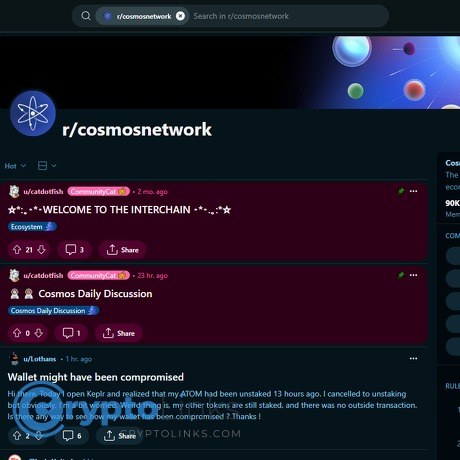
r/cosmosnetwork
www.reddit.com
r/cosmosnetwork review guide: how to get real alpha from Reddit’s Cosmos hub (plus FAQ)
Still bouncing between Telegram threads and X posts trying to keep up with Cosmos—and somehow always feeling a step behind? What if your smartest signal on governance, validator health, builder updates, and airdrops lived in one place you can actually keep up with?
That place is r/cosmosnetwork—and yes, it can be a goldmine when you use it right. The trick isn’t “reading everything,” it’s knowing how to catch what matters while skipping 90% of the noise everyone else gets lost in.
“Heads up: consumer-chain upgrade scheduled. PR here, relayer dashboard here, risk notes for stakers below.”
This is the kind of post that saves you from guessing—links, context, and next steps in one thread.
Most crypto chatter is built to distract. Ephemeral feeds push hot takes; Reddit threads keep receipts. That difference matters. Research on social platforms shows sensational information spreads faster than verified updates—see the Science study on rumor dynamics across networks (Vosoughi et al., 2018). The right subreddit structure helps you spot sources, test claims, and bookmark what’s real.
What’s the pain here?
Too many Cosmos updates, not enough structure. One validator says “upgrade now,” another warns “wait for the patch,” and a third links a GitHub issue from last month. Meanwhile, airdrop threads pop up with sketchy links and zero proof. It’s messy.
- Scattered intel: Discord announcements, X replies, private chats—each with partial context.
- Time sinks: By the time you find the original proposal or PR, the vote window is half over.
- Trust gaps: It’s hard to tell what’s legit without links to on-chain data, repos, or dashboards.
If this sounds like your week, you’re exactly who this guide is for.
What I’ll help you do (the promise)
- Understand how r/cosmosnetwork actually works—and what it’s best at.
- Use simple sorting and flairs to surface the highest-signal threads fast.
- Spot the weekly posts worth checking so you don’t miss governance or upgrade news.
- Recognize red flags instantly so you avoid fake “claim now” traps.
- Build a quick routine that turns the sub into your Cosmos early-warning system.
Who this is for
- Newcomers exploring Cosmos and IBC who want a friendly, source-first place to learn.
- Stakers and validators tracking proposals, client versions, and slashing risk.
- Airdrop hunters who prefer verified timelines over rumor bait.
- Builders watching Interchain Security, Neutron, Dymension, and cross-chain launches.
If you’ve ever thought, “Just show me what’s real and what to watch next,” you’re in the right spot. Ready to make this subreddit work for you instead of adding to the noise?
Up next: what r/cosmosnetwork actually is (and what it isn’t)—so you know exactly why it’s worth your time and how to start strong. Want the quick litmus test I use to tell if a post is worth a click?
What r/cosmosnetwork actually is (and what it isn’t)
r/cosmosnetwork is the main Reddit hub where Cosmos, IBC, and appchain conversations actually breathe. It’s community-run—no foundation PR, no corporate tone—and it’s built for discussion first: governance threads, dev notes, relayer/IBC status, validator ops, airdrop cautions, and user-tested how-tos.
Think of it as the “town hall” for the Interchain. You’ll often see posts that link straight to:
- On-chain governance explorers like Mintscan (Cosmos Hub proposals) and Mintscan (Osmosis)
- Project repos and issues on GitHub (Cosmos SDK), Osmosis, Neutron, or dYdX Chain
- Dashboards and infra like Map of Zones, validator pages, and incident trackers
“In a market where everyone shouts, the calm thread with sources is the real alpha.”
What it isn’t: a pump room, a referral swamp, or a place to chase shadowy “alpha” DMs. Posts without sources get questioned fast, and sensational claims rarely last. That’s the point.
Audience and tone
The crowd is a blend of builders, validators, long-term stakers, and curious newcomers. You’ll notice fewer memes and more structured, link-heavy posts. Commenters push for receipts—on-chain transaction IDs, proposal links, PRs, and dashboards—so good threads feel like mini research notes rather than hot takes.
I see a lot of constructive skepticism here. Someone shares a governance idea? Expect replies with tokenomics angles, relayer implications, validator cost models, and potential security trade-offs. It’s thoughtful, sometimes blunt, and usually helpful.
What you’ll find most often
- Proposal breakdowns across Hub and major appchains (ATOM, Osmosis, Neutron, dYdX, and more). Typical posts summarize what changes, why it matters, who benefits, and how to vote—often linking to sources like Mintscan proposals and forum threads.
- IBC and ICS updates: relayer hiccups, channel status, and Interchain Security discussions that affect validator incentives and ATOM narratives. People commonly cite Map of Zones or status pages when something looks off.
- Validator operations: uptime/slashing alerts, client version notes, commission debates, and best practices. Expect links to validator dashboards, incident reports, and sometimes postmortems from operators who learned something the hard way.
- Airdrop eligibility and warnings: credible criteria and snapshot talk, paired with hard “no” on sketchy claim links. If there isn’t a contract, repo, or official announcement, the comments will say so.
- Launches and postmortems: new consumer chains, upgrades, and lessons learned after outages or misconfigurations. Builders often join in with context, which keeps the signal high.
From tracking hundreds of threads over time, posts that include both an on-chain link (e.g., a proposal on Mintscan) and a code/source link (e.g., a GitHub PR) attract more useful discussion and stay relevant longer. That isn’t academic; it’s what shows up again and again in engagement patterns on the sub.
Mod rules and quality bar
Moderation is simple and strict in the best way:
- No spam or referral trash. Low-effort shills get removed.
- Source everything: proposals, PRs, dashboards, or official posts. If you claim a bug, show the issue or the fix.
- Low tolerance for FUD and fake news. If it’s serious, there should be data.
- Tools and dev posts are welcome when they’re useful and transparent. Explain what it does, how you tested it, and any risks.
If you want your post to land, add:
- On-chain references (proposal ID or explorer link)
- Technical receipts (GitHub issues/PRs, docs, changelogs)
- Clear context (what changed, why now, expected impact)
That’s the culture: fewer slogans, more proof. And when something breaks, you’ll usually see a grounded thread that points to the root cause and a path forward.
So here’s the fun part—how do you surface the best posts fast and avoid burning an hour scrolling? Want the quick playbook I use to catch urgent incidents and quality governance threads in minutes a day?
How to use r/cosmosnetwork like a power user
If you’ve ever opened the sub, scrolled, and thought “Where’s the good stuff?” — this is your playbook. A few simple settings and habits turn r/cosmosnetwork into a real-time cockpit for governance, staking, launches, and airdrops.
“In a space where minutes can cost money, the edge isn’t secrets — it’s structure.”
Sort smart: Top vs. New vs. Rising
Different sorts answer different questions. I rotate through them like instruments on a dashboard.
- Top (Today or This Week) — Use this to catch what the community agrees is worth your time. Long-form proposal analyses, validator risk threads, and upgrade recaps tend to land here. Think of it as the “consensus feed.”
Example: When a major ATOM parameter change hits, the breakdown with direct proposal links usually sits in Top: Today by mid-day. That’s where you’ll find the most complete context and credible counterpoints. - New — This is your early-alert lane. You’ll see urgent posts first: relayer hiccups, chain halts, slashing notices, wallet bugs, or validator version mismatches.
Example: During a consumer-chain hiccup or a rushed patch, screenshots of error logs and quick validator checklists often appear here within minutes, long before anything makes it to Top. - Rising — Great for spotting “getting hot” threads before they explode. Airdrop eligibility clarifications, security heads-ups, or design debates tend to bubble here fast.
Example: A post clarifying snapshot dates for a Cosmos appchain might jump from a handful of upvotes to Rising within an hour, saving you from chasing rumors on other platforms.
My quick daily loop: Morning coffee: Top (This Week) to anchor on the must-reads. Midday: Rising to catch momentum. During upgrades/incidents: New for anything that can affect funds, uptime, or votes.
Why this works: Usability research shows people scan in predictable patterns, so leading with “Top” reduces decision fatigue and keeps you focused on high-signal items first. If you’re curious, Nielsen Norman Group documented this scanning behavior in their well-known F‑pattern research — a handy reminder to structure your own attention on the feed.
Filter by flair
Flairs are the fastest way to batch what you care about and ignore what you don’t. On desktop or mobile, tap the flair and Reddit filters the feed instantly.
- Governance — Proposal threads, voting cues, and parameter change explainers. Perfect when you need to prep a vote with sources.
- Development — Client updates, PRs, breaking changes, and dev tooling. If you run infrastructure or ship code, this saves you hours.
- Airdrop — Eligibility rules, snapshot timelines, and scam warnings. Great for strategy; even better for avoiding traps.
- Security — Slashing alerts, relayer issues, key management tips, and incident postmortems. Treat these as must-read when they pop.
Sample workflow: Before a vote, filter “Governance,” open the top 3 posts, save the one with on-chain links. On upgrade days, flip to “Development” + “Security.” If you’re hunting new opportunities, check “Airdrop” but only trust posts that link to verifiable sources.
Weekly and recurring threads
When you don’t need a full post, use the sub’s recurring megathreads. They’re a shortcut to quick answers and credible links.
- Q&A / Discussion Megathreads — Perfect for:
- “Which consumer chains are live this week under ICS? Any known relayer pain?”
- “Best guide for migrating to the latest gaiad? What did you run into?”
- “Is this a legit airdrop form or a phishing clone? Here are the URLs.”
Post your question with screenshots and what you’ve already tried. You’ll often get pointed to proposal pages, GitHub issues, or validator dashboards in minutes.
Pro tip: If your comment gets a strong reply, hit “Save.” Those become your personal playbook over time — especially handy for node ops and wallet quirks.
Search like this
Reddit’s native search is decent, but I get sharper results with targeted queries. Use Google or your search engine with the site operator plus tight keywords:
- site:reddit.com/r/cosmosnetwork “proposal” ATOM — Surfaces governance debates with sources.
- site:reddit.com/r/cosmosnetwork “ICS” outage — Finds incident threads and workarounds.
- site:reddit.com/r/cosmosnetwork slashing alert — Flags validator risk posts and lessons learned.
- site:reddit.com/r/cosmosnetwork “Neutron” airdrop — Filters eligibility and timelines.
- site:reddit.com/r/cosmosnetwork “IBC” relayers — Pulls threads on channel health and routing tips.
- site:reddit.com/r/cosmosnetwork wallet issue — Collects fix threads for common errors.
Then add a timeframe filter like past month so you’re reading what’s current. To tighten results even more, use quotes for exact phrases, OR for alternates, and a minus sign to exclude noise. Example: “proposal” ATOM OR NTRN -price.
Notifications and tools
When governance is hot or an upgrade is rolling out, speed matters. A couple of light tweaks go a long way.
- Turn on post notifications — Follow the sub, tap the bell, and choose alerts for new posts during active votes or upgrades. You can turn them back down after.
- Save searches with alerts — In the Reddit app, save searches like “proposal” or “ICS” and enable alerts so you get pinged when new matching posts appear.
- Use RES (Reddit Enhancement Suite) — On desktop, RES lets you:
- Tag users (e.g., “validator,” “relayer,” “core dev”) so their comments pop when stakes are high.
- Quick-save and filter your “must‑reference” threads into buckets like Governance, Security, or Tooling.
- RSS for backup — Subscribe to the sub’s RSS feed in any reader. It’s a quiet way to track posts if you don’t live inside the app.
One last ritual that pays off: create a “checklist” note for big events. For example, during a chain upgrade — check New, scan Security flair, open the top Governance post, confirm client versions, save any validator comments with commands. Repeatable systems protect you when everything feels urgent.
This is where the habit meets the hustle. But once you start catching things early, a new problem pops up: separating sharp intel from loud opinions. How do you tell the difference quickly — especially when a post is getting traction? That’s next.
Signal vs. noise: how to vet claims and stay safe
I love Reddit for Cosmos intel—but I never outsource my judgment to a thread. In crypto, speed is a feature and a weapon. The difference between catching alpha and getting burned usually comes down to a 60–90 second verification ritual you run every time you see a bold claim.
“Move fast, verify faster.”
Quick credibility checks
When a post on r/cosmosnetwork catches your eye, I run these instant checks before I click a link or rebroadcast anything:
- Source or it didn’t happen: Is there a link to an on-chain proposal, a GitHub release/PR, a project’s official blog, or a governance portal like Mintscan (Cosmos Hub proposals) or your chain’s explorer?
- Numbers that line up: Governance posts should include a proposal ID, height, or upgrade name. If someone says “ATOM param change just passed,” I expect a direct link to the exact proposal page, tally, and block height.
- Peer pressure (the good kind): Scan the top comments. Do people challenge the claim with data, or is it an echo chamber? The best threads have links, charts, and counterpoints—fast.
- Poster footprint: Click the OP’s profile. Cosmos-heavy history? Prior posts with sources? If it’s all new, all hype, or all outbound links, that’s not my first click.
- Time and context: Does the claim line up with public timelines (testnets, upgrade windows, votes in progress)? Big news rarely drops in a vacuum.
Real example: “Neutron enabling new consumer chain permissions today—APR going 2x.” I’d expect: a link to the Neutron governance proposal on an explorer, a GitHub PR to the contract or module change, and a post or doc from the Neutron team. No sources? I park it.
Red flags to ignore
You’ll avoid 90% of headaches by treating these as automatic passes:
- “Claim now” airdrops with URL shorteners (or Google Docs forms). Legit projects publish on official domains and repos, not mystery links.
- “DM me for support” or “We’ll help you recover” replies. Support doesn’t cold-DM you on Reddit. Ever.
- Brand-new accounts pushing tokens, Telegram invites, or price targets with no sources.
- Fake wallet/extensions: Keplr and Cosmostation clones are common. Only use keplr.app and cosmostation.io, and verify the publisher in the extension store (Chainapsis for Keplr).
- Cloned tools/domains: Popular Cosmos tools like restake.app get spoofed. Bookmark the real ones and use those bookmarks only.
- Sensational price calls with zero data: “100x by Friday,” “guaranteed airdrop if you connect now.” Treat urgency + vagueness as a siren.
Why so strict? Because the data backs it. The FTC reports social media remains a top vector for investment scams, often tied to crypto (see their data spotlights). Chainalysis tracks billions in losses yearly to phishing and investment fraud in its Crypto Crime reports. Reddit is better than most channels—but it’s still the internet.
DYOR workflow
Here’s the fast, repeatable workflow I use to separate signal from noise when a post claims something consequential (airdrop, parameter change, outage, upgrade):
- Find the primary: Governance or dev? Go straight to the source:
- Governance: Mintscan/BigDipper proposal page for the chain (e.g., Osmosis, Neutron, dYdX).
- Development: Project’s GitHub org or the CometBFT / Cosmos SDK releases and PRs.
- Check chain health: If it’s an outage/slashing alert, confirm with multiple explorers and validator dashboards. Look at missed blocks, jail status, and network upgrade heights.
- Cross-verify socials you control: Open the official project site or GitHub from bookmarks, not from the Reddit link. Match announcements on X/Discord to the exact proposal number or commit hash.
- Contracts and code IDs (CosmWasm chains): On Neutron/Juno/Osmosis, verify the contract address, code_id, and admin status on the explorer before interacting.
- Validator perspectives: Look for analysis from recognizable operators (Chorus One, Notional, P2P, Coinbase Cloud, etc.). Validators tend to post clear risk notes around upgrades and param changes.
- Save receipts: Bookmark the explorer page, GitHub PR, and the official announcement. It speeds up your next check and helps you push back on misinformation with proof.
90-second checklist: proposal page open, official repo open, explorer showing height/params, and at least one validator or core contributor confirming. If I can’t complete that loop quickly, I wait.
Privacy and security
Cosmos tools make it easy to click and sign. That convenience is also where attackers live. My safety playbook is boring—and it works:
- Never share your seed or any hint of it. No legit helper needs it. No site should ask for it after initial wallet setup.
- Burner wallets for experiments: For mints, testnets, and “maybe” airdrops, use a fresh address with limited funds.
- Read what you sign: Wallets show message types. If you see unexpected MsgExecuteContract to a random address or strange permissions, cancel. If you don’t understand it, you don’t sign it.
- URL discipline: Type known domains or use bookmarks. Don’t click “claim” links from comments or DMs, even if they look official.
- Separate browser profiles: Keep your wallet extensions in a clean profile with no random extensions installed. Auto-install is off by default for a reason.
- Assume “support” DMs are scams: Real teams route you to ticketing systems or verified Discord channels. If someone promises fast recovery, they want fast theft.
- Redact before you post: If you share screenshots or tx links, hide addresses and memos that tie accounts together. Don’t gift-chain your own opsec.
- Two-factor everything: Secure your Reddit, email, and exchange accounts with app-based 2FA. Compromised comms = compromised coins.
One last mindset shift that saves portfolios: treat “I might miss it” as cheaper than “I might get drained.” Most airdrops worth claiming have long windows and clear docs. Scams demand urgency because truth doesn’t.
You now have the filter to turn r/cosmosnetwork into a trustworthy signal line. Want to see what that signal is actually worth—where the governance wins, IBC/ICS alerts, and legit airdrop intel show up first?
The best value you’ll get from r/cosmosnetwork
Charts tell you what happened. The subreddit tells you why it happened—and what to do next. That’s the edge: real-time context from people who run validators, ship modules, write relayers, and vote with serious skin in the game.
“In a market that moves in minutes, the right comment under a proposal can be worth more than any price chart.”
Governance and staking intel
I treat the sub like an early-warning system for governance and validator ops. The best threads simplify complex changes and flag hidden risks fast:
- Proposal heads-ups, before they hit mainstream feeds. You’ll see links to live votes on Cosmos Hub, Neutron, Osmosis, dYdX, and others, plus plain-English breakdowns. I bookmark sources like the Mintscan proposals page and the Cosmos Hub forum shared in top comments.
- Validator commentary you can act on. When a client upgrade is coming or a parameter tweak could impact downtime windows, operators post exactly which binary, CometBFT version, or cosmovisor steps they’re using. When slashing or missed-blocks clusters show up, you’ll see incident writeups and recovery guides. I often see tools referenced like Tenderduty for alerting and Polkachu’s ops notes (alerts) for real-world configs.
- Confidence for your vote. The most upvoted governance threads usually include on-chain links, treasury math, and trade-offs. Expect pushback and counter-data in the comments—exactly what you want before you commit your ATOM to a decision.
Why this matters: staking returns are sensitive to inflation, consumer-chain revenues, and validator behavior. Threads here routinely link to dashboards and proposal texts so you’re not guessing.
IBC and Interchain Security watch
If you care about the interchain actually moving, this is where operational reality shows up first.
- Relayer health and channel status. Posts flag stuck packets, channel closures, and fixes—often with Hermes and rly logs attached. You’ll see folks cross-checking with Map of Zones and IBC explorers to verify flow and latency.
- Consumer-chain updates that change incentives. When Interchain Security (ICS) adds or upgrades a consumer chain, you’ll find discussions around validator workload, revenue split to delegators, and Hub risk. Neutron and Stride are common reference points, with links to their governance notes and revenue dashboards.
- Narrative, grounded in data. Posts unpack how ICS affects ATOM’s role beyond price talk—tying it to actual fee capture and validator economics, not vibes. I see recurring references to docs and specs so you can verify claims in one tab: Cosmos docs and Hermes for relayer specifics.
Tip: Save threads that link tools, not just opinions. Those become your checklist when something breaks.
Airdrops and new launches
Yes, there’s alpha—but the sub tends to filter it. The best posts follow a simple formula: sources, snapshot dates, contracts, and warnings.
- Eligibility that’s actually checkable. Community-verified posts usually include explorer links and GitHub repos, not “claim now” buttons. Good examples have shown how to verify ATOM, OSMO, or STARS staking snapshots in explorers like Ping.pub or Mintscan before you touch a site.
- Hard “no” on shady links. Brand-new accounts pushing claim sites get shredded fast. Expect pinned comments reminding you to connect only after checking contract addresses and official announcements.
- Early threads on legit launches. Names that keep popping up: Neutron’s app-layer activity, Dymension’s rollups, infrastructure like Lava for RPC, and liquid staking updates from Stride. The comments often include risk notes (smart contract audit status, token unlock schedules) so you don’t get blindsided.
Context boost: macro airdrops like the Celestia and Dymension distributions sparked great explainers on who qualified and why. Pair those with ecosystem reports (Messari’s State of Cosmos) and you get a balanced view of “free” tokens vs. real opportunity.
Builder and power-user threads
Some of the most valuable posts are from people shipping code and running infra. They shorten your learning curve dramatically.
- Tooling releases and benchmarks. Expect hands-on notes for relayers (rly, Hermes), indexers (SubQuery’s Cosmos support), and explorers. The best comments include CPU/RAM/net benchmarks and pruning settings that keep nodes stable.
- RPC and node ops tips. From app.toml tweaks to snapshot sources and pruning profiles, you’ll find copy-paste configs that actually work. When new CometBFT versions land, operators share upgrade gotchas and rollback procedures.
- Feedback loops that improve products. Devs post preview features, ask for repro steps, and push fixes within hours. Users who test get heard—fast. That kind of loop is rare on socials.
Want a sanity check on “is this chain worth building on?” The sub often points to the Electric Capital Developer Report and live repo activity to back claims about traction. It’s one thing to say “devs are here”; it’s another to link the commit graphs.
Bottom line: this is where technical signals and governance reality meet. The signal is strong, the people are accountable, and your time actually compounds.
If this is the kind of signal you want, you’re probably wondering: how does the community handle price questions, bold ATOM targets, and the hard “why down?” conversations without turning into noise? That’s up next—real answers, with sources you can check.
FAQ people always ask (yes, including price talk)
Can Cosmos (ATOM) reach $1,000?
I see this one all the time, and the best replies on the sub do two things: they show their work, and they tie every claim to the chain’s actual cash flows.
Here’s how I frame it when I’m sanity-checking bold targets:
- Market-cap math first. With today’s rough supply, $1,000 per ATOM implies a market cap in the hundreds of billions. That puts ATOM in the same league as Ethereum’s top-cycle valuations. Any model that big needs to show where the money comes from.
- What would have to go right? High consumer-chain adoption under Interchain Security (Neutron, Stride-style), sustained fees and MEV sharing back to Hub stakers, and a credible path to lower net inflation versus real yield. If the Hub captures a cut of many chains’ revenues, a high multiple gets easier to argue.
- What could hold it back? Competing ecosystems with stronger fee capture, emissions outpacing demand, or fragmented liquidity across appchains that never consolidates into the Hub.
On r/cosmosnetwork, big price posts that don’t link to concrete sources (governance proposals changing inflation, consumer-chain revenue share agreements, or on-chain fee dashboards) are usually challenged fast. The smarter threads share long-horizon scenarios—think “if ICS revenue is X and net inflation trends to Y, here’s a DCF on staking yield.” You’ll also see readers cite long-range pieces like Gate’s 2050 scenario tables as scenarios, not forecasts, and immediately ask “what assumptions get us there?” That’s the energy you want.
Bottom line: treat $1,000 ATOM as a stress test for your thesis. If your assumptions don’t turn into on-chain cash flows, it’s just a headline.
Why has Cosmos gone down?
When the sub diagnoses drawdowns, the better takes mix macro, competitive flows, and real network data:
- Macro and rotations: Liquidity rotates to BTC dominance or L2 narratives; risk assets compress across the board.
- Ecosystem headwinds: Some appchains shut down or stall from low traction; narratives around ATOM’s role shift; liquidity fragments across zones.
- Data checks people actually post:
- Active addresses and IBC transfer counts to see if usage dropped or just attention did.
- Validator set health: missed blocks, slashing events, version lag before upgrades.
- Real fees and revenue from consumer chains versus Hub inflation and commissions.
Expect links to current news and “state-of-ecosystem” roundups, followed by comments that yank in dashboards, explorer screenshots, and repo activity. The pattern: narrative first, numbers right after.
How much will Cosmos be worth in 2030?
The only answers worth reading on the sub are scenario-based. Here’s the quick framework I keep pinned:
- Inputs you can source: Hub inflation schedule and potential changes, validator commission ranges, consumer-chain fee sharing terms, and realistic IBC growth rates.
- Build a yield stack: Net staking APR = inflation + consumer-chain fees + MEV share − validator commission − dilution from new supply.
- Map adoption paths:
- Conservative: Few new consumer chains, modest fees; ATOM acts mainly as governance + security budget.
- Base case: A handful of sticky consumer chains contribute steady fees; inflation nudges down; net yield holds.
- Ambitious: Many high-fee appchains secure with ICS; Hub becomes the preferred settlement/security layer; real yield dominates the story.
Price targets that survive the comment section show exactly which assumptions move the number. If a post throws a 2030 number without spelling out fee capture, supply, and risk, it’s entertainment—bookmark it as a “maybe,” not a plan.
What’s the stance on “alpha” and airdrops?
r/cosmosnetwork has a strong BS filter. The culture rewards clear eligibility rules and punishes mystery links. What gets upvoted:
- Receipts: Snapshot block heights, contract addresses, official docs or GitHub for the drop contract.
- Eligibility clarity: “ATOM staked to Hub validators between blocks X–Y” beats “trust me, claim now.”
- Risk notes: Warnings about permit signatures, spend approvals, or contracts that can drain wallets.
Recent “good behavior” examples people point to include documented distributions to ATOM stakers from Cosmos-native projects that posted terms early and shipped signed announcements; posts like that usually include explorer links and independent verifications in the comments. By contrast, anything that looks like “DM me” or a rotating shortlink is flagged quickly. If you don’t see cross-checkable sources, skip it. There’s always another drop.
Want a dead-simple checklist to turn all of this into a daily workflow? I’ve got a fast system I use to catch governance, fees, and credible airdrops in under 5 minutes—should I show you how I set it up?
Should you join r/cosmosnetwork? My quick take and checklist
Short answer: yes—if you want cleaner signal on governance and staking, safer airdrop hunting, and faster reads on IBC/ICS events. The conversations are accountable, the sources are usually public, and the best comments tend to get challenged (and improved) in real time.
My rule of thumb: if it isn’t linked, it isn’t real. The sub rewards proof—on-chain proposals, GitHub PRs, validator dashboards—not hype.
Two quick reasons why this style of community works:
- Checklists beat gut feel. Decision checklists reduce errors in high-stakes fields, and they work here too. If you make “link, source, save” a habit, you’ll avoid most traps. (See Atul Gawande’s The Checklist Manifesto for the evidence-based case.)
- Groups get smarter when they share sources and challenge claims. Research on collective intelligence shows teams perform better with balanced participation and verifiable inputs (Woolley et al., Science).
Quick checklist to get value fast
- Subscribe and set “Top: This Week.” Desktop: Sort → Top → This Week → remember. Mobile: Sort → Top → This Week. This trims noise and highlights consensus reads.
- Follow flairs that match your goals. Prioritize Governance, Development, and Security. Batch-reading by flair turns chaos into a focused feed.
- Save posts with hard links. On-chain proposals (e.g., Mintscan/TCN explorer), Agora/Forum threads, GitHub PRs, validator dashboards, or incident reports. These become your receipts when you act.
- Use weekly Q&A threads for targeted asks. You’ll get faster, higher-quality replies than posting standalone beginner questions.
- Ignore DMs and “claim now” links. No legit team will DM you a claim site. Industry reports from CertiK and Chainabuse show phishing remains the #1 attack vector in crypto—assume DM = scam. (CertiK security reports, Chainabuse insights)
Bonus habits that pay off:
- Flip to “New” during upgrade windows. You’ll catch urgent notices (validator downtime, relayer hiccups) before they hit blogs.
- Tag and track power users. If you use RES (Reddit Enhancement Suite), tag credible validators, devs, and analysts so their comments pop.
- Create a “Cosmos receipts” bookmark folder. Save one link per topic (proposal, incident, airdrop rules). You’ll thank yourself later.
Posting tips if you want great responses
- Lead with sources and what you tried. Example: “IBC channel stuck on Chain X → Chain Y; relayer logs + tx hash included.” Screenshots are fine, links are better.
- Use the right flair and a clear title. NN/g-style guidance applies here: descriptive beats clever. “Proposal: ATOM parameter change—pros/cons and validator impact” gets more traction than “Big change coming?”
- Ask for feedback, not validation. “What am I missing?” invites experts. “Guaranteed 10x?” invites mods.
- Be precise about chains and versions. If you’re reporting a hiccup, include client version, provider, region, and timestamps.
- Skip price-only threads. If you mention price, tie it to data: emissions, consumer-chain fees, validator incentives, treasury runway. That’s the culture.
Examples that get fast replies:
- Security: “Observed double-sign alert on testnet; log excerpt + signer details inside. Anyone else?”
- Governance: “Funding proposal for infra—breakdown of milestones and KPIs. Any validator concerns?”
- IBC/Relayers: “Packet timeouts on channel-XX? Here are traces from the last 2 hours.”
- Airdrops: “Eligibility rules from docs vs. contract filter—my notes + links. Spot mistakes?”
Final thoughts
r/cosmosnetwork is where Cosmos conversations grow up—less hype, more proof. If the interchain is on your roadmap this cycle, make the sub part of your routine and stick to the checklist above. I’ll keep tracking standout threads and curating the best on cryptolinks.com. If you see a must-read post that others shouldn’t miss, send it my way.
One last nudge: set your sort to “Top: This Week,” follow the right flairs, and never click a claim link you can’t verify. That combo alone will save you time, money, and stress.
CryptoLinks.com does not endorse, promote, or associate with subreddits that offer or imply unrealistic returns through potentially unethical practices. Our mission remains to guide the community toward safe, informed, and ethical participation in the cryptocurrency space. We urge our readers and the wider crypto community to remain vigilant, to conduct thorough research, and to always consider the broader implications of their investment choices.