r/Crypto_com Review
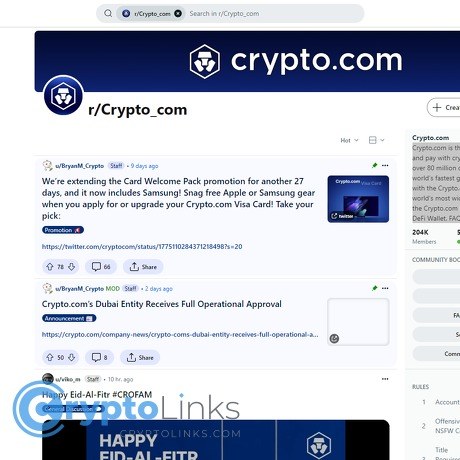
r/Crypto_com
www.reddit.com
r/Crypto_com subreddit review guide: everything you need to know (with FAQ)
Wondering if that reported fee change, card reward tweak, or “shutdown” rumor about Crypto.com is real — or just another hot take?
You’re in the right place. I’m going to show you how to use r/Crypto_com — the main Reddit hub for Crypto.com users — to find reliable info fast, skip the noise, and make smarter decisions about the app, exchange, CRO, and the Visa card.
I test, compare, and review crypto platforms daily on Cryptolinks.com/news. This guide explains exactly how I use the subreddit to spot issues early, verify claims, and track sentiment around real-world topics: card perks, fees, KYC delays, support response times, outages, and more. You’ll leave with a simple system for getting answers you can trust.
Quick proof it’s worth your time: research shows that a large share of Reddit users go there for news and live updates, which is why subs like r/Crypto_com often surface problems minutes before official status pages do. That speed is useful — as long as you can separate signals from noise.
What problems or pain does this solve?
If you’ve ever searched Reddit during a crypto mess, you’ve probably hit at least one of these:
- Endless, conflicting threads — one post says “card benefits cut,” another says “no change,” a third links to a region-specific policy.
- Old or regional info — a 2022 rewards rule pops up in 2025 search; a Europe-only notice gets shared by U.S. users as “global.”
- Hot takes without proof — screenshots with no context or dates; claims with no ticket numbers or links.
- Support confusion — fake “agents” on Reddit, real support only in-app, and everyone saying “DM me.”
- Tax and compliance panic — U.S. 1099 questions, KYC/AML holds, withdrawal limits, and speculation presented as fact.
These problems cost time and, occasionally, money. A good example: when cashback posting delays or limit changes happen, threads explode. If you don’t know how to filter correctly, you can overreact, move funds, or miss an official update that would’ve saved you stress.
Promise: a clear, practical way to use the subreddit
Here’s what you’ll get from this guide:
- What the sub is good for (and what it isn’t) — when to trust a thread, and when to wait for official confirmation.
- How to search like a pro — the right filters and exact phrases that surface the best answers faster.
- How to spot shills and scams — classic red flags and the signals that a fix or warning is legit.
- Clear answers to hot questions — the “shutdown,” IRS, custody, and “what’s trustworthy” debates, kept simple.
Real talk: Reddit is incredible for catching trends early, but it’s easy to get burned by recency bias and loud minority threads. This playbook keeps you in control.
Who this guide is for
- New or returning Crypto.com users who want to check what’s changed before funding an account.
- CRO holders tracking utility, staking rules, and reward mechanics.
- Visa card users comparing tiers, perks, and region-by-region differences.
- Anyone comparing exchanges who wants real user experiences, not just marketing pages.
By the end, you’ll know exactly how to turn r/Crypto_com from a chaotic feed into a reliable dashboard for your decisions — without wasting hours. Ready to see what the subreddit actually covers, how moderation shapes what you read, and which threads to watch first?
What r/Crypto_com is (and why it’s worth your time)
If you want real user experiences around Crypto.com’s app, exchange, Visa card, DeFi Wallet, NFTs, and CRO, this is where the signal lives. The subreddit is community-run, active around the clock, and excellent for spotting outages early, tracking reward or fee changes, and finding practical workarounds from people who just solved the same problem you’re facing.
It’s not official support — and that’s the point. You get unfiltered stories: what worked, what broke, and what to try next. During market spikes or maintenance windows, you’ll often see live reports within minutes, long before polished announcements land. Social platforms have been shown to surface incidents in real time (see research on event detection in social feeds like Sakaki et al.), and this community is no exception.
“Use the crowd to stress‑test what you hear, not to outsource your judgment.”
That’s how I treat r/Crypto_com: fast signal, human context, and a quick gut check against official pages and my own tests.
Quick scope and what to expect
On any given day, you’ll see a steady flow of hands-on reports and how-tos. Typical threads:
- App bugs and outages: “Card top-up failing with error X,” “2FA SMS not arriving,” “App stuck on splash.” Users post device/OS, region, and fixes that actually worked.
- Fees, limits, and timelines: “ACH pending over 3 business days,” “Wire transfer minimums,” “Why did my instant buy fee jump?” People share exact amounts, timestamps, and bank names.
- KYC and withdrawals: “Verification stuck at ‘Under Review’,” “How long for fiat withdrawal to hit Chase/HSBC?” Expect detailed timelines and support ticket numbers for context.
- Rewards and card perks: Changes to cashback, LoungeKey access, and streaming rebates. After updates, users collect region-by-region outcomes to see what really changed.
- CRO news and mechanics: APR shifts, locked vs flexible CRO, Cronos vs Crypto.org network questions, and how CRO price affects card tier strategy.
- Regional restrictions: “Feature not available in my state/country,” alternative paths that others in your region used, and compliance notes from recent experiences.
When the market moves or policies change, sentiment threads spike — you get a real-time temperature check along with links to status pages and official posts. That mix of raw reports and verifications is where the subreddit shines.
Mods, rules, and how that shapes content
Moderation is strict on the stuff that wastes your time or risks your safety:
- No referral spam: Codes and invites are usually restricted to dedicated threads. That keeps support and news readable.
- No fake “support” in DMs: Posts and comments asking you to “DM for help” are removed. Real support won’t message you first.
- Stickies for high-signal info: When there’s an outage, reward change, or policy shift, expect a pinned megathread with region notes and official links.
- AutoMod filters: Low-effort or duplicate panic posts often get merged into megathreads so you can track updates in one place.
End result: you spend less time dodging bait and more time reading verified fixes, timelines, and mod-tagged announcements. When I see a sticky, I read it first — it often compresses hours of scattered comments into a clear summary.
Threads and flairs to watch
Flairs act like shortcuts to the content you need. The most useful ones:
- PSA: Heads-up posts worth reading immediately. Example: “ACH delays this morning — bank-side maintenance,” “Temporary card top-up limits in CA.” Great for live issues.
- Bug: Repro steps, device/OS versions, and workarounds. Example: “Face ID loop on iOS 17.1 — clearing cache fixed it.”
- Support: Account-specific hurdles with context. Example: “KYC pending 5 days; approval after re-uploading utility bill.” Look for multiple users confirming the same fix.
- News: Official updates, scheduled maintenance, CRO/Cronos developments, and exchange notices — often paired with links you can verify.
- Discussion: Strategy and sentiment. Example: “Is locking CRO still worth it after the APR change?” Expect pros/cons from people living the trade-offs.
One more time-saver: weekly or monthly megathreads bundle repeat questions (card perks, taxes, limits) so you don’t have to open 20 near-identical posts. When you’re short on time, those megathreads deliver the most answers per scroll.
Quick emotional truth: when your funds feel stuck or a perk changes overnight, uncertainty hurts. I use flairs and stickies to move from “What’s going on?” to “What can I do right now?” in minutes. Want the exact workflow I use to go from chaos to clarity — without getting lost in threads you don’t need?
How to actually use r/Crypto_com to make better decisions
Reddit can feel like a firehose. I use a simple workflow to turn it into clean, actionable signals: search with intent, skim the right threads, and verify before you act. Here’s exactly how I do it on r/Crypto_com.
“Trust, but verify — especially when it’s your money.”
Search like a pro
The fastest wins come from tight searches and the right filters. I start in the sub’s search bar, then jump to Google if I need precision.
- Use filters with intent: set Sort to Top + All Time or Past Year for evergreen fixes, and New for live issues/outages.
- Search exact phrases in quotes to kill noise:
- "wire transfer limit"
- "locked CRO"
- "card downgrade"
- "IRS 1099"
- Zero in with operators:
- Quotes "..." for exact match
- Minus to exclude: 1099 -Koinly
- OR for alternates: “locked CRO” OR “unstake CRO”
- Use Google for surgical results: site:reddit.com/r/Crypto_com "ACH pending" (then set time to Past Year). Great for tax, card perks, or region-specific limits.
- Leverage flairs in searches when relevant: try flair_name:"Support" withdrawal or flair_name:"PSA" fees.
Real-world example: tax season stress and you’re asking, “Are 1099s out yet?” I run New + 1099 (Past Year) to catch fresh confirmations, then scan Top (Past Year) to see proven answers and timelines from last year. If I see multiple users quoting the same form type and delivery dates, I check the official help center to confirm.
Another quick one: thinking about unstaking? Search "locked CRO" OR unstake CRO with Top (Past Year) to see the most upvoted explanations of lock periods, card tier impacts, and any recent policy changes. Then verify in the official terms before you act.
Sort and skim smart
Sorting is your BS-filter. I use it to separate what’s happening now from what reliably works.
- Top = community-vetted answers. If you need a fix that’s stood the test of time, this is it. Read the top 3–5 posts, not just the first one.
- New = early warnings and outages. When “withdrawal pending” spikes in New, I cross-check with the official status page and recent X/Twitter updates.
- Open multiple tabs and compare. You’re looking for repeated steps that solved it:
- “KYC stuck” threads that consistently mention: better lighting, original documents (no scans), region match, and resubmitting after app update.
- “Card declined abroad” posts pointing to MCC quirks, offline terminals, and preauthorization at gas stations/hotels.
- Scan for authority signals: mod comments, Crypto.com Staff tags, links to official docs, or a pinned sticky that recaps changes.
- Keep a mini-notepad of proven steps. If the same fix appears in multiple high-karma comments, it’s worth trying.
Snapshot example: you see several “ACH deposit pending” posts in New within an hour. I:
1) check status.crypto.com
2) sort Top (Past Month) for “ACH” to find fixes that worked last time
3) look for a mod note or sticky; if none, note timelines users report (e.g., “cleared at T+2 business days”).
Read between the lines
Not every post is legit. Social proof can mislead, and urgency breeds mistakes. I run a simple credibility test before I act on any thread.
- Red flags to step around:
- Brand-new accounts with zero history
- Vague claims or cropped screenshots without transaction IDs/ticket numbers
- “DM me for support,” QR codes, or requests for seed/2FA codes
- Bold claims with no region/date context (limits and rules vary)
- Strong signs you can trust:
- Multiple users confirming the same fix and providing timestamps
- Mod-sticky summaries, or links to the status page and official help docs
- Clear timelines: when the issue started, ticket number (partially redacted), region, app version
Why this matters: research on social influence shows early upvotes can snowball and bias what rises to the top. In one randomized experiment on a social news site, a single positive vote increased final scores by ~25% on average. Translation: Top is helpful, but not gospel. Source: Science, 2013.
Quick credibility checklist I use:
- Is the account older than a few weeks? Any history in crypto subs?
- Does the post include specifics: country, card tier, amounts, dates, app/exchange?
- Are at least two independent users confirming the same result?
- Is there an official link I can check right now?
Use Reddit for real-time signal and workarounds, then lock it in with official sources:
- status.crypto.com
- help.crypto.com
- @cryptocom on X
Want to know which topics show up week after week — Visa perks, fees, staking, outages — and where the best answers usually hide? Keep going; the patterns will save you serious time.
What people actually discuss: the recurring topics
When I scan r/Crypto_com, the same themes come up again and again. That’s not a bad thing — it means answers exist, and you can skip the guesswork. Here’s how I read those conversations and what to expect from each one.
“Perks change. Fees hide. Screens break. The only thing that lasts is what you can verify.”
Crypto.com Visa card benefits and changes
Card threads dominate the sub. People swap data points on cashback, caps, perks, and what actually triggers a benefit loss. The biggest pattern: benefits are tied to an active CRO stake and your region’s rules.
- Cashback tiers: Expect posts comparing effective rates after recent changes. The rough community shorthand you’ll see is Ruby (~1%), Jade/Indigo (~2%), Icy/FRG (~3%), Obsidian (~5%) — but users constantly remind each other to check the live card page because rates, caps, and conditions vary.
- Perks like Netflix/Spotify/LoungeKey: You’ll find “my perk stopped” posts that almost always trace back to an expired or removed stake, hitting a monthly cap, or region-specific differences. Typical fix: re-stake or confirm eligibility in-app.
- Stake expiry surprises: A classic thread reads: “My cashbacks dropped to near-zero this week.” The top reply is often: “Your 180-day stake expired — renew it to restore benefits.” The physical card won’t change, but the rewards engine will.
- Price moves and ROI math: Users share simple back-of-the-envelope models. Example: if you spend $1,000/month and get 2% back in CRO, at $0.10/CRO that’s 200 CRO/month. If CRO later trades at $0.08, your redeemed value fell 20%. The sub treats rewards as variable, not fixed-income.
- Real-world gotchas: Lounge access denied because the lounge requires a same-day boarding pass; “cashback missing” on government or prepaid categories; card processors coding purchases differently. Expect very specific merchant anecdotes.
When I spot multiple users reporting the same perk shift, I cross-check the status page and the pinned subreddit posts — the fastest way to separate policy updates from one-off glitches.
App/exchange: fees, limits, and outages
Fees and limits are where people feel surprises. The sub is the early-warning system.
- Spread vs fee: You’ll see “Why is my quote worse than CoinGecko?” posts. The app price includes a spread; the exchange uses maker/taker fees based on volume. Many users switch to the exchange for tighter pricing when available in their region.
- Deposit methods and timing:
- ACH/SEPA: Often 2–5 business days. “Pending” threads usually clear once banks post funds; users share day/time stamps so you know what’s normal.
- Wire: Typically same business day if sent before bank cutoff; fees depend on your bank and region.
- Card purchases: Instant, but often higher fees and some banks mark them as cash advances. You’ll see cautionary tales of surprise bank charges.
- Withdrawal fees and minimums: The sub keeps running lists for popular coins because network fees fluctuate. Pattern: stablecoins on cheaper networks (like Cronos) get recommended for lower-cost transfers.
- Outages and maintenance: During high volatility, you’ll find minute-by-minute threads about login issues, delayed quotes, or withdrawal queuing. The quickest confirmation comes from status.crypto.com and mod stickies.
- Support ticket outcomes: Many posts document timelines: “KYC resolved in 48 hours,” “ACH hold released on day 3,” “withdrawal unlocked after compliance review.” These help you benchmark your own case.
Pro-tip I picked up from a recurring comment: move a $5 test transaction first to confirm fees, network, and timing before sending size.
CRO, staking, and rewards mechanics
Discussions here split into two buckets: staking for card benefits and earning yield (which changes over time).
- Locked vs flexible CRO: For card tiers, a 180-day locked stake is standard in many regions. Unlocking or removing it typically reduces benefits. Flexible CRO or smaller stakes may not grant perks.
- APR shifts and caps: Users compare historic vs current rates and share screenshots when APRs update. The sub treats APR as variable — “today’s number isn’t a promise for tomorrow.”
- Opportunity cost math: A common post weighs CRO stake vs holding stablecoins. You’ll see breakeven calculators: if you stake X CRO to unlock Y% cashback and Z perks, what monthly spend justifies the lock, assuming CRO moves ±A%?
- Exchange-side benefits: Mentions of fee discounts or rebates tied to CRO on the exchange appear often, with region caveats. Users compare whether those savings beat holding BTC/ETH or stables instead.
Watch for threads where multiple users confirm the same new APR within hours — that’s your signal a change is rolling through.
DeFi Wallet, NFTs, and security basics
Non-custodial questions get a lot of attention because mistakes are permanent on-chain.
- Seed phrase safety: The sub repeats the golden rule: write it offline, never in screenshots or cloud notes, and never share it with “support.” People post painful loss stories — it keeps the message real.
- Network confusion: Cronos (EVM, 0x… addresses) vs Crypto.org Chain (cro… addresses) vs Ethereum. The most common mistake: sending to the right coin on the wrong network. Fixes involve bridges, if recovery is possible at all.
- Gas and approvals: Users warn about forgotten token approvals draining funds on DeFi. Solutions: revoke old approvals and use hardware wallets for larger amounts.
- NFT platform threads: Drop times, whitelists, and withdrawal routes. Expect “can I withdraw to MetaMask?” followed by a chain/network breakdown and fee estimates from recent claimants.
- Quality-of-life tips: Address allowlisting in the app, anti-phishing codes in emails, and “test sends only” culture. These posts are the community’s safety net.
One comment I see a lot: “If a stranger can ‘help you recover’ your wallet, they can also empty it.” Simple, but it sticks.
Regional restrictions and compliance
Where you live changes everything: features, limits, verification hoops, and timelines.
- KYC quirks: Name mismatches, non-Latin characters, and outdated IDs lead to manual reviews. Threads often list which documents finally worked (utility bill vs bank statement, etc.).
- Feature availability: Some services (like the standalone exchange, derivatives, certain yield products, or specific card perks) differ by country or even state. U.S. readers regularly compare notes on state-level access changes.
- Tax and reporting expectations: Users share reminders that exchanges may issue forms or share data where required. You’ll find links to local guidance and third-party tax tools people actually use.
- Banking partners and rails: SEPA vs ACH vs Faster Payments. A recurring UK/EU pattern: new IBANs or intermediary banks cause “returned funds” posts until people update saved details.
Any time I see “suddenly unavailable in my region” threads pop up, I check the pinned post history — regional compliance updates nearly always leave a paper trail.
Bottom line from the community’s day-to-day chatter: benefits are conditional, fees are contextual, and security is personal. The sub proves it with receipts — screenshots, timestamps, and repeat confirmations.
Now, here’s the real test: when you hit a snag, can you tell a real helper from a scammer? In the next section, I’ll show you the exact patterns that fake “support” uses — and how to shut them down before they touch your account. Would you spot them in time?
Safety first: scams, support, and what’s real
I read r/Crypto_com daily, and the fastest way to lose money isn’t a market move — it’s a fake “helper” with just enough details to sound legit. Scammers know you’re stressed and short on time. That’s the moment they strike.
“If someone pushes you to hurry, pause. Nothing legitimate in crypto vanishes in 60 seconds.”
Some context that’s hard to ignore: the FTC reports people have lost over $1B to crypto scams since 2021, often triggered on social platforms, not shady dark-web corners. Chainalysis adds that while 2023 saw fewer mega-hacks than 2022, social engineering and “approval phishing” stayed stubbornly effective. It’s not paranoia — it’s pattern recognition.
Common scam patterns on Reddit
Here’s what I see over and over, with examples you can recognize in seconds:
Fake support agents in your DMs. They comment “I can help” under your post, then move you to Telegram/WhatsApp.
Sample line: “Hello sir, I’m from Crypto.com Security. Send your ticket ID for immediate unlock.”
Tell: brand-new account, no mod flair, pushes you off Reddit fast. Real support won’t DM you first or move you to private messengers.“Refund fee” or “unlock fee.” They claim your card/app is stuck and you must “prepay the gas/tax” to release funds.
Reality: platforms don’t require upfront “release” fees. If someone asks you to send crypto to “prove liquidity,” it’s a drain.QR codes for “restores” or “airdrops.” You scan, approve a WalletConnect prompt, and boom — your tokens move. The FBI has warned about malicious QR codes: attackers swap or spoof them to reroute funds.
FBI PSA on malicious QR codes“Recovery specialists” or chargeback fixers. They promise to recover lost coins for a fee. Crypto transfers are irreversible; you’ll lose the “fee” too.
Remote access requests. AnyDesk/TeamViewer “verification” is a trap to capture 2FA and drain accounts while you watch.
Seed phrase phishing. Fake forms, doctored Google Docs, or off-brand domains ask for your 12/24 words or 2FA codes.
Rule for life: never share your seed phrase, private keys, or 2FA codes with anyone. Ever.
My 15-second shield before I click or reply:
- Check the user’s age/karma and post history. New + zero history = caution.
- Hover or long-press links: do they end in .crypto.com? Typos and hyphens scream fraud.
- Find two confirmations in comments from different, long-standing users.
- Scan the Crypto.com status page for ongoing issues.
- Take 10 seconds. Scammers rely on speed. Make them wait.
Backing data: The FTC notes social scams as a top on-ramp for crypto fraud, and Chainalysis’ 2024 Crime Report shows ~$1.7B stolen in 2023 exploits — with social engineering and malicious approvals a persistent slice. Links for your own review:
- FTC: Reports show scammers cashing in on crypto
- Chainalysis: 2024 Crypto Crime Report
Verifying official channels
When something matters — balances, withdrawals, KYC — I double-check through official pipes, not screenshots in comments.
Website and status:
crypto.com,
status.crypto.com,
help.crypto.com.
If a link doesn’t end in crypto.com, I don’t use it.
In-app support (safest route): open the app → Profile/Settings → Help Center → Chat. Get a ticket number. Real agents won’t ask for seed phrases, remote access, or 2FA codes.
On Reddit: look for moderator tags, sticky posts, and cross-links to official domains. Accounts claiming “Support” without mod verification are noise at best, scams at worst.
Official social: announcements usually mirror across the
Crypto.com X/Twitter and blog. Treat Telegram/WhatsApp “support” as impersonation until proven otherwise.
Domain hygiene tip: crypto[.]com and subdomains like exchange.crypto.com, help.crypto.com. No hyphens, no extras. Bookmark your own “clean” links and use those, not thread links.
The 30‑second verification ritual I use:
- Check the subreddit sticky for current issues.
- Check the official status page.
- Find one recent post from a reputable outlet or the official X handle.
When Reddit isn’t enough
Threads are great for pattern-spotting; they’re not a help desk. For anything account-specific, move to official support fast and build a paper trail.
Open a ticket in-app: include exact error text, device/OS, app version, country, and if relevant, the transaction hash and network. Ask for the case/ticket number and save it.
Track a clean timeline: date/time sent, responses, promised ETAs, any documents requested. Keep screenshots as PDFs.
If funds are frozen or withdrawals stalled: expect compliance checks. Be ready with source-of-funds docs (bank statements, paystubs, exchange receipts). Don’t resend the same file; add context.
Reasonable follow-up rhythm: 48–72 hours between pings unless there’s an outage. If an SLA is given, quote it politely on follow-up.
Escalation paths (region-specific, not legal advice):
- Card issues: contact the card issuer shown on the back of your card for formal complaints/chargebacks. Note: blockchain transfers can’t be charged back.
- Consumer complaints: U.S. — CFPB for card/financial services; state AG/financial regulator; UK — Financial Ombudsman Service; EU — your national financial ombudsman/consumer authority; SG — MAS for guidance. Attach your ticket ID and timeline.
Template I’ve used to keep things moving:
Subject: Support ticket [#ID] — [Issue summary] — [Days outstanding]
Hello Support,
I’m following up on ticket [#ID] opened on [date] regarding [issue].
Status so far: [1–2 bullets].
Impact: [brief, factual].
Attached: [docs, hashes, screenshots].
Please confirm next action and an estimated timeframe.
Thank you.
One last habit that saves headaches: if you want the subreddit to sanity-check your plan, post only what’s safe — redact names, emails, order IDs, and any addresses you still use.
Now, here’s a question I always ask before I act: what’s the mood across the community — upbeat or on edge — and is that noise or signal? Let’s read the room together next.
Community sentiment: reading the room the right way
I treat r/Crypto_com like a live dashboard. It’s great for catching momentum shifts, but it’s not the final word. Here’s how I read the room so I don’t get whipsawed by one loud post or a bad take that gets upvoted at 2 a.m.
The good
There’s a consistent thread of praise that shows up again and again, especially from everyday users rather than power traders:
- Fast rollouts and fixes. New features, added tokens, or card quality-of-life tweaks tend to hit the sub within hours. I often see first-hand reports like “top-up worked instantly” or “Apple/Google Pay link worked on first try.” That kind of repetition across unrelated users is a positive signal.
- Polished mobile experience and card usability. The app’s UI and the Visa card’s day-to-day reliability get regular shoutouts. Threads where people report smooth tap-to-pay at grocery stores or successful airport lounge entries are common—mundane, yes, but that’s the point: things worked as promised.
- Broad coin and product coverage. You’ll see real usage across the app, Exchange, DeFi Wallet, and NFTs. When a platform has dead features, Reddit gets quiet about them. Here, it’s usually active—people post workflows, screenshots, and settings that helped.
How I use it: I look for multiple unconnected users reporting the same “it just worked” outcome. Positive consistency is harder to fake than a single hype post.
The critical
There are recurring pain points you should take seriously because they tend to resurface in cycles:
- Reward cuts and card tier math. Nothing drives more heated threads than changes to card rewards or CRO lock-up benefits. The backlash to the 2022 reward adjustments still echoes—today you’ll still see people recalculating yield vs lock-up and debating downgrades after CRO price swings.
- Fees and FX surprises. Expect posts about spread vs displayed fee, ATM limits, and card top-up costs. When users hit an unexpected fee path, you’ll see screenshots and breakdowns in the comments.
- Regional restrictions and KYC delays. Country/state-level availability changes or compliance checks can trigger waves of threads. During periods of heightened market risk, verification queues and re-KYC requests are common topics.
- Outages or product pauses during volatility. When markets move fast, outage threads spike across the industry. On this sub, you’ll see it around deposits/withdrawals, network congestion, or chain-specific suspensions (for example, stablecoin rails on particular networks being paused during stress events). These threads tend to cluster within short windows.
- Support response time. A steady criticism is ticket turnaround. You’ll see timelines, ticket numbers, and follow-up posts. I pay attention to patterns—if many users report similar delays with similar timestamps, I assume a broader queue issue.
Signal vs noise: a single angry thread isn’t evidence. Ten different users, across different regions, reporting the same friction in 24–48 hours? That’s a trend to respect.
How to use this without getting swayed
Sentiment is useful if you treat it as a signal, not a decision-maker. Here’s my simple system:
- 3-confirmation rule. I don’t act on a claim until I see at least three independent users confirm it with details (timestamps, regions, card tier or app version). Bonus points if a mod adds a summary or links to official comms.
- Timebox the trend. I scan the last 24–72 hours. If a problem is real, posts cluster in time. If the newest complaint is weeks old with no new confirmations, it’s probably resolved or edge-case.
- Check region and product. Many issues are regional (U.S. vs EU vs APAC) or product-specific (App vs Exchange vs DeFi Wallet). If the complaint doesn’t match your setup, weight it less.
- Cross-check with official sources. I always verify with the in-app banner, the official status page, and recent announcements. If a thread claims “system-wide outage” but status is green and comments show mixed results, I assume partial or user-side issues.
- Weigh account credibility. Brand-new accounts with vague claims get low weight. Detailed posts with ticket numbers, case screenshots (redacted), and constructive follow-ups get high weight.
- Test small, then scale. When in doubt about fees/limits, I run a small transaction first. If sub sentiment says “fees changed today,” my micro-test confirms reality without risking much.
Why this works: independent analyses in crypto have repeatedly shown that social sentiment correlates most during stress windows—great for timing caution, not for deciding long-term strategy. So I use Reddit to spot when to slow down and verify, not whether to use a feature at all.
Handy resources to keep nearby
I keep a tight reference list open whenever I’m scanning the sub so I can verify claims fast and avoid reacting to noise. You can use the same set here:
- My quick-reference links for status, official updates, and help
Now, if sentiment swings are making you wonder about the big questions—shutdown rumors, taxes, or what happens if a platform fails—want the plain answers without guesswork?
FAQ: straight answers to the hottest questions
Is Crypto.com shutting down?
No. In June 2023, Crypto.com shut down its U.S. institutional exchange because of low demand, but the main retail app and services kept running. If you see scary thread titles, read the comments and check the sticky post before you panic.
- Official channels to double-check: status.crypto.com for outages and blog.crypto.com for updates.
- News coverage of the 2023 institutional shutdown: CoinDesk.
Does Crypto.com report to the IRS?
Yes. If you’re in the U.S., assume your activity can be reported. Crypto.com has issued tax forms (like 1099-MISC for eligible reward income) to some users in past years and will comply with evolving broker reporting rules. If you sold, traded, spent, or earned crypto, you may owe taxes.
- Track everything: exports from the app/exchange + a tax tool (Crypto.com offers Crypto.com Tax).
- Stay current on rules: IRS guidance on digital assets lives here: irs.gov/businesses/understanding-digital-assets.
- Common subreddit pattern: every January–April, you’ll see posts about missing forms, mismatched cost basis, and how to handle rewards. Cross-check with the IRS page and your own records, not just a single thread.
Quick tip: Even if you don’t receive a form, you’re still responsible for accurate reporting. Keep CSVs and wallet addresses organized now to save pain later.
What happens to my money if Crypto.com goes bust?
With any custodial platform, there’s risk. Crypto balances aren’t FDIC/FSCS insured. Fiat wallets in some regions may be held with partner banks and have different protections—read your in-app/legal disclosures to know what applies to you.
If a platform fails, customers typically enter a legal claims process. Recovery can take months or years and isn’t guaranteed. We’ve all watched bankruptcies (e.g., 2022–2024 cases) where distributions were partial and slow. That’s why the subreddit talks so much about self-custody and diversification.
- Practical moves:
- Keep only what you need for trading/spending on any single platform.
- Use a reputable hardware wallet for long-term holds; back up your seed securely offline.
- Know your exit routes: which networks you’ll withdraw on and the fees/times.
- Save records: deposits, withdrawals, and transaction IDs. They’re crucial if you ever need to file a claim.
What is the most trustworthy crypto site?
There isn’t a one-size-fits-all answer. “Trustworthy” depends on your priorities and jurisdiction. I look at:
- Licensing and oversight: Is the company registered or licensed where you live? Check official registers (e.g., FinCEN MSB in the U.S., FCA register in the U.K.).
- Security basics: Strong 2FA, withdrawal allowlists, cold storage, and clear incident reporting.
- Transparency: Clear fees, reliable status page, and regular communications during outages or upgrades.
- Fiat rails + support: Can you get money in/out quickly? How fast is ticket response during peak times?
- Track record: Look at multi-year uptime, how they handled crises, and consistent user feedback.
Well-known platforms many people compare include Kraken, Coinbase, Gemini, and Crypto.com. Use the subreddit for day-to-day reality checks, but make your decision after testing with small amounts and verifying through official docs.
Wrap-up: your next steps
- Bookmark the subreddit: r/Crypto_com. Check the pinned post before you act.
- Search smart: use Top/All Time for proven answers, New for live issues and outages.
- Verify big decisions with official sources: status.crypto.com, blog.crypto.com, and help.crypto.com.
- Keep receipts: export transactions regularly and note any support ticket numbers.
If this helped, keep an eye on https://cryptolinks.com/. I track updates and share straight-talk guides so you can move faster with fewer mistakes.
CryptoLinks.com does not endorse, promote, or associate with subreddits that offer or imply unrealistic returns through potentially unethical practices. Our mission remains to guide the community toward safe, informed, and ethical participation in the cryptocurrency space. We urge our readers and the wider crypto community to remain vigilant, to conduct thorough research, and to always consider the broader implications of their investment choices.