BitMEX Review 2026: The Exchange Is Closed, But What Happens to Your Crypto?
Last reviewed: November 2, 2026
BitMEX used to be one of those names you couldn't avoid if you spent any time around serious Bitcoin traders. Perpetual swaps, 100x leverage, liquidation madness, and traders staring at charts like their lives depended on them. Yeah, BitMEX was a pretty big deal.
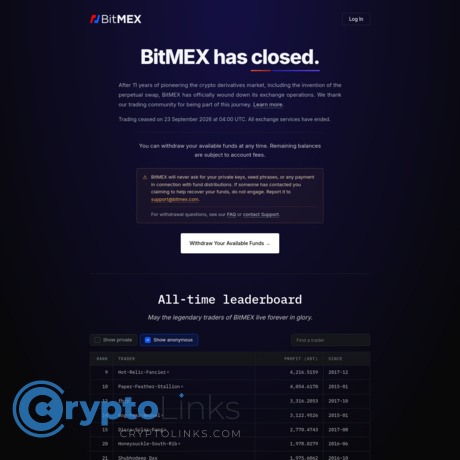
But here's the catch: BitMEX officially closed its cryptocurrency exchange on September 23, 2026. No more trading, no fresh deposits, and no opening new positions. The platform that helped make leveraged Bitcoin trading mainstream is now in its wind-down phase.
So if you're looking for a new crypto exchange, I'll save you some time. BitMEX isn't an option anymore. You'd be better off comparing active platforms in my crypto exchange reviews.
But if you've still got Bitcoin, Ethereum, or other crypto sitting in an old BitMEX account, things get much more interesting. Can you withdraw? How long does it take? Are there hidden fees? And can you actually trust the process?
I went through the official closure announcement, current withdrawal documentation, legal records, and security claims to figure out what users really need to know. I haven't personally withdrawn funds from BitMEX, so I'll separate what the company officially documents from what I can independently confirm.
My Quick BitMEX Verdict
For new traders, BitMEX is no longer worth considering because the exchange has shut down. For existing customers, the priority is recovering eligible funds safely.
BitMEX hasn't simply vanished. Its website remains online, eligible account holders can request withdrawals, and customer support is still available for wind-down issues.
That's a positive in my book. I've seen enough messy stories in crypto to appreciate a company keeping withdrawal procedures accessible after shutting down.
Still, I wouldn't call the situation ideal. Withdrawals now require identity verification, a test transaction, and a mandatory seven-day security hold. Remaining balances can also incur account fees.
My advice? If I had funds sitting there, I'd be more interested in getting them safely into a suitable wallet than reminiscing about the good old days of 100x leverage.
BitMEX has an important place in crypto history. But history and a currently usable trading platform are two different things.
What Was BitMEX and Why Was It So Popular?
BitMEX, short for Bitcoin Mercantile Exchange, launched in 2014 and became one of the most influential names in cryptocurrency derivatives trading.
Unlike a regular spot exchange where you buy Bitcoin and hold it, BitMEX became famous for contracts allowing traders to speculate on price movements without necessarily owning the underlying crypto.
Its biggest contribution was popularizing the perpetual swap, a derivative contract without a fixed expiration date.
Traditional futures expire at a specific time. Perpetual swaps don't. Instead, they use mechanisms such as funding payments to help keep the contract price close to the underlying market.
BitMEX's XBTUSD perpetual swap became particularly well known. Combined with leverage of up to 100x on certain contracts, it attracted traders looking for serious exposure to Bitcoin price movements.
And when I say serious exposure, I mean it.
At 100x leverage, a trader could theoretically control a $10,000 position with around $100 in initial margin, before considering fees and maintenance margin requirements. A relatively small move in the wrong direction could trigger liquidation.
That's exciting until it isn't.
I've always thought the most dangerous part of high-leverage trading is how easily people confuse a bigger position with a better opportunity. Leverage magnifies losses just as effectively as gains.
If you're unfamiliar with these instruments, my guide to crypto futures and derivatives exchanges explains how perpetual contracts, traditional futures, and different trading platforms compare.
What Made BitMEX Different?
BitMEX was designed primarily for active traders rather than casual crypto buyers.
Its historical features included:
- Bitcoin and cryptocurrency perpetual swaps.
- Dated futures contracts.
- Advanced order types and trading controls.
- Margin trading with substantial leverage.
- API connectivity for automated strategies.
- Professional-style charts and trading interfaces.
The platform built a reputation around sophisticated derivatives trading, not beginner-friendly Bitcoin purchases.
And honestly, that's part of why it became influential. BitMEX helped establish many of the concepts that traders now take for granted.
But those features are historical. They're not available for new trading activity following the shutdown.
Why Did BitMEX Shut Down in 2026?
BitMEX announced its closure on July 23, 2026, with the exchange officially ceasing operations on September 23, 2026, at 04:00 UTC.
According to the company's announcement, the board of HDR Global Trading Limited decided to close the exchange following a strategic review of the business and the broader cryptocurrency industry.
New registrations stopped after the announcement, followed by restrictions on trading activity and the eventual shutdown of all remaining exchange operations.
Here's something I want to make clear: BitMEX did not publicly establish one specific financial or regulatory event as the cause of its 2026 closure.
The crypto derivatives market had changed significantly since BitMEX's early years, with competitors such as Bybit, OKX, and other platforms attracting derivatives traders.
But blaming competition alone would be speculation. The official explanation remains a strategic business decision.
BitMEX also stated that there were no legal or regulatory issues associated with the closure decision itself.
That doesn't erase the company's earlier compliance problems, which I'll cover below.
For anyone researching exchanges that are no longer operating, CryptoLinks also maintains a collection of defunct crypto sites and closed platforms. It's a useful reminder that even once-famous crypto businesses don't necessarily last forever.
Can You Still Withdraw Crypto From BitMEX?
Yes. According to BitMEX's current withdrawal instructions, eligible customers can still request withdrawals of their available cryptocurrency balances.
But this isn't the same withdrawal process traders used when the exchange was active.
BitMEX has introduced additional checks as part of its wind-down procedures, including mandatory identity verification and a holding period before the final withdrawal is processed.
How the BitMEX Withdrawal Process Works
Based on the official instructions updated in October 2026, here's what customers should expect:
- Visit the official BitMEX website and sign in using your existing account.
- Complete or refresh your identity verification if requested.
- Navigate to the withdrawal section and provide a supported external wallet address.
- Submit the withdrawal request and complete the required email confirmation.
- Wait for BitMEX to send a small test transaction to your wallet.
- After the test transaction receives blockchain confirmation, a mandatory seven-day security hold begins.
- Once the holding period expires, the remaining balance is scheduled for the next daily processing batch.
I actually like the idea of sending a small test transaction before moving a larger amount. Crypto transactions can be irreversible, and sending assets to an incorrect address or unsupported network is a mistake you really don't want to make.
However, the seven-day holding period means customers can't expect immediate access to their remaining funds.
And that's a legitimate downside.
If somebody urgently needs their crypto, a mandatory security hold can be frustrating, even when the exchange presents it as a protection measure.
BitMEX says customers should contact support if their test transaction hasn't arrived within 48 hours after email confirmation.
I haven't performed a real-money withdrawal, so I can't personally verify actual processing speeds or how smoothly every customer gets through the procedure.
The documented timeline is useful, but it's not a guarantee that every withdrawal will be completed without additional reviews or delays.
Important BitMEX Withdrawal Restrictions
A few restrictions deserve special attention.
Withdrawals are web-only. API-based withdrawals have been disabled, meaning customers need to use the website manually.
Some network options are gone. ETH, USDT, and USDC withdrawals are currently restricted to the Ethereum network.
There's a withdrawal minimum. BitMEX states that the minimum transaction amount is $10 equivalent per asset, excluding the network fee.
That last point could become a headache for anyone holding multiple small leftover balances.
For example, if you've got less than $10 worth of a particular asset, the standard withdrawal system may not let you process it. I'd contact support before assuming there's another way to recover that amount.
And please, don't blindly send USDT to a receiving address on a different network just because that's what you used years ago.
Always confirm the exact asset and network on both sides.
For users planning to move their funds into personal storage, my crypto wallet reviews can help compare different wallet options before making that decision.
BitMEX Fees: What Happens to Funds Left Behind?
Now we're getting to one of the most important parts of this review.
BitMEX's old trading fees aren't particularly relevant anymore. You can't open a futures position on the exchange, so comparing its historical maker and taker rates with today's active exchanges doesn't really help.
What matters now is the cost of getting your money out and the potential charges for leaving it there.
Withdrawal Fees
BitMEX uses asset-specific withdrawal fees that can depend on the relevant blockchain and current network conditions.
The applicable amount should be displayed when preparing the withdrawal request.
I'm deliberately not listing a fixed BTC or ETH withdrawal fee here because those amounts can change.
Anyone withdrawing should check the quoted fee inside the official account interface before confirming.
Remaining Account Balance Fees
In its original closure announcement, BitMEX introduced fees for accounts retaining balances after September 23, 2026.
The announced structure referenced an annualized 1% charge collected monthly and a USD 50-equivalent monthly charge, with the greater amount applying under the published terms.
The company also reserved the right to increase these charges after providing notice.
That's a pretty serious incentive to withdraw.
Take a customer holding $2,000 worth of crypto. At a 1% annualized rate, the percentage calculation alone would equal approximately $20 over a year before balance changes. However, a $50 monthly minimum would be far more significant if applied under the original greater-of structure.
That example is illustrative, not a quote of a customer's current bill. I would verify the latest account-specific notice before calculating exactly what someone owes.
The practical lesson is simple: don't leave crypto on a closed exchange without understanding what fees may continue accumulating.
And don't forget that network fees can make small withdrawals disproportionately expensive.
Is BitMEX Safe? Here's What I Found
Security was always a big part of BitMEX's reputation.
In its closure announcement, the company claimed that during more than 11 years of operation, it had never lost customer funds to a hack.
That's an impressive claim, and it deserves acknowledgment.
But here's where I get a little more cautious.
A strong historical security record doesn't mean every risk disappears.
BitMEX was a centralized, custodial exchange. Customers depended on the company to hold assets and process withdrawals.
Even if private keys are protected through sophisticated security measures, a custodial customer still faces operational and counterparty risk.
Technical security, company solvency, withdrawal access, and regulatory protection are separate questions.
And I couldn't independently establish BitMEX's current platform-wide reserve coverage or verify every remaining customer liability through a recent independent audit.
So I wouldn't describe the platform as completely risk-free.
That isn't an accusation that customer funds are missing. It's simply the difference between a company's security claims and independently verified financial protection.
For anyone concerned about exchange custody, it's worth understanding how non-custodial crypto wallets differ from centralized accounts.
With a properly configured self-custody wallet, you control the private keys. That's a major advantage, but it also makes you responsible for protecting your recovery phrase and avoiding irreversible mistakes.
Beware of Fake BitMEX Withdrawal Messages
There's another risk that deserves attention: phishing.
Whenever an exchange closes, scammers can exploit the confusion by sending fake withdrawal instructions, urgent account verification notices, or messages promising to recover supposedly frozen assets.
BitMEX specifically warns that it will never ask customers for wallet private keys, seed phrases, or additional payments to distribute their funds.
That's worth remembering.
If you receive an unexpected message claiming your funds will disappear unless you connect a wallet immediately, don't click in a panic.
Go directly to the official website and verify the request through legitimate support channels.
You can also explore CryptoLinks' blockchain security resources for additional tools and information about evaluating crypto security risks.
Does BitMEX Require KYC in 2026?
Yes. Identity verification is mandatory for customers requesting withdrawals during the wind-down process.
Even previously verified users may be asked to refresh their information.
For individuals, this can involve government-issued identification, address information, and additional supporting documents when required.
Corporate accounts may face further verification requirements.
From a compliance perspective, I understand why BitMEX would apply stricter checks while winding down its business.
But from a customer's perspective, it's not always convenient.
Imagine opening an account several years ago, changing your address or losing access to an old email account, and then discovering that you need additional documentation before withdrawing your remaining crypto.
That could get annoying quickly.
BitMEX directs users with verification or account-access problems to its official support team.
And no, trying to bypass KYC using fake documents or someone else's identity isn't a smart workaround.
Can US Customers Withdraw From BitMEX?
Interestingly, BitMEX has relaxed certain former geographical restrictions specifically to help eligible users recover their remaining assets.
According to its policy updated September 24, 2026, withdrawal-related access has been enabled for eligible customers in previously restricted regions including the United States, Canada, Hong Kong, Bermuda, Seychelles, and Myanmar.
However, this doesn't mean the exchange has reopened trading in those locations.
Access is limited to account management, verification, and withdrawal of eligible balances.
Sanctions restrictions and additional compliance reviews may still apply.
If you're in a previously restricted country, I'd check the official policy rather than relying on an old BitMEX supported-countries article.
Who Owned BitMEX and Was It Regulated?
BitMEX was operated by HDR Global Trading Limited, a company incorporated in Seychelles.
The exchange was founded in 2014 by Arthur Hayes, Benjamin Delo, and Samuel Reed.
Arthur Hayes became especially well known throughout the crypto industry, and BitMEX grew into a recognized brand among derivatives traders.
But company recognition isn't the same as regulatory protection.
And BitMEX's legal history contains some serious issues.
BitMEX's $100 Million U.S. Fine
In January 2025, the U.S. Department of Justice announced that HDR Global Trading Limited, operating as BitMEX, had been fined $100 million for violations of the Bank Secrecy Act.
The case concerned failures to establish and maintain adequate anti-money-laundering and know-your-customer programs.
The company had previously pleaded guilty, and the sentence also included two years of probation.
This isn't some random accusation from an angry trader on social media. It's documented in an official U.S. Department of Justice announcement.
And yes, I think it's relevant when assessing the company's historical reliability and compliance standards.
However, BitMEX stated that its 2026 shutdown was a separate strategic business decision rather than the direct result of legal or regulatory issues associated with the closure.
I found no conclusive evidence establishing that the earlier AML violations directly caused the later shutdown.
Both facts deserve to be presented accurately.
What About BitMEX's Trading Tools and Leverage?
Historically, BitMEX offered a sophisticated derivatives environment with perpetual swaps, dated futures, advanced orders, margin controls, and API functionality.
Its XBTUSD contract became one of the most recognizable products in Bitcoin derivatives trading.
But these tools are no longer available for active exchange trading.
That's why I wouldn't recommend BitMEX based on its former leverage limits, old charts, or discontinued trading products.
If your interest is specifically leveraged crypto exposure, take a look at my crypto margin trading exchange comparisons instead.
Just remember that maximum leverage is a terrible shortcut for judging a platform.
Execution quality, liquidity, spreads, funding costs, liquidation mechanics, and withdrawal rules often matter much more.
BitMEX Alternatives: Where Can Traders Go Now?
If you used BitMEX for perpetual futures, you now need an active alternative.
There isn't one perfect replacement because different platforms serve different types of traders.
Bybit
Bybit is a relevant alternative for traders looking for a centralized derivatives exchange with perpetual contracts, advanced order functionality, and an active trading environment.
I'd compare its available products, funding rates, withdrawal rules, and local eligibility before opening an account.
OKX
OKX offers a broader crypto exchange environment that includes derivatives and other trading services.
It may suit traders who want more than a dedicated futures interface, although product access depends on jurisdiction.
Deribit
Deribit is especially relevant for traders interested in Bitcoin and Ethereum derivatives, including options.
For someone whose primary interest is sophisticated derivatives trading rather than buying random altcoins, it's a particularly sensible platform to research.
Kraken
Kraken is worth comparing if you prefer an established exchange brand with regional derivatives offerings.
You can explore my Kraken exchange review for a closer look at the platform, although you'll still need to verify which trading services are available in your country.
Hyperliquid
Hyperliquid takes a different approach, offering onchain perpetual trading rather than the traditional centralized exchange model.
That can appeal to traders who prefer crypto-native wallet interactions, but it introduces its own risks involving smart contracts, liquidations, market structure, and wallet security.
Whatever you choose, don't automatically assume a replacement exchange is safer just because BitMEX closed.
Every trading venue deserves its own security and risk assessment.
BitMEX Pros and Cons
What I Like
- Important trading history: BitMEX helped popularize perpetual swaps and shaped the modern crypto derivatives market.
- Reported security record: The company claims more than 11 years without customer funds being lost to hacks.
- Continued withdrawal access: Eligible customers can still request their available balances after closure.
- Published withdrawal procedures: Current documentation explains the test transaction, holding period, and additional verification requirements.
- Ongoing support: Official customer support remains available for account and withdrawal issues.
What I Don't Like
- The exchange is closed: New trading, deposits, and positions aren't available.
- Potential account charges: Keeping funds on the platform may result in continuing balance fees.
- Slow withdrawal structure: The mandatory seven-day security hold limits immediate access to funds.
- Network restrictions: ETH, USDT, and USDC withdrawals are limited to Ethereum.
- Small balance problems: The $10 minimum withdrawal threshold can complicate recovering leftover assets.
- Historical compliance failures: The company received a $100 million U.S. fine for Bank Secrecy Act violations.
Who Should Still Use BitMEX?
At this point, the only practical reason to access BitMEX is to manage an existing account, recover eligible funds, or obtain account-related information.
If you've still got assets there, carefully review the withdrawal process and make sure your destination wallet supports the correct asset and blockchain network.
For everyone else, I see no reason to open a BitMEX account or treat it as an active trading service.
And if you're thinking about moving recovered assets into personal storage, take a little time to understand private-key management before transferring large amounts.
BitMEX FAQ
Is BitMEX still operating in 2026?
No. BitMEX officially closed its cryptocurrency exchange on September 23, 2026. Trading and deposits have stopped, although eligible existing users can still access account and withdrawal functions.
Why did BitMEX shut down?
BitMEX attributed the closure to a strategic business review by its board. The company did not establish one single publicly verified financial cause for the shutdown.
Can I still withdraw Bitcoin from BitMEX?
Yes, if your account and balance are eligible. The published withdrawal process requires KYC, confirmation, a test transaction, and a seven-day security hold before the remaining funds are processed.
How long does a BitMEX withdrawal take?
The process includes a test transaction followed by a mandatory seven-day hold after blockchain confirmation. The remaining balance is then scheduled for a daily processing batch. Verification checks and network conditions may add delays.
Does BitMEX require KYC for withdrawals?
Yes. BitMEX requires identity verification, and some previously verified users may need to update their documents.
What is the minimum BitMEX withdrawal?
The currently published minimum is $10 equivalent per asset, excluding the applicable network fee.
Can I withdraw USDT from BitMEX using Tron?
Not under the published post-closure withdrawal restrictions. USDT, USDC, and ETH withdrawals are currently limited to the Ethereum network.
Is BitMEX a scam?
BitMEX was a long-established derivatives exchange with a documented operating history. However, it also had serious historical compliance violations. Its closure does not by itself establish fraud or prove that customer funds are missing.
Has BitMEX ever been hacked?
BitMEX claims that no customer funds were lost to hacks during its operating history. That's a company-reported statement, not a guarantee against other custodial, financial, or operational risks.
Can U.S. customers withdraw from BitMEX?
Eligible customers in the United States may access the withdrawal-only process under BitMEX's updated restrictions, subject to KYC and applicable compliance rules. Trading is no longer available.
What are the best alternatives to BitMEX?
Relevant alternatives include Bybit, OKX, Deribit, Kraken, and Hyperliquid. The best fit depends on your country, preferred derivatives, trading costs, liquidity, custody model, and risk tolerance.
My Final BitMEX Review: An Important Crypto Name, But Not an Exchange to Use Today
BitMEX deserves a place in the history of cryptocurrency trading. It helped transform Bitcoin derivatives, made perpetual swaps mainstream, and built a platform that influenced many of today's competing exchanges.
But the reality in November 2026 is simple: BitMEX is closed.
I appreciate that the company has maintained a formal process for existing customers to withdraw funds. Its reported history of avoiding customer-fund losses from hacks is also worth recognizing.
But I can't ignore the remaining-balance fees, withdrawal restrictions, mandatory holding periods, and the company's documented regulatory history.
None of those details should be buried behind nostalgic stories about leverage and trading volume.
If I were holding funds on BitMEX, my priority would be understanding exactly what I could withdraw, what it would cost, and how to transfer those assets safely.
If I were looking for a derivatives exchange today, I'd compare active alternatives rather than try to use a platform that's already shut its doors.
Crypto moves fast. Even the biggest names can eventually become part of its history.
My final verdict: BitMEX was an influential derivatives exchange, but in 2026 it's a closed platform with remaining withdrawal obligations, not a trading service I'd recommend to new users.
Editorial note: This review is based on publicly available company documentation and independent reporting. No real-money BitMEX withdrawal or live customer support interaction was performed. Always verify the latest withdrawal instructions directly with the operator.