Solana Accelerate USA Starts Tomorrow: The Signals I’m Watching That Could Light Up SOL Memecoins and Ecosystem Tokens Again
Is this one of those Solana weeks where you blink… and suddenly every SOL memecoin is up 80% before you even find the real contract address?
Solana’s calendar is lining up in a way I haven’t seen in a while: a major in-person catalyst kicks off tomorrow, attention is already building, and the broader market has been looking for a clean narrative it can actually trade.
The big question isn’t “Will Solana trend?” — it probably will. The real question is: does this become a quick hype loop (where most people buy the top), or does it turn into a week where liquidity and real ecosystem activity show up in ways you can measure?
Here’s how I’m thinking about it, and the specific traps I’ve seen people fall into every single time Solana gets loud.

The problem: SOL weeks get loud fast (and most people react too late)
When Solana has a “big week,” it’s rarely calm. It turns into an info firehose: tweets, token launches, “partnerships,” screenshots of wallets, random charts, influencer group chats… and somewhere in that mess, real opportunities do appear.
The issue is speed. Solana’s culture moves fast, the chain is fast, and the market treats that combination like rocket fuel. If you’re not prepared, you end up making decisions based on vibes instead of facts.
These are the most common pain points I see (and yes, I’ve watched smart people get clipped by all of them):
- Chasing green candles because “it’s running” — even though the best risk/reward was hours earlier when nobody cared.
- Falling for fake “partner” announcements that are really just a meme token piggybacking on a brand or event.
- Getting stuck in illiquid memecoins where you can buy easily, but selling turns into a slippery exit with massive slippage.
- Buying the wrong contract because five clones launched with the same ticker and logo in the same hour.
- Missing the actual ecosystem winners because meme noise drowns out legit traction (users, revenue, integrations, shipping).
If that sounds familiar, it’s because “event weeks” compress everything: narrative, liquidity, launches, and scams. It’s not just you — this is how these cycles tend to play out across crypto.
Even academic research backs the idea that attention can move markets. One classic example: Barber & Odean (2008) found that retail investors are more likely to buy attention-grabbing stocks (news, big volume, extreme returns). Crypto behaves even more aggressively because attention spreads faster, trading is 24/7, and token creation is frictionless.
Translation: in weeks like this, attention is the product — and price is often just the receipt.
Promise solution
I’m not here to hype you into random SOL memes or pretend every conference week is a guaranteed pump. What I can do is give you a research-based game plan so you’re not reacting late.
This week, I’m treating it like a checklist-driven operation:
- What to watch each day so I’m early on real momentum and late on fake narratives.
- Which signals matter (liquidity, onchain behavior, real accounts confirming info) vs. which signals are basically noise.
- How I separate memecoin heat from real Solana ecosystem traction — because they can move together, but they’re not the same trade.
If you’ve ever felt like you “always hear about the coin after it already ran,” this is how you fix that: you stop hunting randomly and start tracking repeatable signals.
Why events like Accelerate can move SOL narratives (even if nothing magical is announced)
A lot of people misunderstand conferences. They think the market only moves if some huge announcement drops on stage.
That’s not usually how it works.
Events like Accelerate create coordination. Attention concentrates, builders time releases, creators pick that week to launch, and market participants show up because they expect liquidity and volatility. Even if the “headline news” is average, the timing can still produce sharp rotations.
Here’s what tends to happen around these weeks:
- Founders cluster announcements because it’s easier to get coverage when everyone is watching Solana.
- New tokens launch into the spotlight (including a lot of low-effort copies trying to siphon liquidity).
- Market makers and active traders pay attention because “attention weeks” often bring volume — and volume is opportunity.
- Social proof accelerates: one trending chart pulls in the next wave, which pulls in the next wave, until it flips.
And that last part — the flip — is why you need rules. Attention cuts both ways.
The big question people keep asking: “What made Solana skyrocket?”
I keep getting asked some version of: “Why does Solana move so fast when it moves?”
The simple answer is: speed + cost + user experience. When it’s cheap and fast to trade, mint, and experiment, activity can spike quickly once attention returns.
On the technical side, Solana’s design (including Proof of History, which helps order events efficiently) is part of why the network can handle bursts of activity in a way that feels instant to users. That matters because when people pile in, friction is the enemy of momentum. Solana’s “low friction” environment is a big reason narratives can catch fire fast.
But here’s the part most traders miss: the same speed that helps real usage spike also makes it easier for speculation to explode — especially memecoins.
So what should you watch tomorrow and throughout the week to tell the difference between a quick hype loop and real traction? That’s exactly what I’m going to lay out next, starting with how I read the Miami agenda and which tracks tend to leak alpha into SOL memes and ecosystem tokens.
What Solana Accelerate USA is — and what I’m watching on the Miami agenda
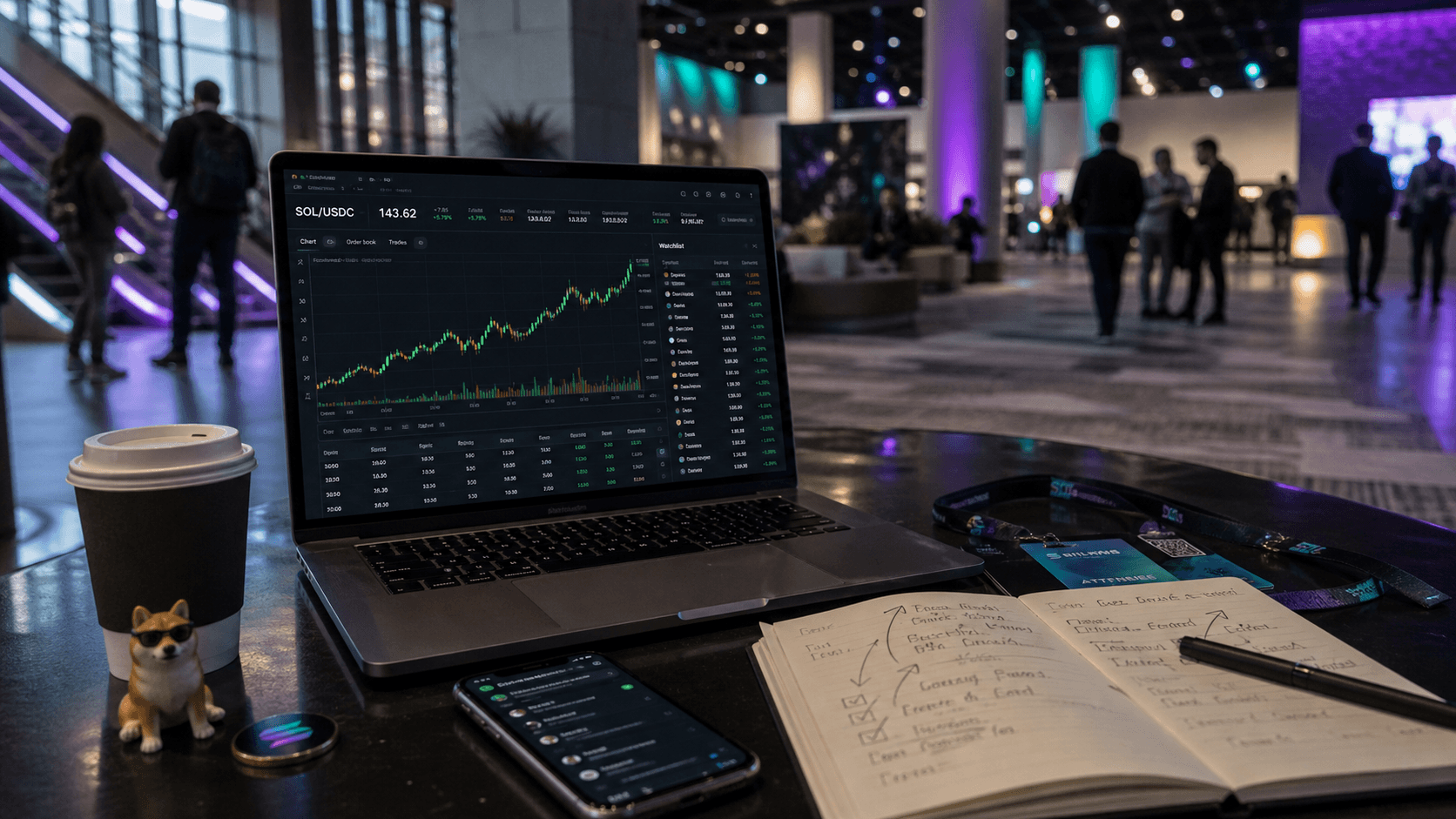
Solana Accelerate USA starts tomorrow in Miami, and I treat weeks like this the same way I treat earnings season in tradfi: not because one announcement “changes everything,” but because attention, capital, and builders all show up at the same time.
Miami matters for one simple reason: it’s a natural collision point for builders + creators + capital. That combo tends to produce two things that markets love:
- Coordination (teams time launches and updates so they don’t get ignored)
- Liquidity (traders and market makers actually show up to play the narrative)
When I look at an event like this, I don’t read the agenda like a schedule. I read it like a narrative map. I’m scanning for tracks that hint where Solana wants attention to go next: consumer apps, DeFi, DePIN, gaming, AI agents, payments, and infrastructure.
If you want to track the same source material I’m using, start here:
- Solana Accelerate Miami page
- Miami agenda (this is the real “signal sheet”)
- Solana’s official event post on X
Then I keep a second layer open: real-time onchain chatter and builders posting demos. These are the kinds of posts that can front-run what Twitter starts repeating 12 hours later:
Here’s how I translate an agenda into tradeable “watch items.” If the agenda leans heavier into:
- Payments / stablecoins / merchant UX → I expect “real usage” narratives and wallet activity discussions
- DeFi (perps, lending, liquid staking) → I expect TVL and volume stories, plus token-specific rotations
- Consumer apps / social → I watch for onboarding metrics and viral loops (the stuff that actually brings new users)
- DePIN → I watch for partnerships, hardware rollouts, and “real-world” traction claims (which need verification)
- AI agents → I watch for bots that transact onchain (not just “AI branding”)
- Infra (RPC, indexing, tooling) → I watch for performance upgrades and reliability narratives (less sexy, but it matters)
My rule: if a track suggests new users or new liquidity, I pay attention. If it suggests “cool tech” with no clear user pull, I keep it on a second screen.
The “catalyst chain reaction”: how SOL, memecoins, and ecosystem tokens usually move together
I’ve watched enough Solana “big weeks” to know the order is usually predictable. Not always, but usually.
- 1) SOL gets the first bid — it’s the easiest exposure, the most liquid, the simplest “I believe in Solana this week” trade.
- 2) Large-liquidity memecoins run next — this is the attention trade. People want something that can move fast, with low friction.
- 3) Then ecosystem tokens catch a bid — this is the “I want beta” phase, where traders move from the headline to the picks-and-shovels.
When does this pattern break? Three common ways:
- Risk-off macro day — if markets broadly dump, the chain reaction gets cut off early.
- BTC dominance spikes — liquidity gets sucked upward and alts stop responding to their own catalysts.
- Memecoin liquidity dries up — if memes can’t keep volume, the “attention engine” stalls and ecosystem plays don’t get the same tailwind.
If you’ve ever wondered why you see SOL pumping, then memes exploding, then suddenly random ecosystem charts waking up… this is the rotation. It’s not magic. It’s just traders moving down the risk curve once they feel “safe” that attention is sticking.
Memecoin momentum: what’s actually different when Solana memes run
Solana memecoins don’t just run because people are funny. They run because the chain makes it easy for the average person to participate:
- Cheap fees so people can trade small size without feeling punished
- Fast finality so “momentum” actually behaves like momentum
- Frictionless swapping so users can rotate quickly
- Creator velocity (memes, clips, influencers) that spreads faster than traditional crypto marketing
But “easy to trade” also means “easy to get farmed.” So before I touch any SOL meme during an event week, I run a quick reality check. Here’s what I look at—every time:
- Holder distribution: if the top wallets can nuke the chart, I treat it like a grenade.
- LP status: is liquidity healthy, and does it look like it could vanish on you?
- Socials: are accounts real, consistent, and active—or is it botted hype?
- Volume quality: steady two-way flow beats one spiky candle that looks like forced attention.
- Wallet clustering: if a bunch of “different” wallets behave like one entity, I assume it is.
- Chart behavior: if it’s straight up with no real pauses, you might be staring at exit liquidity.
Real sample from how these weeks feel: you’ll often see a meme trend on X, then a flood of copycats launch within hours using similar names and logos. If you’re not double-checking what you’re buying, you’re basically clicking the first blue link in a phishing email.
Ecosystem plays: the categories I expect to benefit if attention sticks
If Accelerate week creates sustained attention, I’m not only watching memes. I’m watching the “boring” stuff that becomes very profitable when the market rotates from jokes to infrastructure and apps.
I track ecosystem moves in buckets so I’m not chasing random tickers:
- DeFi primitives (DEXs, perps, liquid staking, lending)
What tends to move this bucket: volume records, new markets, liquidity incentives, integrations, UI upgrades that reduce friction. - Infrastructure picks-and-shovels (RPC, indexing, tooling, wallets)
What tends to move this bucket: reliability/performance updates, big wallet features, dev tooling launches, partnership announcements that actually bring usage. - Consumer/creator apps (social, trading apps, payments UX)
What tends to move this bucket: onboarding metrics, viral product moments, app store traction, creator collaborations, smoother fiat onramps. - DePIN + real-world networks
What tends to move this bucket: real deployments, device counts, coverage maps, revenue proof—not just “we’re building.” - AI/agent experiments (where Solana speed actually matters)
What tends to move this bucket: demos where agents transact onchain, automation that saves users time, and credible teams shipping fast.
A quick research note: historically, crypto “attention shocks” (events, catalysts, big news cycles) tend to cluster trading activity into narrow windows, and that’s when category rotations happen fastest. You can see similar behavior documented in academic work on investor attention and abnormal volume/volatility around high-visibility moments (a classic starting point is Barber & Odean’s research on attention-driven buying). The crypto version is basically that phenomenon on fast-forward.
“Why is Solana up?” in plain English (and where Proof of History fits)
When SOL starts moving during a week like this, people always ask the same question like it’s a mystery: “Why is Solana up?”
In plain English, SOL usually moves because of some mix of:
- Network usage (more transactions, more users doing things that matter)
- Liquidity (more capital willing to trade SOL and Solana assets)
- Developer momentum (apps shipping, integrations going live, teams choosing Solana)
- Narrative confidence (the market believing the ecosystem has “the ball” right now)
Now, where does Proof of History (PoH) fit?
PoH is one of the ingredients in Solana’s design that helps it order events efficiently. You don’t have to memorize the technical details to get the point: when a ton of users pile in—trading, minting, using apps—Solana is built to keep the experience responsive. That responsiveness becomes part of the narrative feedback loop:
- fast chain → better user experience
- better UX → more activity
- more activity → more attention
- more attention → more liquidity
And the reason demand spikes show up quickly on Solana compared to slower, more expensive chains is simple: if it’s cheap and quick to transact, people don’t hesitate. They just… do it. That behavior shows up in metrics fast: swaps, active wallets, transaction counts, app-specific volume.
My “don’t get fooled” checklist for announcement weeks
This is the part most people skip—then they DM me later asking how they bought the wrong token.
- Verify announcements from official channels (not quote tweets, not “my friend at the event said…”)—start with Solana’s official post and the agenda.
- Watch for fake tokens piggybacking on event names—scammers love conference weeks because they know you’re distracted.
- Avoid low-liquidity traps unless you’re treating it like a lottery ticket (and sizing it like one).
- Have exit rules before entry: know your profit targets and what invalidates your trade. If you’re making rules mid-pump, you’re already late.
- Don’t confuse “trending” with “sustainable”: trends can be manufactured; sustainable demand usually leaves footprints in volume and retention.
Resources I’m using to track the week (official + onchain chatter)
If you want to follow along with the same inputs I’m watching in real time, bookmark these:
- https://solana.com/accelerate/miami
- https://solana.com/accelerate/miami/agenda
- https://x.com/solana/status/2051484086233956782
- https://x.com/spawnagents/status/2051585461714333833
- https://x.com/Samerman77/status/2051585461714333833
- https://x.com/drace_mo/status/2051583502819172716
- https://x.com/W00_am_1/status/2051553733914321361
- https://x.com/marinonchain/status/2051581162028757377
Now here’s the question that actually matters: what do you do with this information over the next 7 days—if you’re holding SOL, trading memes, or trying to get ecosystem exposure without becoming someone else’s exit liquidity?
That’s exactly what I’m going to lay out next—with a simple plan, three scenarios, and the rules I use so I’m not guessing mid-week.
My playbook for the next 7 days (if you hold SOL, trade memes, or want ecosystem exposure)
I treat weeks like this the same way I treat earnings week in stocks: I plan the rules first, then I let price and onchain behavior tell me what’s real.
Here’s how I’m thinking about the next 7 days—separated by the three “types of exposure” most of you actually have.
If you’re mainly a SOL holder: what would make me add, trim, or just sit tight
With SOL, I’m not trying to be a hero. I’m trying to be right enough while avoiding the emotional swings that come with event weeks.
- I add (or re-add) only when I see confirmation, not excitement. For me that looks like SOL holding key levels on higher volume after the first wave of hype posts, and not giving it all back within a few hours.
- I trim when SOL turns into the “ATM” for everything else. A common pattern is SOL catching the first bid, then capital rotates out of SOL into memes and small caps. If SOL starts chopping while memes go vertical, I’ll often take a little off and keep a core position.
- I hold when the market is paying up for real usage. If SOL is up and onchain activity is rising in a healthy way (not just one memecoin casino), I’m not in a rush to outsmart it.
A simple rule I use during catalyst weeks: If I wouldn’t feel comfortable buying a fresh position after a 10–15% move in a day, I don’t “chase-add” just because the timeline is loud.
Real sample: If SOL rips into Day 1, I’ll often wait for a boring 4–12 hour window. If price holds up while the feed goes quiet, that’s usually a cleaner signal than the initial spike.
If you trade memecoins: how I size, what I look for, and how I avoid “headline rugs”
Memecoins are where people blow themselves up during conference weeks—not because they picked the “wrong” meme, but because they used the wrong sizing and the wrong assumptions.
My sizing framework (the part nobody wants to hear):
- Most meme trades should be small enough to lose 100% without changing your week. That’s not pessimism; that’s respecting how fast liquidity disappears.
- I size smaller the earlier I am. Early entries can be great, but they’re also where fake contracts, spoofed volume, and “friend of a speaker” lies live.
- I scale out on the way up. I don’t wait for “the top.” If a meme does a fast 2x–3x, I like taking partials and letting the rest ride with a clear invalidation.
What I prefer trading this week: liquid names with consistent volume across multiple hours, not just a 20-minute blast. Liquidity is oxygen. If it’s thin, you’re not “early”—you’re just the exit.
Headline rug pattern I watch for: a token launches with a name that looks “conference-adjacent,” the social account posts a screenshot of a venue badge or an “afterparty flyer,” then volume spikes and the chart turns into a straight line down. If the only proof is viral content, I assume it’s marketing, not truth.
My personal “green flags” checklist before I even consider a memecoin:
- Liquidity and spreads: if the spread is wide and the pool is tiny, I pass.
- Volume quality: I want to see buys and sells distributed over time, not one wallet doing gymnastics.
- Holder sanity check: if a handful of wallets control too much, I treat it like a grenade.
- Social behavior: I like seeing consistent posting and organic chatter, not 200 bot replies and “big announcement soon.”
- Time: I prefer memes that survive their first hype wave. Survival is a signal.
Why I’m strict here: attention-driven assets are reflexive. In traditional markets, research has shown that investor attention can temporarily move prices (for example, Barber & Odean’s work on attention and buying behavior). Crypto is basically that effect with a turbo button—especially during events.
If you want one habit that saves money: never buy a meme while you’re still trying to find the real contract address. If you’re rushed, you’re already in the trap.
If you prefer ecosystem exposure: how I pick categories without chasing the 5x
Ecosystem trades are where I look for the “quiet winners” after meme mania cools down. The mistake people make is buying the chart that already went vertical because it feels “confirmed.” Usually that’s just late.
My approach is category-first, token-second:
- I pick 1–2 categories that should logically benefit if attention sticks. Then I shortlist a few projects in each category.
- I wait for rotation tells. When memes stop being the only thing moving and money starts moving into tools, infra, and DeFi rails, that’s usually a better risk/reward window.
- I avoid the “already did a 5x” chart unless there’s a real second catalyst. A second catalyst could be a product release, a major integration, or a clear onchain usage breakout.
Real sample (how I’d structure it): I’ll build a small “basket” instead of marrying one ticker—say, one DeFi primitive + one infrastructure pick-and-shovel + one consumer app. If the narrative is real, you often get multiple winners. If it’s not, the basket keeps you from getting wrecked by one bad pick.
What I’m watching that actually helps ecosystem tokens:
- New users doing normal things: swapping, staking, using apps—not just minting random memes.
- Stickiness: activity that stays elevated for multiple days, not one headline spike.
- Builders shipping: product updates that are usable today, not just “coming soon.”
In my experience, the best ecosystem entries happen when the timeline is still obsessed with memes, but the data starts showing broader usage underneath.
The 3 scenarios I’m planning for (so I’m not guessing mid-week)
I’m not trying to predict the week. I’m trying to pre-decide how I’ll behave depending on what the market gives us.
1) “Conference pop” then fade
What it looks like: SOL pops, memes spike hard, then everything bleeds back while people argue on X about “sell the news.”
What I watch:
- SOL failing to hold key levels after the first surge
- Memes going vertical while liquidity gets thin and wick-heavy
- Ecosystem tokens not catching any meaningful bid
What I do: I get defensive fast. I take profits quicker, I reduce meme exposure, and I stop “adding” just because something is trending. In this scenario, cash (or SOL core only) is a position.
2) Sustained rotation (SOL → memes → ecosystem) over several days
What it looks like: SOL holds gains, meme volume stays high without collapsing, then money starts bidding up infrastructure/DeFi/consumer names.
What I watch:
- SOL making higher lows instead of giving it all back
- Memecoins cooling off without imploding (a healthy sign)
- Ecosystem tokens starting to move in clusters (not just one random pump)
What I do: I keep my SOL core, I trade memes selectively (not all day, every day), and I start building ecosystem positions on pullbacks instead of chasing breakouts.
3) Market-wide risk-off interrupts everything
What it looks like: BTC dumps, macro fear hits, and Solana narratives don’t matter for a few days.
What I watch:
- BTC dominance spikes and alts lose bids across the board
- SOL starts moving like a high-beta risk asset again (because it is)
- Liquidity dries up in memes first (usually a warning)
What I stop doing: I stop forcing trades. In risk-off, the “best meme” is still just a meme, and the “best ecosystem token” can still drop 30% because the whole market is deleveraging.
Risk notes I want everyone to hear (especially during memecoin weeks)
I love the energy of Solana weeks, but I respect the dark side: scams scale with attention. This isn’t paranoia—it’s pattern recognition. Blockchain analytics firms like Chainalysis have consistently documented how fraud and opportunistic scams surge around hype cycles and retail attention waves.
My non-negotiables this week:
- Verify contracts and don’t rely on screenshots or “trust me bro” posts.
- Use a separate wallet for meme trades. Keep your main funds away from random approvals.
- Don’t sign random transactions just to “check eligibility” or “mint a pass.” That’s how wallets get drained.
- Assume liquidity can vanish. If your plan requires “I’ll just sell when it dips,” you don’t have a plan.
- Viral isn’t verified. A trend can be fake. A screenshot can be fake. A logo on a flyer can be fake.
If you want a simple safety rule: if you feel rushed, you’re the product.

The takeaway I’m carrying into tomorrow
Accelerate USA starting tomorrow is the kind of calendar catalyst that can restart attention and liquidity on Solana fast. That’s the opportunity—and it’s also the trap.
My edge this week isn’t “knowing the next meme.” It’s having rules before the pumps, watching how SOL behaves when the noise peaks, and only taking ecosystem exposure when the market proves it wants more than a quick casino night.
If you set your sizing, your exits, and your verification habits now, you’ll catch cleaner entries, avoid most of the obvious landmines, and you’ll know—quickly—whether this week is just loud or the beginning of a real Solana push