Japan’s SBI Pilot Just Opened the Floodgates — How $115B+ in Deposits Could Supercharge XRP, BTC and ETH Adoption Overnight
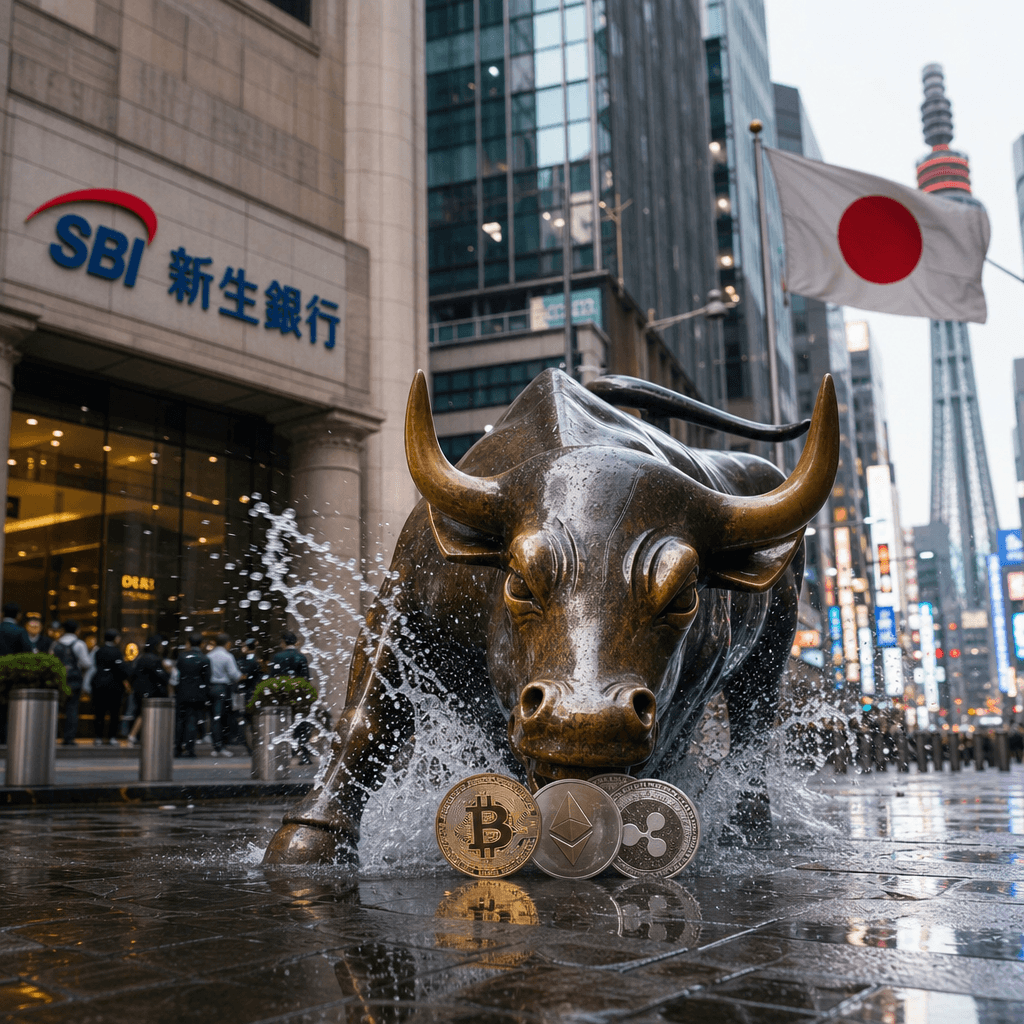
What happens when crypto stops asking regular people to join exchanges and starts showing up inside the bank products they already trust?
That is the real story I see behind SBI Shinsei Bank’s reported June 10, 2026 deposit-linked crypto rewards pilot. Not hype. Not “every saver is suddenly getting paid in XRP.” Not some wild claim that Japanese banks are replacing yen interest tomorrow.
The more interesting point is simpler:
A major Japanese banking brand may be turning normal savings behavior into a doorway for Bitcoin, Ethereum, and XRP exposure.
If this pilot works, it could change how first-time users meet crypto. Instead of downloading an exchange app, passing a new KYC process, worrying about wallets, and deciding whether now is the “right time” to buy, a customer could receive a crypto-related reward through a familiar banking relationship.
That small shift matters a lot.
Crypto adoption has always had a trust problem. Banks already have trust, deposits, identity checks, customer support, and daily financial relevance. So when a bank with a reported deposit base above $115 billion connects savings activity to BTC, ETH, and XRP rewards, I pay attention.
But I also want to keep this honest from the start: the $115B+ number is not automatic buying pressure. I see it as a potential distribution base, not a guaranteed crypto demand event.

The pain point: crypto adoption still feels too hard for normal savers
Most people do not avoid crypto because they have never heard of Bitcoin. They avoid it because the first step still feels uncomfortable.
For a normal saver, crypto often sounds like this:
- Open a crypto exchange account.
- Upload ID documents to another company.
- Choose between dozens or hundreds of coins.
- Understand spreads, fees, wallets, addresses, networks, and taxes.
- Accept that the value may swing hard before breakfast.
That is a lot to ask from someone who simply wants their savings to work a little harder.
This is especially important in Japan. The Bank of Japan’s Flow of Funds data has repeatedly shown that Japanese households keep a large share of financial assets in cash and deposits. That tells me something important: Japan has a deep pool of conservative savers who already trust the banking channel.
So if crypto wants to reach those people, it cannot only speak the language of exchanges, charts, leverage, and trading pairs. It also has to speak the language of deposits, rewards, campaigns, and trusted financial brands.
That is why the SBI Shinsei angle is so interesting. A bank-linked reward does not force a customer to become a crypto trader on day one. It lets the customer experience crypto as a reward first.
Promise solution: SBI’s pilot gives crypto a normal banking doorway
The genius of a deposit-linked crypto reward is that it changes one word:
- From: “I bought crypto.”
- To: “I received crypto.”
That difference sounds small, but psychologically it is huge.
People are used to receiving rewards from financial products. Airline miles. Credit card points. Cashback. Brokerage bonuses. Shopping vouchers. Bank campaigns. These reward systems work because they remove the emotional pressure of making a big investment decision.
If BTC, ETH, or XRP can enter that same rewards category, crypto becomes less intimidating.
The first win is not always price. Sometimes the first win is familiarity.
Once a customer receives a small crypto reward, several things can happen:
- They may check the price for the first time.
- They may learn what XRP, Bitcoin, or Ethereum actually does.
- They may open an account inside the connected crypto ecosystem.
- They may hold the reward instead of cashing it out.
- They may become comfortable enough to buy more later.
That is how adoption often works in real life. Not through one dramatic moment, but through a low-friction first touch.
This is why bank-assisted crypto onboarding could become more powerful than another exchange promotion. Exchanges usually reach people who are already curious. Banks reach people who may never search “how to buy XRP” or “best Bitcoin exchange Japan” in the first place.
The questions readers want answered right away
Before anyone gets carried away with price predictions, I think these are the questions that matter most.
- Is SBI Shinsei really paying interest in crypto?
Based on the reporting so far, I would be careful with that wording. This looks closer to a crypto voucher or bonus linked to deposits, not a full replacement of yen deposit interest with XRP, BTC, or ETH. - Why is XRP included with Bitcoin and Ethereum?
Bitcoin and Ethereum are the obvious names because they are the two largest crypto assets by market recognition. XRP is the standout because SBI has a long history with Ripple-related payment infrastructure. So XRP’s inclusion feels strategic, not random. - Is crypto legal and regulated in Japan?
Yes, Japan has one of the more developed crypto regulatory frameworks among major economies. Crypto-asset exchange service providers are regulated under Japan’s financial rules, and the Financial Services Agency plays a central role in oversight. - How big is SBI Shinsei’s deposit base?
The figure being discussed is above $115 billion, depending on reporting period and exchange-rate assumptions. I do not treat that as money flowing into crypto. I treat it as a massive customer distribution channel. - Could this impact XRP price?
It could help the XRP narrative, especially because SBI and Ripple already have a long relationship. But actual price impact depends on reward size, redemption rates, customer choices, liquidity, and whether crypto is bought on the open market. - Is this safe for regular savers?
It may be a more familiar way to receive crypto exposure, but the assets themselves are still volatile. A bank-linked reward can reduce onboarding friction. It does not remove market risk, tax questions, or the need to understand what the reward actually is.
That is the balance I think this story needs. Exciting? Yes. Worth watching closely? Absolutely. A guaranteed overnight price explosion? No serious reader should accept that without checking the structure.

The key claim I’ll test: “$115B+ in deposits could supercharge adoption”
The headline number is powerful, but it needs to be understood correctly.
When I see $115B+ in deposits, I do not see $115B about to rotate into XRP, Bitcoin, and Ethereum. That would be a lazy reading of the story.
What I see is this:
- Distribution power: SBI Shinsei already has customers, trust, and banking relationships.
- Low-friction onboarding: Customers may not need to start from a crypto exchange mindset.
- Asset visibility: XRP, BTC, and ETH get placed in front of normal savers.
- Habit formation: A customer who receives crypto once may become more open to holding or buying later.
- Banking validation: A regulated bank campaign can make crypto feel less like an outside experiment.
That is where the “supercharge” idea makes sense. Not because every deposit turns into a buy order, but because even a tiny conversion rate can matter when the starting pool is huge.
For example, if a large bank campaign introduces only a small slice of deposit customers to a crypto reward, that could still create thousands or even hundreds of thousands of new touchpoints with digital assets. Some users will ignore it. Some will redeem and sell. Some will hold. Some will learn. Some will come back later.
That is how mainstream adoption often begins.
The floodgate is not the size of the reward. The floodgate is the bank account access.
And that brings up the detail that can make or break the entire story: is this truly crypto interest, or is it a deposit bonus wrapped in a crypto voucher model?
That distinction changes the banking, tax, compliance, and adoption angle completely — and it is the exact point I would check before drawing any serious XRP, BTC, or ETH market conclusion.
What launched today: SBI Shinsei’s deposit-linked crypto rewards pilot
The launch that caught my attention today is not just another exchange cashback gimmick. The cleaner read is this: SBI Shinsei Bank is testing a deposit-linked crypto rewards campaign where eligible customers can receive crypto-related vouchers connected to Bitcoin, Ethereum, and XRP.
That wording matters. According to Ledger Insights, the structure is best understood as crypto vouchers as a bonus on deposit interest. Market coverage from Coinpedia and Crypto.news frames the offer around BTC, ETH, and XRP rewards.
My simple read: customers are not waking up to find their yen savings account magically converted into XRP, Bitcoin, or Ethereum. This looks much closer to a normal deposit product with a crypto reward layer attached.
The customer journey, in plain English, appears to work like this:
- A customer keeps or places money in an eligible SBI Shinsei deposit product.
- The customer meets the campaign conditions.
- The customer receives a crypto-related voucher, coupon, or bonus.
- That reward can then be redeemed through the connected SBI crypto ecosystem.
- The crypto exposure is tied to Bitcoin, Ethereum, and XRP.
That may sound small, but it changes the psychology completely. A normal saver is no longer being asked, “Do you want to open a crypto exchange account and buy a volatile asset?” The question becomes much softer: “Do you want to accept a reward from a bank relationship you already trust?”
That is powerful because finance is full of examples where adoption improves when a product is placed inside an existing trusted flow. Retirement saving studies around default enrollment showed this years ago: convenience and trust can beat education campaigns. In crypto, the same idea applies. If the first touchpoint is a bank-linked reward instead of a trading screen, the fear level drops fast.
Is SBI Shinsei paying interest directly in XRP, BTC, and ETH?
This is the first place I want readers to slow down, because headlines can make this sound bigger than the actual structure.
There is a big difference between these two models:
- Direct crypto interest: a bank deposit earns interest that is contractually paid in BTC, ETH, or XRP.
- Crypto voucher bonus: a bank deposit qualifies the customer for a separate crypto-related reward or coupon.
Based on the reporting I’m seeing, this SBI Shinsei campaign looks much closer to the second model.
That distinction matters for four reasons:
- Compliance: a crypto voucher is easier to separate from the legal treatment of a traditional yen deposit.
- Customer expectations: customers need to know whether they are earning bank interest, receiving a promotional bonus, or redeeming crypto through another platform.
- Deposit protection: a yen deposit and a crypto asset are not the same thing. I would not treat the crypto side as an insured bank deposit.
- Taxes: crypto rewards can create tax questions, especially once redeemed, sold, or exchanged.
I would not explain this to a beginner as “SBI Shinsei is paying your savings interest in XRP.” I would explain it as: “SBI Shinsei is testing a deposit-linked campaign where eligible savers may receive crypto vouchers tied to BTC, ETH, and XRP.”
That may sound less dramatic, but it is actually more important. A direct crypto-interest savings account would raise a mountain of legal and risk questions. A voucher-based model is more flexible, easier to test, and more realistic for a regulated banking group.

Why XRP is the standout name in this story
Bitcoin and Ethereum are expected names in almost any serious crypto rewards program. Bitcoin has the brand. Ethereum has the developer ecosystem. XRP is the interesting name here.
The reason is SBI’s long relationship with Ripple. SBI and Ripple have been connected for years through SBI Ripple Asia, a joint venture focused on payment and remittance infrastructure in Asia. You can see that relationship directly on the SBI Group page for SBI Ripple Asia and Ripple’s own SBI Ripple Asia page.
That makes XRP’s inclusion feel less random.
- Bitcoin gives the campaign instant mainstream recognition.
- Ethereum gives it exposure to the largest smart contract economy.
- XRP connects the story to SBI’s long-running payments and banking strategy.
To be clear, XRP being included in a reward campaign does not automatically mean SBI Shinsei is using XRP for settlement inside the bank. I would not make that leap. But I also would not ignore the signal.
When XRP sits beside Bitcoin and Ethereum in a bank-linked rewards offer, it tells the market something simple: inside the SBI ecosystem, XRP is not being treated like a fringe asset.
That is exactly why XRP holders are paying attention. BTC and ETH inclusion confirms mainstream crypto exposure. XRP inclusion hints at a deeper SBI-Ripple history that traders and long-term believers already know well.
The $115B+ deposit angle: why the bank balance sheet matters
The $115B+ deposit angle should be handled carefully. I do not see it as automatic crypto buying pressure. I see it as distribution power.
SBI Shinsei’s financial materials give the important balance-sheet context. The bank is not a tiny fintech app trying to bribe users into downloading a wallet. It is a major Japanese banking brand with a huge deposit franchise. The SBI Shinsei Bank financial results material is useful here because it shows the scale behind the campaign.
This is how I think about the math:
- 0.1% of a $115B deposit base equals about $115 million in balances exposed to the campaign.
- 1% of that base equals about $1.15 billion in balances touched by the offer.
- 5% of that base equals about $5.75 billion in balances sitting near a crypto reward message.
Again, that does not mean those amounts flow into XRP, BTC, or ETH. The actual reward budget could be much smaller. The key point is that the bank does not need every saver to become a crypto investor. It only needs a small slice of customers to try the reward path for the onboarding numbers to become meaningful.
Here is the real-world sample I keep thinking about:
A saver with ¥1,000,000 in a normal bank deposit may never open a crypto exchange account on their own. But if the bank says, “This deposit campaign includes a crypto voucher,” that same person may take the reward, redeem it, and suddenly own a small amount of BTC, ETH, or XRP.
That first ownership moment matters. Once someone owns even a small crypto balance, they are more likely to check the price, read about the asset, ask tax questions, compare wallets, and understand the market. The first step is usually the hardest. SBI may have found a way to make that first step feel ordinary.

Why Japan is the perfect test market for this kind of crypto banking
Japan is a fascinating place to test this model because it combines conservative saving habits with serious crypto regulation.
Japanese households have historically kept a large share of financial assets in cash and deposits. Bank of Japan flow-of-funds data has shown this pattern for years. That makes Japan very different from markets where retail investors are already comfortable jumping from app to app looking for yield.
So if a crypto rewards model can work in Japan, that is a strong signal.
- Japanese savers are cautious. That makes bank trust more important than crypto hype.
- Japan has a mature crypto regulatory framework. Crypto exchanges operate under Financial Services Agency oversight.
- The country remembers Mt. Gox. That history pushed Japan toward stricter consumer-protection rules.
- Bank brands still matter. A bank-linked crypto reward feels very different from a random offshore exchange promotion.
- BTC, ETH, and XRP already have name recognition. The campaign does not need to introduce completely unknown assets.
This is also why I pay attention when local financial media such as Nikkei covers a story like this. Crypto Twitter can make anything sound massive for a day. Japanese financial press is usually more grounded, and that helps separate a real banking experiment from a viral headline.
The verification stack I’m using before I treat this as more than a promo
I do not like building a major adoption thesis from one headline. For this story, I’m checking the full stack:
- Ledger Insights for the clearest wording around crypto vouchers and deposit-interest bonuses.
- Coinpedia for broader market coverage and how crypto investors are interpreting the offer.
- Crypto.news for the BTC, ETH, and XRP rewards framing.
- SBI Shinsei Bank IR material for deposit and balance-sheet context.
- SBI Group’s SBI Ripple Asia page for the official SBI-Ripple relationship.
- Ripple’s SBI Ripple Asia page for Ripple’s own framing of the joint venture.
- Nikkei for the local Japanese reporting angle.
Put together, the picture is much more interesting than “bank gives away crypto.” It is a regulated banking group testing whether ordinary deposit behavior can become a doorway into BTC, ETH, and XRP.
And that leaves the question the market will care about next: if real depositors start redeeming these rewards, which asset gets the strongest signal first?

What this could mean next for XRP, Bitcoin, and Ethereum adoption
The part I’m watching is not just the reward itself. It is the change in the onboarding path.
For years, crypto adoption has mostly been exchange-first. A person hears about Bitcoin, downloads an app, passes KYC, links a bank account, chooses an asset, and then worries about custody, taxes, volatility, and whether they made a mistake.
A bank-linked reward flips that flow.
Instead of users going out to find crypto, crypto starts appearing inside a financial relationship they already understand. That sounds small, but it is a huge behavioral shift. Most people do not build new money habits because a chart looks exciting. They build them when the experience feels familiar, safe, and low-friction.
This is why I see the SBI Shinsei pilot as a possible sign of where adoption may go next: from exchange apps into everyday financial products.
There are already hints that this model can work. PayPal made crypto easier for mainstream users by placing Bitcoin and other assets inside an app people already used. Cash App helped normalize Bitcoin buying through a familiar payment wallet. In Japan, Rakuten has also shown how powerful loyalty points can be when connected to digital assets through Rakuten Wallet.
The lesson is simple: people are far more likely to try something new when it is attached to a trusted account, a reward, or a familiar brand.
That lines up with broader financial behavior too. The World Bank’s Global Findex has long shown how important formal financial accounts are for participation in modern finance. If crypto wants to reach normal savers, the bank account is one of the strongest doors it can use.
The real adoption breakthrough may not be “everyone becomes a trader.” It may be “millions of people receive small crypto exposure without changing their normal banking behavior.”
Could this move XRP, BTC, or ETH prices overnight?
I’d be careful here.
A pilot like this can move attention very quickly. It can move narratives even faster. But price impact depends on the boring details that most headlines skip.
- How large are the rewards? A small capped voucher is not the same as ongoing crypto-denominated yield.
- How many customers qualify? A massive deposit base matters only if participation is meaningful.
- How many users redeem? Some customers may ignore the voucher or never complete the final step.
- Which asset do users choose? BTC, ETH, and XRP may not receive equal demand.
- How does SBI source the crypto? Market buying, internal inventory, OTC liquidity, or a partner setup can all affect price differently.
- Does the campaign repeat? One short promotion is interesting. A recurring banking product is much bigger.
Here is a simple way I think about it.
If a bank with more than $115 billion in deposits runs a campaign and only 1% of that deposit base effectively participates, that is still about $1.15 billion tied to eligible customer activity. But if the crypto reward is only 0.10% of that amount, the actual reward pool would be around $1.15 million.
That would be great for onboarding, but it would not automatically shake Bitcoin or Ethereum markets.
Now change the assumptions. If the program expands, repeats, gets higher caps, attracts stronger redemption, and other banks copy the model, the story becomes much more serious. At that point, the impact is not just one reward campaign. It becomes a new distribution channel.
For Bitcoin, the benefit is simple: it remains the first asset many new users recognize. If a cautious saver sees BTC offered by a major banking group, that reinforces Bitcoin’s position as the default crypto asset.
For Ethereum, the benefit is different. ETH gets placed in front of users who may not yet understand staking, tokenization, stablecoins, or decentralized finance. A simple reward can become the first step toward learning why Ethereum is treated as core crypto infrastructure.
For XRP, the narrative is the most sensitive. XRP does not just get “another listing” here. It gets included next to BTC and ETH in a bank-connected reward structure from a group that already has a long Ripple relationship. That can strengthen the market’s view of XRP as a payments-linked, institution-friendly asset.
Still, I would not treat this as automatic price fuel. Crypto markets often price the story before the real demand arrives. That can create fast excitement, but it can also create disappointment if the numbers come in smaller than expected.

What can go wrong or limit the impact?
I like the signal, but I do not want to dress it up as a guaranteed adoption explosion.
Several things can limit the impact:
- The campaign may be small. A pilot is usually designed to test behavior, not transform a balance sheet overnight.
- Reward caps may reduce demand. If the bonus is tightly limited, the total crypto purchase requirement may be modest.
- Tax treatment can confuse users. A crypto voucher, bonus, or redeemed asset may create reporting questions for normal savers.
- Volatility can scare first-time holders. If someone receives XRP, BTC, or ETH and sees the value drop quickly, that first impression matters.
- Redemption friction can kill momentum. If users need extra accounts, extra verification, or too many steps, many will stop before claiming.
- Regulatory limits can shape the product. Japan’s crypto rules are stronger than many markets, but that also means products must stay within clear boundaries.
- Some users may cash out immediately. Rewards do not always turn into long-term holders.
- It may remain a promotion. The biggest question is whether this becomes a repeatable product or just a short campaign.
There is also a broader investor-protection point. The Bank for International Settlements studied retail crypto behavior during major market shocks and found that many retail users entered after prices had already risen, often suffering losses when markets reversed.
That is why I prefer bank-linked crypto programs to be clear, modest, and educational. If a saver is receiving a small reward, that is very different from being pushed into risky speculation. The best version of this model introduces crypto carefully, not aggressively.
The deposit should still feel like a deposit. The crypto reward should be explained as a volatile bonus, not as a magic yield product.
What I’ll watch after launch
I’m not focused only on the launch-day headline. The real story starts after customers begin reacting.
These are the signals I’ll be watching closely:
- Participation numbers: How many deposit customers actually join the campaign?
- Redemption data: Do customers claim the crypto reward, or does the voucher go unused?
- Asset preference: Do users choose BTC because it is familiar, ETH because it is established, or XRP because of the SBI-Ripple connection?
- Repeat campaigns: Does SBI Shinsei run this again, expand it, or quietly let it end?
- Reward size changes: Bigger caps or longer terms would signal stronger confidence.
- Purchase mechanics: Any clue on whether crypto is bought from the open market, sourced OTC, or handled through existing SBI channels matters.
- Customer education: Good tax, risk, and custody explanations would make the model more sustainable.
- Nikkei follow-ups: Local Japanese reporting may reveal details that global crypto media misses.
- SBI Ripple Asia activity: Any nearby payment, remittance, or institutional XRP announcement could add context.
- Copycat banks: If another Japanese bank tests a similar structure, that is the signal I would take most seriously.
The copycat point is key.
One bank can run a clever promotion. Several banks testing crypto rewards would suggest a real shift in financial product design. That is when I would start thinking less about a single campaign and more about a new banking category.
Japan is especially important because trust matters there. A crypto offer coming through a regulated banking group carries a different feeling than a random offshore exchange banner. If conservative savers begin seeing digital assets as normal reward options, that is a major cultural step.

Final Take: The floodgate is not the reward size — it is the banking access
My final take is simple: the biggest story is not the size of the first reward.
The biggest story is the access point.
If XRP, Bitcoin, and Ethereum can sit inside normal banking campaigns, crypto no longer has to rely only on traders, influencers, bull-market hype, or exchange sign-ups. It can reach people through the financial products they already use.
That does not mean every saver becomes a crypto investor tomorrow. It does not mean $115 billion in deposits suddenly turns into XRP, BTC, or ETH demand. It does not mean prices must move overnight.
But it does mean the door is opening in a very interesting way.
Crypto adoption may not arrive as one loud moment. It may arrive quietly, through the bank account people already trust.
That is why I see this pilot as bigger than a rewards headline. If the model works, the real floodgate is not the voucher. It is the banking shelf space.
And once crypto earns shelf space inside trusted financial institutions, adoption can start moving in a much more natural way.