
AIN market status at publication check
- Price: approximately $0.0245
- 24-hour change: approximately -85%
- CoinGecko 24-hour range: $0.01239 to $0.2050
- CoinMarketCap 24-hour range: $0.01578 to $0.1861
- CoinMarketCap 24-hour volume: approximately $107.15 million
- CoinMarketCap market cap: approximately $7.82 million
- CoinMarketCap volume/market-cap ratio: approximately 1,371%
- CoinMarketCap circulating supply: approximately 318.97 million AIN
- CoinGecko circulating supply: approximately 185.3 million AIN
- Total/max supply: 1 billion AIN
The key question is not whether AI is popular. It is whether AIN’s market moved much faster than Infinity Ground’s underlying adoption.
For broader coverage of the market, visit the CryptoLinks Cryptocurrency News Blog, or return to the CryptoLinks homepage for exchanges, wallets, research tools, crypto categories and market resources.
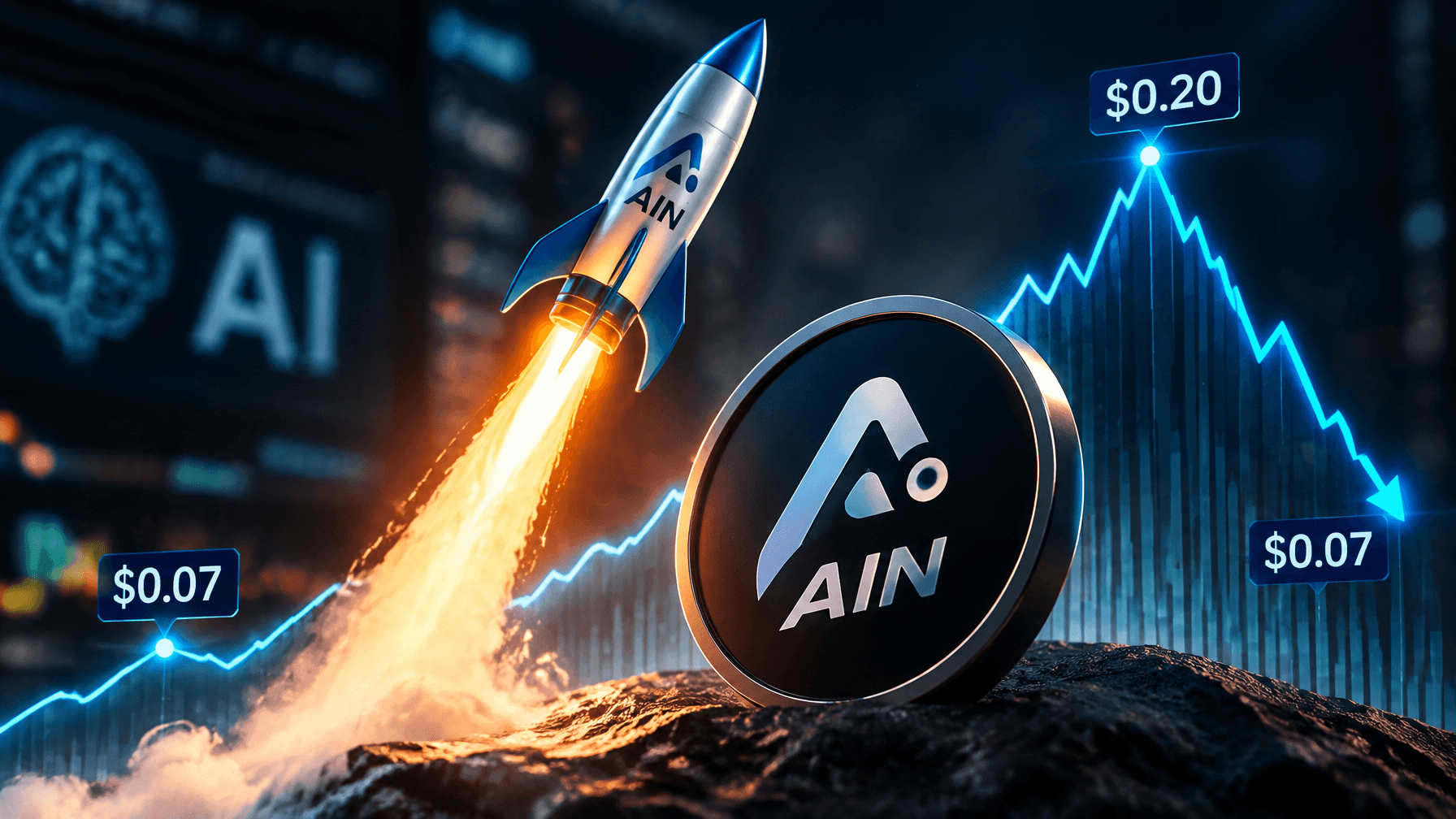
AIN rockets from roughly $0.07 toward $0.20—then round-trips the entire move
The first number I would distrust in this market is the headline percentage gain, because AIN traded very differently depending on venue, index and timestamp.
CoinGecko historical data puts AIN’s September 13 close at approximately $0.068218. Its composite market price subsequently reached approximately $0.2050 on September 15.
That is a rise of roughly:
($0.2050 ÷ $0.068218 − 1) × 100 = 200.5%
So “AIN rose more than 200%” is defensible only when the window is explicitly defined as the September 13 CoinGecko close to the September 15 CoinGecko peak.
The reversal was even more revealing. CoinGecko subsequently recorded a September 16 low around $0.01239. At the roughly $0.0245 publication check, AIN was trading about 88% below the $0.205 peak.
That means AIN did not merely correct after a breakout. At its most extreme, it temporarily traded substantially below the pre-breakout $0.06–$0.08 region before bouncing.
| Measurement | Start | End | Approx. return |
|---|---|---|---|
| Sept. 13 CoinGecko close → Sept. 15 peak | $0.068218 | $0.2050 | +200.5% |
| Sept. 15 CoinGecko peak → publication check | $0.2050 | ~$0.0245 | ~−88% |
| Sept. 15 CoinGecko peak → Sept. 16 low | $0.2050 | $0.01239 | ~−94% |
The round trip is the story. It forces us to ask whether AIN experienced genuine fundamental price discovery, a leverage-driven momentum blow-off, a temporary liquidity vacuum—or some combination of all three.
Did Infinity Ground actually hit a new all-time high?
There is no clean universal answer.
CoinGecko currently identifies $0.2050 on September 15, 2026 as AIN’s all-time high. CoinMarketCap, however, continues to list approximately $0.2057 on July 11, 2025 as the nominal record.
Individual exchanges also traded differently during the event. Some venue-specific AIN markets printed above $0.20, while others remained below the composite high. That makes it misleading to take a single thin-market wick and redefine the global AIN price history around it.
The safest description is:
AIN briefly approached or matched its previous record around $0.20 on major composite indices, while some individual markets traded above that level.
There is another valuation wrinkle here. A similar token price in July 2025 and September 2026 does not necessarily represent the same circulating market capitalization if the number of tokens counted as circulating has changed.
That brings us to the biggest data-quality problem in the story.
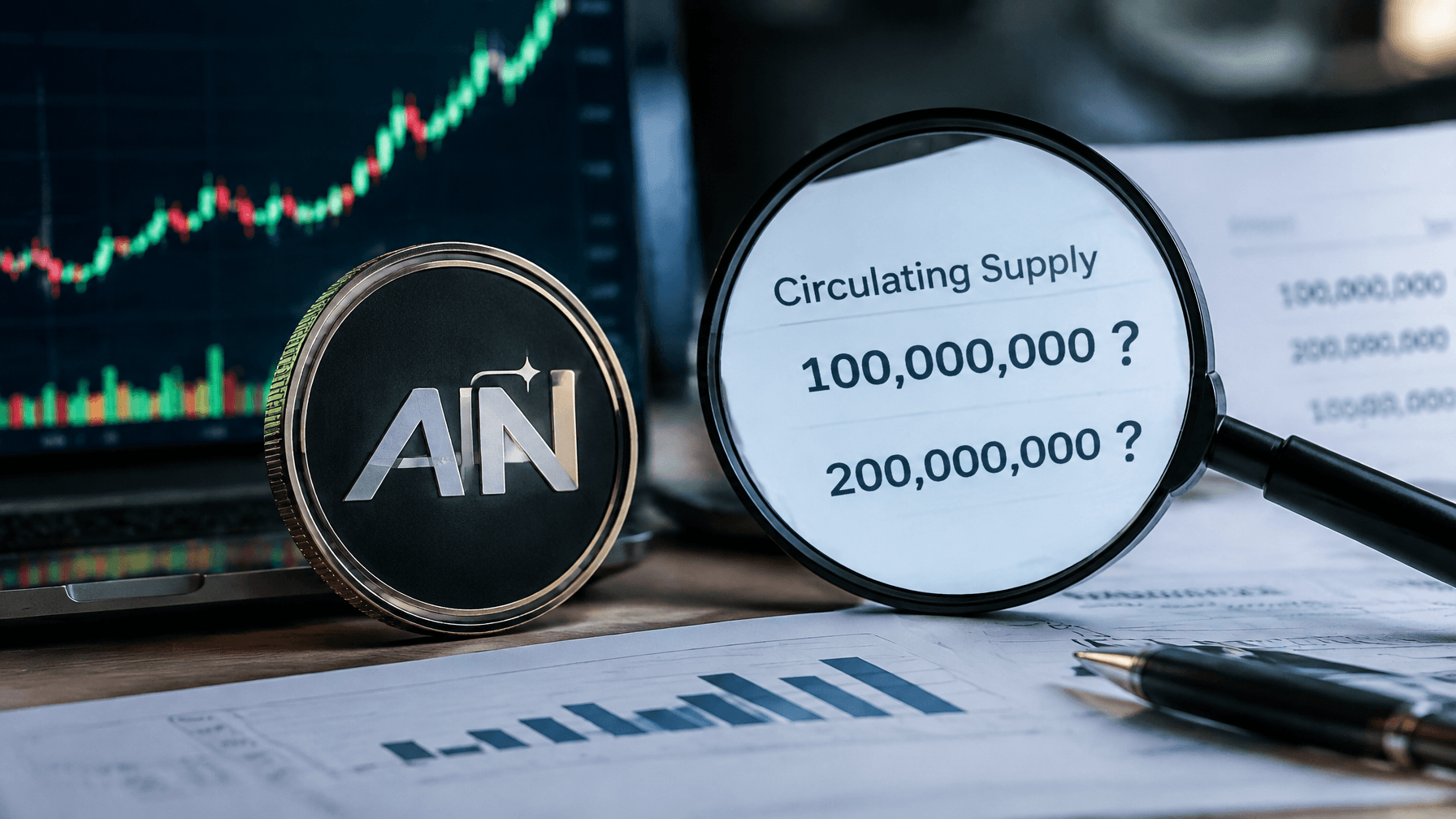
Why AIN’s circulating-supply numbers do not agree
CoinMarketCap currently reports approximately 318.97 million AIN circulating.
CoinGecko reports approximately 185.3 million AIN.
Both report approximately 1 billion AIN as total/max supply.
| Source | Circulating AIN | Share of 1B supply |
|---|---|---|
| CoinMarketCap | ~318.97M | ~31.9% |
| CoinGecko | ~185.3M | ~18.5% |
| Difference | ~133.67M | ~13.4% of total supply |
The difference is enormous for a token this small.
But it would be equally wrong to conclude that 133 million AIN suddenly unlocked during the September rally. Higher circulating-supply estimates were already visible before the September 14–16 volatility event.
Before calling a provider change a token unlock, I would want to see the relevant tokens actually move on-chain and understand how vesting, treasury and ecosystem wallets were reclassified.
This is exactly where on-chain analytics tools and blockchain explorers matter: an aggregator’s circulating-supply figure is a methodology, while blockchain transfers are the underlying evidence.
AIN’s volume-to-market-cap ratio became extraordinary
At the latest CoinMarketCap snapshot, AIN showed approximately $107.15 million of rolling 24-hour trading volume against just $7.82 million of reported circulating market capitalization.
That gives:
$107.15M ÷ $7.82M ≈ 13.7x
In percentage terms, CoinMarketCap displayed a volume-to-market-cap ratio of approximately 1,370.7%.
CoinGecko’s denominator is even smaller because it counts fewer tokens as circulating. Its roughly $75.7 million of volume against about $4.6 million of market cap produces an even larger turnover ratio.
That does not mean $107 million of fresh capital entered Infinity Ground.
Trading volume measures gross turnover. The same capital and the same AIN can change hands repeatedly between market makers, arbitrageurs, bots, discretionary traders and leveraged accounts.
The ratio is also mechanically amplified by the crash: the rolling 24-hour volume still contains trades completed when AIN was worth many times more, while the current market-cap denominator has collapsed with the token price.
This is the same distinction CryptoLinks regularly makes between marked valuation and executable capital. Our analysis of market cap, FDV and real liquidity explains why a large quoted valuation change is not the same thing as an equivalent amount of cash entering or leaving a token.
Spot demand started the move—but derivatives made it more dangerous
AIN already had a substantial derivatives market before this event. Binance launched its AINUSDT USDⓈ-M perpetual in July 2025, not September 2026, with leverage available up to 50x.
So a new Binance Futures launch cannot explain the September move.
What changed was the intensity of trading.
Even before the breakout, derivatives turnover substantially exceeded spot activity in available market snapshots. During the surge, perpetual activity accelerated as traders chased the move.
This distinction matters because leveraged futures can create reflexive price behavior:
- price rises and attracts momentum traders;
- open interest expands as more positions are added;
- positive funding makes leveraged longs increasingly expensive to hold;
- short liquidations can add forced buying during the ascent;
- once price reverses, long liquidations become forced market selling.
If you want a deeper primer on the mechanics, see the CryptoLinks section covering crypto futures and derivatives exchanges.
Was AIN a short squeeze?
Possibly during part of the ascent, but describing the entire rally as a short squeeze misses what happened next.
The more important pattern is that the rally attracted increasingly aggressive leveraged participation. By the crash, CoinStats was showing roughly $3.3 million of 24-hour AIN liquidations in one captured snapshot, with approximately $2.06 million on the long side versus roughly $1.24 million of shorts.
Those figures measure liquidated notional. They do not mean traders collectively “lost exactly $3.3 million.”
What they do show is that the reversal had become a long-side deleveraging event.
The sequence therefore looks less like one simple squeeze and more like:
breakout → speculative leverage expansion → possible short covering → leveraged long chase → reversal → long liquidation cascade.
Huge volume did not mean huge market depth
This is one of the easiest mistakes to make when looking at AIN.
A token can report tens of millions of dollars of daily volume while still having relatively little executable liquidity within a narrow percentage of the current market price.
During the post-crash snapshot, CoinGecko’s exchange table showed only thousands of dollars of liquidity within 2% of price on several AIN markets. For example, Gate displayed approximately $7,000 of +2% depth and roughly $4,500 of -2% depth in one refresh, while Bitget was similarly shallow.
That matters because marginal order flow determines the next price.
If books are thin, a comparatively modest market order can move the quoted price dramatically. Once liquidation engines begin sending additional forced orders into the same shallow book, the move can accelerate.
High turnover therefore does not automatically mean high liquidity quality.
What actually changed at Infinity Ground before the rally?
This is where the fundamental explanation becomes much less convincing.
I could not identify a newly disclosed product launch, financing round, token burn, network launch or verified adoption milestone in the immediate pre-breakout window large enough to explain a 200%-plus repricing on fundamentals alone.
That does not prove there was no narrative catalyst. It means the evidence does not justify saying, “AI adoption caused AIN to rally.”
The market data accelerated far more dramatically than the product data.
And this was not simply a broad AI-token rally. AIN’s move was far more extreme than the surrounding AI-crypto market.
For wider context, CryptoLinks maintains a dedicated guide to AI crypto projects and tokens, including the difference between infrastructure, AI-agent, compute and application-layer projects.
What Infinity Ground actually builds
Infinity Ground does have a real product behind the narrative.
The current Infinity Ground website describes its central product as a Web3-native Agentic IDE. Users describe an idea in natural language, and the system is designed to use AI agents to help generate applications and assets.
The site currently presents examples including:
- web applications;
- mini-games;
- AI-driven experiences;
- smart contracts.
Infinity Ground describes the workflow as “No coding required” and calls the broader concept “vibe coding.”
In simple terms, vibe coding moves the user interface for software creation from manually writing every line toward describing the desired result and allowing AI systems to produce much of the implementation.
Infinity Ground’s historical project material said that users had created 24,179 applications as of April 16, 2025. The project also reported approximately 3.46 million monthly active users during March 2025.
Those are historical project-reported metrics.
I could not find a comparable September 2026 public dashboard showing current:
- monthly active Agentic IDE users;
- active creators;
- applications created;
- applications deployed on-chain;
- paying customers;
- AI inference requests;
- marketplace GMV;
- protocol or product revenue.
That distinction matters enormously.
A live Agentic IDE is evidence of a product. It is not automatically evidence of token demand.

“No-code smart contracts” create a separate security question
Making Web3 development easier has obvious appeal, but smart contracts are not ordinary generated webpages.
AI-generated blockchain code can potentially contain logic errors, access-control mistakes, unsafe approvals, reentrancy vulnerabilities, oracle assumptions or upgradeability problems. Code that compiles successfully is not automatically secure.
Infinity Ground says its agentic workflow can generate and debug applications, but I would not turn that into a claim that every generated smart contract has undergone independent security auditing.
For more background, CryptoLinks maintains a dedicated blockchain security section, while our analysis of autonomous AI agents operating on-chain explains why automation changes the security model once software can execute blockchain actions without continuous human approval.
AIN is a BNB Chain token—but the planned ING Network is different
The current AIN token is a BEP-20 token on BNB Smart Chain.
The canonical contract researched for this article is:
0x9558a9254890B2A8B057a789F413631B9084f4a3
But Infinity Ground should not simply be described as “a BSC blockchain platform.”
There are three separate architectural layers to keep straight:
- Current token network: AIN exists on BNB Chain.
- Current product: Infinity Ground operates an AI/Web3 Agentic IDE and associated web platform.
- Planned native infrastructure: the whitepaper describes ING Network as a future L2 architecture connected with Initia.
The whitepaper says that in the future, with the launch of ING Network, AIN is intended to act as the rollup’s gas token.
I would therefore not describe AIN as the gas token of a live Infinity Ground L2 today.
Which AIN utilities are actually live today?
The whitepaper gives AIN an ambitious utility design, but current functionality and roadmap functionality should not be treated as interchangeable.
| AIN utility / feature | Status | What is established today? |
|---|---|---|
| Agentic IDE | Live | Accessible from Infinity Ground’s current site |
| Natural-language app creation | Live product claim | Site describes “No coding required” workflow |
| AIN payments/services | Designed utility | Whitepaper describes payment and fee roles; current aggregate demand is not disclosed |
| Staking | Infrastructure exists | Stake remains linked from the live site; current reward economics were not independently quantified |
| Governance | Designed utility | Current governance activity was not independently established |
| Marketplace / AI App Store | Mixed / developing | Project architecture describes marketplace functionality, but current GMV and token demand are unavailable |
| Launchpad | Future-oriented | Whitepaper describes future asset issuance/trading access |
| ING Network | Planned | Not independently verified as a live L2 |
| AIN as ING gas | Future | Conditional on ING Network launching as designed |
The most useful question is therefore not, “How many things does the whitepaper say AIN can eventually do?”
It is:
When somebody uses Infinity Ground today, what causes AIN to be bought, spent, locked or permanently removed from circulation?
Public information does not yet give us enough current economic data to quantify that value-capture loop.

Staking is not the same thing as product revenue
Infinity Ground continues to expose a staking section through its current website.
But staking rewards should not automatically be interpreted as protocol revenue. Rewards can be funded from token allocations or incentive pools rather than cash generated by paying users.
This distinction applies across crypto. If you want to compare staking structures and understand where rewards can come from, see the CryptoLinks crypto staking guide and platform section.
Did a token unlock cause the crash?
There is currently no sufficiently verified evidence that a large September 14–16 unlock caused AIN’s reversal.
The circulating-supply disagreement is important, but a disagreement between aggregators is not an on-chain unlock event.
Infinity Ground’s tokenomics also make future dilution harder to model than a simple calendar schedule because project documentation describes some allocations as performance-linked.
Without independently established vesting contracts, milestone conditions and release dates, creating a precise “next 30-day unlock” schedule would be false precision.
For an example of how CryptoLinks separates token allocation, circulating supply and actual unlock mechanics, see our analysis of the Capricorn APR tokenomics and unlock reset.
How concentrated is AIN ownership?
Raw on-chain concentration is high.
CertiK’s current scanner shows roughly 18,290 AIN holders and a 78.04% major-holding ratio for the canonical BNB Chain token contract.
But that should not be rewritten as “whales control 78% of AIN.”
Large addresses can represent exchanges, treasury accounts, vesting contracts, staking infrastructure or other operational wallets. Economic concentration must exclude or appropriately classify those entities before drawing conclusions about insider ownership.
Likewise, an exchange deposit alone is not proof that a holder sold.
AIN’s market moved faster than Infinity Ground’s product metrics
This is the cleanest conclusion from the September event.
On the product side:
- Infinity Ground has an accessible Agentic IDE;
- natural-language application creation is a real product category;
- the platform has historical application and user metrics;
- AI-assisted software development is clearly a broader technology trend.
On the financial side:
- AIN rose roughly 200% from the September 13 CoinGecko close to the September 15 peak;
- rolling volume climbed above $100 million on CoinMarketCap;
- turnover reached more than 13 times CoinMarketCap’s current circulating market cap;
- derivatives and liquidations became major parts of price discovery;
- price subsequently fell roughly 88% from the CoinGecko peak to the publication snapshot.
The financial metrics changed in hours.
There is no comparable evidence that application usage, revenue or token-based product demand tripled in the same period.
That does not prove AIN is fundamentally mispriced. It does show that the immediate event was primarily financial and market-structure driven rather than demonstrably usage driven.
What would make the Infinity Ground AIN thesis stronger from here?
There are three broad paths worth watching without attaching price forecasts to any of them.
Scenario 1: Product adoption catches up with the market narrative
The strongest evidence would be sustained Agentic IDE growth, independently measurable app deployments, current active-user statistics, paying activity, marketplace transactions, real AIN-denominated payments and concrete ING Network milestones.
In that case, September could ultimately look like an early speculative repricing that anticipated later product adoption.
Scenario 2: AIN settles into a high-volatility AI small-cap
Turnover and derivatives exposure could normalize while Infinity Ground continues building gradually. The September episode would then have expanded awareness without permanently resetting the project’s fundamental valuation.
Scenario 3: The speculative round trip continues
If liquidity disappears, derivatives participation collapses, attention fades and no new product metrics emerge, the event would look increasingly like a temporary reflexive move created by narrative, thin liquidity and leverage.
These are analytical scenarios, not predictions.

CryptoLinks conclusion: the AI product is real, but the September candle was a market-structure event
Infinity Ground is more interesting than a random token with “AI” attached to its marketing.
The Agentic IDE exists. Natural-language software creation is a genuine development trend. Infinity Ground is attempting to apply that trend specifically to Web3 applications and smart contracts, which gives the project a legitimate product thesis.
But none of that automatically explains a move from roughly seven cents toward twenty cents and then down into the low-cent range within such a short period.
The immediate evidence is much more financial:
- extraordinary gross turnover;
- heavy derivatives participation;
- forced liquidations;
- thin executable depth relative to headline volume;
- a relatively small circulating float under either major provider methodology;
- and a huge disagreement over exactly how much AIN should even be counted as circulating.
The biggest tokenomics question for me is still why major market-data providers disagree so dramatically on circulating supply.
The biggest product question is equally simple: does growing use of Infinity Ground create measurable, recurring demand for AIN?
Until those questions are answered with better data, the most defensible interpretation is that Infinity Ground has a genuine AI-development product—but AIN’s September 14–16 repricing was dominated by market structure, speculation and leverage.
Verify the AIN contract before interacting
Canonical BNB Chain contract researched for this article:
0x9558a9254890B2A8B057a789F413631B9084f4a3
- Do not identify a token by the AIN ticker alone.
- Fake tokens can reuse names, tickers and logos.
- Verify both the token contract and withdrawal network.
- Never enter a wallet seed phrase into a staking, airdrop or support website.
- High trading volume does not guarantee deep executable liquidity at every price.
- Leveraged futures can create extreme liquidation risk during both rallies and crashes.
CryptoLinks maintains dedicated resources for blockchain security, blockchain explorers and on-chain analytics tools if you want to verify contracts and token activity independently.

Frequently asked questions about Infinity Ground AIN
What is Infinity Ground?
Infinity Ground is an AI/Web3 development platform centered on an Agentic IDE that lets users describe applications in natural language while AI agents assist with generating software and smart-contract components.
What is the AIN token?
AIN is Infinity Ground’s ecosystem token. Project documentation describes uses including payments, feature access, staking, governance, marketplace and launchpad access, and a future role as gas for the planned ING Network. Not every designed utility has independently measurable demand today.
Why did AIN price surge?
The available evidence points to breakout momentum, speculative attention, limited liquidity and rapidly expanding derivatives activity. No comparably large new product-adoption milestone was verified immediately before the move.
Why did AIN crash?
The rally became increasingly vulnerable to leverage and thin market depth. Once the price reversed, forced long liquidations likely amplified selling pressure through already volatile order books.
How high did AIN trade?
CoinGecko recorded approximately $0.2050 on September 15. Individual exchanges produced different highs, with some venue-specific markets trading above $0.20.
Did AIN hit a new all-time high?
The answer depends on the data provider. CoinGecko labels $0.2050 on September 15, 2026 as its ATH, while CoinMarketCap continues to list approximately $0.2057 from July 11, 2025. The safest framing is that AIN approached or retested its previous record zone.
Why was AIN trading volume so high?
Gross turnover was amplified by spot speculation, derivatives, market making, arbitrage and liquidation activity. The same capital can trade repeatedly, so volume should not be interpreted as net money entering the token.
What does a 1,300% volume-to-market-cap ratio mean?
It means rolling 24-hour gross trading volume was more than 13 times the current circulating market capitalization under CoinMarketCap’s methodology. It does not mean 13 times the token’s market cap was invested as fresh capital.
Was AIN’s rally a short squeeze?
Short covering may have contributed to parts of the rise, but the later sequence also showed a leveraged-long chase followed by long-side liquidations. The event should not be reduced to one squeeze label.
Is AIN on BNB Chain?
Yes. The current AIN token researched for this article is a BEP-20 token on BNB Smart Chain.
What is Infinity Ground’s Agentic IDE?
It is Infinity Ground’s AI-assisted development environment for creating applications using natural-language instructions and agent-based workflows.
What does “vibe coding” mean?
Vibe coding describes software development where a user explains the desired result in natural language and AI systems generate, revise or debug much of the code rather than the user writing every line manually.
Is the ING Network live?
We did not find sufficient evidence to describe the planned ING Network L2 as fully live. Current Infinity Ground documentation describes AIN’s gas-token role in future-oriented terms.
How many AIN tokens are circulating?
That remains disputed. CoinMarketCap currently reports approximately 318.97 million AIN, while CoinGecko reports approximately 185.3 million. Both show a 1 billion total/max supply. The discrepancy should not be treated as proof of a recent unlock without on-chain evidence.
Sources and methodology
This analysis compared current CoinMarketCap and CoinGecko market data, Infinity Ground’s official website and whitepaper, current contract/security scanner information, historical project announcements, exchange documentation and derivatives/liquidation data. Values from different providers were kept separate when their methodologies or timestamps disagreed.
Project-reported adoption numbers are identified as historical project claims rather than independent current-user measurements. The article does not assume that a change in aggregator circulating supply equals a token unlock, does not infer sales from exchange deposits, does not label unidentified wallets as whales, and does not treat roadmap token utility as present-day demand.
For more research, browse the latest CryptoLinks crypto news, explore AI crypto projects, compare crypto futures and derivatives platforms, review crypto staking resources, or return to the CryptoLinks homepage.
This article is for informational and research purposes only and does not constitute personalized financial advice.