Bitcoin vs Gold vs Silver vs S&P 500: Who Protects You Most?

Are you actually protected… or just feeling protected because you own the “safe” asset everyone talks about?
I keep seeing the same story play out: someone buys Bitcoin, gold, silver, or an S&P 500 index fund because they want protection from inflation, crashes, or “policy gone wrong.” Then volatility shows up, headlines get dramatic, and suddenly the “safe” thing doesn’t feel safe at all.
So let’s talk like normal humans about what protection really means—without pretending there’s one magic asset that wins in every situation.
The pain: inflation, currency stress, and “paper gains” that vanish fast
2025 has been a year where a lot of people stopped caring about bragging rights and started caring about resilience.
Even if inflation prints cooled compared to the peak years, the worry hasn’t gone away—because what people feel day-to-day is:
- Sticky costs (housing, insurance, food, services)
- Rate changes that swing markets fast
- Geopolitical shocks that hit commodities, energy, and sentiment
- Currency stress (for anyone earning/spending outside USD, this gets real very quickly)
And here’s the frustration that most “best asset” articles skip:
An asset can be up long-term and still fail you at the exact moment you needed it.
Real-life example: if you lost income or had a big expense during a drawdown, it doesn’t matter that your investment “usually recovers.” If you’re forced to sell at the wrong time, the protection wasn’t there when it counted.
That’s why I’m not going to treat this like a performance contest. I’m going to treat it like a protection problem.
Also: inflation isn’t just a vibe—it’s measurable. CPI-style inflation data is public, and while every country’s basket differs, the core idea is the same: purchasing power gets eaten quietly over time. If you want the official baseline for how this is tracked in the US, the Bureau of Labor Statistics explains it here: Consumer Price Index (CPI).
Promise solution
By the end of this comparison, you’ll have a simple framework you can actually use:
- What each asset tends to protect you from (inflation, crisis, currency risk, falling behind)
- What it fails at (and the failure modes that surprise people)
- How to combine them without guessing, panicking, or constantly switching “teams”
No hype. No tribal stuff. Just clean trade-offs.
What “protects you” actually means (I’ll define it first)
When someone says “Bitcoin protects you” or “gold is safe,” they often mean totally different things.
So I’m defining protection in four buckets (and I’ll keep using these buckets through the whole post):
- 1) Inflation hedge — does it tend to hold value as prices rise over time?
- 2) Crisis hedge (fast liquidity) — can you reliably access it and sell it during a real panic without getting destroyed?
- 3) Long-term purchasing power — not just “up,” but does it help you keep up with the world getting more expensive over 5–10+ years?
- 4) Sleep-at-night volatility — can you hold it without panic-selling when it drops 10%, 30%, or 50%?
Important: no single asset wins every bucket.
Historically, different things have done different jobs:
- Stocks have often been strong long-term purchasing power builders because businesses can raise prices and grow earnings (but they can drop hard in recessions). For a data-heavy look at long-run stock/bond performance, NYU’s Aswath Damodaran publishes widely used datasets: Damodaran Online.
- Gold has a long history as a “trust hedge,” especially when people worry about currency credibility or geopolitical risk (but it can go through long boring stretches). The World Gold Council tracks market structure and demand drivers: World Gold Council.
- Bitcoin is newer, trades 24/7, and has shown extreme upside and extreme drawdowns—so it can be powerful, but it’s not calm.
- Silver can behave like a monetary metal and like an industrial commodity, which is why it can surprise people in both directions.
If you’ve ever felt confused by all the confident opinions online, it’s usually because people are arguing from different buckets without realizing it.
Ground rules for this comparison (so it stays honest)
Before we compare Bitcoin vs gold vs silver vs the S&P 500, we need three rules—otherwise this turns into cherry-picking.
Rule #1: Time horizon changes the “winner.”
What protects you over 1 year can look totally different from what protects you over 5–10 years. A lot of anger around “X failed me” is really just a mismatch between the asset and the timeframe.
Rule #2: Currency matters more than people admit.
If your life is priced in USD, your protection needs look different than if you earn in one currency and save in another, or if you live somewhere with repeated devaluations. “Inflation protection” isn’t one universal experience.
Rule #3: Returns are not the same as protection.
A high-return asset that can drop 50% in a liquidity crunch may still be a great long-term holding—but it’s not automatically a great protector when you need cash now.
And yes—volatility and drawdowns are part of the story. If an asset’s normal behavior includes gut-wrenching drops, then “protection” depends heavily on position sizing and whether you can actually hold it.
Now let me ask you a pointed question, because it decides everything:
When you say you want “protection,” are you trying to survive the next 3–12 months… or are you trying to make sure you’re not poorer in 10 years?
Because the answer changes what I’m about to say next—especially once we get to the one asset that’s built like a tank on scarcity… and behaves like a maniac on price.
So let’s talk about Bitcoin—what it protects you from, what it absolutely doesn’t, and why most people lose to it even when they’re technically “right.”
Bitcoin: the hardest asset with the wildest mood swings
Bitcoin is the weirdest “protection” tool people buy… because it doesn’t feel protective while you’re holding it.
On paper, the pitch is clean:
- Fixed supply (no central bank can print more BTC because they “need liquidity”).
- Portable wealth (you can move value across borders in minutes).
- 24/7 liquidity (no waiting for market open on Monday).
- Not tied to one country (it’s not “the U.S. stock market” or “one government’s promise”).
That’s the part that makes people fall in love with it. The part they don’t respect enough: Bitcoin can swing like a mood ring in a thunderstorm. It can feel brilliant for months… and then make you question your intelligence in a single week.
And yes, there’s data behind why people treat it differently than metals. A big academic review in the Journal of Economic Surveys (Corbet, Lucey, Urquhart, Yarovaya) described Bitcoin as sitting in its own category—sometimes behaving like a speculative asset, sometimes like an alternative investment, and often reacting hard when global liquidity tightens. Translation: even if Bitcoin is “hard money” by design, markets still trade it like a risk asset a lot of the time.
“In investing, what is comfortable is rarely profitable.” — Robert Arnott
Bitcoin is the perfect example. It can protect you long-term while making you feel unsafe short-term. If that emotional mismatch isn’t in your plan, Bitcoin becomes the asset you sell at the exact wrong moment.
What Bitcoin protects you from (and what it doesn’t)
I like to be blunt here, because vague promises are how people get hurt.
Bitcoin can protect you from:
- Currency debasement risk over long stretches of time — not “next month,” but over multi-year periods where money supply expansion and fiscal stress start to show up in real life (rent, food, assets).
- Some forms of capital controls — if you can legally access the network and self-custody, you can move value in a way traditional rails often can’t match.
- “Trust me bro” financial system risk — Bitcoin settles without needing a bank to stay solvent, a broker to stay open, or a payment network to approve you.
Bitcoin does NOT protect you from:
- Short-term panic — when markets go “risk-off,” Bitcoin frequently drops with them. If the world is scrambling for dollars/liquidity, Bitcoin can get sold like everything else.
- Liquidity crunches — the irony is painful: the asset designed to be independent still gets punished when people need cash right now.
- Your own time horizon mismatch — if you might need the money next year, Bitcoin is not “protection.” It’s a bet you may be forced to close at a bad time.
Real-life sample: think of the times when leverage unwinds (big margin liquidations, credit stress, sudden yield spikes). That’s when Bitcoin can drop fast—even if the long-term thesis hasn’t changed at all. The price action doesn’t ask whether you’re “right,” it only asks whether you can hold.
If you’re buying Bitcoin as protection, you need the humility to admit this: Bitcoin protects patient people better than anxious people.
“Is gold and silver better than Bitcoin?”
This question sounds simple, but it’s usually someone secretly asking: “Which one will make me feel safe?”
Here’s the straight answer: it depends on the job.
- If you want something that’s had centuries to prove itself, with lower day-to-day chaos, metals usually win psychologically.
- If you want portability, self-custody, censorship resistance, and an asset native to the internet age, Bitcoin has clear advantages.
I don’t treat these as teams. I treat them as tools.
Gold and silver are like a fire extinguisher: not exciting, but you respect it because you know exactly why it’s there.
Bitcoin is like owning a high-performance vehicle with a roll cage: it can get you somewhere fast, it can survive conditions others can’t… but if you don’t know what you’re doing, you’ll still wrap it around a pole.
So “better” is the wrong argument. The right question is: Do you want stability first, or mobility and asymmetric upside first?
Bitcoin as money vs Bitcoin as an asset
This debate never dies because both sides are partially right.
Critics say it’s not money because money is supposed to be a stable unit of account and a reliable medium of exchange. Bitcoin can jump or drop 5–10% in a heartbeat. That’s not what most people want to price groceries in.
Supporters treat it like money-in-the-making because Bitcoin behaves like a monetary asset in one key way: scarcity. Its supply schedule is transparent, and its issuance declines over time. That’s the opposite of how fiat systems usually work under pressure.
And here’s the part most articles don’t say out loud: the “store of value” argument is often just a timeframe argument.
- On a short timeframe, Bitcoin can feel like a casino chip.
- On a long timeframe, many holders treat it like digital property—volatile, yes, but structurally scarce.
If you’re trying to use Bitcoin like cash, volatility will drive you crazy.
If you’re treating Bitcoin like a long-term position sized appropriately for its swings, it starts to behave like something else entirely: a hedge against the idea that your money’s purchasing power will quietly leak away year after year.
The real Bitcoin risk people ignore: behavior
When people tell me Bitcoin is “too risky,” I usually agree—then I ask what kind of risk they mean.
Because the biggest Bitcoin risk isn’t the chart. It’s the human.
- Panic-selling after a scary headline or a brutal red week.
- Over-leverage (using borrowed money on an asset that already swings hard).
- Buying without a plan (no target allocation, no timeline, no rules).
- Position sizes that hijack sleep (if you’re checking price at 3 a.m., you’re oversized).
I’ve watched this happen in real time for years: someone buys a small amount of Bitcoin, it moves against them, and suddenly they “need to get even.” So they buy more at the wrong time, crank up risk, and turn a smart idea into an emotional trap.
Bitcoin doesn’t usually fail people because it’s broken.
It fails people because they treat it like a lottery ticket instead of a volatility-sized position.
Here’s a simple self-check I use before I add exposure:
- If Bitcoin dropped 30% in a month, would I still be fine financially?
- If it dropped 50%, would I be forced to sell?
- If the answer is “yes,” the position is too big for “protection.”
Now let me ask you something that decides everything going forward:
When you say you want protection, do you mean “I want a calm hedge”… or do you mean “I want an escape hatch if the system gets weird”?
Because the next asset answers that emotional need in a totally different way—and it’s the one central banks still quietly respect.
Gold: steady, trusted, and still the central bank favorite
When everything feels a little too loud—rates, wars, elections, “soft landings,” “hard landings,” surprise CPI prints—gold is the asset people reach for when they want protection that doesn’t need a story.
I’ve watched this pattern repeat for years: the moment confidence cracks, gold stops being “a boring rock” and turns into the one thing almost everyone on Earth instantly recognizes as value. It’s liquid, it’s widely accepted, and it doesn’t depend on a CEO, a central bank promise, or a platform staying online.
And in 2025, the tell is still the same: central banks keep treating gold like a strategic asset. The World Gold Council has documented that central banks bought over 1,000 tonnes in both 2022 and 2023—an eye-opening signal that the “official” world still wants an anchor that sits outside someone else’s liability.
“Gold is money. Everything else is credit.” — J.P. Morgan
That quote hits harder in years like this, because it speaks to a very human emotion: the desire to own something that doesn’t require you to trust the system at the exact moment you trust it least.
“Is gold predicted to go up?” (and what that really means)
Yes, you’ve probably seen it—big banks and research desks publishing bullish gold outlooks. The usual drivers get name-checked:
- Tariff / trade uncertainty (anything that threatens growth or stability tends to boost demand for hedges)
- ETF demand turning back on when investors want simpler exposure
- Central bank buying staying strong
- Real yields falling (gold often benefits when the “real return” on cash/bonds gets less attractive)
But here’s the part most forecasts skip: a price prediction isn’t a plan.
If you need gold to do its job this year—reduce portfolio stress, help in a currency wobble, act as “financial noise-canceling headphones”—then a 12-month price target is mostly entertainment. Predictions only matter when they match your timeframe and your ability to hold through periods when gold goes sideways and everyone mocks it.
Real talk: the biggest mistake I see is people buying gold for excitement. Gold is not a thrilling partner. It’s the friend who quietly shows up when your other friends disappear.
When gold protects you best
Gold tends to protect you best when the threat is trust—trust in currencies, in policy, in geopolitics, in smooth markets.
Here are the environments where gold historically shines:
- Currency stress: when people worry about purchasing power or local currency weakness
- Geopolitical fear: conflict risk, trade shock risk, sudden “risk-off” waves
- Falling real yields: when inflation-adjusted returns on safe bonds/cash are unattractive
- “No counterparty risk” moments: when owning an asset that isn’t someone else’s promise feels priceless
This isn’t just vibe-based. Academic work has tested gold’s “safe haven” behavior. One of the most-cited papers is by Baur & Lucey (2010), which explores how gold behaves as a hedge and a safe haven during market stress—useful context if you like seeing research behind the folklore. (If you want to look it up later: “Is Gold a Hedge or a Safe Haven?”)
And you don’t need a spreadsheet to feel the logic: when markets get chaotic, the asset that doesn’t require a chain of payments to remain “true” suddenly becomes emotionally valuable. Gold can’t default. It can’t get diluted by a board vote. It doesn’t need an internet connection. That simplicity is the feature.
The downside: gold can be boring (and that’s the point)
Gold can frustrate you in long stretches where growth is strong and risk assets are flying. It also doesn’t produce cash flow. No dividends. No earnings. No “innovation premium.”
So yes—there are times you’ll hold gold and feel like you’re holding a position that’s doing “nothing.” That feeling is exactly why gold works as protection for many people: it’s not supposed to entertain you. It’s supposed to reduce the chance that one ugly macro period wrecks your financial confidence.
I think about gold like a fire extinguisher: if you only value it when the kitchen is on fire, you waited too long. But if you buy ten extinguishers and skip the smoke alarms, you also missed the point. The art is sizing it so it helps you stay steady when the world isn’t.
Physical gold vs paper gold (quick checklist)
This is where people accidentally sabotage themselves—by buying the wrong “type” of gold for the reason they wanted gold in the first place.
Use this quick checklist before you buy:
- If you want “no counterparty risk”: physical bullion (coins/bars) stored safely can match that goal better than most paper products.
- If you want fast liquidity and easy rebalancing: a major gold ETF is often simpler (but you’re accepting custody structure and market plumbing).
- Watch the premium: popular coins can carry higher premiums over spot—great for collectability, not always great for pure hedging.
- Storage and insurance: home safe vs bank box vs professional vaulting—each changes your real cost of ownership.
- Verify what you’re buying: reputable dealers, assay cards, serials on bars, and clear buyback policies matter.
- Know your exit: how quickly can you sell, and what spread will you eat when you do?
- Tax treatment: in some countries, physical metals and ETFs can be taxed differently—don’t let that surprise you later.
One simple sanity check I use: if owning “gold” adds stress (worrying about storage, authenticity, or complicated products), you’ve drifted away from gold’s real job: making you feel safer, not more anxious.
Now here’s the question that usually changes the whole conversation: what if you want protection, but you also want a built-in growth engine? Because that’s exactly where things get interesting—and it’s why the next comparison (silver vs the S&P 500) surprises a lot of people.
Silver and the S&P 500: one is a metal with a growth engine, the other is a business machine
If you’ve ever caught yourself thinking “I’ll just buy silver because it’s a safe haven” or “I’ll just buy the S&P 500 because it always goes up,” you’re not alone.
These two get mixed up because they can both feel protective for totally different reasons:
- Silver looks like a “sound money” metal… but often trades like an industrial commodity with mood swings.
- The S&P 500 isn’t a hedge product at all… but it’s one of the strongest long-term “don’t fall behind” machines ever built.
And emotionally? This is where investors get whiplash. Silver can make you feel smart fast… then punish you fast. The S&P can feel boring for months… then quietly remind you why compounding is undefeated.
“In the short run, the market is a voting machine but in the long run, it is a weighing machine.” — Benjamin Graham
That quote hits even harder with silver, because silver’s “votes” can get loud.
“Has silver outperformed the S&P 500?”
In 2025, silver had a headline year in many market wrap-ups—often described as one of the standout performers, and in several windows it beat broad U.S. equities. If you held it at the right time, it didn’t just “keep up”… it grabbed attention.
Why did silver run so hard (in plain English)? Usually it’s a mix of:
- Industrial demand (especially anything tied to electrification—solar panels, electronics, power grids).
- Supply tightness (silver supply doesn’t respond instantly to price—new mining and refining capacity takes time).
- Macro uncertainty (when people feel weird about rates, currencies, or geopolitics, metals get a bid).
- Momentum flows (once silver starts moving, traders pile in because it’s known for sharp runs).
If you want a credible place to sanity-check the industrial story, I like starting with the Silver Institute’s research and summaries (they regularly cite solar and electronics demand): https://www.silverinstitute.org/.
The important part isn’t “silver beat stocks this year.” The important part is why it can happen—because it tells you what kind of ride you’re signing up for.
Silver’s big advantage: two drivers instead of one
Silver has a split personality, and that’s its superpower and its trap.
Driver #1: Monetary metal vibes
- People reach for it when they’re nervous about currencies, inflation narratives, or policy mistakes.
- It benefits from the same “hard asset” psychology that helps gold—just with a lot more adrenaline.
Driver #2: Industrial engine
- Silver is an input. It gets used up in real stuff (solar cells, electronics, medical applications).
- That means demand can surge when manufacturing and energy infrastructure spending ramps.
Here’s the catch that burns people: industrial demand also makes silver cyclical. If growth expectations roll over (recession fears, manufacturing slowdown), silver can drop like it forgot it was a “safe haven.”
I’ve seen this play out emotionally in real portfolios: someone buys silver “for safety,” then panics because it trades like a high-beta asset when the macro story flips. Silver isn’t “bad” for that—silver is just being silver.
If you want a simple mental model, I use this:
- Gold = insurance-first behavior.
- Silver = insurance + growth sensitivity… which means spikier outcomes.
S&P 500: not a crisis hedge, but a long-term shield against “falling behind”
The S&P 500 doesn’t protect you by being calm. It protects you by being productive.
When you own an S&P 500 index fund, you’re not buying a “hedge.” You’re buying a rotating portfolio of large businesses that (as a group) try to:
- grow earnings,
- raise prices over time,
- pay dividends,
- buy back shares,
- and adapt to whatever the economy turns into next.
This is why, over long stretches, stocks have historically been one of the strongest tools for purchasing-power defense—because your “asset” isn’t a bar of metal. It’s a claim on future cash flows.
If you want to look into the long-run evidence, there’s a deep body of work on long-horizon equity returns and inflation (Jeremy Siegel’s long-run equity research is often referenced in this context). Even if you don’t agree with every conclusion, the key idea is consistent: business ownership compounds.
But I need to say the quiet part out loud: the S&P 500 can feel like it fails you right when you need it most—because in a real crisis, stocks can drop fast. That’s not a bug. That’s the price of admission.
“Where will the S&P 500 be in 5 years?” (a better way to think about it)
I get why people ask for a number. A number feels like certainty. But point forecasts are basically a comfort blanket—especially after a strong run or a scary pullback.
What I pay attention to instead is a range of outcomes and what has to happen for each one.
Here’s a cleaner way to frame a 5-year S&P 500 outlook:
- Earnings growth: do large U.S. companies keep expanding profits, or do margins compress?
- Valuations: if today’s valuations are high, future returns can be fine… but more of the return must come from earnings, not multiple expansion.
- Dividends: boring but real—dividends and reinvestment matter more than people admit.
- Rate regime: higher real yields can compete with stocks and pressure valuations.
That’s the honest answer: not “S&P to X by 2030,” but “what’s the economic path, and what are you paying today for future cash flows?”
If you want a neutral source for index methodology and long-term index data context, S&P Dow Jones Indices publishes a lot of material (great for checking your assumptions): https://www.spglobal.com/spdji/en/.
This is the risk that doesn’t show up in confident tweets.
Sequence-of-returns risk is simple: if you need money soon and the market crashes early, your plan can break even if long-term average returns look “good on paper.”
A quick real-life example (I’ve seen versions of this more times than I can count):
- Two investors both average similar long-term returns in the S&P 500.
- One invests steadily while still earning income (no withdrawals).
- The other starts withdrawing during a downturn (or loses a job and needs cash).
- The second person can permanently damage their outcome because they’re forced to sell shares when prices are down.
This is why “stocks are the best protection” can be true over decades… and still feel brutally untrue over 12–24 months when life timing is unlucky.
And it’s also why silver can trick you: when it’s ripping upward, it feels like the answer. But if that move reverses right when you need liquidity, the same volatility that created the gains can become the threat.
So here’s the question I want you to sit with before you choose sides: are you trying to protect against a market event… or protect against a life event?
Because once you answer that honestly, the “who protects you most” question stops being a debate—and turns into a scorecard. And yes, I’ll lay out that scorecard and the mix that usually wins next.
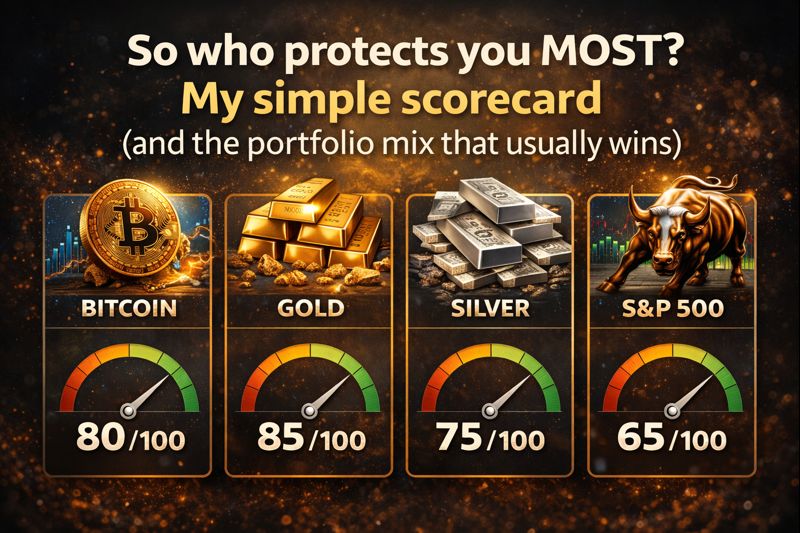
So who protects you MOST? My simple scorecard (and the portfolio mix that usually wins)
I’ll be blunt: the moment you ask “which one protects me the most?” you’re already half a step away from making a mistake.
Because “protection” has multiple jobs. If you try to force one asset to do all of them, you usually end up with the worst outcome: you abandon the position right when you needed it.
The win isn’t picking the loudest winner. The win is holding the right tool through the exact week it feels emotionally “wrong.”
Here’s the scorecard I use for real-life decisions, based on the four protection buckets we’ve been using throughout this post (inflation, crisis, long-term purchasing power, sleep-at-night volatility).
My practical scorecard: best asset for each threat
At-a-glance scores (1 = weak, 5 = strong)
- Bitcoin
Inflation/debasement (long horizon): 5/5
Crisis hedge (short-term panic): 1/5
Long-term purchasing power: 4/5
Sleep-at-night volatility: 1/5 - Gold
Inflation/debasement (long horizon): 4/5
Crisis hedge (short-term panic): 4/5
Long-term purchasing power: 3/5
Sleep-at-night volatility: 4/5 - Silver
Inflation/debasement (long horizon): 3/5
Crisis hedge (short-term panic): 2/5
Long-term purchasing power: 3/5
Sleep-at-night volatility: 2/5 - S&P 500
Inflation/debasement (long horizon): 4/5
Crisis hedge (short-term panic): 1/5
Long-term purchasing power: 5/5
Sleep-at-night volatility: 3/5
Now the “best tool for the job” version (the one I actually use):
- Short-term crisis calm: gold (and a cash buffer you control)Why I say this: gold has a long history of showing “safe haven” behavior in specific stress windows. There’s academic work supporting this idea (for example, research by Baur & Lucey on gold’s safe haven properties during market stress). It’s not magic, but it’s one of the few assets people globally run toward when they’re scared.
- Long-term debasement hedge with upside: BitcoinThe real sample I see constantly: when trust in policy gets shaky, Bitcoin tends to act like a “pressure valve” for people who want an asset outside the traditional system. The trade-off is brutal: Bitcoin can drop hard exactly when liquidity disappears. If you’re buying Bitcoin for “next month protection,” you’re basically asking it to do the one job it’s worst at.
- Industrial + monetary upside (but spiky): silverHow it plays out in real life: silver can rip when industrial demand + investor flows line up… and it can also slap you with drawdowns that feel completely unfair. If you size it like gold, you’ll hate it. If you size it like a spicy satellite, you can actually hold it.
- Long-term “don’t fall behind”: S&P 500Why this is still the core for most people: the S&P 500 is basically a compounding machine tied to corporate earnings. Over long stretches, equities have historically been one of the most reliable ways to protect (and grow) purchasing power. This isn’t a hot take—long-run market history research like the Credit Suisse / UBS Global Investment Returns Yearbook (Dimson, Marsh, Staunton) documents the long-term equity premium across markets.
Important: “Best” changes by timeframe. If you need money soon, your “best protector” is often boring (cash + short-duration instruments) even if it’s not the best long-term return engine. Most people don’t want to hear that, but it’s true.
My “sleep-at-night” allocation logic (not financial advice)
Here’s the framework I keep coming back to when I’m building a portfolio that a normal human can actually hold through bad headlines:
- Core (growth + long-term purchasing power): S&P 500This is the “I refuse to fall behind the economy” bucket.
- Hedge (crisis + policy fear): goldThis is the “I want something boring that tends to be respected globally” bucket.
- Asymmetric hedge (upside + debasement protection): BitcoinThis is the “I want an asset with a different rulebook” bucket—but sized small enough that I don’t panic-sell it.
- Optional satellite (higher volatility, dual-driver bet): silverThis is the “I understand this can swing like a maniac” bucket.
Real-world sample mixes (not advice, just examples of how people make this holdable):
- Conservative “I hate volatility”
S&P 500: 70–85%
Gold: 10–25%
Bitcoin: 0–5%
Silver: 0–3%Who this fits: you want protection you can stick with. Your enemy is panic, not missing the moonshot. - Balanced “I want protection + upside”
S&P 500: 60–75%
Gold: 10–20%
Bitcoin: 5–12%
Silver: 0–5%Who this fits: you can handle some drawdown, but you still want an anchor. - Aggressive “I can stomach drawdowns”
S&P 500: 50–70%
Gold: 5–15%
Bitcoin: 10–20%
Silver: 0–7%Who this fits: you understand volatility is the entry fee. You’re not using this money next year.
The one rule I won’t compromise on: if Bitcoin or silver volatility makes you check the price five times a day, your position is too big. “Protection” that wrecks your nervous system isn’t protection.
Rebalancing rules that stop you from self-sabotage
The biggest hidden edge isn’t the asset. It’s the behavior. Rebalancing is how you automate the behavior you wish you had during chaos.
My simple rebalancing rules:
- Pick target weights (like the examples above) and write them down. If it’s not written, it’s not real.
- Use bands, not feelings: rebalance when an asset drifts ±20–25% from its target weight.
Example: if Bitcoin is meant to be 10% and it grows to 13%+, I trim. If it falls to 7%-, I add (only if my life situation hasn’t changed). - Rebalance on a schedule if you prefer simplicity: quarterly or twice a year is enough for most people. Constant tinkering turns “protection” into entertainment.
- Trim winners, add to laggards—but don’t average down into broken plans.
If you’re adding just because you’re angry, stop. Add because your written plan says so. - Respect taxes and fees: in taxable accounts, unnecessary trading can quietly destroy your results. Sometimes “rebalance with new contributions” beats selling.
This is the unsexy truth: a decent portfolio + consistent rebalancing often beats a brilliant portfolio you can’t hold.
What top voices are saying right now (quick context, not hype)
I keep a running list of strong opinions—not because I copy them, but because it’s useful to compare their conviction against my own plan.
Here are a few posts worth skimming if you want to feel the temperature of the room (and then come back to your own rules):
- Brian Armstrong on X
- Michael Saylor on X
- Brian Armstrong (another take) on X
- CZ (Binance) on X
- Robert Kiyosaki on X
- Rashad Hajiyev on X
- Grant Cardone on X
- Elon Musk on X
My filter when I read posts like these: “Is this person talking about the same timeframe I’m investing for… or are they selling a mood?”
If you want, I’ll make this painfully practical next: the rapid-fire answers to the questions I get every week—Is gold and silver better than Bitcoin?Was gold ‘supposed’ to go up?Did silver really beat the S&P 500?—with zero fluff. Which one are you personally stuck on right now?
Quick answers (so you leave with clarity)
If you’ve read this far, you don’t need another hot take. You need a clean decision you can actually stick with when the next ugly week hits.
Here are the straight answers I’d give a friend who asked me this over coffee—plus a couple of real-world examples so it doesn’t stay theoretical.
Is gold and silver better than Bitcoin?
Sometimes, yes. Sometimes, no. It depends on the job you’re hiring the asset to do.
- If your goal is psychological stability (you want to hold through chaos without checking your phone every 10 minutes), gold usually “works” better for most people.
- If your goal is asymmetric upside + a long-term hedge against debasement, Bitcoin is hard to beat—but you pay for that with volatility.
- If you want a “metal with a turbo button”, silver can deliver big runs, but it can also punish you fast when growth expectations flip.
A simple real-life example:
If you lost your job tomorrow and needed liquidity next month, Bitcoin’s “long-term thesis” won’t comfort you if it’s down 25% that week. In that situation, holding some gold (and cash) often feels like protection because it behaves like insurance. If you’re investing for 5–10 years and can stomach drawdowns, Bitcoin’s volatility becomes the price of admission for its upside potential.
There’s also something people hate hearing but it’s true: the best asset is often the one you can hold. A “perfect” hedge that you panic-sell is a bad hedge.
And yes, there’s research behind the idea that they behave differently. A classic reference is the paper “Is Gold a Hedge or a Safe Haven?” (Baur & Lucey, 2010), which found gold has tended to act as a hedge/safe haven in certain stress windows—while risk assets often don’t. Bitcoin has some “digital gold” characteristics, but its history is shorter and its stress behavior has been less consistent.
My practical answer: if you’re trying to protect your life, not win a Twitter argument, a blend usually beats a single-asset identity.
Is gold predicted to go up ?
Plenty of forecasts were bullish. The common reasons were the same ones you’ve seen everywhere: central bank buying, geopolitical uncertainty, and investors looking for assets that don’t depend on someone else’s promise.
But here’s my real answer:
A forecast isn’t a plan. If you own gold, own it because you want a piece of your net worth that’s meant to behave like financial shock-absorption—not because a bank slapped a price target on a PDF.
A good way to pressure-test your reasoning is this question:
- If gold went sideways for 18 months while stocks climbed, would you still be happy holding it?
If the answer is “no,” you may not actually want protection—you may just want the best performer. And that’s fine, but it’s a different game with different rules.
If you want a data-based anchor, the World Gold Council regularly publishes research on gold demand drivers and central bank activity. It’s worth bookmarking as a reality check when headlines get dramatic: https://www.gold.org/
Has silver outperformed the S&P 500?
Silver had a standout year in many reports. That part is real.
But here’s the part people mess up:
- Outperforming doesn’t automatically mean “safer.”
- It often just means it moved more—and silver is famous for moving more in both directions.
A practical sample of how this plays out:
If you bought silver after a big run because it “proved itself,” you might be buying the exact moment volatility is about to spike against you. Silver can be fantastic as a satellite position, but it can also whipsaw you hard if industrial demand expectations cool or if the dollar rips higher.
Translation: silver can be a great tool, but it’s not a replacement for a long-term compounding engine. It’s a separate tool with a different personality.
My closing stance: protection is a behavior, not a brag
I’ve watched people “win” with Bitcoin, gold, silver, and the S&P 500.
I’ve also watched people lose with all four—not because the asset was broken, but because their plan was.
Protection isn’t picking the loudest winner. It’s matching the asset to the threat you actually fear… and then holding it through the exact moment it feels hardest to hold.
If you want to leave with something concrete, do this today:
- Pick your timeframe (1 year, 5 years, 10 years).
- Pick your mix based on what you’re protecting against (inflation, crisis liquidity, long-term purchasing power, volatility).
- Set rebalancing rules so you’re not making emotional decisions in the middle of chaos.
- Stop letting headlines do your investing for you.
If you can do those four things, you’re already ahead of most people—because you’re playing defense on purpose, not by hope.