

If you are new to the architecture behind this story, start with our CryptoLinks Arbitrum guide and our broader guide to Ethereum Layer-2 blockchains and rollups. Robinhood Chain is built with Arbitrum technology, but it is not the same network as Arbitrum One.
Key takeaways
- The $1.92 million figure is already historical. It was a September 1 rolling 24-hour Chain Revenue snapshot. The latest working DefiLlama figure is approximately $3.38 million.
- Chain Fees, Chain Revenue, App Fees and App Revenue are different metrics. They should never be combined into one “Robinhood revenue” number.
- The Arbitrum Expansion Program receives 10% of Net Protocol Revenue after qualifying settlement costs.
- The Robinhood-specific split is 8% to the ArbitrumDAO treasury and 2% to the developer component. Robinhood’s ArbitrumDAO factsheet labels the latter the Developer Guild, while DefiLlama describes it as the developer fund.
- ARB holders do not automatically receive this revenue. There is no automatic Robinhood-funded ARB dividend, buyback or burn.
- The current revenue boom is not purely a tokenized-stock story. GMGN, Pons, Uniswap and speculative token activity are major drivers of application economics.
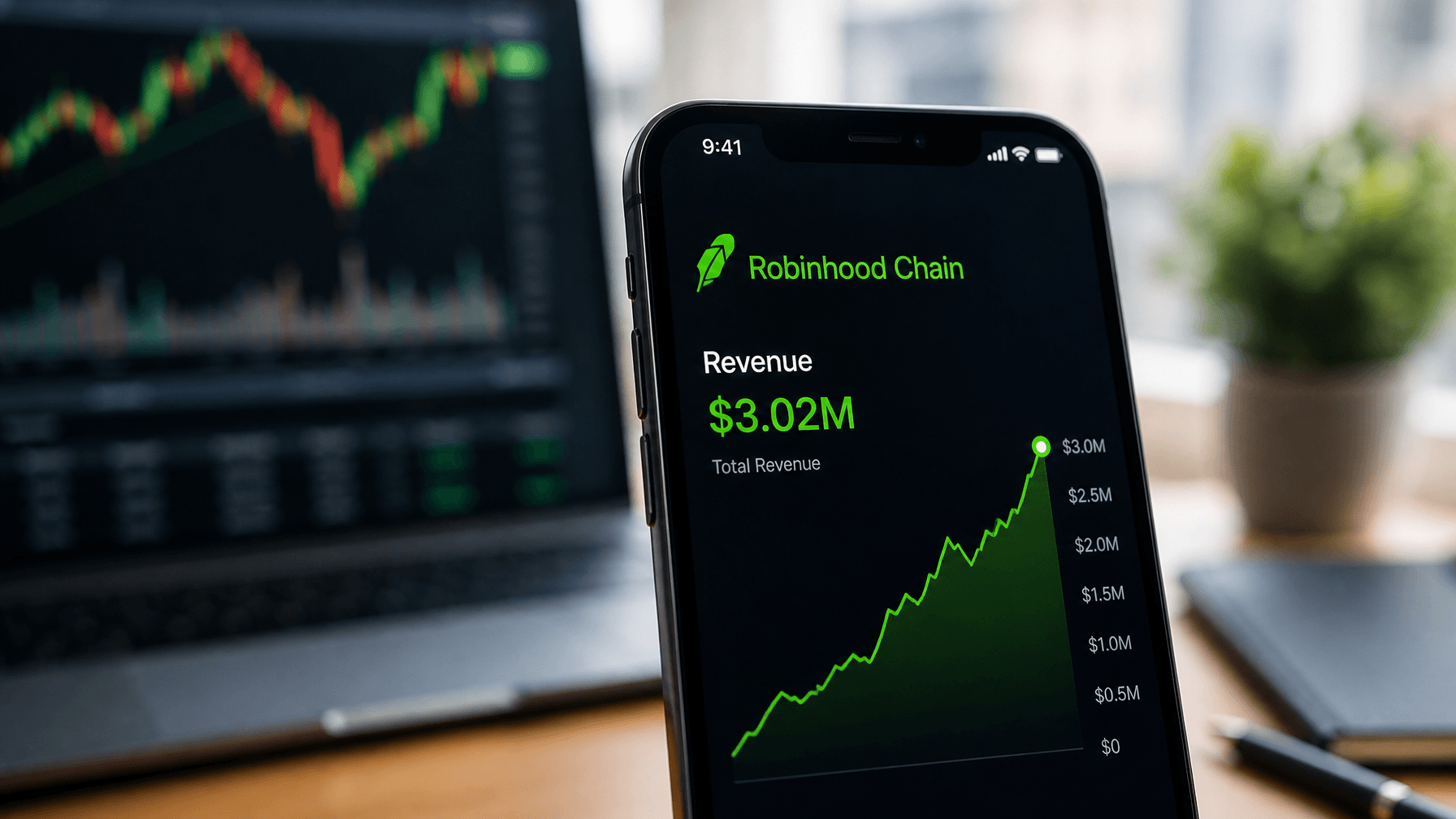
Robinhood Chain revenue has already blown past the $1.9M catalyst
The first number I would correct is the widely repeated $1.9 million revenue headline.
On September 1, CoinDesk captured Robinhood Chain at approximately $1.92 million of rolling 24-hour Chain Revenue. ARB rallied roughly 25% to 30%, depending on the exact price snapshot, as traders connected the rising revenue to Arbitrum’s percentage-based fee arrangement.
That $1.92 million figure was accurate for that reporting snapshot. It is not the latest record.
By September 2, DefiLlama showed approximately:
| Robinhood Chain metric | Latest working snapshot |
|---|---|
| Chain Fees, 24h | ~$3.75M |
| Chain Revenue, 24h | ~$3.38M |
| Chain REV, 24h | ~$3.75M |
| App Revenue, 24h | ~$3.70M |
| App Fees, 24h | ~$16.98M |
| DEX Volume, 24h | ~$1.438B |
| DEX Volume, 7d | ~$7.78B |
| Perpetuals Volume, 24h | ~$387M |
| DeFi TVL | ~$757M |
| Bridged TVL | ~$2.64B |
| Stablecoin market cap | ~$833M |
| Active RWA market cap | ~$182M |
These are rolling metrics, not completed accounting days. They will move as older hours leave the window and new activity enters it.
That is why I would describe the current story as Robinhood Chain revenue topping $3 million, while preserving $1.92 million as the dated September 1 catalyst.
Chain Fees, Chain Revenue and App Revenue are not the same thing
This distinction is essential because the largest Robinhood Chain numbers describe different economic layers.
| Metric | What it actually means |
|---|---|
| Chain Fees | Transaction gas fees generated by Robinhood Chain. |
| Settlement Cost | Ethereum L1 execution and blob/data costs needed to settle the L2. |
| Net Protocol Revenue | Qualifying gross chain economics after settlement costs. |
| AEP Fee | 10% of Net Protocol Revenue returned to the Arbitrum ecosystem. |
| DAO Revenue | 8% of Net Protocol Revenue routed to the ArbitrumDAO treasury. |
| Developer component | 2% of Net Protocol Revenue routed to the developer fund/Guild component. |
| Chain Revenue | DefiLlama’s Robinhood Chain metric after Ethereum L1 costs and the 10% AEP payment. |
| App Fees | Fees generated inside applications such as DEXs, trading tools and launchpads. |
| App Revenue | The portion of application fees retained by individual protocols. |
| DEX Volume | Notional value traded. It is not revenue. |
| TVL | Assets deposited in DeFi protocols. It is not revenue. |
A chain can process $1.4 billion of DEX volume without earning $1.4 billion. Likewise, Robinhood Chain showing almost $17 million of App Fees does not mean Robinhood Markets earned $17 million.
Those application fees can include liquidity-provider fees, launchpad charges, trading-bot fees, protocol charges and other app-level economics.
Robinhood Markets’ corporate revenue, Robinhood Chain protocol economics, application revenue and Arbitrum’s AEP revenue therefore need to remain separate.
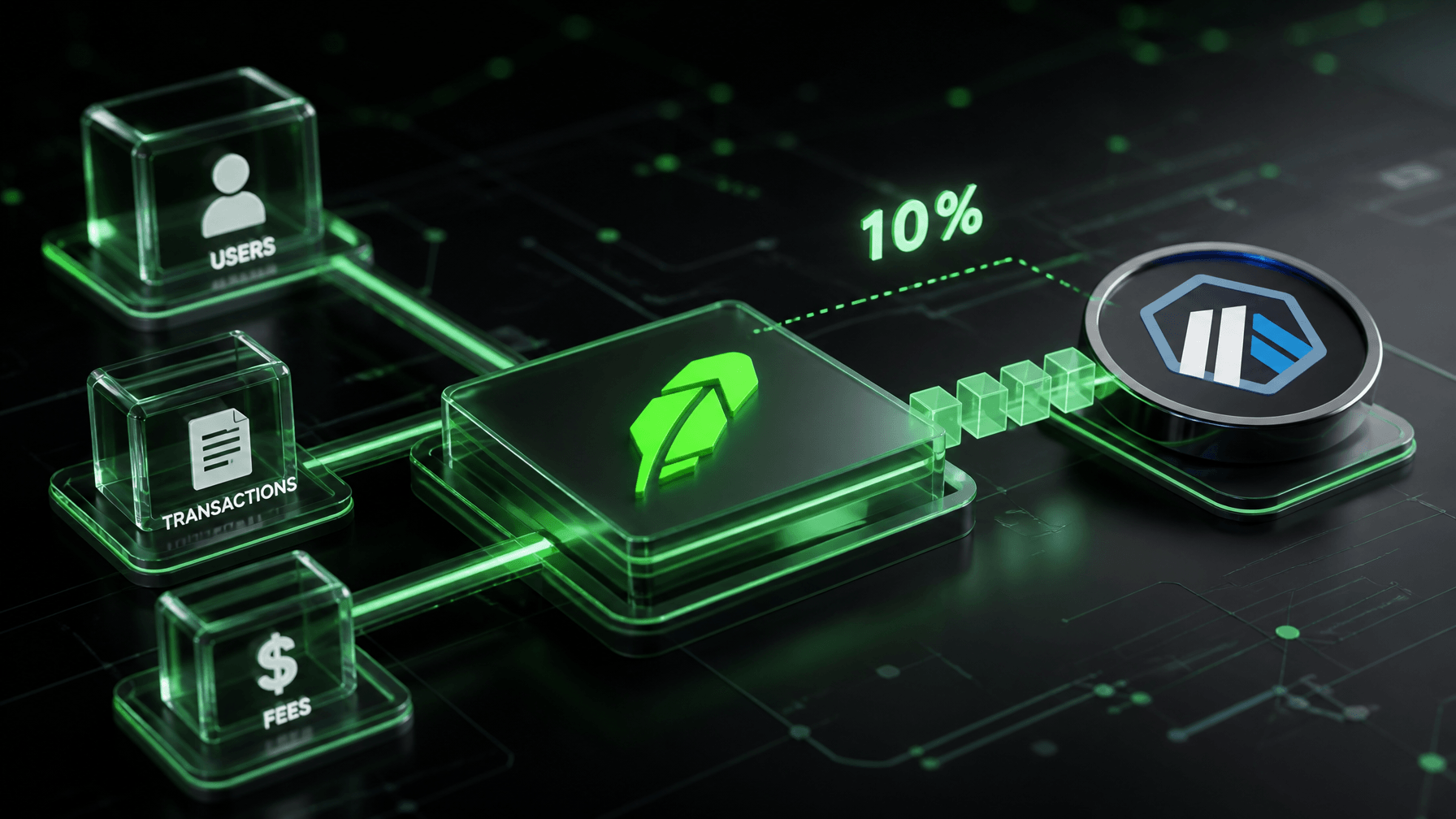
How Robinhood Chain’s 10% Arbitrum payment actually works
Robinhood Chain went live on public mainnet on July 1, 2026. It is a dedicated Arbitrum Chain, settles to Ethereum and uses ETH as its gas token.
That is different from Arbitrum One, the shared general-purpose Layer 2 most crypto users historically associate with the Arbitrum name.
Robinhood Chain falls under the Arbitrum Expansion Program’s licensing economics.
The official high-level formula is:
Net Protocol Revenue = Gross Revenue − Settlement Costs
Then:
AEP Fee = Net Protocol Revenue × 10%
At the fee-component level, Arbitrum’s documentation describes the AEP calculation as:
AEP Fee = [(L2BaseFee + L2SurplusFee + L1BaseFee + L1SurplusFee) − L1BaseFee] × 10%
which can be simplified to:
AEP Fee = (L2BaseFee + L2SurplusFee + L1SurplusFee) × 10%
The reason the ordinary L1 base-fee component is removed is that it reimburses the cost of publishing and settling Robinhood Chain activity on Ethereum.
Only after that settlement liability is handled do the AEP percentage economics apply.
Why only 8% goes to the ArbitrumDAO
A common shortcut is to say “Robinhood pays 10% to the DAO.”
That is not precise.
The Robinhood-specific ArbitrumDAO factsheet describes the economics as:
8% of Net Protocol Revenue → ArbitrumDAO treasury
2% of Net Protocol Revenue → developer component
10% total → Arbitrum ecosystem
DefiLlama currently tracks the full 10% payment as Arbitrum Nitro “Fees” and the DAO’s 8% component as Arbitrum Nitro “Revenue.”
At our latest snapshot, those values were approximately:
| AEP metric | 24h | 7d | 30d |
|---|---|---|---|
| Full 10% AEP contribution | ~$377,206 | ~$820,644 | ~$1.04M |
| DAO 8% component | ~$301,765 | ~$656,515 | ~$829,609 |
The arithmetic gives us a useful independent check:
$301,765 ÷ 80% ≈ $377,206
The implied developer component for the same rolling period is therefore approximately:
$377,206 − $301,765 ≈ $75,441
Where the latest Robinhood Chain economics go
Because the full AEP payment equals 10% of Net Protocol Revenue, the ~$377,206 snapshot implies approximately:
$3.772 million of Net Protocol Revenue
for the matching AEP calculation window.
| Revenue layer | Illustrative rolling amount |
|---|---|
| AEP-implied Net Protocol Revenue | ~$3,772,060 |
| ArbitrumDAO 8% share | ~$301,765 |
| Developer 2% share | ~$75,441 |
| Total AEP payment | ~$377,206 |
| Remaining economics after AEP | ~$3,394,854 |
There is an important technical caveat here.
DefiLlama’s separately displayed Robinhood Chain Revenue number is approximately $3.38 million, and its methodology explicitly defines that figure as transaction gas fees net of Ethereum L1 execution/blob costs and the 10% AEP share.
In other words, you should not take the $3.38 million Chain Revenue figure and multiply it by another 10%.
That would double-count the AEP deduction.
The AEP and Robinhood Chain dashboards also roll continuously, so their snapshots can be separated by minutes. I would rather disclose that timing difference than fabricate an exact Ethereum settlement-cost figure from numbers that were not sampled at precisely the same block and timestamp.
How much has Arbitrum actually received?
The cumulative figure is more useful than annualizing one exceptional day.
DefiLlama currently shows approximately:
- $1.40 million in cumulative full AEP contributions from Robinhood Chain;
- $1.12 million in cumulative DAO revenue; and
- approximately $281,000 attributable to the developer component.
This is not Arbitrum’s first source of protocol economics. The ecosystem already has Arbitrum One, Nova, Timeboost and other fee mechanisms.
What makes Robinhood Chain different is that it provides one of the clearest new external revenue streams tied directly to adoption of the Arbitrum technology stack.
An enterprise can move from shared infrastructure toward its own dedicated chain without necessarily disappearing from Arbitrum’s economic model.
That is why I increasingly think the most interesting Arbitrum thesis is not simply “one successful Ethereum L2.” It is the possibility of an infrastructure-licensing network where outside chains use the stack and return a percentage of their qualifying economics.
But does ARB actually capture Robinhood Chain revenue?
Not directly.
This is the biggest distinction in the entire story.
| Mechanism | Exists today? | Direct ARB-holder benefit? |
|---|---|---|
| Robinhood Chain AEP revenue | Yes | No direct distribution |
| DAO treasury accumulation | Yes | Indirect |
| ARB governance over DAO decisions | Yes | Indirect |
| Developer funding | Yes | Ecosystem benefit |
| Automatic Robinhood-funded ARB buyback | No verified mechanism | No |
| Automatic ARB burn | No verified mechanism | No |
| Robinhood fee dividend to ARB holders | No | No |
| Automatic revenue staking yield | No verified mechanism | No |
The 8% portion goes to the ArbitrumDAO treasury.
ARB gives holders governance rights over that ecosystem and its treasury decisions. But that does not mean treasury revenue is automatically distributed to individual ARB wallets.
It does not automatically buy ARB.
It does not automatically burn ARB.
And it does not automatically create an ARB staking yield.
The causal path today is better described as:
Robinhood Chain growth → higher DAO treasury revenue → stronger ecosystem finances → more strategic resources governed through ARB → potentially higher market value assigned to ARB.
That is indirect value accrual.
A DAO with another $10 million in treasury assets may have more capacity to fund infrastructure, developers, grants, liquidity programs and other governance-approved initiatives. That can strengthen an ecosystem.
But owning ARB does not automatically give a holder a legal pro-rata cash claim on those treasury assets.
So why did ARB rally?
Because markets price expectations, not only current cash distributions.
The strongest constructive interpretation is that Robinhood Chain provides evidence that Arbitrum technology can monetize successful third-party chains even when their users are not transacting directly on Arbitrum One.
That creates several reasons traders may assign ARB a higher valuation:
- Robinhood validates the Arbitrum stack with a major consumer-facing financial company.
- AEP revenue scales with qualifying chain economics.
- The revenue reaches a token-governed treasury.
- Other Arbitrum Chains could eventually produce similar licensing income.
- A larger treasury gives governance greater strategic flexibility.
- The market may anticipate future governance mechanisms that improve token utility or value capture.
That last point is where investors need discipline.
Possible future token economics are not current token rights.

What is actually driving Robinhood Chain’s activity?
Robinhood Chain was launched around tokenized stocks, real-world assets and financial infrastructure.
Its breakout fee period looks considerably more crypto-native.
Current DefiLlama application-revenue data show approximately:
| Application | Category | 24h revenue |
|---|---|---|
| GMGN | Trading tool / bot | ~$1.70M |
| Pons | Token launchpad | ~$1.11M |
| Uniswap | DEX | ~$363K |
| o1.exchange | Trading / launchpad | ~$268K |
| up | DEX | ~$146K |
GMGN, Pons and Uniswap alone account for the overwhelming majority of the headline application-revenue total.
This follows the pattern already visible on August 30, when approximately 22,600 tokens were launched through Pons in a single day. At that earlier snapshot, GMGN and Pons generated about $2 million of $2.66 million in App Revenue.
That matters for revenue quality.
A fee boom generated by recurring institutional settlement deserves a different durability assumption from a fee boom generated by thousands of speculative token launches, high-frequency bots and rapidly rotating memecoins.
CryptoLinks has already documented this unexpected side of the network in our earlier analysis of the CASHCAT and Robinhood Chain trading frenzy.
Tokenized stocks and memecoins are starting to overlap
The speculative activity does not necessarily invalidate Robinhood’s original real-world-asset thesis.
It may be creating a stranger version of it.
Robinhood Chain currently shows roughly $182 million of active RWA market capitalization, alongside more than $832 million in stablecoins. Readers wanting more background on the concept can see our CryptoLinks guide to real-world asset tokenization.
What interests me is the emergence of tokens trading against tokenized equities rather than only ETH or stablecoins.
If speculative assets increasingly use tokenized NVDA, TSLA, GME, AAPL or other Stock Tokens as quote assets, tokenized equities begin functioning as on-chain liquidity primitives, not merely blockchain representations of traditional securities exposure.
That creates an unusual possibility: crypto-native speculation itself could increase the usefulness and turnover of tokenized financial assets.
It is too early to call that a durable trend, but it makes a simple “stocks versus memes” classification less useful.
Uniswap controls roughly three-quarters of Robinhood Chain DEX volume
Uniswap is at the center of Robinhood Chain’s trading architecture, and current DEX data show just how dominant it has become.
| DEX | 24h volume | Approx. share |
|---|---|---|
| Uniswap | ~$1.104B | ~76.8% |
| RamsesX | ~$89M | ~6.2% |
| up | ~$79M | ~5.5% |
| GIGA | ~$39M | ~2.7% |
| Metric | ~$36M | ~2.5% |
| Other DEXs | ~$91M | ~6.3% |
Total rolling 24-hour DEX volume was approximately $1.438 billion.
Again, DEX volume is not chain revenue. A $1 billion swap-volume day does not mean $1 billion was earned by Robinhood, Arbitrum or Uniswap.
The economics of UNI and Uniswap also need to remain separate from ARB. Uniswap has its own fee architecture and token economics. Robinhood Chain’s AEP payment does not mean 10% of Uniswap trading fees automatically goes to ARB holders.
The 90-day gas subsidy is an important sustainability test
There is another caveat investors should not ignore.
At Robinhood Chain’s July 1 launch, Robinhood said it would cover gas for eligible Robinhood Wallet users for the first 90 days, including qualifying swaps, bridge transactions and other supported activity.
September 2 remains inside that launch window.
This does not make the chain’s fee economics fake. Someone is still paying the sequencer and the network is still generating economic activity.
But there is a major difference between:
“Users voluntarily paid $3.75 million because the transactions were worth the cost to them.”
and:
“Robinhood Chain generated $3.75 million of transaction-fee economics, with some eligible user gas sponsored by Robinhood.”
The second statement is the safer one.
The end of the subsidy window will therefore create one of the cleanest tests of organic Robinhood-native demand.
Ethereum also gets paid
Robinhood Chain does not replace Ethereum economics.
It settles to Ethereum.
Ethereum therefore captures value through data/blob publication, L1 settlement and the broader role of ETH in securing and operating the ecosystem.
Arbitrum’s payment is structurally different.
Ethereum receives settlement and data costs.
Arbitrum receives a percentage of Net Protocol Revenue through the AEP.
This creates an interesting value-capture experiment.
If a dedicated Layer 2 becomes extremely profitable without its Ethereum data costs rising at exactly the same rate, percentage-based infrastructure licensing can scale differently from blockspace settlement revenue.
But one exceptional week is nowhere near enough evidence to declare Arbitrum or Ethereum the “winner.”
They are supplying different parts of the stack and capturing value in different ways.
Robinhood Chain can help Arbitrum even if activity leaves Arbitrum One
This is perhaps the most strategically interesting part of the model.
Robinhood’s original Stock Tokens launched on Arbitrum One. The newer Stock Token architecture runs on Robinhood Chain.
A company moving to dedicated infrastructure could reduce some activity on the shared L2 while simultaneously increasing revenue for the broader Arbitrum ecosystem through AEP fees.
That means Arbitrum does not necessarily need every successful application to remain permanently concentrated on Arbitrum One.
Instead, the stack itself can potentially monetize customers as they scale into dedicated chains.
For readers comparing the different models, our Layer-2 blockchain guide explains where rollups sit in the wider Ethereum scaling stack.

ARB’s rally is also being amplified by leverage
I would not attribute the entire ARB move to fundamentals.
CoinGlass currently shows approximately:
- $845 million to $870 million of 24-hour ARB futures volume depending on the rolling snapshot;
- roughly $84 million to $93 million in tracked spot volume;
- approximately $172 million of aggregate open interest; and
- around $3.3 million of 24-hour liquidations at one current snapshot.
That is a substantial derivatives market relative to ARB’s roughly $769 million market capitalization.
Price and open interest expanding around the revenue catalyst suggest new leveraged positioning has entered the market. That is different from a rally caused purely by shorts closing.
My classification would therefore be:
fundamentally triggered, but leverage-amplified.
This distinction matters if Robinhood Chain revenue normalizes while derivatives positioning remains crowded.
September has more fundamental support than ARB’s July Robinhood rally
This is not the first time Robinhood Chain has sent ARB higher.
On July 9, ARB jumped approximately 19% as Robinhood Chain’s early on-chain trading frenzy reached around $568 million.
CryptoLinks covered the network’s subsequent speculative development in our July Robinhood Chain analysis.
The September event has a stronger fundamental base.
We can now point to:
- more than $3 million of daily Chain Revenue at the latest snapshot;
- visible AEP receipts;
- more than $800 million of stablecoins;
- more than $750 million of DeFi TVL;
- roughly $182 million of active RWA value;
- deep Uniswap liquidity; and
- more than $1 million of cumulative DAO revenue from the AEP adapter.
Those did not exist at the same scale during the first July repricing.
But July still provides a warning against treating every Robinhood narrative rally as a permanent new valuation floor.
Do not annualize one exceptional revenue day and call it a forecast
The latest DAO share of roughly $301,765 would look spectacular if simply multiplied by 365.
That calculation produces a peak-day run rate of approximately $110 million per year.
It does not mean the ArbitrumDAO is going to receive $110 million from Robinhood over the next twelve months.
The current data are heavily back-loaded into the recent surge.
A better framework compares three views:
- Trailing 30-day average: the most conservative short-run baseline.
- Trailing seven-day average: captures the current acceleration.
- Current peak-day run rate: a stress-test/high case, not a forecast.
The enormous difference between those numbers is itself useful information. It tells us revenue is accelerating faster than a stable business normally would.

The bull case for ARB
- Robinhood validates Arbitrum technology with a major financial platform.
- The AEP produces measurable external revenue.
- The 10% model scales with qualifying Net Protocol Revenue.
- The DAO receives cash flow rather than only narrative value.
- More AEP chains could diversify the model beyond Robinhood.
- Robinhood Chain liquidity, stablecoins, DeFi and RWAs are all expanding.
- A growing treasury gives ARB governance greater strategic optionality.
- The market may eventually value Arbitrum as infrastructure software rather than only a single rollup.
The bear case for ARB
- ARB holders do not directly receive Robinhood Chain revenue.
- No automatic Robinhood-funded ARB buyback has been established.
- No automatic ARB burn is created by the AEP payment.
- No automatic fee dividend exists.
- Current revenue is heavily concentrated in an exceptional short period.
- GMGN, Pons and speculative token activity are major revenue drivers.
- Eligible Robinhood Wallet activity is still benefiting from a launch-period gas subsidy.
- Derivatives leverage has amplified the price move.
- Future DAO spending can help Arbitrum without necessarily creating proportional ARB buy pressure.
- Other L2 technology stacks can compete for enterprise-chain customers.
Three ways the Robinhood-Arbitrum trade could develop
Scenario 1: Revenue remains elevated
Robinhood Chain sustains high 30-day Net Protocol Revenue, DAO receipts keep growing, Stock Token and RWA usage expand, speculative application concentration falls and other Arbitrum Chains begin contributing material AEP revenue.
In that world, investors could increasingly value Arbitrum as an infrastructure and licensing ecosystem rather than simply an L2 governance token.
Scenario 2: Robinhood succeeds, but ARB value capture stays indirect
Robinhood Chain could become highly successful while ARB still has no direct revenue distribution, buyback or burn mechanism.
The DAO treasury grows and funds ecosystem development, but token-price performance becomes increasingly dependent on what governance does with those resources.
This outcome can be good for Arbitrum without producing equivalent appreciation in ARB.
Scenario 3: The speculative fee spike fades
Pons and GMGN activity cools, token launches fall, DEX volume retraces, the gas-subsidy period ends and Chain Revenue returns closer to its August baseline.
If ARB derivatives positioning remains elevated at the same time, the token could give back part of the repricing.
That would suggest traders annualized a temporary speculative event too aggressively.

My conclusion: the revenue is real—the ARB claim is still indirect
Robinhood Chain has now passed an important test for Arbitrum.
The Arbitrum Expansion Program is no longer just an interesting licensing formula in documentation. It is producing visible, increasingly meaningful cash flow.
At the latest snapshot, the full 10% AEP contribution was running near $377,000 over 24 hours, with roughly $302,000 attributable to the ArbitrumDAO treasury and approximately $75,000 to the developer component.
Cumulative DAO revenue tracked through the current adapter is already around $1.12 million.
That is meaningful evidence that the Arbitrum software stack itself can become an economic product.
The mistake would be jumping from that observation to:
“ARB holders now receive Robinhood revenue.”
They do not.
Today, ARB governs an ecosystem whose external revenue capacity appears to be becoming more valuable. The market is betting that control over a growing treasury, more AEP customers and potential future governance choices will eventually make the token itself more economically important.
That is a defensible thesis.
It is also a thesis about future value capture, rather than a dividend that exists today.
For me, ARB’s next fundamental test is not whether Robinhood Chain can produce another record 24-hour number. It is whether the network can maintain meaningful 30-day revenue after speculative token activity cools, after the initial gas subsidy expires, and as more of its intended tokenized-finance use cases mature.
If that happens—and if similar economics emerge from multiple external Arbitrum Chains—the market may eventually stop viewing Arbitrum as merely one Ethereum rollup.
It may start viewing the Arbitrum stack itself as a revenue-producing blockchain infrastructure network.
Frequently asked questions
Why is Arbitrum’s ARB token rising?
ARB rallied after Robinhood Chain’s revenue accelerated sharply and traders began repricing the economic importance of Arbitrum’s 10% Expansion Program fee. Increased derivatives positioning has also amplified the move.
How much revenue is Robinhood Chain generating?
At our September 2 snapshot, DefiLlama showed approximately $3.38 million of rolling 24-hour Chain Revenue. Because the metric is rolling, the exact figure changes continuously.
Did Robinhood Chain really generate $1.92 million in a day?
Approximately $1.92 million was the rolling 24-hour Chain Revenue snapshot reported on September 1. It was a real event snapshot, but the metric subsequently moved above $3 million.
What is Robinhood Chain?
Robinhood Chain is a dedicated Ethereum-compatible Layer-2 blockchain built using Arbitrum technology. Its public mainnet launched July 1, 2026, it settles to Ethereum and uses ETH for gas.
Is Robinhood Chain part of Arbitrum One?
No. Robinhood Chain uses Arbitrum technology but operates as its own dedicated chain. You can learn more about the distinction in our Arbitrum review and Layer-2 guide.
What is the Arbitrum Expansion Program?
The AEP is the licensing and revenue-sharing framework under which qualifying Arbitrum Chains return 10% of Net Protocol Revenue to the Arbitrum ecosystem.
Does the entire 10% go to the ArbitrumDAO?
No. Robinhood Chain’s specific arrangement allocates 8% of Net Protocol Revenue to the ArbitrumDAO treasury and 2% to the developer component.
Do ARB holders receive Robinhood Chain fees?
No automatic distribution exists. The DAO treasury receives its share, while ARB holders participate in governance. Treasury revenue does not automatically land in individual tokenholders’ wallets.
Does Robinhood Chain revenue burn ARB?
No automatic Robinhood-revenue-funded ARB burn has been established.
Does ARB now pay a dividend?
No. The Robinhood Chain AEP payment should not be described as an ARB dividend.
Why is Uniswap important to Robinhood Chain?
Uniswap currently handles roughly three-quarters of Robinhood Chain’s DEX volume, making it a central execution and liquidity layer for the network.
Are tokenized stocks driving all of the volume?
No. Tokenized stocks and RWAs are growing, but memecoins, token launchpads, trading bots and other crypto-native applications currently contribute heavily to activity and application revenue.
Does Ethereum earn money from Robinhood Chain?
Yes. Robinhood Chain settles to Ethereum and pays for Ethereum L1 execution and blob/data resources. Those settlement economics are separate from Arbitrum’s percentage-based AEP fee.
Is Robinhood Chain revenue sustainable?
It is too early to know. The strongest test will be whether 30-day revenue remains elevated after speculative activity normalizes and after Robinhood’s initial 90-day eligible-user gas-subsidy period ends.
Sources and methodology
Data cutoff: September 2, 2026. Chain, application, market and derivatives figures are rolling snapshots and may have moved since publication.
- ArbitrumDAO Robinhood Chain mainnet factsheet
- Arbitrum Foundation AEP fee-calculation documentation
- DefiLlama Robinhood Chain dashboard
- DefiLlama Robinhood Chain revenue rankings
- DefiLlama Arbitrum Nitro AEP adapter
- DefiLlama Robinhood Chain DEX rankings
- CoinMarketCap ARB market data
- CoinGlass ARB derivatives data
- Robinhood Chain launch and support materials
- CoinDesk September 1 Robinhood Chain/ARB reporting
- CoinDesk July 9 Robinhood Chain/ARB reporting
Chain Fees, Chain Revenue, App Fees, App Revenue and DEX Volume were treated as separate metrics. Application revenue was not assumed to enter the AEP calculation. ARB governance rights were separated from direct financial claims. Peak-day annualizations were treated only as run-rate illustrations, never forecasts.
Disclosure: This article is for informational purposes only and does not constitute investment, financial, legal or tax advice. Cryptocurrency prices, token economics and blockchain activity can change rapidly.