Ledger Confirms CryptoBilis Wallet Implant: What Buyers Should Do
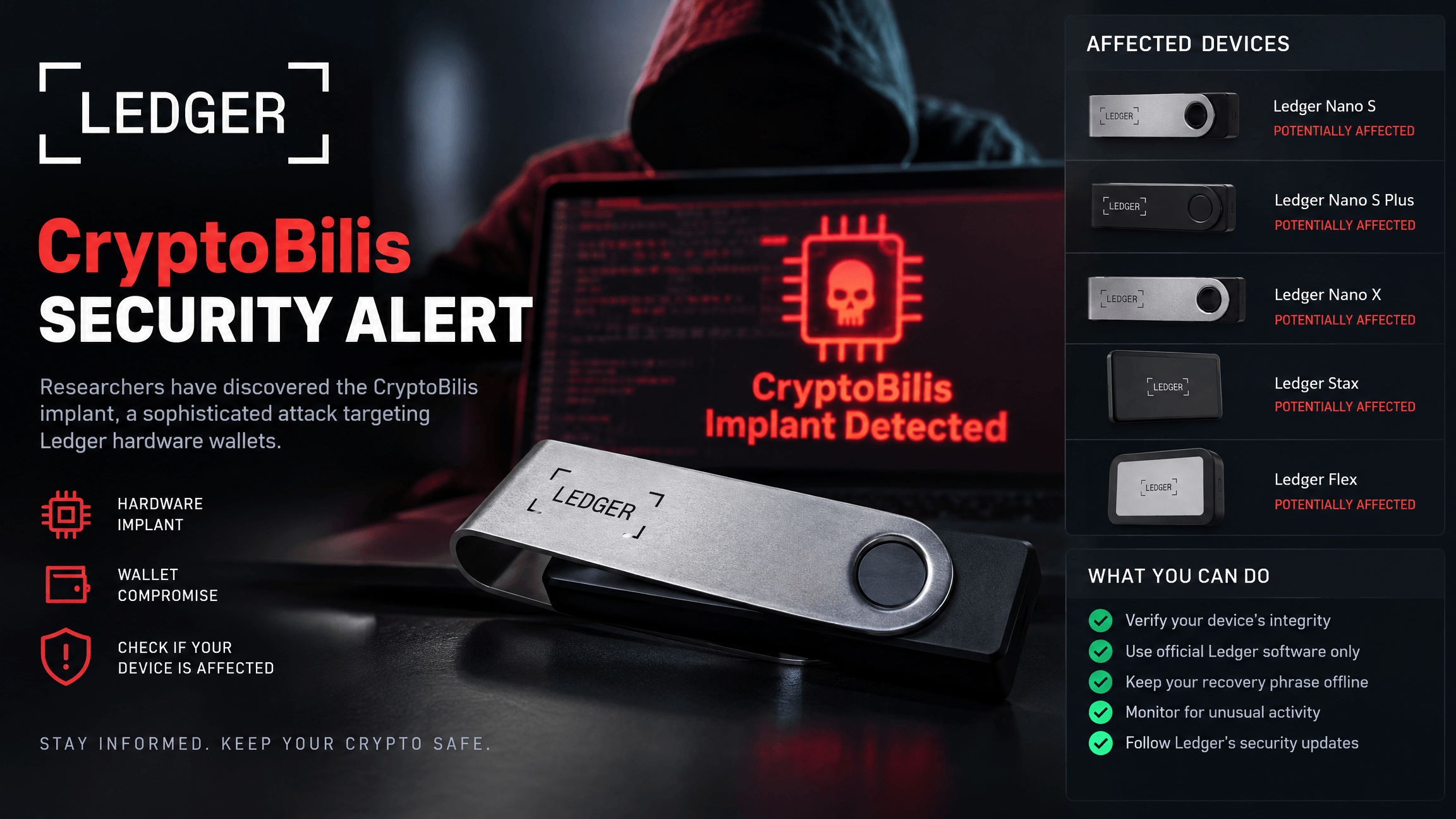
Ledger has confirmed an unauthorized hardware implant inside a device belonging to a customer affected by the October 2026 cryptocurrency thefts. The company says all cases it has confirmed so far involve devices sold through Southeast Asian reseller CryptoBilis. That finding deserves urgent attention from buyers, but it does not prove that every reported theft involved the same implant—or that every wallet sold by CryptoBilis was altered.
Published October 12, 2026. Evidence and reporting checked through October 12, 2026, 18:18 UTC. This is a developing investigation; manufacturer instructions and on-chain estimates may change.
The key distinction: Ledger has publicly confirmed a physical implant in one affected customer’s device. Research teams are tracing much larger suspicious withdrawals, but those blockchain calculations do not establish the physical cause of every loss. CoinDesk reports Ledger’s confirmation and initial buyer instructions.
Bought a Ledger from CryptoBilis? What to do first
If I had to choose one part of this story to put first, it would be the instructions for potentially exposed buyers. Ledger’s October 9–11 communications told CryptoBilis customers not to initialize unused devices and advised people who had already set up a device to move to a new recovery phrase on a trusted device obtained from Ledger. Its initial warning referred to purchases in the preceding 90 days, but that should not be mistaken for a proven boundary around all potentially affected devices. Follow the most recent instructions via official Ledger Support.
| Your situation | Practical next step |
|---|---|
| Bought from CryptoBilis, not yet initialized | Do not initialize, connect, dismantle or test it. Keep purchase records and packaging. Ask Ledger Support for current instructions before returning or changing the device. |
| Bought from CryptoBilis, already set up | Treat the existing recovery phrase as potentially exposed. Follow Ledger’s advice to migrate to independently generated new keys on a trusted device. Do not generate the new phrase on the suspect device or restore the old one to the replacement. |
| Assets already missing | Save transaction hashes, public addresses, receipts, dates and correspondence. Contact Ledger through its official site and report the incident to local law enforcement. Do not share your recovery words with anyone. |
| Purchased Ledger elsewhere | Ledger says its own systems and direct sales channels are unaffected and that its confirmed cases involve CryptoBilis. Those are company assurances about known evidence, not proof that every other device is physically safe. |
| Bought a different wallet brand from CryptoBilis | Check that manufacturer’s own incident notice. OneKey has published a qualifying replacement program; do not assume it applies to other brands. |
Critical security warning: Never enter a recovery phrase into a website, ordinary computer form, chat conversation or purported “wallet validation” service. Ledger says it will not request your 24 recovery words or contact you unsolicited to collect them. Do not reset, power on, reconnect or ship back a suspicious device merely to test whether it is compromised; follow official incident-response instructions and preserve evidence.
What Ledger actually confirmed
The first public reports appeared on October 9, 2026, when Ledger acknowledged customer fund losses involving CryptoBilis purchases and asked the reseller to pause sales and shipments. On October 10, Ledger Support stated that one affected user’s device contained an unauthorized hardware implant. On October 11, Ledger said the number of confirmed cases appeared limited and that all cases confirmed so far in the October 9 draining incident involved CryptoBilis. Ledger also said its internal systems and direct sales channels remained unaffected. These statements were reproduced in Unchained’s October 12 coverage and Decrypt’s reporting; Ledger’s public update is linked here.
Ledger said it was working with relevant authorities and with support from the Security Alliance’s SEAL 911 incident-response effort. It also said CryptoBilis had stopped selling hardware wallets. I would not interpret either statement as proof of who installed an implant or where in the distribution chain the interference occurred.
The expression “all confirmed cases” matters. It does not disclose the number of physically inspected devices, the evidentiary standard used to classify customer cases, or a complete inventory of potentially exposed shipments. At this cutoff, I could not verify an official Ledger batch or serial-number checker, a comprehensive model list, or published incident-specific replacement eligibility terms. The publicly described physical implant finding is one confirmed device, not hundreds of independently examined implants.
Incident timeline
- October 9: Ledger acknowledged the CryptoBilis-linked reports, requested a sales pause and issued initial buyer precautions.
- October 10: Ledger confirmed an unauthorized hardware implant in one affected device.
- October 11: Ledger linked all of its confirmed cases to the CryptoBilis reseller channel and said its own systems and direct sales were unaffected.
- October 12: OneKey announced precautionary reseller measures and a replacement offer; Bitquery issued a revised on-chain count and corrected an attribution error.
How could a genuine hardware wallet contain a spy implant?
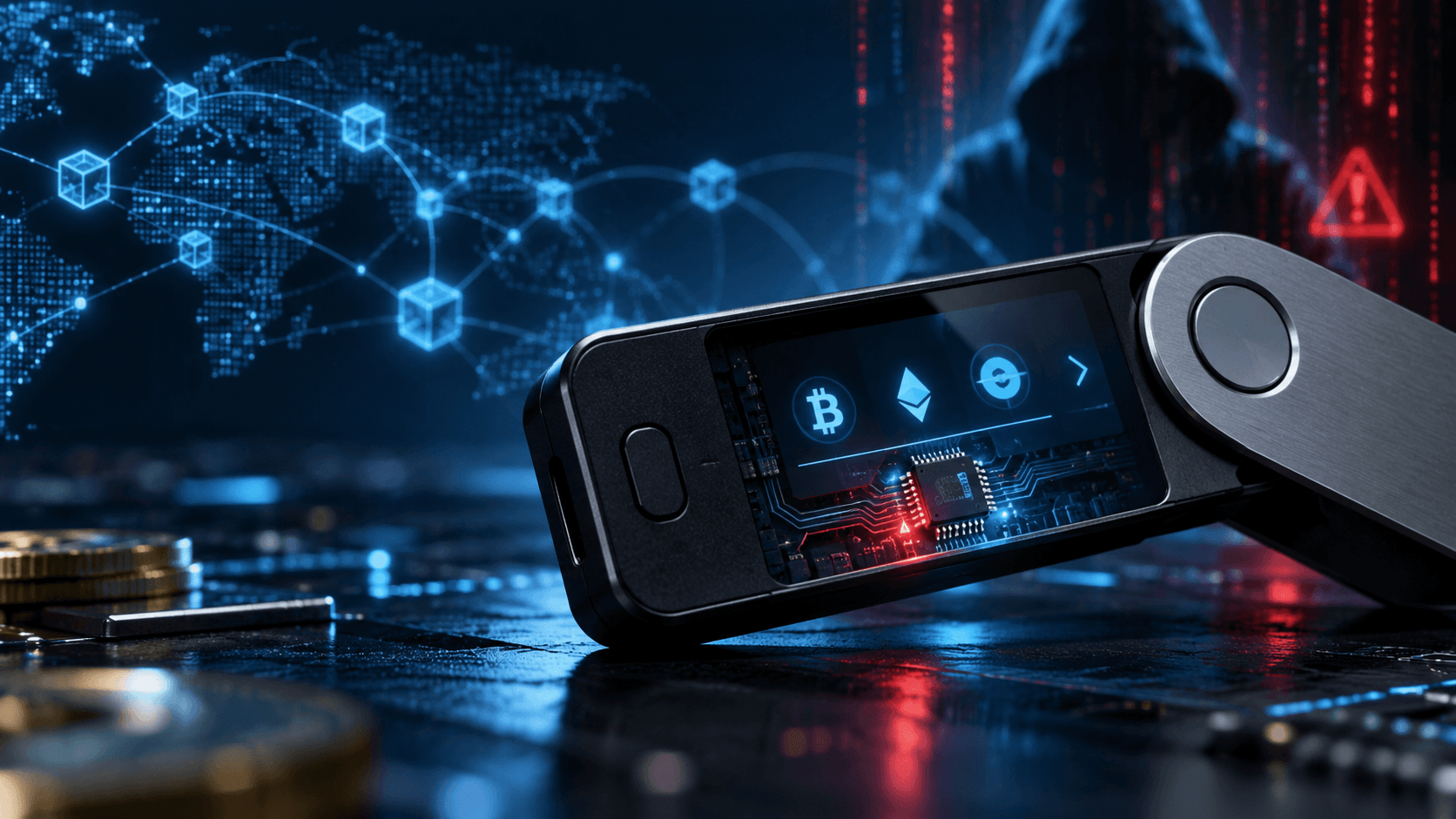
The reported attack concerns a genuine device that may have been physically modified. That is different from a counterfeit wallet, malicious firmware, or a proven compromise of Ledger’s secure element. An attacker who can observe a recovery phrase when it appears on a screen may be able to reconstruct the corresponding wallet later, without stealing the original hardware.
Researchers and technical reporters have described additional circuitry near a Ledger Nano X display, including components alleged to be capable of communicating externally. YFarmX discusses the reported samples and their provenance, while Joe Grand’s separately documented hardware-implant reverse-engineering presentation shows why this class of attack is plausible. But these are not automatically the same physical sample as the customer device Ledger confirmed. The publicly accessible material has not established a complete forensic chain of custody, proven recovery-word transmission and destination for that victim’s device.
There is an especially important point in Ledger Donjon’s own documentation of the Genuine Check: it authenticates the secure element, but cannot detect unauthorized physical spying implants if the original secure element remains intact. A normal Genuine Check, intact packaging or familiar-looking screen should therefore never be treated as conclusive proof that a suspicious unit has no extra hardware.
This is a specific supply-chain trust problem, not evidence that every hardware wallet fails. For broader background, I’ve previously pointed readers to CryptoLinks’ secure crypto storage guide and its blockchain security resource category. The lesson from CryptoBilis is narrower and more urgent: the security of recovery words also depends on what happened to a device before the owner first used it.

Why are the alleged losses reported as $86 million, $93 million, $102 million and $103 million?
The different numbers come from researchers using different address sets, tracing rules and update times. They are not four separate losses to add together. None is a Ledger-certified total, and blockchain records by themselves cannot prove which withdrawals resulted from physical hardware tampering.
| Estimate and date | What it actually represents |
|---|---|
| About $86M–$87M Early public tracing, October 9 |
Preliminary counts from a short list of suspected collection addresses; incomplete and unaudited. |
| $93.2M / 315 wallets Earlier Bitquery version |
An older calculation that Bitquery subsequently revised. It should not be added to the latest estimate. |
| $102.0M / 324 wallets / six chains Bitquery, October 12, 14:00 UTC |
Researcher’s estimate of victim-wallet outflows, using October 9 reference prices and excluding identified follow-on transfers. |
| $103.4M / 530 addresses / seven chains YFarmX, October 12, 09:30 UTC |
A broader address universe, including additional Bitcoin activity and chains. Addresses do not equal individual victims or physical devices. |
Bitquery also published an important October 12 correction. Some transfers it had linked to the suspected thief actually involved other customers of THORChain’s shared vaults. That correction illustrates why even detailed on-chain analysis can change as investigators learn more about routing infrastructure.
Both the amount and the population remain uncertain. One person can control multiple addresses; the same address can appear on more than one chain. Different researchers can include or exclude older sweeps and transfers for defensible reasons. Frozen assets are also not the same as recovered or reimbursed assets. I would not use a large loss estimate in the headline, and I would not claim that a single hardware implant caused every dollar identified by these analysts.
Which devices, countries and purchase dates may be affected?
Ledger’s publicly confirmed cases currently point to CryptoBilis, which operated reseller channels associated with Malaysia, Indonesia and the Philippines. That is a link to a sales channel, not a validated affected-country boundary. No published, definitive Ledger serial-number range or complete device-model list was available in the sources checked.
The physically confirmed victim device’s exact model was not specified in the Ledger statements available through reporting. Descriptions of modified Nano X samples in separate examinations should not be presented as an official list of affected CryptoBilis products. Equally, a device outside a highlighted purchase period is not automatically proven safe. Buyers should rely on Ledger’s latest official advice rather than third-party “eligibility checkers”.
OneKey’s response: reseller removal and free replacement
On October 12, OneKey announced that CryptoBilis was no longer an authorized reseller, new-reseller onboarding was paused, and existing resellers would be reviewed again. OneKey said it had no reports of OneKey users losing funds linked to this incident at the time. These are precautionary measures, not confirmation that OneKey devices contained the same implant.
Under the English-language notice, customers who bought any OneKey hardware-wallet model from CryptoBilis from March 1 through October 12, 2026 may request a free replacement, whether they activated it or not. They must supply proof of purchase, the device model and its activation status through the support button on OneKey’s official website. The company says no return is required, replacements ship directly from OneKey, and an unavailable original model will be replaced by a newer one at no extra cost.
The English notice gives December 31, 2026 as the application deadline. However, the Hong Kong-language version displays December 17. I would apply promptly and ask OneKey to confirm which date governs the specific claim. Replacement hardware does not mean reimbursement of stolen assets.
CryptoBilis also sold other wallet brands, including Trezor, Tangem, SafePal and imKey. I could not verify comparable incident-specific replacement terms for those manufacturers by the research cutoff; do not assume OneKey’s program extends to them.
Why a new device is not enough if your recovery phrase was exposed
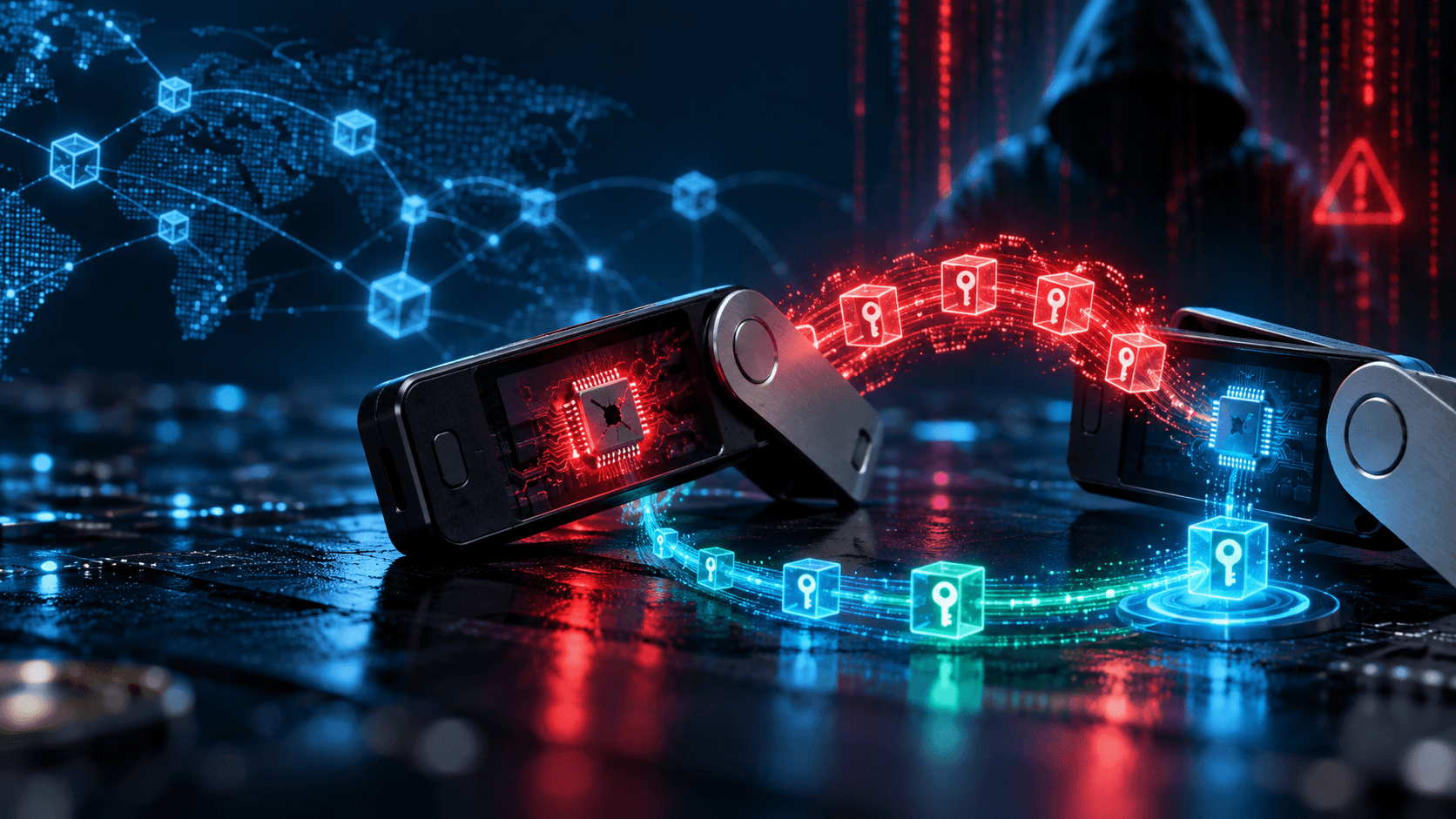
Your funds are controlled by private keys derived from your recovery phrase. The physical wallet protects those keys, but the device itself is not where the blockchain keeps your money. If a spy implant captured the phrase during setup, putting those same words into a brand-new device would restore the same potentially exposed wallet.
That is why I would focus on new keys, not merely new packaging. A proper migration uses a trusted environment to generate an entirely new recovery phrase and sends still-accessible funds to the new wallet’s addresses. Do not create the new phrase on the suspicious device. Do not assume that a PIN change, firmware update, factory reset or token-approval revocation repairs a leaked recovery phrase.
If you would need to reconnect a suspect wallet to authorize an outgoing transaction, obtain device-specific incident guidance from Ledger first, rather than casually using the hardware again. You may need to balance urgent asset protection with preserving forensic evidence. Never follow a stranger’s DM, connect to a “recovery portal” or type your seed words into a page claiming to verify eligibility.
For readers learning how recovery phrases and custody options ordinarily work, CryptoLinks has a crypto security guide, a hardware-wallet resource section and a broader cryptocurrency wallet directory. Those general resources are background reading; they cannot replace the manufacturer guidance for a potentially altered device.
If your funds have already been stolen
Document what happened without publishing secrets. Preserve public transaction hashes, wallet addresses, dates, the original receipt, seller identity, product packaging and correspondence with the retailer or manufacturer. Report the issue through Ledger’s official support site and the appropriate law-enforcement channel. If an exchange or service is still directing deposits to a potentially compromised address, ask its official support team how to stop further deposits.
Do not send your 24 words, private keys or personal documents to a social-media account offering to investigate the case. There is no verified assurance that missing funds will be recovered, and a hardware replacement—if offered—is a different question from reimbursement.
What remains unanswered?
- How many customer devices have been physically examined and confirmed to contain an implant?
- Which models, reseller batches, purchase periods and countries, if any, can be reliably identified?
- Where was the implant inserted, and what evidence establishes access to recovery words or actual data transmission?
- How many unique people lost funds because of this particular physical mechanism, rather than another type of compromise?
- Will Ledger publish a formal incident report, an official replacement or recall procedure, and any restitution guidance?
- Will CryptoBilis publish an independently verifiable response explaining its own findings?
I have not independently examined a device or interviewed the affected customers, and I am not treating allegations about individual perpetrators or ownership changes at CryptoBilis as established facts. The available evidence does not support assigning responsibility to any particular employee, owner or buyer.
My bottom line
A physically confirmed implant is a real reason for CryptoBilis buyers to take precautions. It is not a reason to describe all Ledger devices as compromised, nor is it enough to attribute every suspicious transfer to a single hardware trick. My reading is straightforward: follow current official instructions, protect a newly generated recovery phrase, preserve potentially valuable evidence and be skeptical of anyone selling a quick recovery or an instant “device safety” test.
I’ll continue to treat this as a developing crypto-security story, not a finished forensic case. Readers can find ongoing reporting in the CryptoLinks news blog and broader educational resources through the CryptoLinks homepage, including the site’s blockchain security and hardware-wallet sections.
Source and update note: Key primary materials include Ledger Donjon’s genuineness threat model, Bitquery’s dated investigation, YFarmX’s on-chain account and OneKey’s October 12 advisory. Ledger’s incident comments are attributed through its public statement and accessible reporting. Figures and instructions are current only to the verification cutoff above.