Fiserv Goes Live on Solana: What Roughrider Coin Means for 90+ North Dakota Institutions
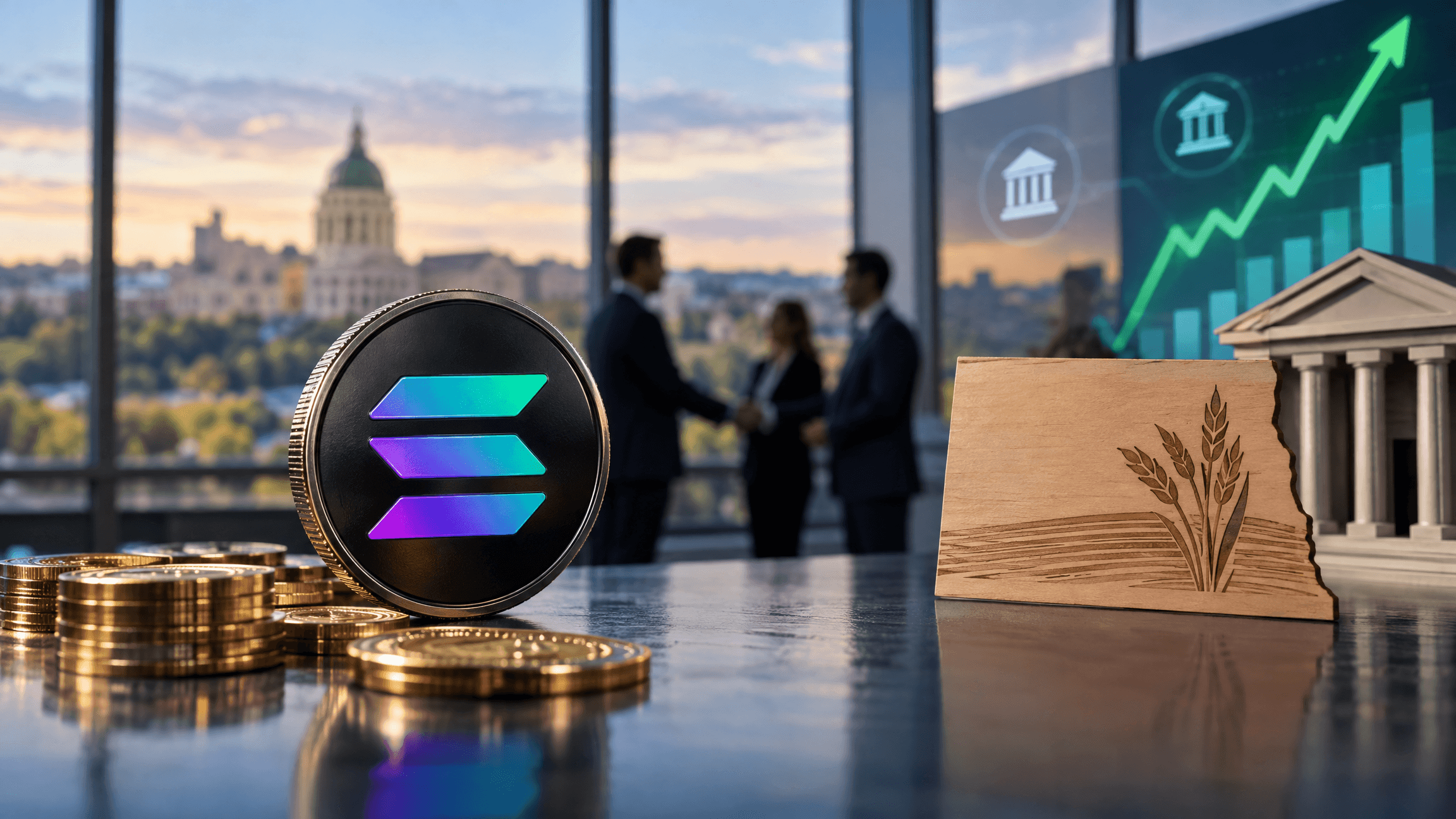
Fiserv’s Digital Asset Platform entered production on October 1, 2026, with Roughrider Coin as its first live use case, giving more than 90 participating North Dakota banks and credit unions access to a new interbank payment rail. VersaBank USA issues the asset, Solana processes its transactions, and production usage figures remain undisclosed.
The most interesting part of the Fiserv Solana announcement is how little a bank employee may need to think about blockchain. Roughrider Coin fits into existing banking workflows, while its public-chain transaction layer operates underneath institutional controls. The public cannot buy or invest in it.
For me, the important question is whether this becomes ordinary banking infrastructure: something staff use because it makes a payment easier, without needing to become blockchain specialists.
The launch establishes a production deployment. It does not yet establish widespread, recurring use—or prove that final settlement of every associated dollar obligation happens when a Solana transaction finalizes.
Key takeaways
- Fiserv announced its Digital Asset Platform was live on October 1, 2026.
- Roughrider Coin is the platform’s first announced live use case.
- The 90-plus figure describes participating banks and credit unions, not a verified count of active senders.
- VersaBank USA handles issuance; Bank of North Dakota provides governance and oversight.
- Access to Roughrider is permissioned, although the underlying Solana network is public.
- The architecture combines a fast token transfer with separate banking-account reconciliation and daily netting.
What actually went live?
Fiserv’s launch announcement identifies Roughrider as the first production use case of its Digital Asset Platform. Participating institutions access it through Commercial Center, Fiserv’s commercial online banking system.
That distribution choice matters. A payment rail has a better chance of becoming useful if it meets bank staff where they already work. The practical challenge is more than sending a token: someone must approve the payment, screen it, account for it, manage exceptions and explain the result to an auditor.
This is the same infrastructure theme behind our coverage of Mastercard’s BVNK acquisition: the value lies in connecting digital money to operational systems that institutions already trust.
There is also a clear boundary around the initial scope. North Dakota’s March 25 commission minutes approved Phase I for bank-to-bank transactions, contract negotiations with Fiserv, and governance policies. That approval is not evidence of a live consumer payment network.

Who does what in the Roughrider Coin system?
VersaBank’s own announcement places the issuer responsibilities with its U.S. subsidiary, VersaBank USA, N.A.
| Layer | Entity | Role |
|---|---|---|
| Project governance | Bank of North Dakota | Oversight and institutional relationships |
| Banking interface and platform | Fiserv | Commercial Center access, digital-asset services and reconciliation |
| Legal issuance | VersaBank USA, N.A. | Issues Roughrider Coin |
| Minting and burning | VersaBank USA | Creates and extinguishes tokens |
| Custody and reserves | VersaBank USA | Custody and reserve-asset management |
| Wallet and token infrastructure | Fireblocks | Institutional digital-asset infrastructure and tokenization services |
| Blockchain processing | Solana | Processes token transactions |
These responsibilities should remain separate in any assessment of risk. A blockchain transaction record cannot establish what sits in a reserve account. Wallet security cannot determine whether a holder has a deposit-insurance claim. Each layer answers a different question.
Does “90+ institutions” mean 90 active banks?
No. The release describes more than 90 participating banks and credit unions, but does not disclose how many have completed onboarding, minted tokens or sent a production payment.
There is another useful detail in BND’s B3 Forum agenda: it names BND, Fiserv, VersaBank and First International Bank & Trust as the pilot test group. That description does not identify the first live sender or prove that the broader group is transacting.
A launch can be real while deployment remains gradual. My adoption test would distinguish access, activation and repeat use. The third is the strongest commercial signal: an institution has tried the service, reconciled the result and chosen to use it again.
How a Roughrider payment moves through the system
BND’s architecture description sets out the following sequence:
- A participating institution funds a designated FBO account from its operating account. FBO means “for benefit of.”
- After funding is confirmed, Roughrider tokens are minted.
- Tokens enter a Fireblocks-secured institutional wallet and transfer on Solana.
- Arrival in the recipient wallet triggers an automatic burn instruction.
- Fiserv reconciles the positions; FBO account flows net daily against a VersaBank concentration account at BND.
This makes Roughrider interesting as a temporary payment instrument. The design need not encourage institutions to accumulate tokens indefinitely.
It also changes the measurement problem. Imagine a payment instrument repeatedly created for transfers and extinguished on arrival. Its end-of-day balance could be small even when the day’s payment activity is substantial. That is an illustration of the accounting logic, not a claim about Roughrider’s actual volume.
The useful metrics are gross issuance, gross burns, transfer value and time-weighted average outstanding supply. Ending supply equals beginning supply plus issuance minus burns. A turnover calculation divides transfer value by average supply, although the result becomes unstable when the denominator approaches zero.
Solana finality and banking finality answer different questions
Blockchain finality concerns acceptance of a transaction under network consensus. Banking finality concerns when an obligation is legally discharged and the recipient has an unconditional claim to the corresponding money.
Daily netting creates a reason to examine that distinction carefully. It does not, by itself, prove that the recipient waits until day-end for usable funds. Equally, a finalized token transfer does not establish that every related cash movement has completed.
| Stage | What needs to happen | What it does not establish alone |
|---|---|---|
| Funding | Confirm the dollar transfer | Recipient’s final entitlement |
| Mint | Record token creation | Completion of the payment |
| Transfer | Finalize the Solana transaction | Discharge of every bank-account obligation |
| Burn | Execute the redemption instruction | Completion of all associated cash movements |
| Reconciliation | Match ledger positions | Legal finality without contractual terms |
| Daily netting | Settle or offset account positions | Absence of intraday exposure |
The missing document is the rulebook connecting those stages. When does the receiving institution obtain its final claim? Who bears an exception between transfer and burn? What happens if reconciliation identifies a mismatch?
I would not call the whole arrangement atomic settlement without evidence that its token and cash obligations complete together. Automation and atomicity are different properties.
Public Solana, permissioned Roughrider
The distinction between network access and asset access is essential.
| Layer | Access model |
|---|---|
| Solana network | Public, permissionless network |
| Roughrider holders | Approved financial institutions |
| Minting | Controlled issuance |
| Institutional wallets | Restricted operational access |
| Retail ownership | Unavailable under the disclosed program |
| Redemption | Controlled institutional process |
Solana supplies the transaction infrastructure; it does not become the reserve custodian or the bank’s compliance department. Readers exploring the underlying networks can use the CryptoLinks Layer 1 blockchain directory.
BND identifies Token-2022 capabilities as part of the architecture’s rationale. Solana’s tokenization documentation describes controls for institutional assets, while its permanent-delegate documentation explains a mechanism that can authorize transfers and burns across a mint’s token accounts.
That is technical capability, not an audit of Roughrider’s configuration. The partners have not publicly identified the canonical mint in the sources reviewed. Freeze authority, permanent delegate, transfer hooks, pause settings and signer identities therefore remain unverified.
A freeze restricts future actions; it does not erase blockchain history. Recovery powers, if enabled, would also need documented authority and procedures. Bank operators may value those controls, while users seeking unrestricted bearer assets would evaluate them differently.
A token’s name is insufficient authentication. Until an official mint is identified, a blockchain explorer cannot reliably tell readers which similarly named asset belongs to this program.
What backs Roughrider—and is it FDIC insured?
BND describes one-to-one dollar backing and institutional FBO accounts. That establishes the stated backing model, not a verified reserve balance or a complete investment policy. Earlier Treasury-related language should not be silently merged with the current dollar-backed description.
The outstanding questions include reserve composition, account ownership, segregation, redemption timing and independent attestations. “Dollar-backed” alone does not distinguish cash from every other dollar-denominated asset.
Terminology adds another complication. Fiserv and VersaBank call Roughrider a stablecoin; BND calls it a token deposit. A legally recognized bank deposit recorded on a blockchain and a separate reserve-backed payment liability can have different rights.
The FDIC’s April 2026 proposal discusses that distinction, including technology-neutral treatment of qualifying deposits. The OCC’s GENIUS Act proposal addresses issuance, reserves, redemption and supervision within its jurisdiction. These are proposals, not a product-specific ruling on Roughrider.
OCC records identify VersaBank USA as a national bank. That does not make every instrument it supports an insured deposit.
I would not describe Roughrider as FDIC insured without program-specific legal support. The holder’s claim, the reserve account’s insurance and the issuer’s regulatory status are separate issues. Our crypto regulation resource category provides a starting point for broader research.
How does it compare with ACH, wires, FedNow and RTP?
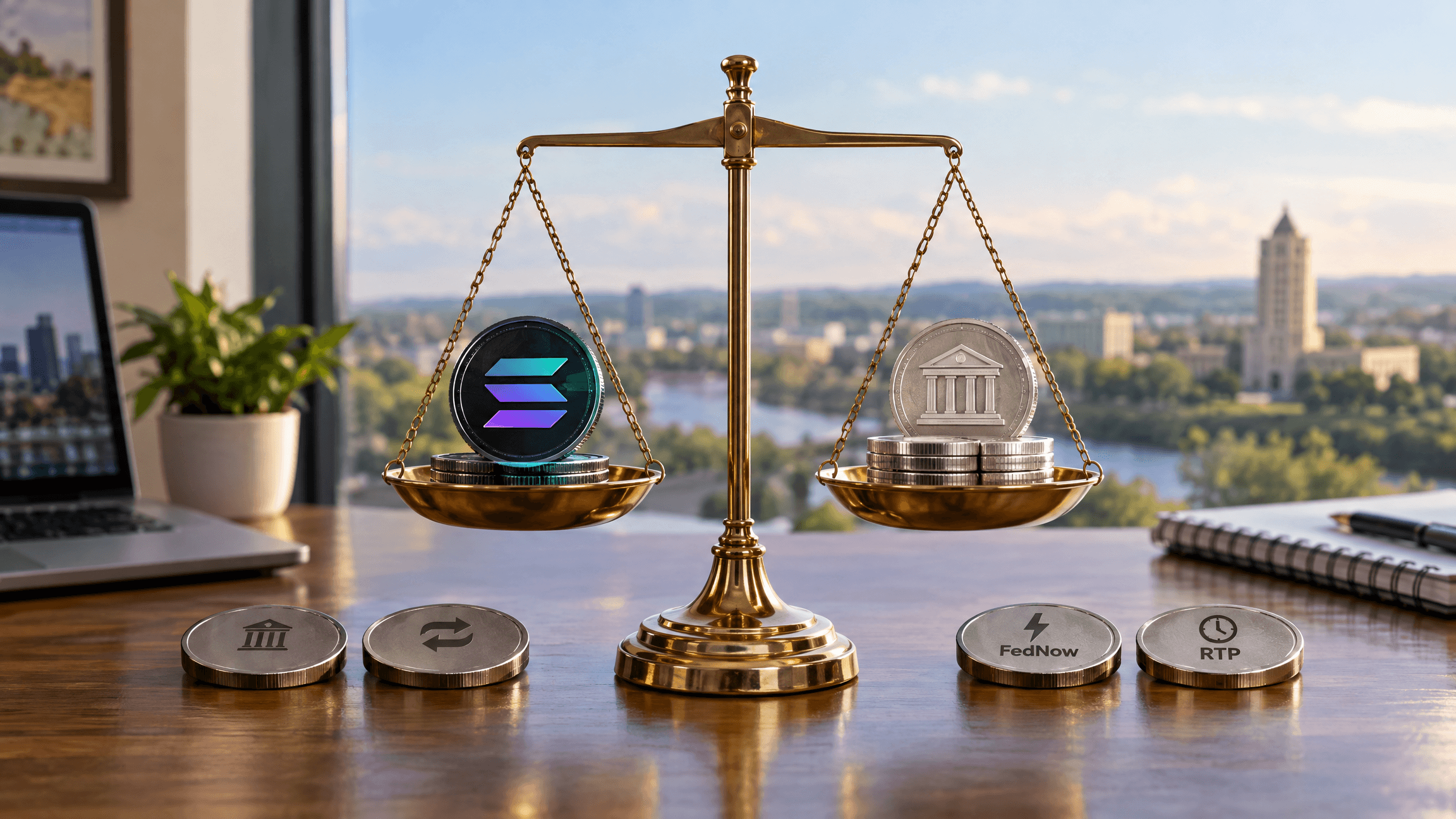
Roughrider enters a market where instant payments already exist.
| Rail | Availability | Settlement model | Main qualification |
|---|---|---|---|
| ACH | Scheduled business-day windows, including Same Day ACH | Batch processing | Returns and other rules depend on payment type |
| Fedwire | Extended operating hours on funds-transfer business days | Real-time gross settlement in central-bank money | Bank customer cutoffs can be earlier |
| FedNow | 24/7 | Real-time interbank settlement | Institution participation and enabled services matter |
| RTP | 24/7 | Prefunded real-time settlement | Final and irrevocable; return requests are separate |
| Roughrider | Designed for 24/7 token transfers | Solana token leg plus bank-account netting | Complete legal finality and production performance need disclosure |
Nacha confirms that ACH includes same-day processing. Federal Reserve materials describe Fedwire’s operating hours and FedNow’s continuous availability. The Clearing House describes RTP settlement as final and irrevocable.
The competitive case therefore needs more than speed. It needs convenient integration, suitable controls, dependable liquidity and lower total operating costs for a particular workflow.
BND’s approximately one-cent figure is a positioning estimate, not independently measured all-in pricing. A fair comparison includes platform charges, wallet services, compliance, funding and exception handling. End-to-end completion time matters more to a treasury team than blockchain speed considered alone.
What happened to FIUSD?
Fiserv announced FIUSD in June 2025. Its current product page markets a fully reserved digital dollar and banking integrations.
However, the reviewed materials do not establish a verified circulating FIUSD supply, official production mint or live Roughrider–FIUSD interoperability. A product page cannot substitute for those deployment details.
Roughrider’s confirmed production status should stand on its own. Calling it a white-label FIUSD implementation would require explicit confirmation. Likewise, platform support for cards, cross-border payments and programmable commerce does not establish that every advertised use case is operating with clients.
Fiserv’s distribution matters—but it is not adoption
Fiserv’s June 2025 announcement cited relationships with approximately 10,000 financial institutions and a broader network processing 90 billion transactions annually. Those are historical corporate-footprint figures, not Roughrider customer or Solana transaction counts.
The opportunity is repeatability. If onboarding, controls, accounting and exception handling can be packaged effectively, subsequent deployments may require less institution-by-institution work.
The constraint is that different banks have different contracts, liquidity arrangements and customer needs. Software distribution can open a door; it cannot establish that the new rail is the best choice for every payment.
I would watch completed integrations and recurring transactions before treating the wider client base as a rollout pipeline.
Does this create meaningful demand for SOL?
Solana transactions require network fees paid in SOL. The unresolved question is who pays those fees for Roughrider. The reviewed disclosures do not establish bank SOL holdings, fee-payer addresses or whether infrastructure providers handle gas centrally.
Payment value and network revenue measure different things. A large dollar transfer need not cost proportionally more than a small one. One bank payment may also involve several on-chain instructions or transactions.
A defensible fee calculation would identify attributable transactions and sum their actual fees. Multiplying payment dollars by a guessed fee percentage would not measure Solana’s economics.
DefiLlama’s Solana dashboard, reviewed October 2, displayed approximately $16.282 billion in stablecoin market capitalization and 43.95% USDC dominance. It does not establish Roughrider’s supply or market share.
The deployment could be strategically significant while generating modest direct fees. It gives infrastructure providers a production example to evaluate; it does not guarantee SOL appreciation. Our on-chain analytics directory is useful background for separating supply, activity and fee metrics.

What would prove adoption over the next 90 days?
I would prioritize five measurements: repeat active institutions, genuine payment value, end-to-end completion times, fully allocated cost and operational exceptions.
The denominator matters. Ten active institutions out of ten onboarded means something different from ten out of ninety. Transfers among service wallets must also be distinguished from customer-driven interbank payments. Multiple token accounts do not necessarily represent multiple banks.
Three outcomes remain plausible without assigning probabilities. Roughrider could become routine infrastructure with growing repeat use. It could serve a valuable but narrow treasury niche. Or technical availability could outrun demand while institutions prefer existing rails.
BND’s October 5 press conference and October 7 panel are opportunities to clarify onboarding, first transactions, reserves, legal finality and outage procedures. Until those answers arrive, undocumented fallback arrangements should remain questions rather than assumed safeguards.
My conclusion is that the launch makes public-blockchain banking more concrete. The next evidence should show whether institutions choose the rail repeatedly, reconcile it reliably and gain a measurable benefit. That is the point where an infrastructure announcement becomes an adoption story.
Frequently asked questions
Can I buy Roughrider Coin?
No. The disclosed program restricts access to financial institutions. Similarly named public tokens are not authenticated by their names.
Do participating banks need to run Solana nodes?
BND describes a service that avoids requiring institutions to build or manage blockchain infrastructure. No bank-validator requirement is established in the reviewed materials.
Is Roughrider a bank deposit or a stablecoin?
The partners use different terminology. Product-specific legal terms are needed to establish the holder’s precise claim and insurance treatment.
Have all 90-plus institutions used it?
That has not been disclosed. Participation, onboarding and active sending are different measurements.
Sources and methodology: Research reviewed October 2, 2026. Launch facts come from Fiserv and VersaBank; operational descriptions are attributed to BND. Regulatory proposals are identified as proposals. No authenticated mint, complete transaction dataset, reserve attestation or participant contract was available in the sources reviewed. Analysis is distinguished from reported performance.
For further research, explore the CryptoLinks homepage and resource categories or follow the CryptoLinks news blog.