
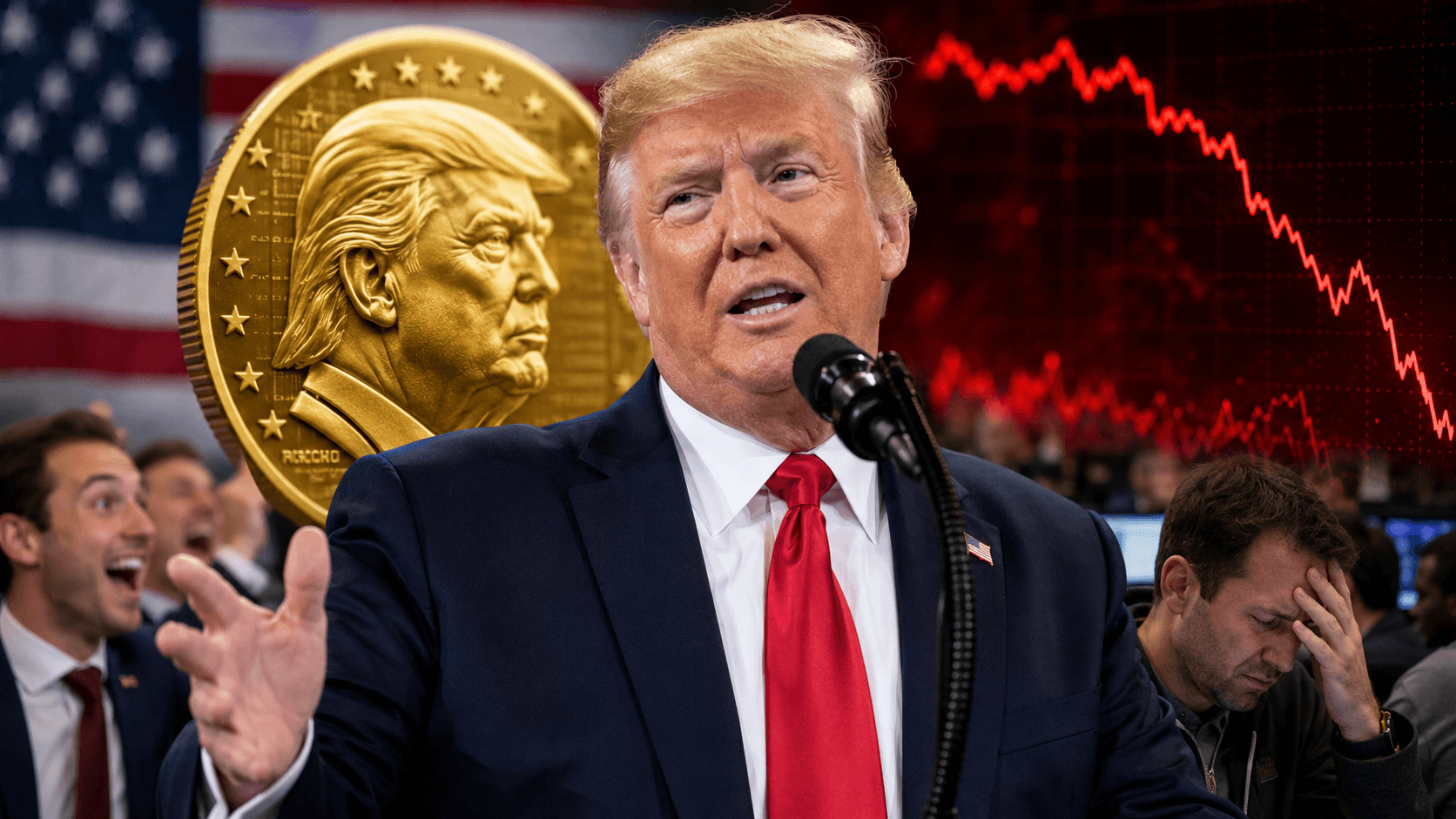
President Donald Trump said he has become a “big crypto guy” while answering a question about whether Bitcoin could ever be added to Trump Accounts. At nearly the same time, Nansen data first reported by The New York Times and summarized by CoinDesk and The Block showed that 988,905 wallets that bought Official Trump, or $TRUMP, were down a combined $3.81 billion through the end of June. Another 492,285 wallets were reportedly up $4.04 billion. The important detail is that these are wallets, not necessarily unique people.
Key Takeaways
- Trump called himself a crypto supporter, but he did not announce that Bitcoin is being added to Trump Accounts.
- Nansen data reportedly shows 988,905 $TRUMP-buying wallets down $3.81 billion.
- 492,285 wallets were reportedly up $4.04 billion, with gains concentrated among early buyers.
- Trump-linked disclosures and reporting show hundreds of millions in memecoin-related income, but that is separate from buyer profit and loss.
- The biggest lesson is not simply that memecoins are volatile. It is that political attention can create liquidity, but late buyers can also become exit liquidity.

Current $TRUMP Data Snapshot
Market snapshot time: July 7, 2026, 13:30 UTC. Crypto prices move quickly, so readers should recheck the live market before making any decision.
| Metric | Snapshot | Source |
|---|---|---|
| Token name | Official Trump / TRUMP | CoinGecko, CoinMarketCap |
| Price | CoinGecko: about $1.66; CoinMarketCap: about $1.67; DexScreener Orca/SOL pool: about $1.65 | CoinGecko, CoinMarketCap, DexScreener |
| Market cap | CoinGecko: about $394.2M; CoinMarketCap: about $395.9M; DexScreener: about $391.7M | CoinGecko, CoinMarketCap, DexScreener |
| Fully diluted valuation | About $1.65B–$1.66B | CoinGecko, CoinMarketCap, DexScreener |
| Circulating supply | About 237.4M TRUMP | CoinGecko, CoinMarketCap |
| Max / total supply | About 1B TRUMP | CoinGecko, CoinMarketCap |
| 24h volume | CoinGecko: about $69.1M; CoinMarketCap: about $254.4M | CoinGecko, CoinMarketCap |
| All-time high | CoinGecko: $73.43; CoinMarketCap: $75.35, both listed for Jan. 19, 2025 | CoinGecko, CoinMarketCap |
| Approximate decline from ATH | About 97.7%–97.8% below ATH, depending on tracker | Calculated from CoinGecko/CoinMarketCap snapshot prices |
| Official Solana mint address | 6p6xgHyF7AeE6TZkSmFsko444wqoP15icUSqi2jfGiPN |
Solscan, CoinGecko |
| Current holders | CoinMarketCap showed about 647.18K holders | CoinMarketCap |
What Trump Actually Said About Crypto
The first thing I would separate is Trump’s crypto policy stance from the trading outcome of the $TRUMP token. The two are politically connected, but they are not the same thing.
Trump was asked whether Bitcoin or crypto could be included in Trump Accounts. He responded that “something could happen” and described himself as a “big crypto guy,” explaining his crypto stance partly through U.S. competition with China. That is a pro-crypto comment, but it was not an official Bitcoin allocation, not a confirmed investment change and not a formal announcement that Trump Accounts will hold crypto. The quote and context were reported by Bitcoin Magazine and BeInCrypto.
The official Trump Accounts website currently describes tax-advantaged accounts for eligible U.S. children, including a $1,000 Treasury contribution for children born from Jan. 1, 2025 through Dec. 31, 2028. The government page says children’s funds will be invested in American companies. It does not confirm a Bitcoin or crypto component.
That distinction matters. A president being publicly pro-crypto may help the broader policy environment for Bitcoin, stablecoins and market-structure legislation. It does not automatically make a political memecoin a good investment.
The $3.81B Loss Figure: What Nansen Data Reportedly Shows
The reported $3.81 billion loss figure comes from wallet-level blockchain analytics attributed to Nansen. According to CoinDesk and The Block, the analysis covered about 1.48 million wallets that bought $TRUMP and found that 988,905 wallets were down by a combined $3.81 billion through the end of June 2026. The same reporting said 492,285 wallets were in profit by a combined $4.04 billion.
A realized loss happens when a wallet sells for less than it paid. A paper loss happens when a wallet still holds the token but the current value is below its purchase cost.
That sounds simple, but the methodology has limits. A wallet is not automatically a person. One trader can use multiple wallets. Some wallets may be bots, exchange-related wallets, market-making wallets or institutional accounts. Some centralized-exchange activity may not be fully visible in public on-chain data. The analysis is still useful, but it should not be described as “nearly one million people” unless that is independently proven.
Why “Nearly 1 Million Wallets” Does Not Mean 1 Million Unique People
I would be careful with the phrase “nearly one million investors lost money.” The more precise wording is that nearly 989,000 wallets were reportedly down.
That is still a major signal. It means a very large number of buying accounts entered at prices above their sale price or current marked value. But it does not prove exactly how many human buyers lost money, whether each wallet belongs to a retail trader or whether every loss is already final.
This is one of the biggest misunderstandings in memecoin coverage. Blockchain data can show wallet-level behavior better than almost any traditional market, but it cannot automatically identify human intent, off-chain ownership or every centralized-exchange trade.

$TRUMP Winners and Losers: The Numbers Side by Side
| Group | Wallet count | Combined result | What it means | What it does not prove |
|---|---|---|---|---|
| Losing wallets | 988,905 | -$3.81B | Many buyers entered above current or exit prices | Not necessarily 988,905 unique people |
| Winning wallets | 492,285 | +$4.04B | Gains were concentrated among earlier or better-timed wallets | Not automatically insiders |
| All analyzed wallets | About 1.48M | About +$230M to +$236M net | Wallet gains and losses nearly offset at the trader level | Does not include issuer revenue |
The arithmetic is important: $4.04 billion in gains minus $3.81 billion in losses equals roughly $230 million to $236 million net across analyzed wallets, depending on rounding. That does not make the story positive for late buyers. It shows that the market produced a very uneven distribution.
What stands out to me is not only the size of the losses, but the timing gap between early buyers and everyone else.
How Early Buyers Captured Most of the Upside
Memecoins are timing markets before they are utility markets. $TRUMP launched with enormous political attention, instant media coverage and a clear brand identity. That combination can create violent early demand.
Early buyers who entered before peak hype had the chance to sell into later buyers. Later buyers often entered after the price had already accelerated, when the risk/reward had changed completely. In that environment, a large market cap does not necessarily mean durable demand. It can simply mean that the last marginal buyer is paying a high price for a thin or emotionally driven market.
This is why I always separate attention from value. Attention can create liquidity. It can also become the mechanism that transfers gains from late entrants to early entrants.
Readers who want the broader mechanics should review how meme coins work and how meme coin launch platforms can amplify viral speculation.

Trump-Linked Crypto Income Is Separate From Buyer P&L
The Block reported that Trump’s annual financial disclosure showed a $636 million payout tied to the $TRUMP token and more than $1.4 billion in total crypto-related income for 2025. AP reported that Trump’s filing showed about $1.2 billion from crypto businesses last year, including more than $500 million from World Liberty Financial and about $600 million from CIC Digital LLC’s Trump-themed meme coin activity. These figures should be treated as reported disclosure-related categories, not as buyer trading profit and loss.
The part many headlines miss is that issuer income and buyer P&L are different accounting categories.
| Category | Meaning |
|---|---|
| Royalties / licensing income | Revenue connected to brand, licensing or rights arrangements, depending on the disclosure category. |
| Token sales | Income from selling tokens or token-linked interests. |
| Transaction fees | Revenue generated from trading activity, if the token structure routes fees to a project-linked party. |
| Unrealized token holdings | Tokens still held by an entity, valued on paper but not necessarily sold. |
| Buyer realized losses | Losses locked in when a wallet sells below its cost basis. |
| Buyer paper losses | Losses on still-held tokens whose market value is below the purchase cost. |
| Market cap decline | The fall in total token valuation from peak to current price. This is not the same as realized losses. |
| Net trader P&L | Gains minus losses across analyzed wallets. This excludes issuer-linked income unless specifically included by the methodology. |
Buyer P&L measures what wallets gained or lost by buying, selling or holding the token. Issuer-linked income may involve token sales, licensing, royalties, transaction fees, business interests or other disclosure categories. These can be politically and ethically connected, but they should not be merged into one number.
That is why this story is uncomfortable even without making legal claims. Many wallets lost money. Early wallets made money. Trump-linked entities reportedly generated large crypto income. Those facts can sit next to each other without proving intent, fraud or a specific legal violation.
Why Political Memecoins Create Extreme Asymmetric Risk
Political memecoins add a layer of identity to an already speculative market. Buyers may confuse support for a person, party or movement with investment value. That is dangerous.
A token can have a powerful brand and still have weak long-term demand. It can have a famous name and still have unlock risk. It can trade billions in volume and still lack sustainable utility. High volume can represent churn, not adoption.
Before buying any political token, I would check:
- Verify the exact contract address.
- Check circulating supply and fully diluted valuation.
- Check top-holder concentration.
- Check unlock schedules.
- Check whether issuer-linked wallets can sell.
- Check real liquidity and market depth.
- Check whether the token has utility beyond branding.
- Check whether revenue flows to holders or mainly to issuer-linked entities.
- Avoid buying immediately after viral political headlines.
- Treat celebrity or political branding as marketing, not a valuation model.
CryptoLinks also maintains resources on common crypto scam warning signs, blockchain explorers, token security scanners, on-chain analytics tools and decentralized exchanges, all of which are useful before touching fast-moving tokens.

What the $TRUMP Crash Says About Attention-Driven Markets
$TRUMP is a clean example of how attention can create asymmetric outcomes. The token did not need deep utility to attract buyers. It needed attention, liquidity and a clear narrative. For early buyers, that was enough. For late buyers, it may have been the trap.
This does not mean every losing buyer was naive. It also does not mean every winning wallet was an insider. The available data does not prove that. But it does show how brutal the timing curve can be when a political asset trades more like a viral product than a fundamental network.
WLFI Adds Another Layer to the Trump Crypto Story
World Liberty Financial, or WLFI, is a separate project from $TRUMP and should not be merged into the same loss calculation. CoinDesk and The Block reported that Nansen tracked 26,663 secondary-market WLFI wallets, with 22,715 underwater, about $83 million in losses and about $23 million in gains. They also noted that ICO or primary-sale wallets were excluded from that particular loss analysis.
That matters because WLFI has a different structure, liquidity history and token-transfer profile than $TRUMP. It belongs in the broader Trump crypto discussion, but it should not be used to inflate or confuse the $TRUMP-specific loss figure.
Could Trump’s Crypto Policy Help Bitcoin But Not $TRUMP?
Yes. That is one of the most realistic outcomes.
A pro-crypto president could support Bitcoin policy, stablecoin rules, crypto banking access or market-structure legislation. Those developments could help parts of the crypto industry. But a political memecoin is not the same as Bitcoin, a stablecoin network or a regulated exchange.
Scenario A: Trump’s Crypto Support Lifts Broader Crypto Policy, But Not $TRUMP
Policy support for Bitcoin, stablecoins or market structure does not automatically revive a political memecoin. The broader crypto market can benefit from friendlier regulation while a branded token still suffers from weak demand, poor timing and supply uncertainty.
Scenario B: $TRUMP Becomes a Permanent Political Trading Vehicle
$TRUMP could remain a political trading vehicle if liquidity stays active, exchanges continue supporting it, holders remain engaged and the token keeps reacting to rallies, elections, headlines and public appearances. That would not make it low-risk. It would simply mean the market keeps treating it as a speculative political instrument.
Scenario C: $TRUMP Continues to Fade
The bearish scenario is that buyers separate political support from token value. If volume keeps falling, holder interest weakens and more buyers remain underwater, the token could continue losing relevance even if Trump remains pro-crypto.
None of these scenarios is a price prediction. They are frameworks for thinking about what could happen next.
The Strongest Defense of $TRUMP
The strongest defense is that $TRUMP was an openly speculative memecoin. Supporters can argue that buyers knew, or should have known, that memecoins are volatile, that no one was forced to buy and that early buyers taking profit is normal market behavior.
Supporters may also argue that Trump’s pro-crypto position is good for the industry and that political tokens are a legitimate expression of online culture, community and market demand.
That defense should be taken seriously. Not every bad trade is fraud. Not every collapse is illegal. Not every early seller is an insider.
The Strongest Criticism of $TRUMP
The strongest criticism is that the structure created a huge asymmetry between political attention, issuer-linked income and late-buyer outcomes.
Critics argue that when a sitting president’s brand is tied to a token, normal memecoin risk becomes a political-finance and conflict-of-interest concern. The Block reported that Democrats have pushed ethics provisions around crypto dealings by federal officials and that Sen. Kirsten Gillibrand proposed restrictions on elected officials and spouses issuing or sponsoring tokens.
That is the debate. The data does not prove criminal intent. But it does show why political memecoins are likely to become a major regulatory and ethics issue.

What to Watch Next
Watch the current holder count, volume trend, exchange liquidity, top-holder movement, unlock-related information, issuer-linked wallets and whether $TRUMP continues to react to political headlines. Also watch whether U.S. crypto legislation includes restrictions on tokens connected to elected officials or their families.
For me, the conclusion is simple: political attention is not the same as investment value. $TRUMP proved that attention can create one of the loudest token launches in crypto history. The Nansen-reported wallet data now shows who paid for that attention.
Frequently Asked Questions
Did Trump really say he is a big crypto guy?
Yes. Trump was reported saying he had become a “big crypto guy” while discussing whether crypto could ever be part of Trump Accounts, but he did not announce a confirmed Bitcoin allocation.
What is $TRUMP coin?
$TRUMP, or Official Trump, is a Solana-based memecoin associated with Trump branding. The official Solana mint address to verify is 6p6xgHyF7AeE6TZkSmFsko444wqoP15icUSqi2jfGiPN.
Did nearly 1 million $TRUMP buyers lose money?
Nearly 989,000 wallets were reportedly down, but wallets are not the same as unique people. Some traders may control multiple wallets, and some wallets may represent bots, exchanges or institutions.
What does the $3.81B loss figure include?
The $3.81 billion figure reportedly includes realized and paper losses through the end of June 2026. Realized losses are from selling below cost; paper losses are from still-held tokens marked below purchase cost.
Did all $TRUMP holders lose money?
No. Nansen data reportedly showed 492,285 wallets in profit by a combined $4.04 billion, while 988,905 wallets were down $3.81 billion.
Who made money on $TRUMP coin?
Early or better-timed wallets appear to have captured most of the gains. That does not automatically prove those wallets were insiders.
How much did Trump earn from $TRUMP?
The Block reported that Trump’s financial disclosure showed a $636 million payout tied to the token. AP reported about $600 million from CIC Digital LLC’s Trump-themed meme coin activity. Those reported income figures are separate from buyer trading losses.
Is $TRUMP coin a scam?
Major losses, issuer-linked income and political criticism do not by themselves establish legal fraud. The more precise conclusion is that $TRUMP shows extreme memecoin risk, asymmetric timing and serious political-ethics concerns.
Is $TRUMP connected to World Liberty Financial?
$TRUMP and WLFI are separate Trump-linked crypto projects. They should be analyzed separately because the token structures, trading history and loss calculations are different.
Could Bitcoin be added to Trump Accounts?
It is possible Trump could support that idea later, but no official Bitcoin allocation for Trump Accounts has been confirmed. The official Trump Accounts website currently describes investments in American companies, not crypto.