Solana Memecoin Launches Are Exploding Again: $FERGANI Giveaways, “Stealth” Drops, and the New 48‑Hour Degen Playbook

Are we seriously back in that “blink-and-it’s-up-200%” memecoin market… while the rest of crypto feels half-asleep?
Because that’s exactly what the last couple of days on Solana have felt like. If you’ve been watching new launches, you’ve probably seen $FERGANI sliding into timelines with giveaway-style posts pulling big engagement, and a wave of traders doing the classic “I’ll just grab a quick flip” routine.
And here’s the weird part: this kind of mania usually shows up when the whole market is euphoric. But right now, we’re seeing it pop up inside a dip—which tells me this isn’t about fundamentals or “the next big tech narrative.” It’s about attention, speed, and how Solana makes it frictionless to gamble.
When the market is boring, degens don’t suddenly become investors. They just rotate to the fastest casino.
In this post, I’m going to lay out what’s actually pushing this mini-frenzy, why it’s happening on Solana specifically, and how I think about risk when everyone is yelling “10x before March” like it’s a calendar event.
Listen to this article:

The real pain right now: fast launches, faster hype, and even faster rugs
The hardest part of memecoin trading in 2026 isn’t “finding a token.” Let’s be real—there are endless trackers, alerts, and group chats. The real pain is this:
- You see it after the first pop, because the first pop happens before most people even notice.
- You buy the hype candle, telling yourself you’re “still early.”
- You hesitate on the exit, because the chart is moving too fast to think straight.
- You become exit liquidity for someone who bought 20 minutes earlier with a better entry and zero emotional attachment.
And that’s in the “honest” scenario.
In the uglier scenario, you’re dealing with:
- Liquidity that looks fine… until it isn’t (and price starts teleporting through levels).
- Whale wallets that can nuke the chart in one sell.
- Launch mechanics designed to confuse you (or rush you).
- “Giveaway marketing” that might be organic… or might be manufactured to bait market orders.
That last one matters more than people admit. A giveaway post can look like “community,” but it can also be a carefully timed attention spike meant to create the exact chart shape that triggers apes.
If you’ve traded enough of these, you know the feeling: you’re not even sure what you’re buying anymore—you’re buying momentum that might disappear in minutes.
And this is why I keep repeating one boring truth: speed is not the same thing as edge. Solana just makes it easier for everyone to move fast, including the people setting traps.
Promise solution
I’m not here to pretend there’s a magic “anti-rug” button. There isn’t. But I do have a process—and it’s the only reason I’m willing to touch these launches at all.
I’m going to map out the exact signals I personally watch—on-chain, social, and launch mechanics—to decide whether something is:
- Just noise (a quick spike engineered by attention tricks)
- Actually tradable (enough momentum and structure for a short-term flip)
And I’m also going to talk plainly about what “quick gains” really means in practice, because the internet version of a “2x” is cute. The real version is messy:
- Slippage
- Failed transactions at the worst moment
- Spreads widening when everyone panics
- That one red candle that erases three hours of green in 30 seconds
I’ll also cover what can go wrong in minutes, not days—because Solana memes don’t usually “fade slowly.” They snap.
Who this is for (and who should skip it)
This is for you if you’re in one of these buckets:
- Solana traders hunting early entries and trying to stop being the last buyer in the chain.
- Airdrop/giveaway hunters who want to understand how engagement turns into price action (and when it doesn’t).
- Anyone trying to understand why “degenerate” money rotates into meme launches during dips, when you’d expect everyone to be cautious.
You should probably skip this if you’re looking for:
- Safe long-term investing ideas
- “Set it and forget it” plays
- Anything where a -70% candle won’t ruin your week
Memecoin launches are not where disciplined investing gets rewarded. This is a different game: short attention cycles, fast liquidity shifts, and narratives that live or die on social feeds.
Quick context: what makes Solana memecoin launches different in 2026
Solana is basically built for this behavior:
- Low fees, so people can spam entries/exits without feeling every click in their wallet.
- Fast confirmations, so charts move like a live wire and traders get addicted to the instant feedback loop.
- A mature launch + LP culture, meaning there’s a well-worn path from “token appears” to “everyone is trading it.”
That combination is great for momentum… and perfect for traps.
If you want a simple mental model, I think about it like this: Solana doesn’t just make trading cheaper—it makes coordination cheaper. It’s easier for communities to rally fast, and it’s also easier for bad actors to manufacture the appearance of a rally.
And that brings me to the part most people ignore: attention is a measurable edge in markets like this.
There’s a long history in market research showing that retail attention can move prices, especially in hype-driven assets. Even outside crypto, studies like Da, Engelberg, and Gao’s work on attention using search trends helped popularize the idea that when attention spikes, price behavior changes. Crypto is basically that concept on fast-forward, with social engagement acting like a trigger.
So when you see a memecoin getting hammered with replies, reposts, quote-tweets, and “who’s still early?” spam, it’s not just noise. It’s often the fuel. The problem is that fuel can power a run… or blow up the engine.
So what actually happened in the last 48 hours that made $FERGANI-style launches feel “back” again? Was it real demand, coordinated hype, or just Solana’s meme machine doing what it always does when traders get bored?
Next, I’m going to lay out the exact pattern I’ve been watching—how “stealth” drops and giveaway virality combine into a predictable attention spike—and the specific signals that tend to show up right before degens ape.

In the last 48 hours, I watched the same Solana memecoin pattern play out so cleanly it almost felt scripted.
A ticker shows up with that “where did this come from?” energy. Early posts look casual (sometimes intentionally). Then a giveaway-style push hits X. Engagement spikes. Chart-watchers notice the volume. And suddenly you’ve got a full-blown degenerate rotation—not because anyone discovered “fundamentals,” but because attention found a new slot machine.
$FERGANI is a good example of how fast this loop can complete when the social layer and the on-chain layer sync up at the same time. If you want to see the style of posts that tend to light the match, look at these threads and “raid-shaped” posts:
- cryptofergani post
- pogapulse post
- craigsather post
- memecoin_king92 post #1
- memecoin_king92 post #2
- Meme_WoIf post
- memebullishups post
What matters isn’t the exact wording—it’s the shape of the engagement: fast replies, lots of “I’m in” signals, repeated catchphrases, and the sense that something is happening right now. That’s the stealth-launch effect in practice: it creates the feeling you’re still early… even when you’re not.
The hidden engine here is attention. Price follows attention, then attention follows price, and the loop feeds itself until it breaks.
This isn’t just “crypto bro theory,” either. In traditional markets, research like Barber & Odean’s work on attention-driven buying has shown that retail participants often buy what grabs their attention (news, unusual volume, hype) rather than what’s objectively “best.” Crypto memecoins compress that same behavior into hours.
Why giveaways still work (even when everyone knows the game)
Giveaways are not about the prize. They’re about manufacturing speed.
Here’s the mechanic as I see it:
- Retweets/comments create instant social proof.
- Social proof creates “I’m late” anxiety.
- That anxiety turns into market buys because nobody wants to miss the candle.
Even if everyone “knows” the giveaway is marketing, it still works because traders aren’t treating it like free money—they treat it like a momentum signal. A giveaway post that pulls real engagement fast is basically a giant blinking sign that says: “eyes are here.”
And the first 6–24 hours are where this matters most. That’s when:
- the narrative is still fresh (people are repeating the same joke, the same tagline),
- early buyers still have conviction,
- and the chart hasn’t disappointed anyone yet.
There’s also a psychology angle: giveaways trigger a “participation reflex.” People comment not because they’ve researched the token, but because it’s easy, public, and feels like getting in the room early. That public participation becomes the ad.
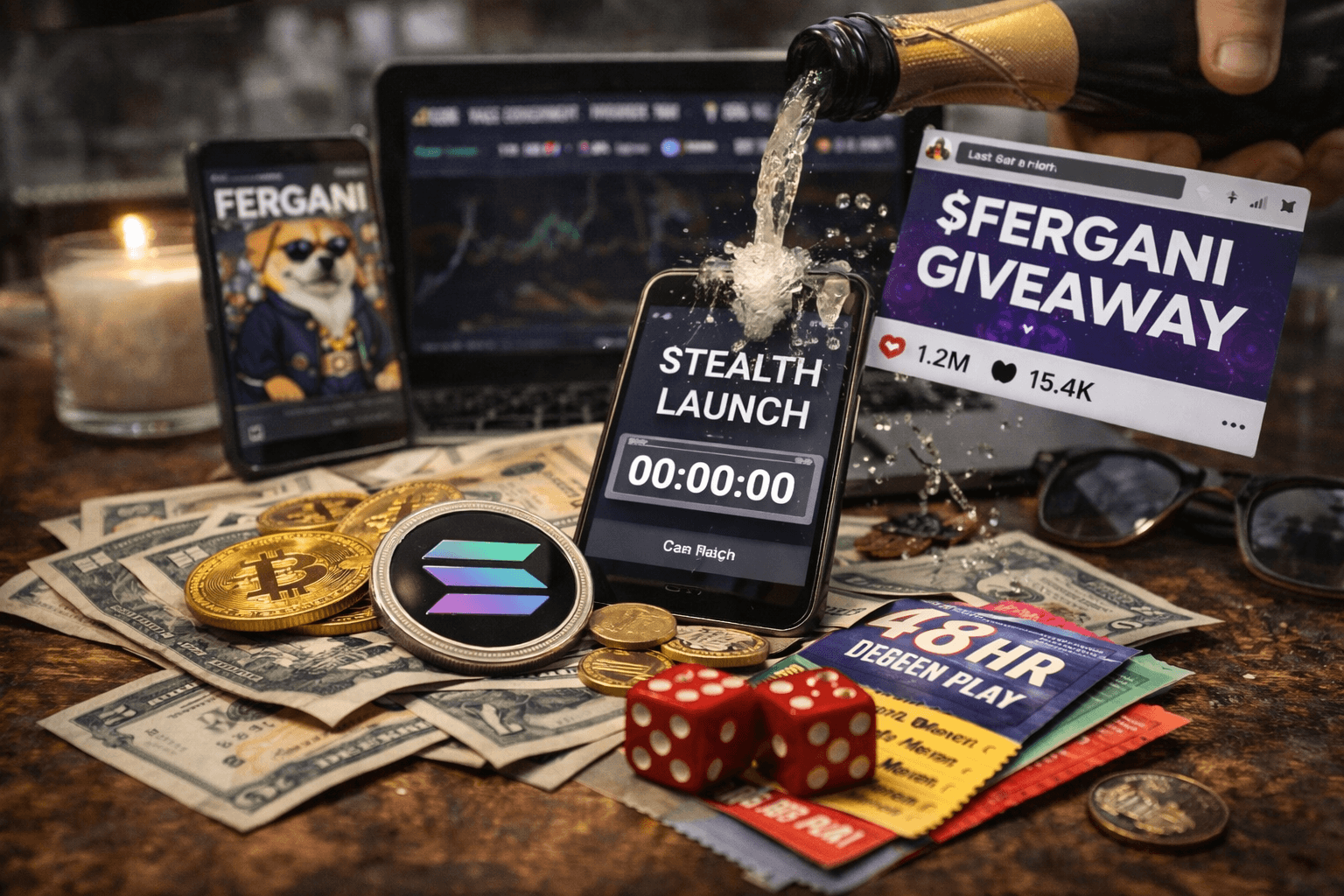
The triggers behind the frenzy: 7 signals degens chase before they ape
When I see a Solana memecoin start running off “stealth + giveaways,” I don’t ask, “Is it a good project?” I ask, “Is this a tradable attention event?”
These are the seven “green lights” I notice degens reacting to (often without admitting it):
- 1) Stealth launch timing + early distribution vibes If it feels like nobody “big” has shilled it yet, people assume upside remains. The best stealth launches look organic at first—quiet posts, light branding, minimal overproduction.
- 2) Early liquidity shape (and whether it looks fragile) Traders watch whether buys move price too easily (thin liquidity) and whether sells crater the chart (also thin liquidity). Ironically, thin liquidity can attract degens because it enables violent upside—until it enables violent downside.
- 3) Volume bursts that don’t instantly fade The “tell” is when volume spikes… then keeps showing up in waves instead of going flat after the first pump. That’s usually the difference between a one-candle wonder and a multi-hour runner.
- 4) Holder growth vs. whale concentration Degen brains love seeing holder count rise fast, but the smarter ones also look at concentration. A chart can look bullish while a few wallets hold the real power to end the party in one sell.
- 5) Fast meme propagation When I see the same joke repeated across different accounts (not just copied text—same idea), that’s narrative spread. Memecoins are basically story tokens, and story velocity matters.
- 6) Influencer echo without obvious coordination If multiple mid-sized accounts mention it without identical phrasing, it reads as “real discovery.” If the posts look templated, traders start whispering “bundle” and “manufactured.”
- 7) “Community doing work” vs. botted spam Real communities reply like humans. Botted ones look like a wall of generic hype. The scary part is that early on, both can pump price—so I treat “community” as a risk factor unless it’s clearly authentic.
If you want the honest truth: a lot of people pretend they’re trading charts, but they’re really trading crowd behavior. And crowd behavior shows up on X before it shows up on candlesticks.
People also ask (and I’ll answer directly)
Are Solana memecoins pumping again in 2026?
Yes—at least in short bursts. What I’m seeing isn’t “everything pumps,” it’s micro-seasons: a few tickers get most of the attention, then capital rotates fast. The $FERGANI-style surge is consistent with that “48-hour pocket” behavior.
What does “stealth launch” mean in crypto?
A stealth launch usually means the token launches with minimal pre-marketing, often without big influencer lead-up. In memecoin land, “stealth” is also a vibe: it’s designed to make buyers feel like they found it before the crowd.
Do X giveaways actually move token price?
They can, because they spike visibility and engagement, and engagement is a proxy for attention. There’s a real-world parallel here: studies in market behavior have repeatedly shown that attention shocks can influence short-term buying decisions (again, Barber & Odean is the classic reference point for attention-driven buys). In crypto, the effect can be even more exaggerated because friction is low and reaction time is everything.
How do I find new Solana memecoin launches early?
Practically, most traders combine: (1) watching X for repeated tickers, (2) tracking on-chain activity/volume changes, and (3) monitoring launch platforms/DEX activity. The “early” part usually comes from noticing a ticker before the giveaway posts go fully viral.
What’s the safest way to trade memecoin launches?
“Safest” is relative. The safest approach I know is to treat it like a high-volatility scalp: small sizing, planned exits, and zero tolerance for sketchy liquidity behavior. If you need certainty, this arena won’t give it to you.
Can memecoins really do 10x in days—and how often does that happen?
It can happen, yes. “How often” depends on market temperature. In choppy conditions, 10x moves tend to be rarer but still possible, and they usually require sustained attention (not one viral post). Most runs don’t do 10x—they do a fast pump, then messy chop, then bleed.
How do I avoid rugs and fake “community” tokens?
You reduce risk, you don’t eliminate it. I look for warning signs like fragile liquidity, suspicious wallet concentration, weird sell behavior, and engagement that looks botted or templated. If the whole “community” appears in 30 minutes and talks like clones, I assume it’s rented.
My “quick gains” framework: how I think about 2x vs 10x without lying to myself
When people say “quick gains,” they usually picture the outlier. I bucket these launches into three outcomes and I try to trade the middle, not the fantasy.
1) The common outcome: small pump → messy chop → slow bleed
This is the default. The token gets attention, early buyers take profit, late buyers try to “hold for the next leg,” and the chart slowly leaks as attention moves on.
What kills it: thin liquidity, no second wave of buyers, whales distributing into every bounce, or the meme never escaping the first circle.
2) The tradable outcome: momentum waves you can actually exit
This is where I’m most interested. You get multiple pushes, some pullbacks, and enough liquidity/volume to take partials without getting wrecked by slippage.
What has to be true: repeated attention bursts (not just one), holder count rising without extreme concentration, and X chatter staying “alive” for more than a single hour.
3) The outlier outcome: real 10x+ moves
These happen when the meme breaks containment and becomes the day’s obsession. Not “a coin people are buying,” but the coin people are talking about.
What has to be true: sustained narrative propagation, visible community output (memes, replies, raids) that feels human, and enough liquidity depth that big buyers can enter without instantly nuking the chart structure.
I’ll say it bluntly: most traders get hurt because they manage a common outcome as if it’s an outlier outcome.
Practical playbook: if I were trading this kind of launch today
This is not financial advice—just the process I use to avoid doing the usual degen self-sabotage.
- How I set entries (no chasing vertical candles)If the candle is vertical and X is screaming, I assume I’m late. I’d rather miss a move than become the liquidity for someone exiting. I look for a pullback that holds, or a consolidation that proves there are real buyers beyond the first hype click.
- How I size positions like it can go to zeroI size small enough that I can think clearly. If my heart rate changes, my size is too big. Memecoin trades punish emotional sizing.
- Where I take partial profits (and why)I like taking partials into strength because it turns the trade from “hope” into “managed.” In this game, getting paid early is how you earn the right to hold a moon bag.
- What invalidates the trade immediatelySudden liquidity weirdness, aggressive dumps that erase structure fast, or social engagement that flips from “hype” to “confusion.” The moment the crowd starts asking “why is it dumping?” I assume the best part is over.
- How I avoid getting emotionally stuck in a memeI remind myself that memes are designed to be sticky. They make you feel like selling is betrayal. That’s a trap. I prefer rules over loyalty.
If you want to understand why these Solana memecoin launches move so violently, stop staring at the chart for a minute and watch the social proof assembly line on X.
In the posts I linked above, you’ll notice familiar ingredients:
- Giveaway hooks that force interaction (comments/retweets)
- Raid energy (rapid reply chains, “run it up” language)
- Repetition (same punchlines across different accounts)
- Implicit urgency (“now,” “next,” “don’t fade”)
That mix creates the illusion of inevitability. And once enough people believe the move is inevitable, they buy in a way that briefly makes it true.
But here’s the question I want you to keep in your head as you read on: when a memecoin run is powered by attention mechanics, what happens when attention rotates away—especially heading into March 2026?
I’m going to answer that next, and it’s the part most traders avoid thinking about until it’s too late.
What this means going into March 2026: opportunity, rotation, and the part nobody wants to hear about risk
When memecoin launches heat up during a dip, I pay attention for a different reason than “number go up.” It usually means one of two things:
- A real risk-on pocket is forming inside the market (even if majors look dead), and traders are willing to pay up for volatility again.
- Everything else feels slow, so liquidity starts hunting the most emotional charts because it’s the only place you can still get a quick adrenaline hit.
Both can be true at the same time. And that’s why this is tricky: a hot launch cycle can be the first sign of broader appetite returning… or it can be a short-lived attention spike that burns everyone who confuses “engagement” with “support.”
One thing that’s been consistent for years (and it’s even more true now that attention moves at lightspeed) is that attention itself moves price in the short term. That’s not a meme-trader theory — it’s backed by old-school market research. Barber & Odean’s well-known paper “All That Glitters” showed that individual investors are more likely to buy what grabs attention, because attention acts like a filter for what to purchase in a massive universe of assets. That’s equities, but the logic is even cleaner in memecoins where “story” is basically the product.
So going into March 2026, I’m watching whether this is the start of a sustained rotation… or just a quick burst where the same money churns in and out of one chart and leaves a crater behind.
If you’re chasing “10x flips,” here’s what to watch next (without guessing)
I don’t try to predict which ticker becomes the next monster. I watch the ecosystem signals that tell me whether the environment can even support a run of winners.
Here’s the forward-looking checklist I’m watching over the next 1–2 weeks:
- Do new launches keep getting traction… or was it a one-off moment?If it’s real rotation, you’ll see multiple fresh tokens catch bids, hold volume for longer than a single frenzy window, and keep new buyers showing up even after the first hype wave cools.
- Does volume sustain across multiple tokens (real rotation), or concentrate into one chart?In a true “mini season,” attention doesn’t just spike — it travels. You’ll notice traders taking profits from one runner and immediately deploying into the next launch with similar momentum. If volume only lives in one place, it’s usually closer to a one-time stampede.
- Is liquidity depth improving… or staying paper-thin?This is the unsexy one that decides whether March is tradable or suicidal. When depth improves, dumps become sell-offs instead of cliffs. When depth stays thin, every candle is basically a negotiation with chaos.Practical “real life” sample: if a token can drop 20–30% from a single medium-sized market sell, it’s not a “community coin,” it’s a liquidity experiment.
- Do bigger accounts keep engaging after the first wave?Not just one quote tweet. I’m looking for repeat engagement: ongoing replies, meme production, and consistent activity once the easy engagement is gone. If the big voices vanish right after the first vertical move, that’s usually a tell.
- Do “losers” die quickly, or do they base and attempt a second run?In healthier conditions, even failed breakouts often form a base and attempt a reclaim. In weaker conditions, they just bleed out and never come back. That difference matters because it signals whether there’s any real bid under the casino.
If you want a simple way to think about it: I’m not hunting the next winner — I’m checking if the table is still open.
The downside checklist: how degens actually get wiped in this exact setup
I’ve watched the same wipeout stories repeat for years, and they’re always more avoidable than people want to admit. Here are the most common ways this specific “giveaway + stealth vibe + fast chart” setup deletes traders:
- Buying the top right after a giveaway-driven candleGiveaway posts create urgency. Urgency creates market orders. Market orders create ugly entries. Most people don’t lose because the token “was a scam.” They lose because they paid the worst price in the entire move.
- Holding through liquidity removal or sudden dumps because “it’ll bounce”On Solana, things can go from “healthy” to “no exit” fast. If you’re still thinking in terms of slow-market rules (“I’ll just wait for confirmation”), memecoins will punish you.
- Getting trapped by fake community engagementReplies are cheap. Raids are cheap. Bot activity is cheaper than ever. A comment section that looks alive can still be a ghost town financially.And yes, attention matters — but manufactured attention creates a different kind of chart: it pumps fast, then collapses the moment the campaign stops feeding it.
- Over-sizing because “it’s Solana, I’ll be quick”This one is brutal. People size up because they believe they’ll react fast. Then the chart moves 40% in a minute, they hesitate for ten seconds, and the exit is gone.
- Not respecting that memes can go -70% in an hourThat’s not exaggeration. In thin-liquidity conditions, it’s normal. If a -70% candle would emotionally wreck you, your position size was wrong before you clicked buy.
My rule: if I’m not comfortable watching it drop 50–70% without making a stupid decision, I’m too big.
Also, don’t ignore the psychology trap that studies have been pointing at for ages: when something captures attention, people chase it. That can push price up short-term… and it also increases the chance you’re buying what everyone already noticed. In equity markets, attention-driven buying is a documented behavior; in memecoins, it’s basically the whole game.
So what do I do with this info?
I’m treating the current Solana memecoin heat as a tradable environment, not a promise. The upside is real when rotation is real. But the risk is just as real, and it shows up faster than most people can react.
Here’s the simple action list I keep for the next time this “stealth + giveaways” combo starts trending:
- Track whether rotation continues (multiple tokens sustaining volume) instead of marrying one chart.
- Refuse bad entries. If the candle is vertical and you feel late, you probably are.
- Assume liquidity is fragile until proven otherwise. Plan exits like the door might shrink.
- Take profits like an adult. If you’re up fast, paying yourself isn’t “paper-handing,” it’s survival.
- Size like it can go to zero, because sometimes it basically does.
- Respect the attention cycle: when the crowd moves on, your chart can die even if nothing “bad” happened.
The big takeaway going into March 2026 is simple: memecoin virality on Solana can still create violent upside when attention flips on — but the edge isn’t “getting lucky once.” It’s having a repeatable process, staying nimble, and making sure one bad candle doesn’t erase your month.