US Senate’s New Crypto Bill Just Dropped: End of Regulatory Chaos… or a Perfect Bull Trap?

Is this the moment the U.S. finally gives crypto a real rulebook—or are we about to watch the market pump on a political headline and then get rug-pulled by the fine print?
I’ve seen this movie before: a “big” Washington announcement hits, prices react, influencers scream “clarity is here,” and then everyone realizes the text either (1) doesn’t do what people think, or (2) takes so long to matter that traders get chopped up in the meantime.
So I’m going to write this the same way I review crypto sites and tools on Cryptolinks: practical, skeptical, and obsessed with what actually changes your risk.

The pain: “Regulatory clarity” has been a slogan, not a reality
If you’ve been in crypto longer than a single cycle, you already know the U.S. regulatory vibe hasn’t been “clear.” It’s been… fragmented. A patchwork where different agencies (and states) can look at the same token or product and see completely different things.
Here’s why it has felt chaotic:
- SEC vs CFTC turf battles — One side leans “most tokens are securities,” the other often treats major digital assets like commodities. Same market, two playbooks.
- State-by-state licensing headaches — Even if you’re trying to be compliant, you can end up navigating money transmitter rules that feel like 50 separate mini-regimes.
- Enforcement-first headlines — Instead of “here are the rules,” the market often gets “here’s the lawsuit,” and everyone has to reverse-engineer what the government thinks the rules were supposed to be.
You’ve probably watched this play out in real time:
- Projects geo-fencing Americans — U.S. users show up and get hit with “Not available in your region.” That’s not decentralization; that’s legal triage.
- Exchanges playing defense — Delistings, frozen product roadmaps, and conservative listings because the penalty for guessing wrong can be existential.
- Banks hesitating on custody — Because custody isn’t just “hold keys.” It’s compliance, capital treatment, audit comfort, and bankruptcy questions that lawyers don’t want to gamble on.
- Institutions staying on the sidelines — Big allocators don’t hate returns. They hate unknown rules. Most of them would rather be late than be a test case.
And this isn’t just vibes. Even outside the U.S., we’ve seen how regulation shifts builder behavior. For example, Electric Capital’s developer research has tracked how developer activity disperses across regions over time—builders follow opportunity, but they also avoid hostile uncertainty when it becomes a drag on shipping and fundraising. (If you like data-heavy reads, check their reports: Electric Capital Developer Reports.)
Meanwhile, compliance uncertainty also changes where economic activity happens. Chainalysis has repeatedly documented how crypto usage patterns vary by geography and policy environment, especially when it comes to where liquidity, stablecoin usage, and on/off-ramps concentrate. (Their global adoption reporting is here: Chainalysis Reports.)
So when a Senate bill “drops,” the only question I care about isn’t whether it sounds bullish on X.
The question is: Does this bill reduce legal risk for normal users and legitimate businesses—or does it just rearrange the risk into a new shape?
Because rearranged risk still nukes portfolios. It just does it later.
Promise solution: how I’ll help you read this bill like an insider (without the fluff)
Most people read crypto bills like they read a hype thread: they skim for buzzwords and assume the rest is “details.” In regulation, the “details” are the whole game.
When the text matters, I use a simple checklist. These are the sections that usually decide whether something is real progress… or just a new headache with a fresh label:
- Definitions — What is a “digital asset”? What is a “security”? What is a “commodity”? This is where markets get repriced.
- Jurisdiction — Who regulates what? When does the SEC have authority, and when does the CFTC?
- Stablecoins — Issuer rules, reserve standards, redemption rights, audits/attestations, and whether the pathway is federal, state, or both.
- Custody — Who can custody, what standards apply, and what happens if a custodian blows up.
- DeFi and self-custody language — Are they targeting actual intermediaries, or trying to regulate software like it’s a bank?
- AML + consumer protections — What’s reasonable fraud prevention vs. what quietly makes whole categories impossible to run legally.
And just as important: I separate political theater from legislative momentum.
- Who are the sponsors? Are they serious operators with committee influence, or headline merchants?
- What’s the committee path? If it’s stuck in procedural mud, the “bullish” impact is mostly narrative.
- Who supports it? Not just “industry likes it,” but which parts of the industry (banks, exchanges, stablecoin issuers, DeFi teams) and whether regulators are signaling cooperation or hostility.
- What will get amended? Most bills don’t pass in their original form. The market often prices the dream version.
Finally, I map the language to actual market impact—because “crypto” isn’t one thing. The rules that help BTC might be neutral for DeFi, and the rules that help stablecoins could be a disaster for certain altcoin launch models.
My filter is simple: “If this becomes law, who gets an easier compliance lane… and who gets boxed out?”
What people are asking right now (and how this post will answer it)
I’m not guessing what you want to know—I’m using the same questions I keep seeing pop up in search results and community chats.
Here’s the exact kind of stuff people are asking right now, and I’ll answer each one in plain English as we go:
- What is the Senate crypto bill? (And what does it actually change versus what headlines imply?)
- Who regulates what now—SEC or CFTC? (And does this finally stop the “pick-your-ref” chaos?)
- Does this affect stablecoins? (Reserves, audits, redemption… and whether this unlocks institutional scale.)
- What does it mean for DeFi and self-custody? (Are they going after fraud, or after software?)
- Will this change taxes or reporting? (Especially the slippery “broker” type definitions that can reshape compliance.)
- Is this bullish—or a bull trap? (What signals I’ll watch to tell the difference.)
Now here’s the real hook: the market usually reacts to the headline… but the money that matters reacts to definitions + jurisdiction + compliance pathways.
So what are the specific sections that tend to move prices, unlock listings, and bring institutions off the sidelines? That’s what I’m about to break down next—starting with the parts that can flip a token from “legal question mark” into “tradable at scale.”
What the Senate crypto bill likely changes (the sections that actually move markets)
I’ve learned the hard way that most “pro-crypto” headlines don’t move markets for long. Definitions do. Jurisdiction does. And the boring plumbing—custody, disclosures, bankruptcy treatment—can flip liquidity on or off overnight.
So when I look at a new U.S. Senate crypto bill, I’m not asking “Is it bullish?” I’m asking:
“Does this text reduce the number of ways the market can get rug-pulled by interpretation?”
Here are the sections that typically decide whether we get a real onshore boom… or a clean-looking bull trap.
1) “Market structure” in plain English: the commodity vs security line
Market structure sounds like policy-speak, but it’s basically the rulebook for:
- What a token is (commodity, security, payment instrument, something else)
- Who can list it (and under what license)
- What disclosures are required (and who’s responsible for them)
Why this moves markets: one clean definition can turn a token from “legally radioactive” into “listable with a compliance playbook.” That affects:
- Exchange listings (and re-listings)
- Market maker participation (spreads tighten when pros can operate comfortably)
- U.S. liquidity returning onshore instead of routing through offshore venues
Real-world example you’ve already seen: when tokens get labeled “unregistered securities” in enforcement actions, U.S. platforms often de-risk fast—pulling listings, limiting access, widening spreads. A bill that draws a clearer commodity/security boundary can unwind that fear trade.
What I look for in the text:
- Does it define a “digital commodity” in a way that actually fits how networks work?
- Is there a clear path for a token to transition from “issuer-driven” to “sufficiently decentralized” (without magical thinking)?
- Does it avoid turning “any token with a foundation” into an automatic security forever?
2) Jurisdiction cleanup: where the SEC could shrink/shift and the CFTC could expand
This is the part that can change the U.S. trading landscape the fastest.
Most serious bills aim to reduce the SEC-vs-CFTC turf fight by:
- Giving the CFTC clearer oversight of spot markets for certain digital commodities
- Keeping the SEC lane focused on tokenized securities / investment contracts
- Creating a registration track that looks more like “crypto exchange / broker / dealer” than forcing everything into old boxes
If the CFTC lane expands, the immediate market impact isn’t philosophical—it’s practical:
- More predictable listing standards (less “we’ll find out via lawsuit”)
- Cleaner compliance for broker-dealers that want to touch crypto
- Better odds of deeper U.S. order books, because big firms hate uncertainty more than they hate regulation
Study angle (why institutions care): the Deloitte Global Blockchain Survey has repeatedly flagged regulation and compliance uncertainty as a major blocker for enterprise adoption. The point isn’t “institutions want zero rules”—it’s that they want rules they can actually follow without betting the company on a future interpretation.
3) Consumer protection that actually matters (not just PR)
Consumer protection becomes real when it hits the areas that caused the most damage in the last cycle:
- Disclosures: who is behind a token, what insiders can do, what supply mechanics look like
- Conflicts of interest: exchange vs market maker vs proprietary trading lines
- Custody standards: segregation of client assets, internal controls, qualified custodian definitions
- Proof-of-reserves expectations: not just “a screenshot,” but meaningful attestations and clarity around liabilities
- Bankruptcy treatment: whether customer assets are clearly protected if a platform fails
Why I’m obsessed with custody and bankruptcy language: it’s the difference between “your coins are yours” and “good luck in court.” And yes, it’s boring—until it’s your money.
Study angle: the BIS has highlighted for years that weak governance + maturity/liquidity mismatch is how financial products blow up in stress. Good custody and reserve rules are basically “stress-proofing” the pipes before the next panic.
Stablecoins: the fastest lane to institutional adoption (and the most political)
If you’re trying to spot what part of a Senate crypto bill could unlock real adoption fastest, it’s stablecoins. Not because they’re exciting—but because they’re useful.
Stablecoins are the bridge between:
- Payments (faster settlement, 24/7 transfers)
- Treasury management (moving collateral, parking funds)
- Exchange liquidity (most trading pairs still depend on stables)
- Cross-border transfers (especially in high-fee corridors)
That’s also why lawmakers get intense here: stablecoins sit right next to systemic risk, bank-like runs, and “what backs the money?” questions.
What I look for in stablecoin language:
- Issuer licensing: who can issue, and under which regulator
- Reserve requirements: cash/T-bills vs “creative assets”
- Redemption rights: do holders have a clear, enforceable 1:1 redemption claim?
- Audits/attestations: frequency, standards, and who can sign off
- Limits on algorithmic models: outright bans, restrictions, or higher standards
- State vs federal pathways: is there a workable dual track, or a messy clash?
Why this can change DeFi overnight: stablecoin rules can alter:
- Which stables get listed on U.S.-facing exchanges
- Which stables DeFi front-ends feel safe supporting
- How much liquidity market makers deploy (because redemption confidence = tighter spreads)
Study angle: reports from the IMF and BIS repeatedly point out that stablecoins can face “run” dynamics if reserves are questionable or redemption is uncertain. Translation: the bill’s reserve + redemption details are not red tape—they’re the foundation.
DeFi and self-custody: where bills usually get messy
This is where a lot of well-intended bills start to wobble, because DeFi doesn’t fit the classic question: “Who’s the intermediary?”
In DeFi, the “intermediary” could be framed as:
- a front-end website
- a wallet provider
- developers who wrote code
- validators sequencing transactions
- a DAO voting on parameters
The wrong definition here can accidentally regulate software like it’s a bank. That’s how you get:
- developers geo-fencing the U.S.
- front-ends blocking users aggressively
- innovation moving offshore (again)
AML/KYC pressure points (what’s realistic vs what breaks things):
- Realistic: focusing AML obligations on fiat on/off-ramps, custodians, brokers, centralized stablecoin issuers, and identifiable operators who custody funds
- Danger zone: treating open-source devs, node operators, or non-custodial wallet software as “financial institutions” by default
Study angle: the Chainalysis Crypto Crime reporting over the years has consistently shown that a lot of large-scale illicit flow touches centralized services at some point (exchanges, mixers, bridges, off-ramps). That’s not a “DeFi is clean” argument—it’s a “target enforcement where it can actually work” argument.
My quick intent test when reading DeFi language:
- Are they targeting fraud and custody?
- Or are they trying to make publishing code equal running a regulated financial institution?

“End of regulatory chaos” vs “bull trap”: my reality-check framework
Here’s how I tell if a Senate crypto bill is real progress or just a beautiful headline that fades.
Signs it’s real progress:
- Clean definitions that courts and agencies can’t twist into opposite meanings
- A workable compliance path for exchanges, brokers, issuers, and custodians
- Preemption clarity (so we don’t get 50-state chaos layered on top)
- Realistic timelines (not “comply next month” for infrastructure that takes a year)
- Regulator + industry alignment that signals enforcement posture will match the new framework
Signs it’s a bull trap:
- Vague language that punts decisions into discretionary rulemaking
- Massive “we’ll decide later” powers that keep the fear premium alive
- Compliance burdens that only the biggest incumbents can meet (quietly killing competition)
- A bill that reads good on X, but can’t survive committee, House reconciliation, or agency resistance
Market behavior I watch (this matters more than vibes):
- Do we see custody announcements from banks and serious trust companies?
- Do U.S. exchanges start relisting or expanding offerings?
- Do we see VC deployment into U.S.-based onchain infra instead of “Cayman-first” structures?
- Does the bid hold after the headline week?
Who wins / who loses if this bill becomes law
This is the part traders don’t like hearing: even “good” regulation creates winners and losers.
Likely winners:
- Compliant U.S. exchanges that can finally operate with clearer lanes
- Qualified custodians and custody tech providers
- Stablecoin issuers with strong reserves + clean attestations
- Audit/attestation firms (yes, the boring picks-and-shovels)
- Regulated market makers who can scale onshore without stepping on legal landmines
Mixed bag (depends on wording):
- DeFi front-ends (could be fine, could be forced into heavy compliance)
- Privacy tools (often become political targets regardless of legit use cases)
- Cross-chain bridges (security + AML pressure tends to land here)
Likely losers:
- Shady offshore venues that rely on U.S. gray-zone access
- Token issuers whose entire plan is “we’ll figure compliance out later”
- Anything propped up by unclear token status and hype cycles
The “timeline trap”: how this could take months (or years) even if it’s bullish today
This is the part that kills overconfident trades: even a strong bill can take forever to become implemented reality.
Expect the usual grind:
- committee edits and markups
- amendments (including poison pills)
- a competing House version
- reconciliation and political bargaining
- agency rulemaking timelines
- possible court challenges
What institutions usually wait for:
- final text (not “leaks”)
- rulemaking clarity (the actual operational rules)
- signals that enforcement posture will match the new framework
That gap—between “bill introduced” and “rules in force”—is where bull traps love to live.
Quick answers to common searches (the ones people actually type)
What is the Senate crypto bill?
It’s typically a market-structure and oversight attempt that tries to draw clearer lines around tokens, trading venues, custody, and often stablecoins.
Will it make crypto legal in the US?
Crypto is already legal. The real question is which activities become clearly permitted, under which regulator, with what compliance duties.
Does it help Bitcoin?
Usually indirectly: clearer rules can increase institutional comfort and onshore liquidity. BTC tends to benefit when the “U.S. is un-investable” narrative weakens.
What about Ethereum and altcoins?
That hinges on how the bill treats decentralization, staking, token distribution, and ongoing disclosures. ETH-adjacent and DeFi-heavy tokens can swing hardest based on definitions.
Will this change taxes?
Sometimes bills touch reporting and “broker” definitions, which can impact who must report what. Big tax rewrites usually show up separately—still, the reporting scope matters.
Social and market pulse (resources I’m watching in real time)
I’m tracking sentiment and claims here—not as truth, but as leads to verify against actual bill text and committee notes:
- https://x.com/ChartSage_agent/status/2010936737955041634
- https://x.com/CryptoGoblinBot/status/2011156471351033965
- https://x.com/assetdash/status/2010946009791082776
- https://x.com/CryptoGoblinBot/status/2011143512482595133
- https://x.com/Unchained_pod/status/2011127133305729520
- https://x.com/skyyyc1e/status/2011103949638529522
- https://x.com/Fifteenmin_news/status/2010946002975436945
- https://x.com/BullTheoryio/status/2011115513792094264
- https://x.com/CryptoGoblinBot/status/2011206912923353261
- https://x.com/remiaxyz/status/2010686728332300780
- https://x.com/adrianjordan_io/status/2010923166588121254
- https://x.com/TheMoneyApe/status/2011048850530992458
- https://x.com/G1avius/status/2010951263148478554
- https://x.com/byul_finance/status/2011187721776349405
- https://x.com/retiredpotatoz/status/2011134025864192353
- https://x.com/scottmelker/status/2011094636765335768
- https://x.com/GordonGekko/status/2010976982985494926
- https://x.com/MiXXchange_com/status/2011111041028010440
- https://x.com/CorwinXRP/status/2011212930696548677
- https://x.com/InvestWithD/status/2011165483333226754
Now the real question: if this bill is “bullish,” how do you position without getting chopped up by the headline pump, the amendment dump, and the slow rulemaking reality?
In the next section, I’ll show you exactly how I separate policy catalysts from implemented regulation—and the simple positioning ladder I use so I’m not emotionally trading Senate tweets.
How I’m playing this (and how you can, without getting chopped up)
I treat crypto bills the same way I treat exchange listings and ETF rumors: there are two trades.
- The headline trade (fast, emotional, usually messy)
- The text + probability trade (slower, boring, and where the real money tends to stick)
Right now, the market is pricing the headline. That’s fine—just don’t confuse a green candle with a finished law.
Here’s my playbook:
- I’ll trade the initial volatility with small size (because you can be “right” and still get liquidated on a wick).
- I’ll invest only when I can point to specific sections of text that reduce legal ambiguity and when the bill has a realistic path through committees and reconciliation.
Not financial advice. I’m just telling you how I keep myself from becoming exit liquidity for a policy pump.
A good reality anchor: the academic evidence is pretty consistent that policy uncertainty changes market behavior—risk appetite shrinks, spreads widen, and long-horizon capital delays entry. For a clean example outside crypto, see the classic policy uncertainty work by Baker, Bloom, and Davis (and their dataset that institutions actually use): policyuncertainty.com. Crypto reacts the same way—just faster and louder.

A simple “positioning ladder” (pick the rung that matches your personality)
I like ladders because they force you to admit who you are: a capital preserver, a swing trader, or a full-time chaos enjoyer.
- Rung 1: Conservative investor (sleep-first strategy)
- Action: keep core exposure in BTC (and possibly ETH if your risk tolerance allows it), keep dry powder.
- What you’re waiting for: finalized language + clear implementation timeline + signs of institutional onboarding (custody expansions, bank pilots, regulated venues adding pairs).
- Sample approach: add in tranches after key milestones (committee vote, Senate passage, House alignment), not on the first headline candle.
- Rung 2: Medium-risk investor (theme baskets, but with rules)
- Action: build a small basket around likely “beneficiaries” only after you confirm what the bill actually rewards (compliance, disclosures, custody standards, stablecoin reserves, etc.).
- My rule: any token in this basket must survive a question: “If regulators get their way, does this project get easier to operate—or harder?”
- Sample sizing: core positions + small satellites; satellites get cut fast if the bill language turns hostile.
- Rung 3: Higher-risk trader (headline surfing, tight leash)
- Action: trade volatility on majors and liquid names only. Avoid thin books; policy headlines love slippage.
- Structure I use: pre-defined invalidation (a level, a time window, or a “news confirmation” trigger).
- Hard rule: if I can’t explain why a move should persist after 72 hours, I treat it like a scalp, not a swing.
If you want one clean principle: don’t size your position based on how bullish the narrative sounds. Size it based on how fragile the catalyst is. Policy catalysts are fragile until the text is real and the votes are counted.
Risk management: what would break the bullish thesis (fast)
When I’m watching a bill-driven rally, I keep a list of “thesis killers.” If one hits, I don’t argue with my screen.
- Poison-pill amendmentsExample: language that effectively treats open-source DeFi front-ends like regulated intermediaries without a realistic compliance path, or expands “broker” definitions in ways that cause mass offboarding again.
- Stalled committees / procedural ice ageIf it starts “getting studied” instead of marked up, that’s often the political way of saying “not this year.” Markets hate limbo.
- Hostile agency postureIf major regulators publicly signal they’ll interpret the bill aggressively (or claim it doesn’t change their enforcement approach), expect the market to reprice that “clarity” narrative quickly.
- Court challenges that freeze implementationThis is a quiet killer. Even a “good” law can get tied up long enough that the market rotates back to offshore liquidity and uncertainty trades.
- Implementation timelines that are fantasyIf compliance deadlines are too short or rulemaking is open-ended, the bill can become a volatility machine instead of a certainty engine.
One practical tip: I keep a simple “policy catalyst calendar” next to my charting calendar. If I can’t name the next concrete step (markup date, committee vote, CBO scoring, House companion movement), I assume the rally is running on vibes.
A practical checklist: what to read first when the bill text is public
When the PDF drops, most people read the press release and stop. I do the opposite: I ignore the adjectives and scan for the parts that change behavior.
- 1) Definitions
- Look for: digital asset, commodity vs security triggers, stablecoin, broker, exchange, custodian.
- Why it matters: markets don’t move on “supporting innovation.” They move when a definition changes who can list what, where, and under which regulator.
- My quick test: if definitions leave giant gray zones (“as determined by the Commission…”), that’s not clarity—that’s delegated discretion.
- 2) Jurisdiction + registration pathways
- Look for: the exact SEC/CFTC split, how a venue registers, and whether the pathway is actually usable for exchanges and brokers.
- Red flag: requirements that read fine on paper but are operationally impossible (the kind that pushes activity back offshore).
- 3) Stablecoin section
- Look for: reserve rules, segregation, redemption timelines, audits/attestations, who can issue, and whether state pathways are preempted or harmonized.
- Why I care: stablecoins are the liquidity layer for both trading and DeFi. If rules strengthen trust (without killing issuance), volumes can shift fast.
- Data point worth knowing: the BIS has repeatedly highlighted how stablecoins can impact payment systems and settlement risk—useful context when you’re reading why lawmakers get intense here: BIS publications.
- 4) Custody + bankruptcy treatment
- Look for: customer asset segregation, custody standards, and what happens in insolvency.
- Why it matters: this is where institutional capital stops “watching” and starts allocating. Big money cares less about slogans and more about recoverability and legal ownership under stress.
- Real-world example: after major exchange failures, the “who owns what in bankruptcy” question stopped being academic. If the bill makes that cleaner, that’s not hype—that’s infrastructure.
- 5) Implementation timeline (effective dates, rulemaking deadlines, grandfathering)
- Look for: when rules actually take effect, whether there are safe harbors, and how long agencies have to write rules.
- My shortcut: if benefits are immediate but obligations are delayed, markets may pump early. If obligations are immediate but guidance is delayed, markets may dump on “compliance shock.”
If you want to read it like a pro: open the bill and search for “shall,” “must,” “may,” “exempt,” “safe harbor,” and “rulemaking”. That’s where the teeth are.
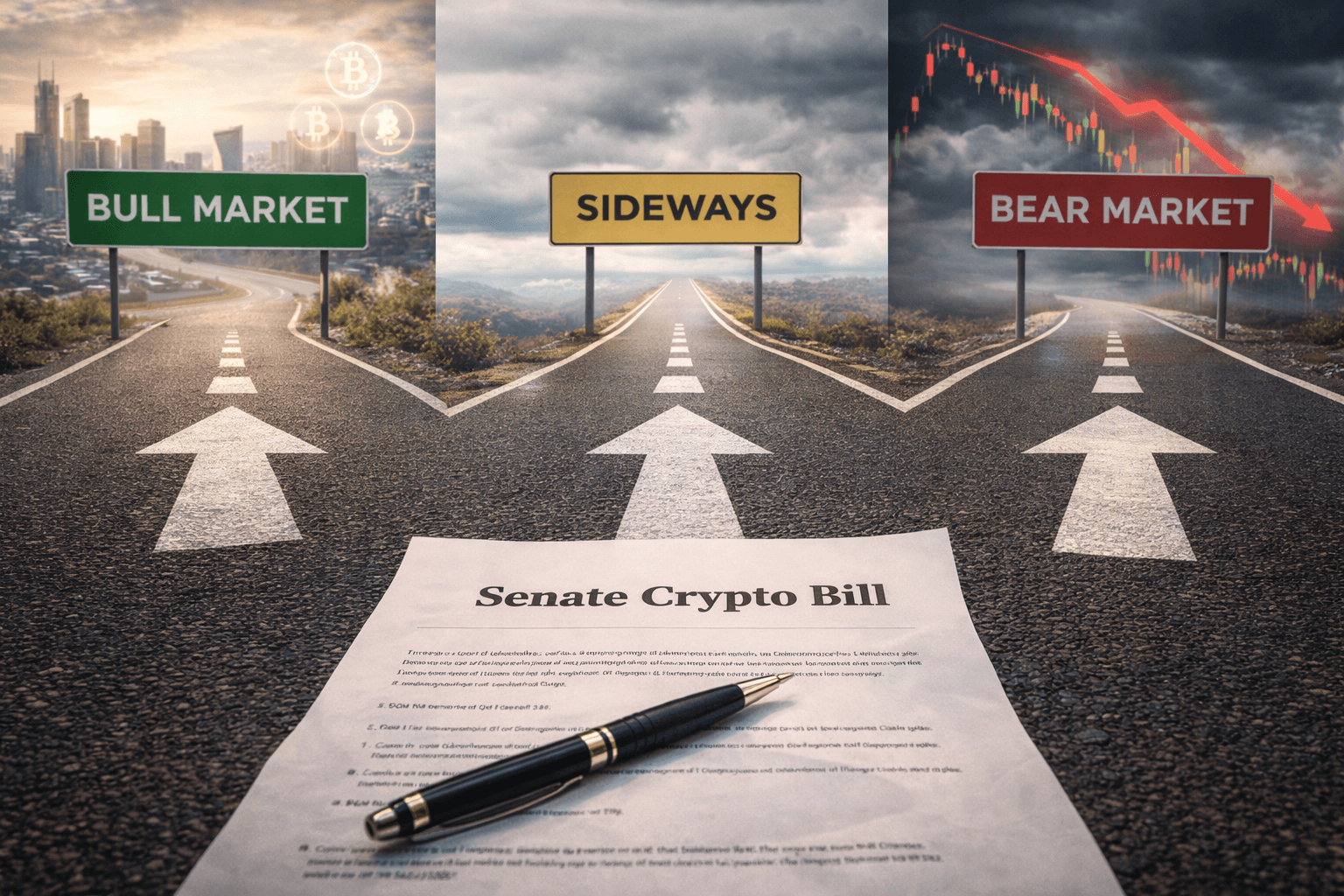
Scenarios for 2026: three paths this bill can take
I’m thinking in scenarios because single-outcome prediction is how you end up married to a narrative.
- Bull case: clean text + real momentum
- What it looks like: definitions that reduce ambiguity, workable registration routes, stablecoin rules that increase trust without freezing issuance, and a custody framework institutions can live with.
- Market impact: less “surprise enforcement” premium, more onshore liquidity, and a steadier bid from institutions instead of retail-only spikes.
- How I’d act: scale into positions on legislative milestones, then look for second-order winners (custody providers, regulated exchanges, compliant stablecoin rails).
- Base case: mixed clarity + long rulemaking grind
- What it looks like: some clear wins (maybe stablecoins, maybe venue registration), but key areas get kicked to agencies and rulemaking takes forever.
- Market impact: headline pumps, then choppy rotations. Selective winners outperform, while “regulatory maybe” tokens stay casino-like.
- How I’d act: keep core heavy, trade satellites, and be ruthless about taking profit on narrative spikes.
- Bear case: vague mandates or political stall
- What it looks like: broad discretionary authority, compliance burdens that don’t match how the tech works, or the bill stalls and becomes a campaign talking point.
- Market impact: relief rally fades, uncertainty premium returns, and offshore venues quietly regain share.
- How I’d act: reduce exposure to anything dependent on U.S. “clarity” and stick to assets that don’t need a friendly interpretation to survive.
The important part: the market can rally in all three scenarios temporarily. Only one of them tends to create durable, lower-volatility uptrends.
My final take
This bill could be the start of real clarity. But I’ve seen this movie too many times to clap at the trailer.
The market will overprice the headline and underprice the fine print.
So I’m staying opportunistic, not emotional. I’ll respect the momentum, but I’ll place my real bets only when the text shows me who gets a clean lane—and when the political path looks real, not theatrical.
If you want, send me the exact section you’re focused on (stablecoins, DeFi/self-custody, exchange registration, custody/bankruptcy). I’ll translate it into plain English and tell you what I think it does to markets—without the PR gloss.