Coinsbee Review
Coinsbee
coinsbee.com
CoinsBee.com Ultimate Review Guide (2026): Buy Gift Cards With Crypto + FAQs That Actually Matter
Have you ever stared at your crypto balance and thought: “Cool… but how do I actually spend this on normal life without jumping through hoops?” If you’ve tried, you already know the frustrating truth: owning crypto is easy compared to using it for everyday purchases.
That’s exactly why services like CoinsBee keep popping up in crypto circles. The promise is simple: turn crypto into gift cards and vouchers for popular brands, then shop like everyone else—no bank transfers, no exchange selling, no waiting days for “processing.”
The real problem: crypto is hard to “spend” in daily life
Crypto is everywhere in headlines, but at checkout? Not so much.
Even in 2026, most people I talk to are still stuck in this loop:
- Most stores don’t accept crypto directly (especially the big household-name brands).
- “Crypto debit cards” aren’t always available in every country, and sometimes they come with limits, freezes, or compliance surprises.
- Cashing out to fiat can be annoying: exchange fees, bank delays, and yes—often a taxable event depending on where you live.
- Even when a merchant says “we take crypto”, it might only be via a specific payment provider, specific chain, or specific wallet flow.
And it’s not just anecdotal. Studies keep showing that ownership doesn’t automatically equal real-world usage. For example, the Pew Research Center has repeatedly reported that while a meaningful share of adults have owned crypto, far fewer use it for buying goods and services in day-to-day life. That gap is the exact space gift-card marketplaces try to fill.
So if you’ve ever wanted to use crypto for:
- groceries or household shopping
- gaming credits or subscriptions
- travel-related spending
- mobile top-ups while abroad
…you’ve probably discovered that “just pay with crypto” usually turns into a mini project.
Promise solution
CoinsBee’s pitch is basically: stop trying to force every store to accept crypto.
Instead, you buy a gift card or voucher with crypto, receive a code, and redeem it at the brand just like any normal gift card.
Real-life example: Let’s say you’re holding USDT and want to buy something from a major retailer that doesn’t take crypto. The “classic” route is: send USDT to an exchange → sell → withdraw to bank → wait → then pay. The gift-card route is: pay crypto → get a code → checkout like normal.
That’s the appeal. No converting to fiat in your bank account, and often no waiting for a card shipment or approval process.
What this review will help you decide
I’m not here to sell you a dream. Gift cards are useful, but they also come with their own “gotchas.” So in this guide, I’m going to help you figure out whether CoinsBee makes sense for your situation by covering:
- How the buying flow actually works (what you do, what you receive, and where people mess up)
- Payment methods and what to watch for when picking coins and networks
- Delivery speed expectations (and why “instant” sometimes isn’t instant)
- Fees and spreads that can quietly change the value you get
- Supported coins and networks so you don’t send funds the wrong way
- Safety and privacy expectations (and when extra checks can happen)
- Common issues and how I avoid them when testing these platforms
- Alternatives worth checking if CoinsBee isn’t the best fit
Now here’s the question that matters before you spend even $10: what is CoinsBee exactly—and what is it definitely not? That’s where most confusion (and most bad experiences) start… and it’s what I’ll clear up next.
What CoinsBee is (and what it isn’t)
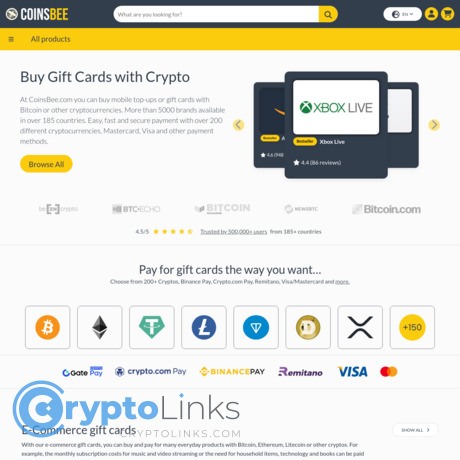
CoinsBee is a gift card and voucher marketplace. I pick a brand (say, Amazon, PlayStation, Netflix, or a mobile top-up), pay with crypto, and get a digital code I redeem on the brand’s side.
That sounds simple—because it is. But it’s important to keep the mental model straight:
- CoinsBee is not a crypto exchange. You’re not “trading” in a market order-book sense. You’re paying for a product (a voucher).
- CoinsBee is not a wallet. It doesn’t “store” your funds like a self-custody wallet. You send a payment; you receive a code.
- CoinsBee is not a universal “pay any merchant with crypto” button. It’s a bridge: crypto → store credit.
If you understand that one idea, you’ll avoid 80% of the frustration people run into.
Think of it like this: you’re not spending crypto at Amazon. You’re buying an Amazon gift card with crypto, then spending the gift card at Amazon.
How does CoinsBee work? (step-by-step buying flow)
Here’s the flow I follow when I’m testing gift card platforms. CoinsBee is pretty standard in how it works:
- 1) Choose a brand (example: “PlayStation Store”).
- 2) Choose the country/region (this matters more than people expect).
- 3) Pick the amount (fixed or custom, depending on the brand).
- 4) Enter your email (that’s typically where the code lands).
- 5) Choose payment method (crypto asset + network, or other supported options).
- 6) Confirm details (brand, country, amount, and the network you’ll use).
- 7) Send the payment exactly as instructed.
- 8) Receive the voucher code (often within minutes) and redeem it on the brand’s website/app.
That last part is where some buyers get confused: redemption isn’t happening “inside CoinsBee.” If you buy a PlayStation code, you redeem it in the PlayStation Store. If you buy a mobile top-up, you follow the top-up instructions. CoinsBee is the purchase layer, not the final checkout.
Real-world example: If I buy a $50 PlayStation voucher for the US region and try to redeem it on a non-US PlayStation account, it may fail—even though CoinsBee delivered a perfectly valid code. That’s not CoinsBee being “broken.” That’s region-locking, which is common with gift cards.
How to pay on CoinsBee (crypto, networks, and other options)
CoinsBee usually gives you a menu of crypto assets and (depending on the asset) multiple network choices. Sometimes there are also instant-pay options like Binance Pay / Crypto.com Pay, and in some regions even card/bank methods—availability changes based on where you are and what CoinsBee has enabled at that moment.
The biggest “gotcha” is the network selection. Not the coin. The network.
- If you choose USDT on TRON (TRC20) and accidentally send USDT on Ethereum (ERC20), your payment can fail or get stuck in a support headache.
- If you choose Polygon but send on BSC, same problem.
- If you pick a network with higher fees (like ERC20 during congestion), you can end up underpaying if your wallet subtracts fees from the amount you intended to send.
So the way I do it is boring—but it saves money:
- I pick the asset and network first based on low fees and reliable confirmations.
- I copy/paste the address (no retyping), and I double-check the first/last characters.
- I send the exact requested amount and keep the transaction ID (TXID) ready.
Rule I live by: If the checkout says “send exactly 23.8471 USDT on TRC20,” I send exactly that on TRC20—not “about 24” and not “USDT on whatever network my wallet suggests.”
Supported brands, countries, and who CoinsBee is best for
CoinsBee’s main value is breadth: it’s built for people who want to turn crypto into codes that work at recognizable brands.
What I see people using it for most:
- Big retailers (general shopping, online marketplaces)
- Gaming credits (console stores, game platforms, in-game currency)
- Subscriptions (streaming, memberships—depending on what’s listed)
- Phone top-ups (especially useful if you travel or you’re helping family abroad)
The country filter is not optional. Gift cards are often region-locked by design. Even when the brand is global, the gift card code is frequently tied to a specific country store.
If you’re buying for someone else, this is where I slow down and verify:
- Which country is their account set to?
- Which currency does their store use?
- Do they already know how to redeem gift cards in that ecosystem?
This is also why CoinsBee can be great for travelers and expats: you can buy a voucher for a specific region without dealing with a bank card that gets declined for “foreign transactions.”
Fees, rates, and the “spread” people don’t notice
This is the part most reviews skip because it’s not as exciting as “hundreds of brands!”—but it’s where your money actually goes.
When you buy a gift card with crypto, your final cost can include:
- Network fees (paid to miners/validators; varies by chain and congestion)
- Service fees (sometimes shown clearly, sometimes bundled)
- Exchange-rate spread (the sneaky one: the crypto-to-fiat conversion rate may be worse than the mid-market price you see on charts)
What I do before I hit pay: I compare the voucher value to the checkout total in my chosen asset. If a $100 card ends up costing me the crypto equivalent of $112 after everything… I want to know that before the transaction is final.
Small test purchase strategy (works every time): If I’m on a new platform or trying a new network, I start with the smallest amount that still makes sense (like $10–$25). Once I confirm (1) delivery is fast and (2) redemption works in my region, then I scale up.
Speed of delivery: how fast do you get the code?
In normal conditions, delivery can be quick—often within minutes—because digital vouchers are made for instant fulfillment.
When it’s not instant, it’s usually one of these:
- Blockchain confirmations: some networks/assets need more time (or more confirmations) before a payment is considered final.
- Network congestion: fees spike, transactions sit pending longer.
- Payment method checks: certain methods can trigger extra verification steps.
- Occasional manual review: especially if something about the order looks risky.
If your code doesn’t show up, this is my checklist before I panic:
- Check spam/junk (sounds basic, but it happens a lot).
- Confirm the payment actually left your wallet and has confirmations.
- Save the TXID and any order/reference number.
- Check the order status on the site (if available).
- Contact support with: email used, timestamp, TXID, asset, network, and amount.
Most “missing code” cases I’ve seen online end up being either (a) pending confirmations or (b) someone sent the right coin on the wrong network.
Is CoinsBee safe and legit? My trust checklist
When people ask me “is it legit,” what they usually mean is: Will I get the code, and will it work? That’s the right question.
Here’s the checklist I run through with any gift card marketplace (CoinsBee included):
- HTTPS + basic site hygiene: secure checkout, no weird redirects.
- Clear terms and refund rules: gift cards are usually final once issued.
- Transparent checkout: country/region clearly stated, amount and payment instructions unambiguous.
- Normal brand coverage: recognizable brands and categories you’d expect from a mainstream voucher reseller.
- Support process exists: not just a contact form that disappears into a void.
The risk model is different with vouchers. If you send crypto to an exchange and something goes wrong, there are sometimes reversal processes (or at least account-level investigation). With gift cards, once a code is issued, it can be redeemed quickly—sometimes instantly. That’s exactly why gift card fraud is so common in the broader world.
If you want a sobering reminder of why platforms can be strict (and why “final” often means final), read how often scammers push victims to pay with gift cards. The U.S. FTC has tracked gift card scam patterns for years, and it’s consistently one of the most abused payment rails in fraud: FTC: Gift Card Scams.
My safety habit: I screenshot the product page (brand + country), the checkout instructions (asset + network), and I keep the TXID. If anything goes sideways, those three screenshots save time.
Privacy + KYC: do you need verification?
People love the phrase “no KYC,” but I treat it like a marketing claim—not a promise.
Many voucher sites keep checkout lightweight (often just an email), but that doesn’t mean every transaction will glide through with zero questions. Any of these can trigger extra checks:
- High-value orders
- Repeat orders in a short time
- Certain payment methods (especially anything card-like, or methods with chargeback risk)
- Risk signals (location mismatch, unusual behavior patterns)
The practical advice: assume you might be asked for additional info at the worst possible time (like when you need a code urgently). If you’re buying something time-sensitive—airtime top-ups, travel needs, a last-minute gift—do a small test run earlier so you’re not learning the rules under pressure.
Where is CoinsBee located? (and a common confusion)
CoinsBee is commonly associated with a Europe-based operator; you’ll often see it referenced as Coinsbee GmbH (Germany-based).
And yes—there’s a funny (and constant) confusion I keep seeing in search results: people mixing up CoinsBee with Coinbase.
They’re not the same company. Coinbase’s headquarters and corporate info are irrelevant to CoinsBee. If you’re verifying anything, verify it using CoinsBee’s own legal/company pages and checkout disclosures—not random snippets that happen to show up in Google.
Common problems (and how I’d avoid them)
Most issues are preventable. Here are the ones I see the most—and exactly how I’d reduce the chance of getting burned:
- Buying the wrong country/region card
Fix: Match the gift card country to the account/store country (especially for gaming and app stores). When in doubt, buy the smallest amount first. - Choosing the wrong network (the classic USDT problem)
Fix: Confirm the network in both places: the CoinsBee checkout and your wallet’s send screen. If they don’t match exactly, stop. - Underpaying because of wallet fees
Fix: Use a wallet/exchange withdraw screen that clearly shows whether fees are added on top or subtracted. If it subtracts, increase the send amount carefully (or switch networks). - Expecting refunds on gift cards
Fix: Assume “final sale” unless the policy explicitly says otherwise. Gift cards are a one-way door in most cases. - Code redemption fails on the brand side
Fix: Check region, account status, and redemption instructions. Sometimes it’s the account (wrong store) not the code. - Support delays during peak times
Fix: Save TXID + screenshots, and provide clean details in the first message so you don’t waste 48 hours going back and forth.
If you’ve read this far, you already know the real game: this isn’t about “can I buy a gift card with crypto?” You can. The question is where you get the best deal and the least friction when you actually need it.
So here’s what I’m going to answer next: if CoinsBee isn’t the cheapest (or if you want a different brand selection, better pricing, or fewer headaches), which platforms do I pick instead—and why?
CoinsBee alternatives (when I’d pick something else)
CoinsBee does what it promises: it turns crypto into gift cards fast. But I don’t treat any gift-card platform as a “forever choice.” I switch depending on pricing, brand availability in my country, supported networks, and how confident I feel that support will solve a problem if something goes weird.
Here’s when I personally reach for an alternative instead.
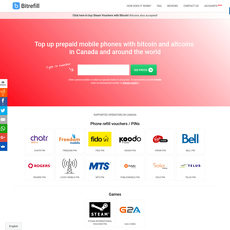
1) Bitrefill (my pick when I want the smoothest “crypto spending” experience)
If you want the most polished, repeatable workflow, I usually point people to Bitrefill. The interface is clean, delivery is typically quick, and it tends to be the platform I use when I’m buying the same things again and again (mobile top-ups, gaming credit, common retail cards).
When I’d choose Bitrefill over CoinsBee:
- I’m buying a card I purchase often and want the least friction.
- I care about network options (this changes over time, but Bitrefill has often been strong on practical payment routes).
- I’m optimizing for reliability over hunting for the absolute best rate on a single purchase.
Real-world example: If I’m traveling and need a mobile top-up right now, I’ll pick the platform that has the cleanest top-up flow for that country and delivers instantly. Bitrefill is often that “don’t make me think” option.
2) CryptoRefills (my pick when I’m hunting for a specific region/brand combo)
CryptoRefills is another solid cross-shop. The reason I check it isn’t because it’s “better” in general—it’s because gift cards are weirdly regional, and sometimes one marketplace has the exact brand/country pairing the other one doesn’t.
When I’d choose CryptoRefills over CoinsBee:
- I need a specific local brand (especially if I’m buying for someone in another country).
- I want to compare final checkout pricing (not just headline value).
- I’m doing a one-off purchase and can take a minute to cross-check options.
Real-world example: If I’m trying to buy a voucher that’s picky about region (some entertainment and retail cards are), I’ll compare both platforms and choose the one that clearly labels the country and redemption rules.
3) Other “similar platforms” (when coverage beats familiarity)
Depending on where you live, you may find strong local players—or crypto payment processors that also sell gift cards. My rule is simple: if the brand is region-sensitive (or you’re buying in higher amounts), I stick to platforms with clear redemption instructions, transparent checkout totals, and a track record of support actually responding.
And a quick note on why I’m picky: gift cards are a common fraud target industry-wide. For example, the U.S. Federal Trade Commission has repeatedly flagged gift cards as a frequent payment method in scam reports in recent years. That doesn’t mean these platforms are shady—it means the space is high-risk, so platforms can be strict, and mistakes are often hard to undo.
My personal rule: if I’m testing a new gift-card site, I start small, redeem immediately, then scale up. No exceptions.
What usually differs between CoinsBee and alternatives (the stuff that actually matters):
- Brand + country coverage: who has the exact card for your region today.
- Final pricing: not just fees—also the exchange-rate “spread” baked into the checkout total.
- Payment rails: which coins and networks are supported at the moment you’re buying.
- KYC / risk checks: some platforms trigger verification more often, especially at higher amounts or with certain payment methods.
- Support experience: how fast you can get an answer when a code doesn’t arrive or a payment needs manual review.
Quick FAQ: CoinsBee questions I see the most
- “How does CoinsBee work?” → I buy a voucher using crypto, then I redeem the code on the brand’s website/app like a normal gift card.
- “How to pay on CoinsBee?” → I pick the asset and the correct network (or a supported pay option), send the exact amount, and the voucher code is delivered (usually by email).
- “Where is CoinsBee located?” → It’s operated out of Europe (commonly referenced as Germany-based). It’s not Coinbase.
- “Are there alternatives to CoinsBee?” → Yes. I most often cross-check Bitrefill and CryptoRefills, plus any strong local option available in your country.
Who I recommend CoinsBee for (and who should skip it)
I recommend CoinsBee if:
- You want a practical way to turn crypto into everyday spending at known brands.
- You’re traveling and want quick top-ups or region-specific vouchers.
- You’re fine with the “gift card mindset”: you’re buying store credit, not making a reversible card payment.
I’d skip it (or at least be extra cautious) if:
- You need refund flexibility like you’d get with a credit card.
- You hate dealing with network selection and confirmations (one wrong choice can ruin your day).
- You’re trying to pay a merchant directly and expect a normal checkout flow (gift cards are a workaround, not true merchant crypto acceptance).
My final take: a useful bridge—if you use it like a grown-up
I look at CoinsBee as a handy “crypto-to-gift-card bridge.” It’s not magic, and it’s not forgiving—but it can be genuinely useful when you treat it like what it is: buying a code that you’ll redeem somewhere else.
My simple action plan:
- Start with a small purchase on the exact brand + country you need.
- Redeem immediately so you know that specific voucher type works for you.
- Only then scale up to larger amounts.
- When in doubt, compare the final checkout total with Bitrefill/CryptoRefills and pick the one that’s clearer and cheaper for that exact card.
If you use CoinsBee like that—carefully, with a test-first habit—it can turn crypto into something you can actually use in real life without waiting on bank transfers or jumping through exchange hoops.