4 New ETFs Just Launched — Why Dogecoin and SUI Jumped 5–10% in Days (and What Happens Next)

Have you ever noticed how one “ETF launched” headline can move an altcoin faster than a week of normal trading… even when nothing fundamental changed overnight?
That’s exactly what this week looked like: four new ETFs hit the market in a tight window, and suddenly Dogecoin (DOGE) and Sui (SUI) were printing quick ~5–10% moves like it was the most natural thing in the world.
One “ETF launched” headline can make an altcoin move faster than a week of normal trading, and this week was a perfect example: four new ETFs went live almost back-to-back, and suddenly Dogecoin and Sui were ripping 5–10% in a few days like it was inevitable. That’s the exact moment people get trapped—because ETF news is loud, price reacts fast, and your brain wants to label every green candle as “smart money is here.” The problem is that the first move around ETF headlines is often messy and emotional: thin liquidity, leverage squeezes, and attention-driven buying can push price hard even if nothing changed underneath. So instead of chasing the candle, I’m going to walk through what actually matters right after an ETF launch and how I quickly tell whether DOGE and SUI strength is real support that can hold for days/weeks or just a short-lived liquidity pop that fades the moment the headline adrenaline wears off.
Listen to this article:
Here’s the catch: ETF news is one of the easiest ways to get emotionally baited into misreading a pump. So before anyone starts calling this “the start of a new leg up,” let’s get grounded on what usually happens around ETF headlines—and why the first move is often the noisiest one.

The real pain: ETF headlines are noisy, and altcoin pumps are easy to misread
Most people see “ETF launch” and mentally translate it to: “new money is forced to buy the coin, price goes up, and it stays up.”
In reality, the early jump is often driven by a much messier mix:
- Positioning (traders were already leaning long/short and get squeezed)
- Thin liquidity (it doesn’t take much market buy pressure to move price 5–10% on many alts)
- Reflexive momentum (price rising becomes the reason more people buy, at least temporarily)
- Attention trading (headline → search spike → market orders → wick)
If that sounds “soft,” it’s actually well-studied in traditional markets: research on attention-driven buying (like Barber & Odean) and work linking search interest to short-term price pressure (Da, Engelberg & Gao) both point to the same basic idea—when attention spikes, prices can temporarily move in ways that have nothing to do with long-term demand.
Crypto amplifies this because liquidity can be patchy, leverage is always nearby, and narratives travel at the speed of a screenshot.
Here are the big traps I see people fall into every time an ETF story breaks:
- Confusing filing vs. approval vs. launch A filing is just paperwork. Approval means a regulator cleared it. A launch means it’s actually trading and can start attracting real volume and (sometimes) real flows. Markets often pump on the earliest stage because it’s easiest to front-run—and hardest to verify.
- Assuming “ETF = sustained inflows” Day-one excitement can be mostly trading activity, not sticky investment demand. If volume is high but spreads are wide and follow-through is weak, you may be watching a temporary liquidity event, not a lasting bid.
- Ignoring float + depth (liquidity reality) DOGE and SUI can both move fast for different reasons, but the common thread is this: when the order book thins out, price can jump on relatively modest impulse buying—especially if it’s reinforced by perpetuals.
- Chasing the candle instead of tracking the mechanism If you can’t explain whether the move started in spot or derivatives, you’re basically trading vibes. And “vibes entries” usually end in chop.
My rule: the first ETF headline move is guilty until proven innocent. I want evidence that the bid is real—and staying—before I treat it like anything other than momentum.
Promise solution
I’m going to keep this simple and practical: I use a quick checklist to decide whether ETF-related strength in DOGE and SUI is:
- Real support (the kind that can hold levels for days/weeks)
- or just a short-lived liquidity pop (the kind that retraces once the headline adrenaline fades)
Instead of guessing, I’ll show you exactly what I look at—the specific metrics that tell me whether buyers are stepping in with conviction or if the market is just recycling liquidity and leaving late chasers holding the bag.
What readers are really asking (People Also Ask)
These are the questions I see pop up every single time an ETF narrative hits crypto. I’ll answer them directly, and for each one I’ll attach a clear metric you can track (no “trust me bro” required).
Do ETFs directly buy Dogecoin or SUI?
Sometimes yes, often no—depending on the product structure. Some ETFs hold spot assets, some hold futures, and some use structured exposure that doesn’t require direct spot buying the way people assume.
What to track:the fund’s holdings disclosure (if published), stated strategy in the prospectus, and whether creation/redemption involves in-kind spot activity or cash-based hedging.
How does an ETF launch affect altcoin liquidity?
Even when an ETF isn’t “buying DOGE/SUI,” it can still move them through market maker hedging, basket trading, and narrative rotation (“ETF week” tends to pull traders into higher beta plays). The liquidity effect often shows up first as tighter spreads and higher continuous volume, not just a single green candle.
What to track: spot order-book depth, bid/ask spreads, and whether volume stays elevated for multiple sessions (not just the first hours).
Is this pump sustainable or just news trading?
The easiest tell is whether the move is being carried by spot demand or by leverage. If the rally is mostly perpetuals-driven, it can unwind fast. If spot keeps absorbing sells and holding above key levels, it has a better chance to stick.
What to track: spot vs perp volume share, funding rates, and whether open interest rises faster than spot volume (that’s often “hot money” fuel).
What should I watch: flows, volume, open interest, or on-chain data?
All of them matter, but not equally, and not at the same time. During the first headline window, I prioritize flow/volume quality and derivatives positioning because they explain most of the immediate 5–10% impulse. On-chain can help later, but it’s rarely the first signal for ETF-driven moves.
What to track:
- Flows/AUM (if reported) to confirm real allocation
- Spot volume consistency across multiple days
- Open interest + funding to spot leverage spikes and resets
- Exchange-level volume concentration to see if the move is fragile
So what actually happened with these four ETF launches—and how can the same “ETF week” headline push DOGE and SUI in slightly different ways?
Next, I’m going to lay out the timeline and the mechanics that matter, so you can stop guessing and start reading these moves like a pro.
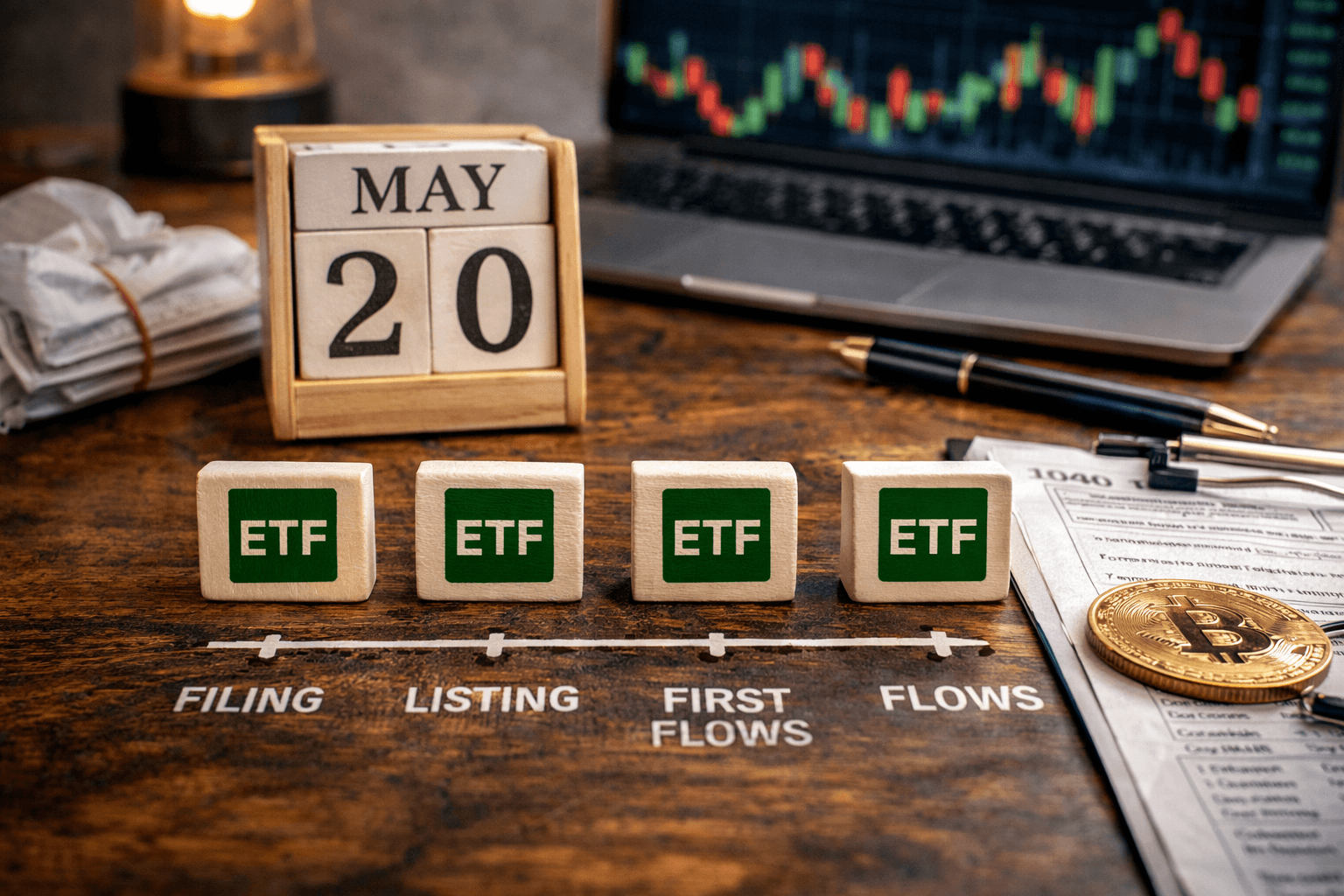
What actually launched this week: the 4-ETF timeline (filings → listing → first flows)
When people hear “4 new ETFs launched,” they picture a clean, direct pipeline: ETF goes live → money pours in → the underlying coin instantly pumps. In real markets, the sequence is messier, and the timing is where most traders get tricked.
Here’s the timeline format I use to keep it straight. I’m not just tracking headlines—I’m tracking when a product becomes tradable, and when it starts printing real flow (not just hype).
- Phase 1 — Filing / Registration shows up
What it really means: intent, not impact. This is when positioning often starts, especially in perps.
What I check: issuer docs, regulator database entries, proposed structure (spot vs futures vs notes), and whether there’s a seeded amount. - Phase 2 — Approval / effectiveness / “green light”
What it really means: tradability is now possible, but still not guaranteed to matter on day one.
What I check: final prospectus language (creation/redemption details), fee, benchmark index, and named service providers (prime broker, custodian, authorized participants if disclosed). - Phase 3 — Exchange listing goes live (ticker appears, market opens)
What it really means: market makers must quote, spreads start telling the truth, and hedging kicks in.
What I check: first 15–60 minutes of prints, spread behavior, whether volume is steady or “one big splash then silence.” - Phase 4 — First flows / AUM updates (the only part that can sustain a trend)
What it really means: you’re finally seeing whether distribution exists (advisors, platforms, institutional tickets).
What I check: issuer AUM updates, end-of-day shares outstanding changes, and whether day-2/day-3 volume holds up.
Why this matters for DOGE and SUI: those coins can move hard in Phase 2 and Phase 3 even if Phase 4 ends up small. That’s how you get a clean-looking 5–10% move that later turns out to be mostly positioning + hedging + reflex.
Also, a quick “reality filter” that’s backed by traditional ETF market structure research: ETFs can transmit volatility through arbitrage and hedging even when the underlying market is separate. Studies like Ben-David, Franzoni & Moussawi (2018) and Da & Shive (2018) (equity ETFs) documented how ETF activity and hedging mechanics can amplify short-term moves and volatility. Crypto has its own microstructure quirks, but the mechanism—fast hedging against a basket-like wrapper—rhymes closely.
ETF mechanics in plain English: how “paper” products can move “spot” altcoins
This is the part most people miss: an ETF doesn’t need to buy Dogecoin or SUI directly to move Dogecoin or SUI.
There are four “transmission lines” I watch in real time:
- 1) Market makers hedge instantly (often in perps first)If an ETF starts trading and market makers are short inventory (or expect net buying), they hedge exposure with what’s liquid right now. In crypto, that usually means perps and large spot venues. This can create a fast impulse in high-beta coins when the broader complex heats up.
Translation: the ETF is the excuse, the hedge is the engine.
- 2) Creation/redemption expectations change behavior even before they happen In markets where creation/redemption is active, participants trade the wrapper and hedge the ingredients (or correlated proxies). Even when the product isn’t directly holding an altcoin, the hedging can spill into correlated risk-on baskets.
- 3) Narrative rotation is a real flow (BTC/ETH → majors → high-beta alts) When ETF headlines hit, a lot of desks and systematic traders rotate “risk” buckets. The rotation often goes: BTC/ETH strength → majors perk up → high-beta names get chased. DOGE and SUI both sit in that “fast beta” lane, just for different reasons.
- 4) Liquidity pockets exaggerate everything DOGE and SUI can both gap on relatively modest pressure when order books thin out. That’s not conspiracy—it’s microstructure. A small imbalance can look like a big “pump” when resting liquidity isn’t deep.
The Dogecoin move (why a meme coin reacts so fast)
DOGE is basically built for headline-speed reactions. Here’s what I look at when DOGE prints a quick 5–10% move around ETF chatter:
- Liquidity depth: bids vanish faster than you expect DOGE can look liquid on the surface, but in a momentum burst, visible bids often step back. The spread might not look crazy, but the depth behind it gets thin. That’s how you get those sharp green candles that feel “inevitable” in the moment.
- Derivatives positioning: funding + open interest are the hidden engine When DOGE runs on news, I usually see perps take the lead: open interest expands, funding turns more positive, and price accelerates as late longs market-buy. If the move is “real demand,” spot tends to keep pace. If it’s mostly leverage, spot lags and you get nasty wick reversals.
- Why DOGE becomes the “headline proxy” DOGE is a reflex trade—simple, recognizable, and heavily traded. So even if an ETF isn’t DOGE-specific, DOGE often catches the “risk-on meme bid” when the market wants something that moves now.
- What confirms real demand (and what doesn’t) Here’s my quick confirmation filter:
- Good: spot-led volume, steady VWAP reclaim, higher lows over multiple sessions
- Bad: perps-led spike, funding overheats, spot volume fades, and you see long wicks near highs
If you’ve ever wondered why DOGE can look “strong” for six hours and then go dead silent, this is usually why: the first wave is often structure (hedging + leverage), not sticky demand.
The SUI move (why SUI can react differently than DOGE)
SUI is a different animal. DOGE is mostly liquidity + reflex. SUI is much more sensitive to access + venue concentration + ecosystem narrative.
- Ecosystem/news sensitivity vs meme liquidity SUI tends to respond when traders believe “new access rails” are opening—more venues, more products, more ways for size to get exposure without slippage. That’s why ETF weeks can pull newer L1s up: the market reads it as a broader legitimization event.
- Exchange concentration risk (where most volume sits) If a large chunk of SUI volume is concentrated on a few venues, moves can look cleaner (or more chaotic) depending on how those venues manage liquidity and liquidations. In these situations, one venue’s derivatives flow can drag the global chart around.
- Why “new access rails” matter more for newer L1s For a newer L1, the story isn’t “everyone loves it.” It’s “can bigger money enter and exit without getting chopped up?” Anything that signals improving market plumbing—products, listings, better liquidity—can re-rate the asset faster than a meme coin move.
- What I watch to confirm it’s not just a one-day rotation
- Spot volume consistency across at least two sessions (not just one candle)
- Perps cooling down (OI stops rising while price holds = healthier)
- Follow-through bids during US/EU liquid hours, not only during thin sessions
The 5–10% “impact” claim: separating correlation from causation
I don’t attribute moves based on vibes. Here’s how I pressure-test whether the ETFs likely contributed to DOGE/SUI price action—or whether the market just happened to be risk-on.
- 1) Compare timing: news timestamp vs price impulseI line up the first credible “live trading” confirmation with the first impulsive move. If price moved hours earlier, that’s usually positioning, not impact.
- 2) Did spot lead, or did perps lead?If perps lead (OI pops first, funding jumps, spot lags), the move is likely leverage + hedging. If spot leads (clean spot volume expansion, tighter spreads, fewer wicks), that’s closer to real demand.
- 3) Look for second-day follow-throughReal money often shows up slower. Day-1 can be chaos and headlines. Day-2 tells you if the bid is serious.
- 4) Was it broad altcoin beta or DOGE/SUI-specific?If everything high-beta ripped the same way, it’s probably macro risk-on + rotation. If DOGE/SUI outperformed their peer group while majors were flat, then I start taking the “specific catalyst” argument more seriously.
Quick checklist: how I judge whether an ETF launch matters for an altcoin
If you want a simple scoring system you can copy into your notes app, this is mine. I give each item a quick 0–2 score (0 = no, 1 = mixed, 2 = yes). Anything 10+ is worth respecting.
- Is it a filing, approval, or live trading? (live trading matters most)
- Is it spot, futures-based, or structured exposure? (spot/clean access usually matters more)
- Who is the issuer, and do they have distribution? (bigger pipelines = better odds of real flows)
- Day-1 volume and spreads (tight spreads and steady prints = serious participation)
- Any reported flows/AUM growth? (the closest thing to “proof” you’ll get quickly)
- Market maker footprint (consistent tight quoting beats a one-hour volume spike)
One rule I don’t break: if I can’t tell whether volume was real and spreads were healthy, I treat the move as a liquidity event, not a new long-term trend.
Resources I’m watching (for context, not as the whole story)
These are the posts that kicked off a lot of the conversation and helped me map the timeline. I use them as starting points, then I verify details against primary sources (issuer pages, exchange notices, and official filings) before I treat anything as “confirmed.”
- https://x.com/jocorama1/status/2023883183931163071
- https://x.com/PennybagsCX/status/2022728818272641026
- https://x.com/Kylechasse/status/2023472454308339937
- https://x.com/suintern_/status/2023989233342423322
- https://x.com/martypartymusic/status/2023831430225354856
- https://x.com/Sharkx/status/2022372837273616723
- https://x.com/btcliveco/status/2022388077965050358
- https://x.com/CoinGapeMedia/status/2022585597454618756
- https://x.com/TheCoinRepublic/status/2022583924963397727
- https://x.com/TheETFTracker/status/2022379717744083086
Now the real question: after the launch-week impulse fades, do DOGE and SUI keep the bid… or does the market hand late buyers a perfect “headline exit”?
In the next section, I’ll show you exactly what I watch in the 7–14 day window after ETF week—because that’s where the easy narratives die and the real liquidity tells the truth.

What this means next: liquidity, volatility, and the “second wave” after the headline
ETF launch week is usually the loud part. The useful part is what happens after the noise fades.
In my experience, post-launch price action tends to follow a pretty repeatable script:
- Phase 1: The first spike — fast repricing, usually driven by positioning, thin books, and “everyone saw the headline at once.”
- Phase 2: Mean reversion — volatility stays high, but price starts snapping back toward the pre-news range as late buyers get tested.
- Phase 3: The second wave — this is where it gets real. Either:
- (a) steady bid shows up (flows/AUM grind up, spot volume stays healthy), or
- (b) slow fade happens (hype dries up, perps cool off, spot volume gets thin again).
If you want a clean real-world parallel, look at how “new access” products often behave around launch: there’s frequently an early pop, then a cooling-off period, then the longer trend gets decided by whether the product keeps attracting assets. Crypto has its own quirks, but the rhythm is familiar.
Also worth noting: ETF structure and ETF trading activity can change short-term market behavior even when the long-term thesis is still unproven. A widely-cited equity-market paper by Ben-David, Franzoni, and Moussawi (2018) found ETFs can be linked to higher volatility in underlying securities through trading and arbitrage channels. Crypto is not equities, but the lesson is transferable: when a new “wrapper” gets attention, the plumbing can amplify moves, especially in thinner books.
My rule of thumb: Week-one pumps are usually a liquidity event first. The “investment event” only becomes clear after the second wave.
If you’re trading DOGE or SUI: my “don’t get chopped” game plan
I’m going to keep this practical. When something rips 5–10% on a tight headline window, your biggest enemy isn’t being “wrong” — it’s getting chopped to pieces by whipsaw.
Here’s the framework I use so I’m not making emotional decisions candle-by-candle.
1) The only levels I care about at first
- Pre-news range high and low (the box price lived in before everyone cared).
- Launch-week VWAP (a good “fair price” anchor while the market decides if this move deserves to stick).
- The impulse low (the first sharp pullback low after the pump).
If you want a simple way to visualize it, pull up a 1H or 4H chart and literally mark:
- the last 3–7 days of chop before the headline,
- the breakout point,
- the first serious retrace.
2) What confirms strength (the “okay, this might stick” checklist)
- Higher lows above the pre-news range high (retest holds without instantly snapping back inside the box).
- Spot-led volume (spot exchanges doing real work, not just derivatives fireworks).
- VWAP acceptance (price spending time above launch-week VWAP and using it as support).
- Funding not screaming (a little positive is fine; “everyone max long” is when it gets fragile).
With DOGE, I’m especially strict about that spot-led requirement because it’s famous for fast reflexive runs that look strong… right up until they aren’t.
3) What screams “exit liquidity”
- Perps lead, spot lags (price jumps on perpetuals first, spot follows weakly).
- Open interest rockets while spot volume fades (leverage building on top of air).
- Big wicks + no follow-through (breakout attempts that instantly reject).
- Funding stays elevated even as price stalls (buyers paying up, but not getting continuation).
If you track this stuff, tools like CoinGlass (funding/OI) plus a clean spot chart on TradingView are usually enough.
4) The risk rules I actually follow (because narratives don’t protect your account)
- Size down when volatility expands. If DOGE/SUI daily range doubles, my position size does not stay the same.
- Use invalidation, not hope: if price reclaims the pre-news range and stays there, I treat the breakout as failed.
- Time-based exits: if I’m trading the headline move and it doesn’t continue within my expected window (often 24–72 hours for momentum legs), I trim or exit. Stagnation is a signal.
- No adding to losers in the chop zone (the zone between pre-news range high and launch-week VWAP is where accounts go to die).
If I had to reduce all of this to one sentence:
I want continuation to be earned — through holds, retests, and spot participation — not granted because the timeline is excited.

If you’re investing: the longer-term question is access, not one green candle
For investors, I don’t think the important question is “Did DOGE or SUI pump this week?”
The important question is: did these products create a new, durable access rail?
That matters because access changes behavior in slow, boring ways that eventually show up in price:
- Easier sizing: more participants can take positions without learning every exchange workflow.
- Cleaner compliance: some money simply won’t touch offshore venues or certain custody setups.
- More consistent liquidity: deeper participation can tighten spreads over time and reduce “air pockets.”
A good mental model is what happened in traditional markets when big, simple wrappers made exposure easier. Gold is a classic example: once broad access products existed, participation widened and liquidity improved over time. Crypto won’t copy-paste that path perfectly, but the principle holds: distribution matters.
So if you’re thinking in months (not days), I’d frame it like this:
- Week 1 tells you attention.
- Weeks 2–8 tell you adoption.
- Quarter 1+ tells you whether the product becomes part of the baseline market structure or just a temporary story.
What I’ll monitor over the next 7–14 days (simple watchlist)
This is the bookmark section. If these signals line up, the odds improve that the move wasn’t just a one-week wonder.
- Reported AUM/flows for each ETF (if published)
- I’m looking for a trend, not a single day.
- Even modest, steady growth beats a one-day splash followed by silence.
- Volume consistency (not just day 1)
- Day-1 volume is often curiosity and positioning.
- Days 3–10 tell you whether it’s becoming a habit.
- Spot/perps lead-lag on DOGE and SUI
- If spot leads and perps follow, I trust the move more.
- If perps lead and spot goes quiet, I get defensive fast.
- Funding rates and open interest resets
- I want to see leverage cool off without price collapsing.
- A healthy market can “reset” and hold structure.
- Broader market beta (BTC dominance, ETH strength, alt index behavior)
- If BTC dominance is ripping upward, many alt rallies struggle to sustain.
- If the broader alt complex holds up, DOGE/SUI follow-through gets easier.
For quick context checks beyond charts, I also keep an eye on ecosystem traction dashboards (where relevant) like DeFiLlama for broader on-chain activity trends, plus exchange-level volume breakdowns when available.
My bottom line
Four ETF launches landing close together can absolutely light a fire under high-beta names and produce a clean 5–10% move. That part is believable.
The part that matters now is simpler:
Does liquidity stick around after the hype?
If the answer is yes, you’ll see it in flows/AUM growth and spot volume quality over the next couple of weeks.
If the answer is no, the chart usually tells on itself: perps run first, funding stretches, spot gets quiet, and price slowly leaks back toward the pre-news box.
Track flows + volume quality, not vibes. Treat first-week ETF moves as a liquidity event first, and an investment thesis second.